They Bought a Rocket Company. The Filing Sells Data Centres.

Share
They Bought a Rocket Company. The Filing Sells Data Centres.

Deals Catchers
Deals Catchers • August 23, 2026
Mike LeeBy Mike Lee · 23 Aug 2026

The largest IPO in history was priced as a rocket company. The filing describes a data centre business that does not exist yet.
Hidden inside the SpaceX S-1 is the master plan for Elon’s next big disruption.  Get the name and ticker here of the No. 1 way to play it, free of charge.  Ad
A solar array edge-on against black sky
Featured
SPACE / AIFrom the filing
They Bought a Rocket Company. The Filing Sells Data Centres.
SpaceX’s S-1 describes building orbital networks of satellites that perform space-based computing. Investors who bought the largest listing on record own a stake in a business with no customers, no hardware in orbit and no revenue.
The scale of the ambition was filed with a regulator, not a press office. On January 30 the company asked the FCC for permission to operate up to one million orbital data centre satellites, at altitudes between 500 and 2,000 kilometres. By the filing’s own arithmetic, launching a million tonnes of them a year would produce roughly 100 gigawatts of AI compute — the equivalent of about a fifth of all electricity the United States currently consumes, dedicated to one purpose.
Put that against what exists. Starlink, already the largest constellation ever flown, runs somewhere around six to seven thousand active satellites. A million would be roughly 150 times bigger. And the FCC application is not a commitment to launch anything — it is a reservation of spectrum and orbital slots, which is the cheapest possible way to stake a claim on a scale nobody else has attempted.
The hardware is real enough to photograph. The first-generation satellite, AI1, carries 120 kilowatts of average compute and peaks at 150, spans 70 metres tip to tip — wider than a Boeing 747 — and stands 20 metres tall deployed. Two prototypes are planned for early 2027. The logic behind it is the one this newsletter has been circling all week: terrestrial data centres are constrained by power and cooling, and in orbit sunlight is constant and space is cold.
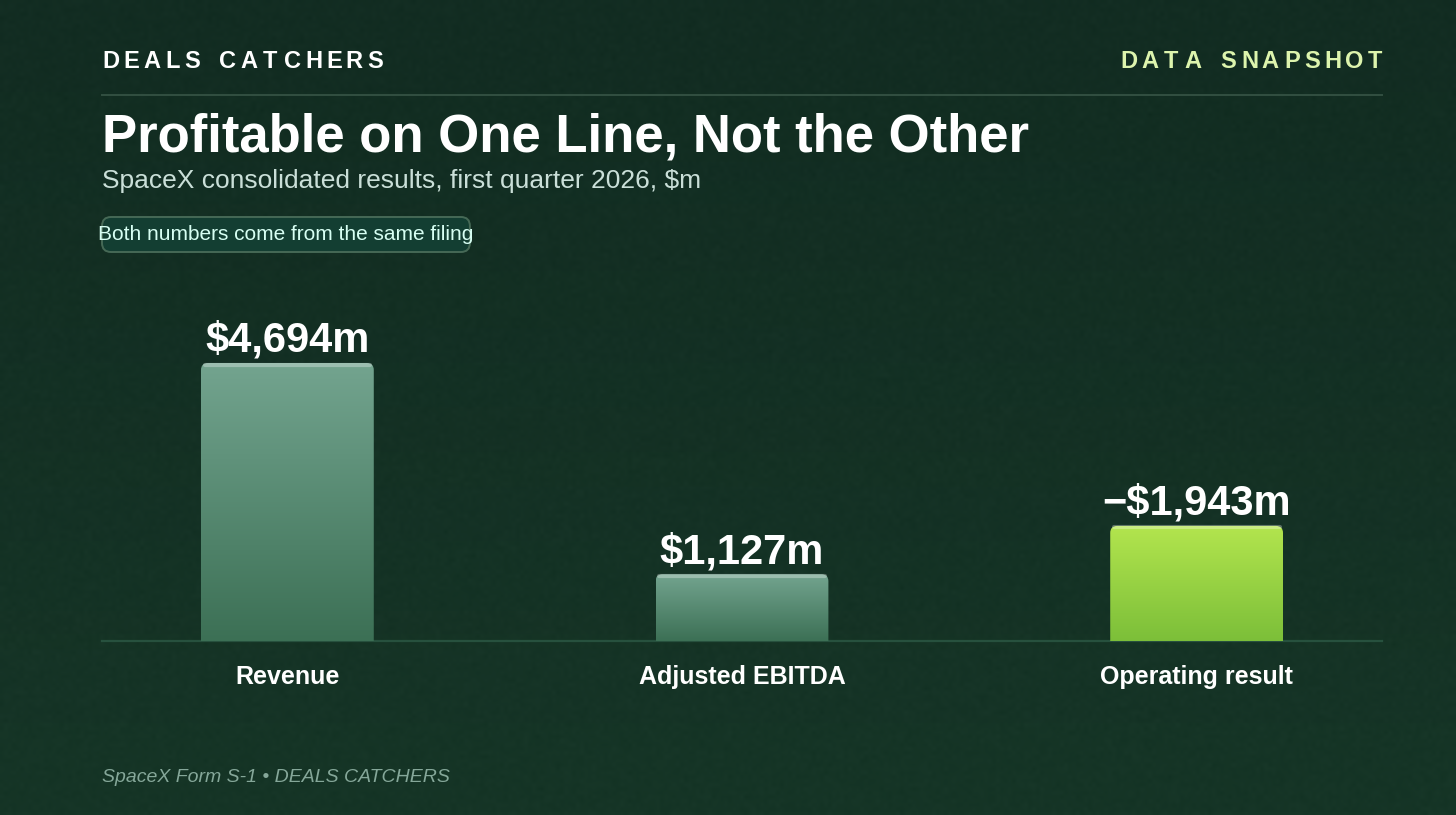
Profitable on one line, not the other
SpaceX consolidated results, first quarter 2026.
The numbers underneath deserve reading twice. In the first quarter the company reported revenue of $4.69 billion and adjusted EBITDA of $1.13 billion — alongside a loss from operations of $1.94 billion. Starship research and development alone consumed $3 billion in 2025 and another $930 million in the first quarter of this year. This is a company spending heavily against a thesis, and the filing says so plainly.
None of it is settled. The economics of orbital compute remain unproven, thermal management in vacuum is the hardest part and the least demonstrated, and the chief executive of the largest AI lab in the world dismissed the whole concept this year as ridiculous. Reported anchor customers for rented AI capacity include Google and, per press accounts, Anthropic — which is the company that makes Claude, the assistant used to produce this newsletter, so treat that particular detail as disclosed rather than endorsed.
Here’s why it lands on your desk: the pattern in these filings is that the boring pages carry the strategy. A company that merged an AI lab into a launch business in February and then asked permission for a million satellites in January is not building rockets to reach orbit. It is building them to put something there — and whoever supplies that something has a different economic future than they did last year.
Source: SEC Form S-1 / FCC filings / TechCrunch
Sponsored
The Part of the S-1 Nobody Read
SpaceX S-1
You will NOT believe what Elon Musk is doing next. Hidden inside the SpaceX S-1 is the master plan for Elon’s next big disruption. It could transform the world… rewrite the rules of AI… And create the most valuable company EVER. This is the AI story no one’s talking about… yet.
Latest StoriesSee all →
An old balance scale with unequal pans
PRECIOUS METALSTransaction data
A 40% Premium Still Buys It Below Book
Gold-focused acquisitions this year have cleared at an average of 0.73 times net asset value, with headline premiums of 35% to 45% over the target’s pre-announcement price.
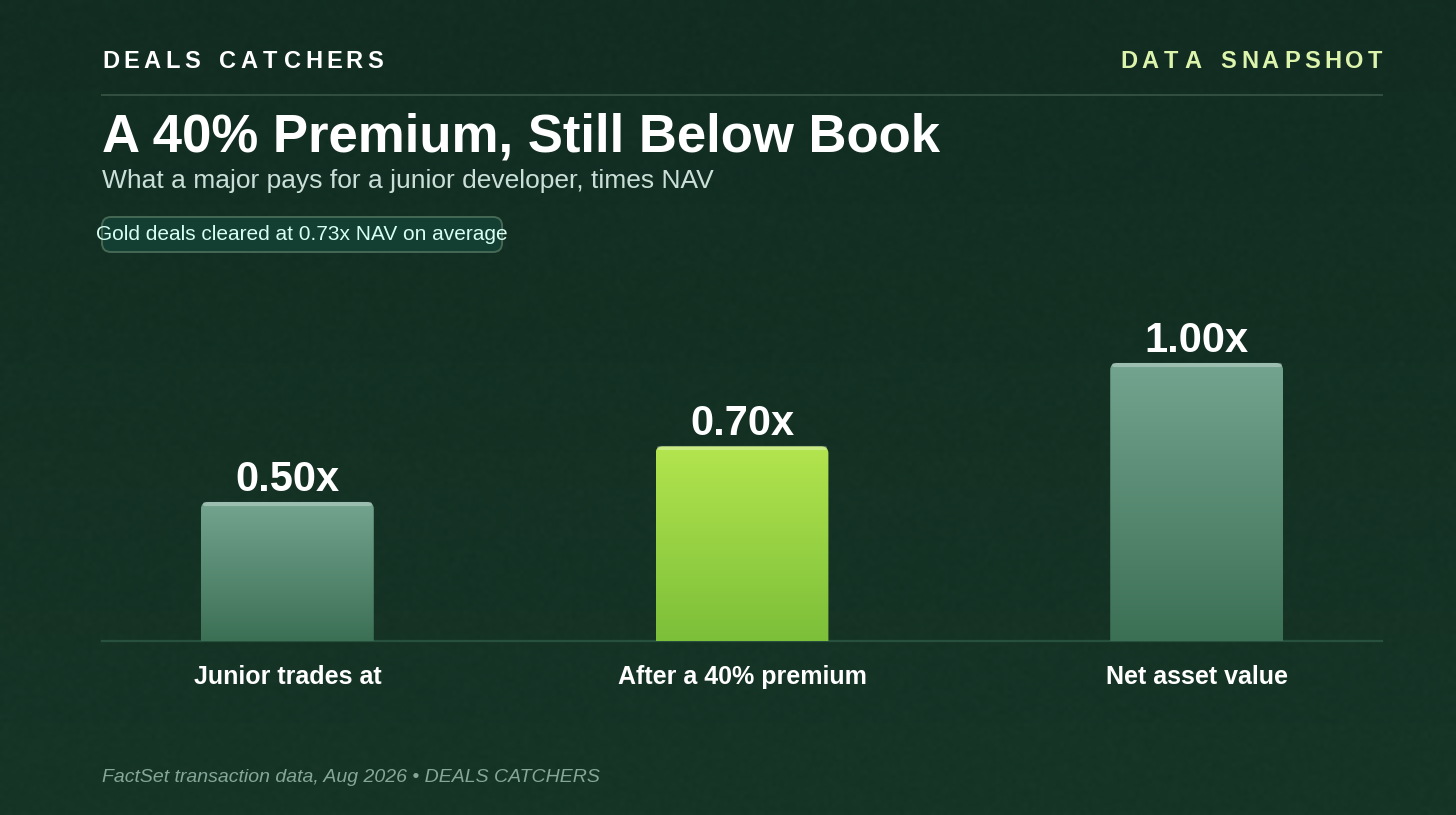
Both halves of that sentence are true at once, which is the part worth slowing down for. A premium of 40% sounds like an acquirer overpaying. Run it through: a developer trading at 0.50 times net asset value, bought at a 40% premium, changes hands at roughly 0.70 times NAV. The buyer paid up publicly and still acquired the asset for less than the sum of its parts.
A 40% premium, still below book
What a major pays for a junior developer, times NAV.
The reason the discount exists at all is that equities have not tracked the metal. Mining shares have been trading at roughly a 15% to 17% discount to bullion, and the sector spent much of the year between 0.6 and 0.8 times NAV — valuations you would expect in a bear market rather than with gold above $4,000. Analysts covering producers in Europe, the Middle East and Africa have the sector pricing in long-run gold of $3,200 to $3,800 an ounce, about 20% below institutional targets for the end of this year.
In other words, the market is valuing these companies as though the current gold price is temporary. That may turn out to be correct. But it means an acquirer with a different view gets to buy the disagreement, and the gap between the two views is what the premium comes out of.
The discount is not free money, and the reason it persists is not stupidity. Junior developers carry financing risk, construction risk and management risk that a major does not. Many seniors are down 20% to 40% from recent highs and some juniors more than 50%, which is what happens to leveraged exposure when the metal pauses. Miners historically move two to three times as far as gold in both directions, and one desk noted a senior-miner ETF doing roughly triple gold’s move in a single week this month.
The distinction worth holding: a valuation gap is an observation, not a catalyst. It can persist for years and it closes on somebody else’s timetable — usually a board’s, announced on a morning you were not watching. The gap tells you the arithmetic favours a buyer. It tells you nothing about which company gets bought, or when.
Source: FactSet transaction data / Scotiabank / CNBC
Sponsored
A Dollar of Gold for Thirty-Six Cents
Gold
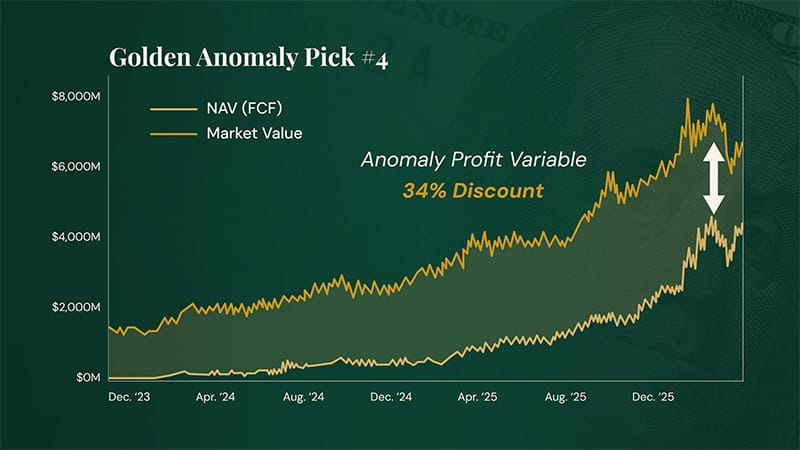
Right now, you can buy a dollar’s worth of gold for about 36 cents.

That sounds impossible. Here’s how it’s real.

The major gold miners are throwing off record cash flow — even after gold’s recent pullback. The four largest have never had this much free cash on hand. Ever. At today’s gold price, they’re running margins as high as 75% — the most profitable they have ever been.

Which hands them a problem.

Go here to see the problem — and why the majors are about to go on a shopping spree for the ages.

When a major gold miner makes record profits, it does one of two things: hand the cash back to shareholders, or buy the best junior mining assets to secure future production.

And here’s the piece the market is missing:

The best junior assets are still priced as if gold were stuck at $1,800 an ounce — not north of $4,000, where it trades today.

So the majors are staring at their own future production shrinking, sitting on record cash, looking at top-tier junior assets trading at a fraction of what that gold is worth at today’s price.

They don’t have a choice. They buy — or their output keeps shrinking until they’re out of business.

That’s how you buy a dollar of gold for 36 cents: you own the junior before the major is forced to pay up for it.

The gap between what these assets are worth and what they trade for has a name. I call it the Golden Anomaly. It only appears early in a gold bull market, and it closes fast — usually the moment the majors start writing cheques.

So you can pay full price after the gap closes…

Or buy the dollar for 36 cents while the Anomaly still exists.

My name is Garrett Goggin, CFA, CMT, and it’s why Porter Stansberry recently called me:

“THE most knowledgeable gold investor in the world.”
Best,
Garrett Goggin, CFA, CMT
Lead Analyst and Founder, Golden Portfolio
ENERGYFour days out
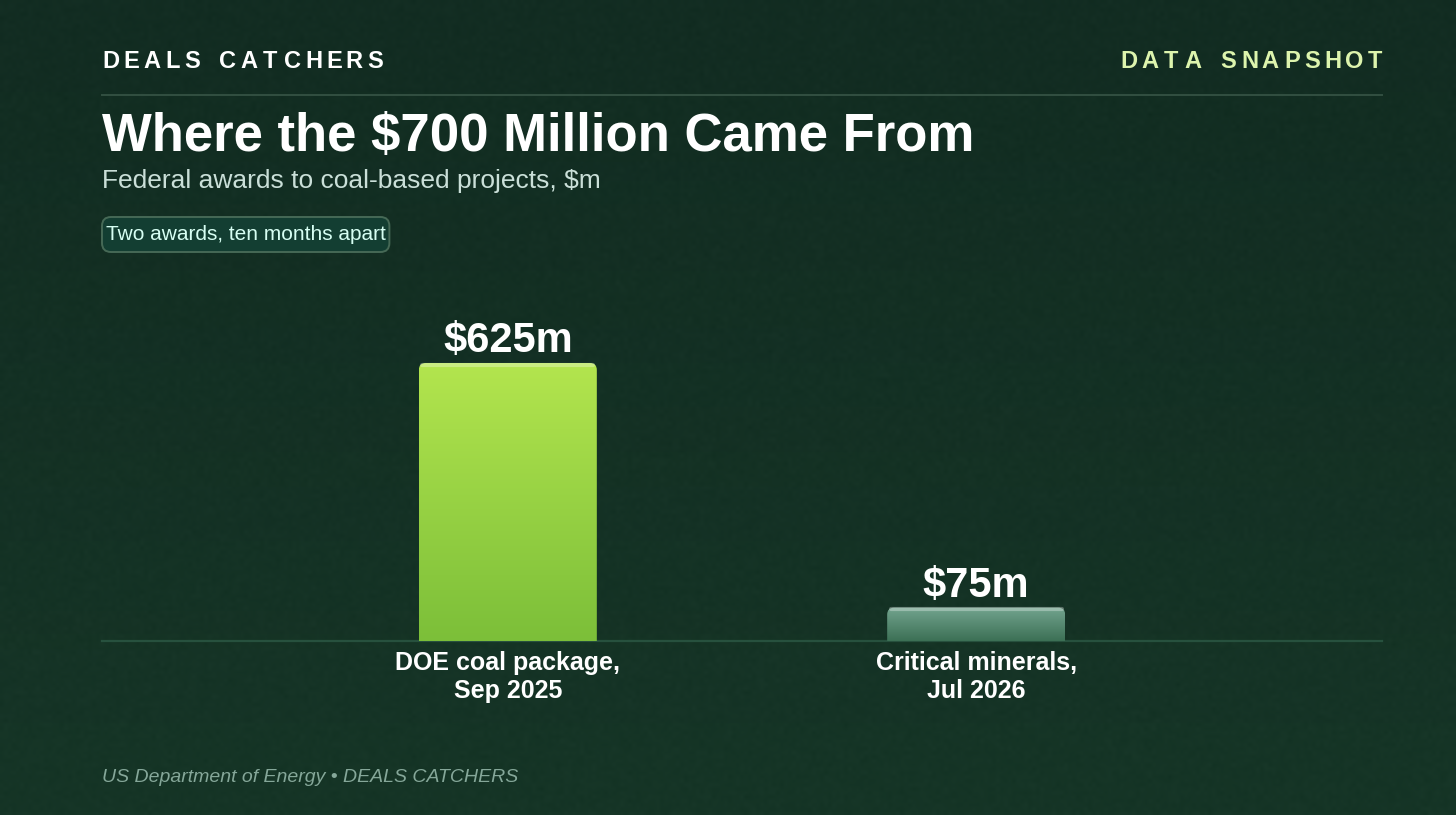
The $700 Million Is Two Cheques, Ten Months Apart
Federal support for coal is real and worth counting properly. The figure circulating as a single commitment is two separate awards, and knowing which is which tells you what the money is actually for.
Where the $700 million came from
Federal awards to coal-based projects.
The larger piece is a $625 million Energy Department package announced in September 2025, aimed at keeping existing coal generation available. The smaller is $75 million awarded on July 1 this year to five projects extracting rare earths and other critical materials from coal and coal-based feedstocks. The first keeps the lights on. The second treats the rock as a source of materials rather than heat — which, as we covered on Friday, is what an executive order reclassified it as last year.
The practical read: policy support for coal is not one gesture but a series of smaller, specific commitments pointed at different problems. That is more durable than a headline number, and considerably less exciting.
Source: US Department of Energy
Sponsored
TRUMP-BACKED COAL REVIVAL
America’s $700M Coal Comeback Just Got a Governor’s Blessing

Share price deadline: August 27
Frontieras
President Trump’s administration just committed nearly $700 million to revive American coal. Days later, West Virginia Governor Patrick Morrisey stood up and welcomed one company by name to Mason County — Frontieras.

“We are excited to welcome Frontieras North America and its state-of-the-art project to Mason County,” Morrisey said, backing an $850M facility that turns coal into diesel, jet fuel, and fertilizer — without burning it.

It’s tapping into a combined $2.1 trillion market. One retired power-generation engineer from Maryland already put in $13,500 — because he saw where this was headed before Wall Street did. Ticker $FASF Reserved.

Become a Frontieras shareholder by August 27 to lock in the $9.87 share price.
Pricing locks August 27 (8/27) — act before the deadline.
An empty lectern in a conference room
THE WEEK AHEADStarting tomorrow
Two Events, and Everything Else Is Filler
Nvidia reports Wednesday. Kevin Warsh gives his first Jackson Hole keynote as Fed chair from Thursday to Saturday. Nothing else on the calendar competes.
Warsh is the more unusual of the two, because nobody knows what the format will be. He has dismantled conventional forward guidance and floated cutting the number of FOMC meetings each year. Jackson Hole exists as an institution precisely to give a chair a venue for signalling, and this chair has spent his tenure arguing that signalling is the problem. The speech is either a policy statement or a demonstration that he means not to make one, and both would move markets.
The setup coming in is calm to the point of complacency. After Wednesday’s minutes, traders put the odds of a September hike near 27% and are fully pricing no move before the start of next year — despite three officials having dissented in favour of a hike at the July meeting. The index sits at record highs and volatility near 2026 lows.
Last week’s retail results left the consumer looking fine at both ends and uneven in the middle. Home Depot and Target beat, Lowe’s cut its outlook, and Walmart beat and raised while leaning on $2.9 billion of tariff refunds that will not repeat. Three of the four leaned on something other than customers buying more.
If you are drawing income from savings, the week to watch is this one rather than the one behind it. A record-high index priced for no rate rise, going into a speech from a chair who has refused to pre-commit, is a narrow place to be standing.
Source: CME FedWatch / Federal Reserve / company releases
This is the AI story no one’s talking about… yet.  Get the name and ticker here of the No. 1 way to play it, free of charge.  Ad

The Week Ahead
Nvidia reports Wednesday the 26th, a day before Jackson Hole opens. The two land back to back, which means a hawkish speech and a soft guide could compound rather than offset each other.
The Frontieras Reg A+ price window closes Thursday the 27th. Under Regulation A a company may move its share price by up to 20% without requalifying the offering, which is what a pricing deadline in this format actually refers to.
SpaceX plans two AI1 prototypes for early 2027 with volume production targeted by the end of that year. Every quarter between now and then is a chance for the schedule to slip, and orbital hardware schedules usually do.
Gold M&A has passed $7.9 billion across four major deals this year, with January alone carrying 85 mining transactions worth over $11 billion. More than three quarters of that M&A total was gold and silver.
China is organising its own orbital compute effort, which turns a company’s engineering bet into a jurisdictional race. Spectrum and orbital slots are allocated first-come, and that is the real reason to file for a million satellites before you can build ten.
 
Stat of the Day
Satellites SpaceX has asked the FCC for permission to operate. It currently flies roughly six to seven thousand
1 million
FCC filing, 30 January 2026
Forget the hot picks — protect what you’ve already built, and read the boring pages of the filing before you read the headline about it. Because the best trade you’ll ever make is the loss you never took.
— Lee
Thanks for reading. See you tomorrow.
✱ Sources & Disclosures
This is a paid advertisement for Frontieras’s Regulation A offering. Please read the offering circular at https://invest.frontieras.com/. Reservation of the ticker symbol is not a guarantee that we will be listed on the NASDAQ; listing is subject to approvals. Under Regulation A, a company may change its share price by up to 20% without requalifying the offering with the Securities and Exchange Commission. Sources* The global market for our products is worth a combined value of over $2.1 trillion — GlobeNewsWire.com, MarketsAndMarkets.com, TransparencyMarketResearch.com, FortuneBusinessInsights.com, MarketResearchFuture.com, PrecedenceResearch.com.

Editorial figures from SpaceX’s Form S-1 and its FCC filing of 30 January 2026; FactSet transaction data and mining M&A commentary of August 2026; US Department of Energy announcements of September 2025 and July 2026; and CME FedWatch. Sponsored sections are supplied by the advertiser and reproduced as written; their claims are the advertiser’s own and have not been verified by us. This newsletter is produced with the assistance of Claude, an AI assistant made by Anthropic — a company named in one of today’s reported figures. Nothing here is investment advice.
Read more

The Stretch Lasted 36 Years. Heirs Now Have Ten.

The Stretch Lasted 36 Years. Heirs Now Have Ten.

The tape is watching the next industrial project. The inherited-IRA deadline is 101 days out, and a missed withdrawal is now a 25% bill.͏ ͏ ͏ ͏ ͏ ͏ ͏ ͏ ͏ ͏ ͏ ͏ ͏ ͏ ͏ ͏ ͏ ͏ ͏ ͏ ͏ ͏ ͏ ͏ ͏ ͏ ͏ ͏ ͏ ͏ ͏ ͏ ͏ ͏ ͏ ͏ ͏ ͏ ͏ ͏ ͏ ͏ ͏ ͏ ͏ ͏  21 SEPTEMBER 2026 By Mike Lee sponsoredThis Tesla Demo Shocks EveryoneThis Tesla Demo Shocks Everyone"Hi, I'm Jeff Brown...I'm

By Mike Lee
Forty-Five Percent, Against a Record of Twenty-Seven

Forty-Five Percent, Against a Record of Twenty-Seven

AI-linked stocks are 45% of the S&P 500 against a previous record of 27%. Goldman now attributes half the index's earnings growth to the same spending.͏ ͏ ͏ ͏ ͏ ͏ ͏ ͏ ͏ ͏ ͏ ͏ ͏ ͏ ͏ ͏ ͏ ͏ ͏ ͏ ͏ ͏ ͏ ͏ ͏ ͏ ͏ ͏ ͏ ͏ ͏ ͏ ͏ ͏ ͏ ͏ ͏ ͏ ͏ ͏ ͏ ͏ ͏ ͏ ͏ ͏ ͏ ͏ ͏ ͏ ͏ ͏ ͏ ͏ ͏ ͏ ͏ ͏ ͏ ͏  18 SEPTEMBER 2026 By Mike Lee sponsoredThe Hidden Middleman Cut in Every CupSUPPLY CHAIN ANALYSISThe Hidden Middleman Cut Built

By Mike Lee
The Fed Raised Rates, and the Chair Still Will Not Say Where He Stands

The Fed Raised Rates, and the Chair Still Will Not Say Where He Stands

The Fed raised rates for the first time since 2023, unanimously, and then published a dot plot on which nobody agrees about what comes next. The chair again withheld his own.͏ ͏ ͏ ͏ ͏ ͏ ͏ ͏ ͏ ͏ ͏ ͏ ͏ ͏ ͏ ͏ ͏ ͏ ͏ ͏ ͏ ͏ ͏ ͏ ͏ ͏ ͏ ͏ ͏ ͏ ͏ ͏ ͏ ͏ ͏ ͏ ͏ ͏ ͏ ͏ ͏ ͏ ͏ ͏ ͏ ͏ ͏ ͏ ͏ ͏ ͏ ͏ ͏ ͏ ͏ ͏ ͏ ͏ ͏ ͏  17 SEPTEMBER 2026 By Mike Lee sponsoredA Promiscuous Robot (Only Today — Invest Before 9/17 or Miss This Price

By Mike Lee
The List of Weak Banks Already Exists

The List of Weak Banks Already Exists

Every bank above a billion dollars publishes its uninsured deposit ratio every quarter. That number predicted the 2023 failures, and it is free to look up.͏ ͏ ͏ ͏ ͏ ͏ ͏ ͏ ͏ ͏ ͏ ͏ ͏ ͏ ͏ ͏ ͏ ͏ ͏ ͏ ͏ ͏ ͏ ͏ ͏ ͏ ͏ ͏ ͏ ͏ ͏ ͏ ͏ ͏ ͏ ͏ ͏ ͏ ͏ ͏ ͏ ͏ ͏ ͏ ͏ ͏ ͏ ͏ ͏ ͏ ͏ ͏ ͏ ͏ ͏ ͏ ͏ ͏ ͏ ͏  16 SEPTEMBER 2026 By Mike Lee sponsoredWhy Is This NVIDIA Collaborator Robot Called Flippy?Why’s This NVIDIA Collaborator Robot Called Flippy? (Invest by

By Mike Lee