The Wiring Under Your Money Is Fifty Years Old

 |
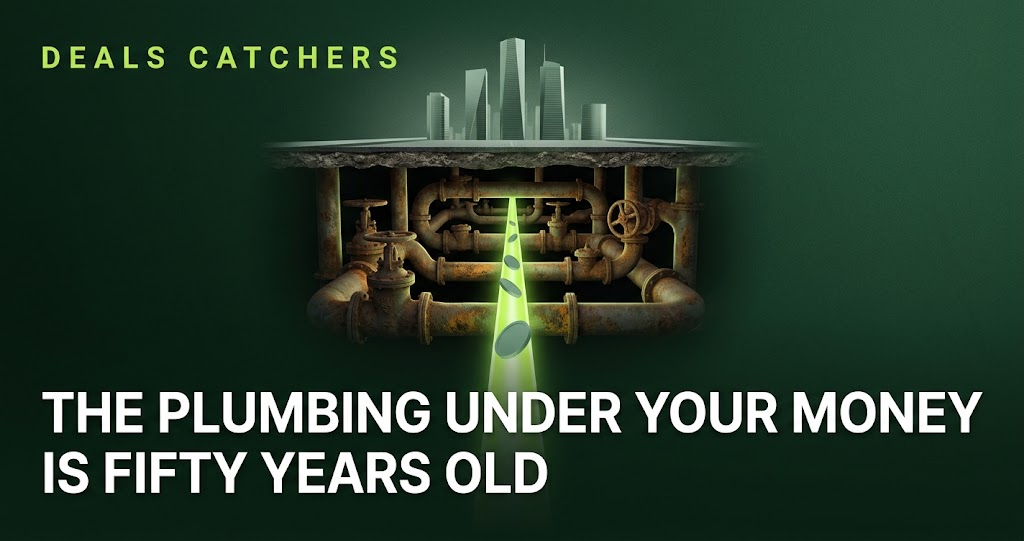
The Plumbing Under Your Money Is Fifty Years Old
 By Mike Lee14 Jul 2026 · 9 min read
Three stories crossed my desk today — a rewiring of how money itself moves, a scramble for the minerals that build everything, and a fifty-year-old accounting quirk hiding a trillion dollars. They look unrelated. They are the same story about ground shifting under your feet.
⏱ The 60-Second Catch
• The wiring under the financial system — how a trade actually settles — is being rebuilt, with the biggest names on Wall Street calling tokenization the next evolution of market infrastructure.
• A four-month squeeze on a single strait exposed how fragile the supply of critical minerals really is — and turned domestic lithium into a national-security question.
• And a quiet 1973 number still values U.S. gold at 42 dollars an ounce while it trades near 5,000 — a gap now worth more than a trillion dollars.
THE OPEN
When you buy a stock, the money doesn’t actually arrive for a full day. In 2026. With supercomputers everywhere. Ever wonder why?
The answer is buried plumbing. Underneath every trade sits a maze of clearinghouses and separate ledgers built decades ago, quietly passing IOUs around until, a day or two later, the cash and the shares finally change hands. You never see it. You just wait.
That hidden machinery is finally being ripped out and rebuilt — and for once, that is not a fringe claim. It is the most consequential thing happening in finance right now, and almost nobody outside Wall Street is talking about it in plain English. So let’s do that.
Sponsored
Trump’s New Money Grid
If you’re looking for the best place to invest $1,000 right now…
Forget about AI…
Forget about nuclear energy, quantum computing and crypto.
This dwarfs all of it… combined.
Here’s the story…
President Trump just signed this bill into law, forcing the immediate replacement of ALL the plumbing under our $382 trillion financial system.
Forget about AI…
Forget about nuclear energy, quantum computing and crypto.
This dwarfs all of it… combined.
Here’s the story…
President Trump just signed this bill into law, forcing the immediate replacement of ALL the plumbing under our $382 trillion financial system.
Just like the plumbing under your house moves water, there’s plumbing under our economy that moves money. And right now America’s “financial plumbing” is 50 years old.
It’s slow, it’s clunky and it breaks all the time…
However, thanks to a breakthrough new technology that BlackRock CEO Larry Fink is calling “the next major evolution in market infrastructure”, there’s finally a replacement…
Insiders are calling it The New American Money Grid.
And thanks to this legal mandate that just left President Trump’s Desk…
Every financial asset in America MUST be moved onto this New American Money Grid by April 2027.
And once it’s in place, every transaction on the New American Money Grid will burn a scarce “Digital Fuel” and that’s what this new interview is about.
Getting you in on the ground floor of this little-known asset set to potentially EXPLODE as the trillions starts moving in the coming weeks.
Unfortunately major institutions like BlackRock, Fidelity and Grayscale are already backing up the truck, quietly positioning themselves before the news goes mainstream.
So you don’t have long to act.
It’s slow, it’s clunky and it breaks all the time…
However, thanks to a breakthrough new technology that BlackRock CEO Larry Fink is calling “the next major evolution in market infrastructure”, there’s finally a replacement…
Insiders are calling it The New American Money Grid.
And thanks to this legal mandate that just left President Trump’s Desk…
Every financial asset in America MUST be moved onto this New American Money Grid by April 2027.
And once it’s in place, every transaction on the New American Money Grid will burn a scarce “Digital Fuel” and that’s what this new interview is about.
Getting you in on the ground floor of this little-known asset set to potentially EXPLODE as the trillions starts moving in the coming weeks.
Unfortunately major institutions like BlackRock, Fidelity and Grayscale are already backing up the truck, quietly positioning themselves before the news goes mainstream.
So you don’t have long to act.
The rewiring nobody explains
Wall Street Is Quietly Replacing Its Own Nervous System
The technical word is tokenization — recording who owns what on a shared digital ledger instead of a tangle of private ones. Strip the jargon and it means one thing: money and assets that can move instantly, together, instead of limping through a two-day settlement cycle.
This is not a crypto pitch. The people saying it are the least speculative names alive. BlackRock’s Larry Fink — who runs the largest money manager on earth — put it bluntly this year.
“Tokenization can modernise the infrastructure that still makes parts of the financial system slow and costly.”
— Larry Fink, BlackRock
The New York Stock Exchange is building a platform for it. JPMorgan already moves billions a day on its own blockchain. The plumbing is genuinely being replaced — the only real questions are how fast, and who gets to build the new pipes.
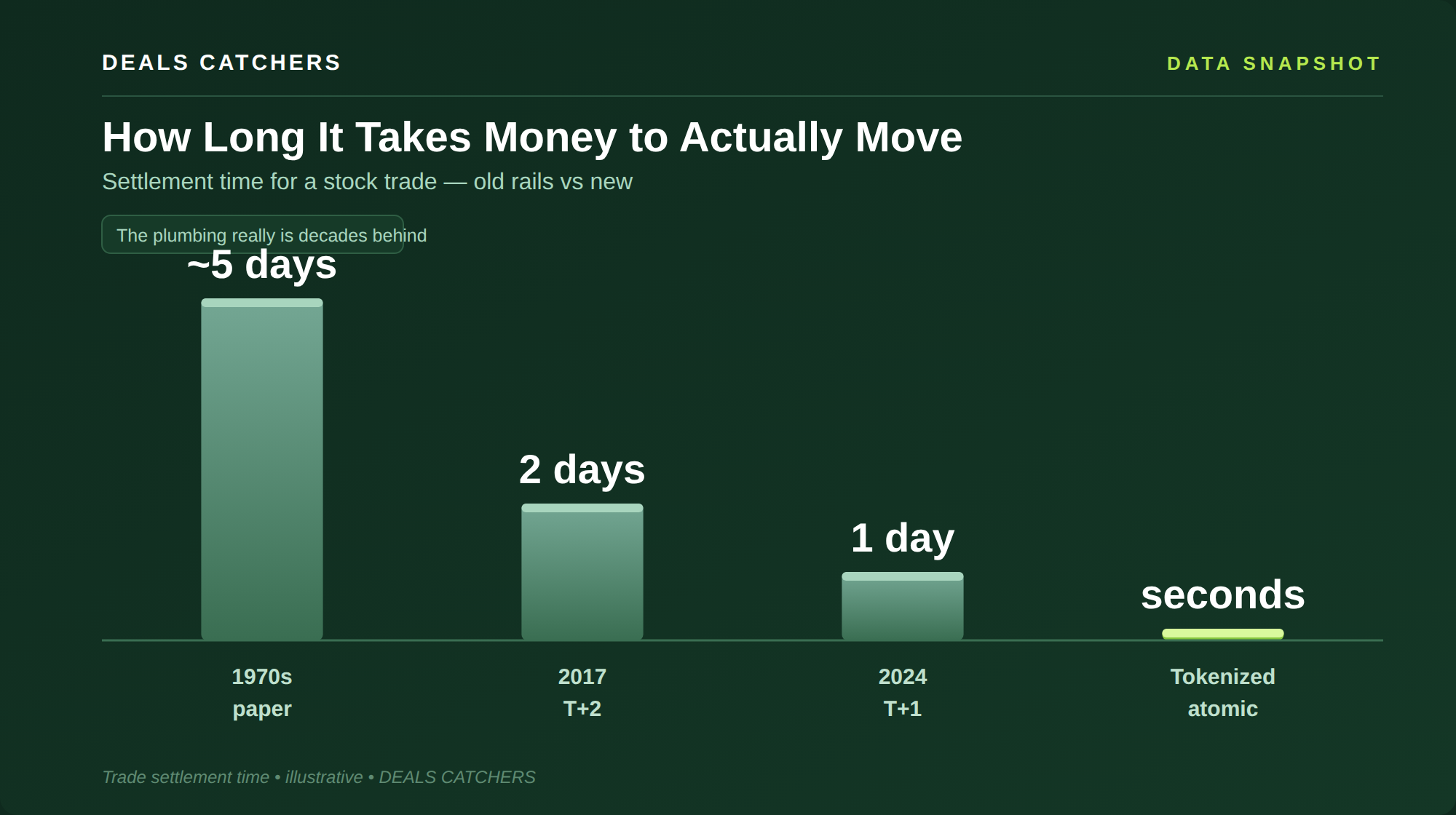
The rails really are decades behind — trade settlement time, old vs new.
WHERE IT TOUCHES THE GROUND
New rails still have to carry something real, and that is where the second story comes in. For four months, traffic through the Strait of Hormuz — the narrow channel that carries a fifth of the world’s oil — ran at a fraction of normal. What it revealed was uncomfortable: the modern economy runs on a short list of critical minerals, and America controls very little of the supply.
Lithium, cobalt, nickel, copper — the raw material of every battery, data center, and defense system — mostly gets processed on the other side of the world. When a single waterway tightened, the whole chain wobbled. Governments noticed. Digging those minerals out of American soil stopped being an environmental debate and became a security one.
This is the quiet link between the two stories. New financial rails, domestic mineral supply, gold on the books — each is really about the same instinct: bring the foundations home, and stop depending on someone else’s pipes. When you see a domestic-lithium pitch like EnergyX below, that is the current it is riding.
Sponsored

Why the Pentagon Called Domestic Miners Before Striking Iran
The United States and Iran signed a memorandum of understanding to end the war.
Then Iran hit a cargo vessel with a drone in the middle of the strait. The U.S. responded with strikes on Iranian missile storage facilities and radar sites. And Iran launched drones at Bahrain.
So much for the peace deal.
Here’s what serious investors need to understand about what’s happening — because the media is missing the story.
The MOU guarantees toll-free passage for 60 days. After that, Iran and Oman will “define the future administration and maritime services” in the strait. Iran has already established something called the Persian Gulf Strait Authority — a government agency to manage “safe passage permits.” They insist they won’t charge tolls. They’ll charge “fees.” For “navigational services” and “environmental protection.”
The distinction is semantic. The reality is structural: Iran is positioning itself to control access to the waterway through which 20% of the world’s oil and liquefied natural gas normally flows. And shipping traffic through the strait remains a fraction of pre-war levels.
But oil isn’t the only thing that is shipped through Hormuz.
Half the world’s seaborne sulfur supply passes through that strait. Sulfur is the foundational chemical reagent required to process critical minerals — including lithium, cobalt, nickel, and copper. When the strait closed, it didn’t just spike oil prices. It disrupted the entire upstream supply chain for the batteries that power electric vehicles, AI data centers, and the U.S. defense industrial base.
The Pentagon understood this. The day before the first strikes were launched, they asked domestic mining companies to boost production of 13 critical minerals. That is not a coincidence.
This crisis didn’t create America’s critical mineral vulnerability. It exposed it. And it made the case for domestic lithium production a matter of national security.
One private U.S. company is already producing battery-grade lithium on American soil.
Then Iran hit a cargo vessel with a drone in the middle of the strait. The U.S. responded with strikes on Iranian missile storage facilities and radar sites. And Iran launched drones at Bahrain.
So much for the peace deal.
Here’s what serious investors need to understand about what’s happening — because the media is missing the story.
The MOU guarantees toll-free passage for 60 days. After that, Iran and Oman will “define the future administration and maritime services” in the strait. Iran has already established something called the Persian Gulf Strait Authority — a government agency to manage “safe passage permits.” They insist they won’t charge tolls. They’ll charge “fees.” For “navigational services” and “environmental protection.”
The distinction is semantic. The reality is structural: Iran is positioning itself to control access to the waterway through which 20% of the world’s oil and liquefied natural gas normally flows. And shipping traffic through the strait remains a fraction of pre-war levels.
But oil isn’t the only thing that is shipped through Hormuz.
Half the world’s seaborne sulfur supply passes through that strait. Sulfur is the foundational chemical reagent required to process critical minerals — including lithium, cobalt, nickel, and copper. When the strait closed, it didn’t just spike oil prices. It disrupted the entire upstream supply chain for the batteries that power electric vehicles, AI data centers, and the U.S. defense industrial base.
The Pentagon understood this. The day before the first strikes were launched, they asked domestic mining companies to boost production of 13 critical minerals. That is not a coincidence.
This crisis didn’t create America’s critical mineral vulnerability. It exposed it. And it made the case for domestic lithium production a matter of national security.
One private U.S. company is already producing battery-grade lithium on American soil.
They hold 120-plus patents on a direct lithium extraction technology that recovers up to 94% of lithium in days — not the 18 months required by traditional evaporation methods. Their Texarkana plant — Project Lonestar — is the largest DLE facility in the United States. At full commercial scale, it projects roughly $1 billion a year in revenue.
General Motors led a $50 million round. The Department of Energy backed them with a $5m grant.
General Motors led a $50 million round. The Department of Energy backed them with a $5m grant.
The strait may reopen fully. Or it may not. Iran may drop its toll demands. Or it may not. But the lesson of the last four months is not going away: America cannot afford to depend on foreign chokepoints for the materials that power its economy.
∗
The trillion-dollar typo
There Is a 1973 Number Hiding a Fortune
Here is the fact that genuinely stopped me. On the U.S. government’s own books, its gold is valued at $42.22 an ounce — a statutory price set in 1973 and never touched since. Gold trades near $5,000 today. The government is carrying one of the largest gold hoards on earth at a number from the Nixon era.
The country holds about 261 million ounces — over 8,000 tonnes, the biggest official stash in the world. At the book price, that is worth around $11 billion. At the market price, it is worth well over a trillion dollars. The gap is pure accounting fiction, and it has sat there, ignored, for fifty years.
Why does anyone care now? Because the national debt is closing on $39 trillion, interest alone runs near a trillion a year, and Washington is hunting for money that doesn’t require new borrowing. A President can revalue that gold under a 1934 law — no vote required — exactly as Roosevelt did in the depths of the Depression. It may never happen. But the door is real, and it is quietly being discussed by people who are not cranks.
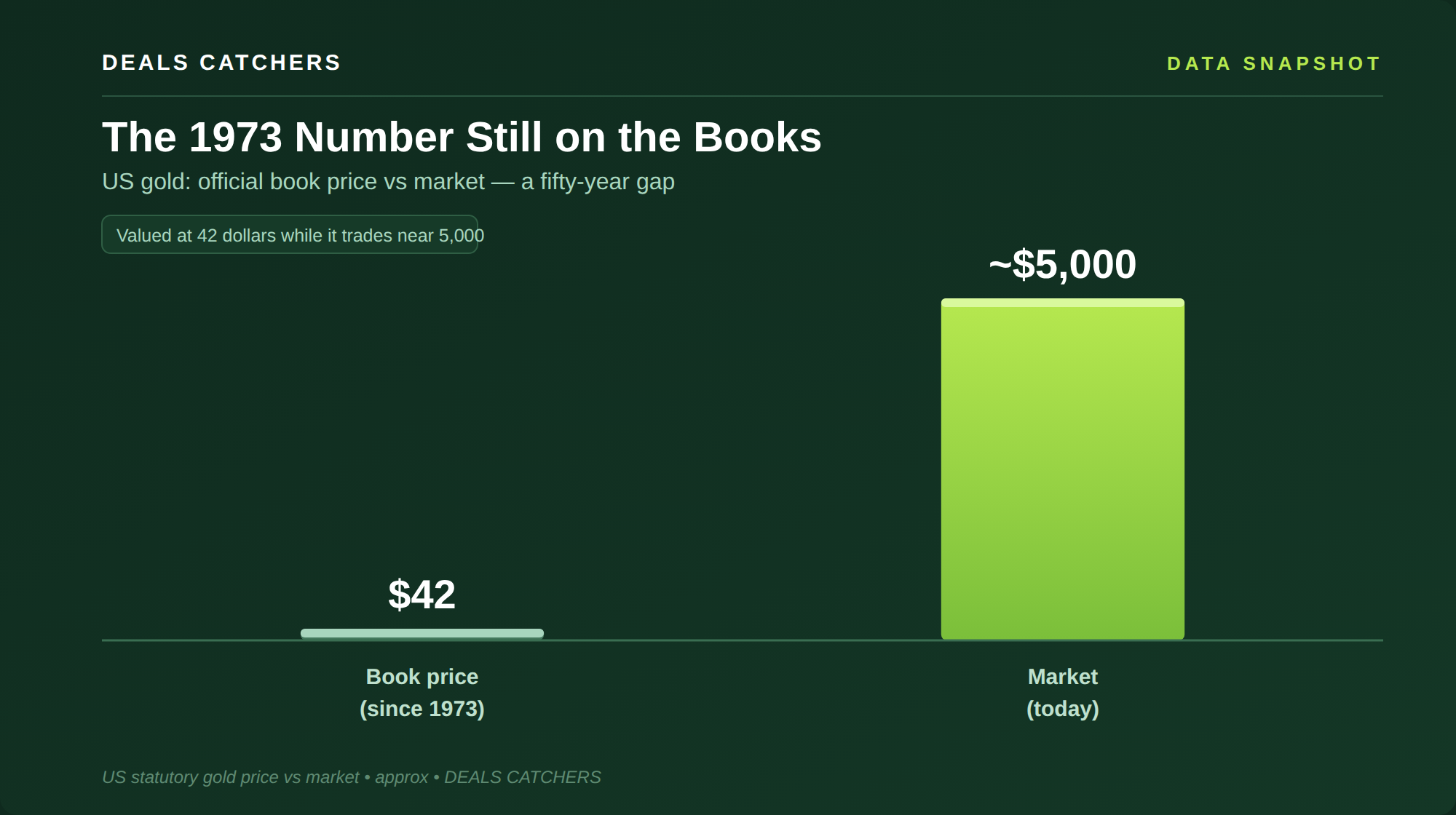
A fifty-year-old price tag — U.S. gold on the books vs in the market.
Sponsored
Gold Hit $5,400… Then This Happened
A strange thing happened after gold hit $5,400…
Weak hands panicked.
Wall Street called the run “over.”
And millions of Americans quietly walked away… again.
But here’s what almost nobody realizes:
The REAL reason gold exploded in the first place hasn’t changed at all.
Not one bit.
The U.S. government is STILL valuing its gold reserves at just $42.22 an ounce.
Meanwhile?
Gold is sitting around $4,700.
Think about how insane that is for a second.
America is allegedly holding one of the largest gold stockpiles on Earth…
Yet it’s being priced on government books using a number from 1934.
That discrepancy is now worth over $1.3 trillion.
And according to a growing number of analysts…
Trump may have the exact executive authority needed to change it overnight.
The same authority FDR used nearly 90 years ago.
Now here’s why this pullback matters so much…
At $2,000 gold, most people said: “Too expensive.”
At $5,400 gold, they said: “I missed it.”
Now gold has pulled back…
But the executive order thesis is STILL alive.
Central banks are STILL buying.
The accounting fiction is STILL unresolved.
And the people quietly positioning right now?
They aren’t treating this like a collapse…
They’re treating it like a second chance.
Because if this gold revaluation move happens…
It may trigger one of the largest wealth shifts in modern financial history.
And by the time the mainstream media starts screaming about it…
The move could already be gone.
That’s why this free briefing was just released.
It breaks down:
• Why the $42.22 gold loophole still exists
• How a presidential signature could change everything fast
• Why the recent pullback may be the setup not the end
• And how ordinary Americans are trying to position before any announcement hits
Tap here now to watch the presentation before this window closes.
Weak hands panicked.
Wall Street called the run “over.”
And millions of Americans quietly walked away… again.
But here’s what almost nobody realizes:
The REAL reason gold exploded in the first place hasn’t changed at all.
Not one bit.
The U.S. government is STILL valuing its gold reserves at just $42.22 an ounce.
Meanwhile?
Gold is sitting around $4,700.
Think about how insane that is for a second.
America is allegedly holding one of the largest gold stockpiles on Earth…
Yet it’s being priced on government books using a number from 1934.
That discrepancy is now worth over $1.3 trillion.
And according to a growing number of analysts…
Trump may have the exact executive authority needed to change it overnight.
The same authority FDR used nearly 90 years ago.
Now here’s why this pullback matters so much…
At $2,000 gold, most people said: “Too expensive.”
At $5,400 gold, they said: “I missed it.”
Now gold has pulled back…
But the executive order thesis is STILL alive.
Central banks are STILL buying.
The accounting fiction is STILL unresolved.
And the people quietly positioning right now?
They aren’t treating this like a collapse…
They’re treating it like a second chance.
Because if this gold revaluation move happens…
It may trigger one of the largest wealth shifts in modern financial history.
And by the time the mainstream media starts screaming about it…
The move could already be gone.
That’s why this free briefing was just released.
It breaks down:
• Why the $42.22 gold loophole still exists
• How a presidential signature could change everything fast
• Why the recent pullback may be the setup not the end
• And how ordinary Americans are trying to position before any announcement hits
Tap here now to watch the presentation before this window closes.
P.S. Gold already showed you what’s possible at $5,400. The scary part? The underlying trigger behind that move still hasn’t been resolved. See what smart money is watching before the next leg begins.
WHAT IT ADDS UP TO
Step back and the three stories rhyme. The wires that move money, the minerals that build things, the metal that once backed the dollar — all of it is being pulled back toward home ground and re-examined after decades of nobody looking. That is what a genuine shift feels like from the inside: not a crash, but a slow realization that the foundations were never as solid as they seemed.
None of that tells you what to buy, and it is not meant to. It tells you where to point your attention. When the ground moves, the people who do well are rarely the ones who lunged at the loudest headline — they are the ones who understood which way it was tilting, and stayed steady while everyone else scrambled.
The Catcher’s Watchlist
Four liquid ways to watch the same three forces — ones you can actually buy and sell on a Tuesday.
COIN
The rails trade. A blunt, liquid proxy for money moving onto digital infrastructure — volatile, but it moves with the theme.
The rails trade. A blunt, liquid proxy for money moving onto digital infrastructure — volatile, but it moves with the theme.
LIT (Lithium ETF)
The minerals trade. The whole critical-mineral scramble in one ticker, no private raise required.
The minerals trade. The whole critical-mineral scramble in one ticker, no private raise required.
GLD (Gold)
The metal itself. The cleanest way to own the thing sitting on the government’s books at a 1973 price.
The metal itself. The cleanest way to own the thing sitting on the government’s books at a 1973 price.
GDX (Gold Miners)
Gold with the volume up. Where a revaluation-driven move would be amplified — in both directions.
Gold with the volume up. Where a revaluation-driven move would be amplified — in both directions.
Analyst’s Note
Of tonight’s three, the one I would actually carry around is the gold-on-the-books number. Not because a revaluation is coming — it may never come — but because it is a perfect, concrete example of how much of what we call “value” is really just an agreement nobody has bothered to revisit. A country’s gold marked at 42 dollars while it trades near 5,000 tells you the map and the territory drifted apart a long time ago. The tokenization story is the same lesson from the opposite side: the machinery we trust is older and creakier than we assume, and it is being quietly rebuilt whether we follow along or not. My honest advice is unglamorous. You do not need to catch the exact vehicle in any of these — the private deal, the token, the miner. You need to understand which way the ground is tilting, keep what you own in things you could sell tomorrow if you had to, and never confuse a genuine trend with an urgent deadline. The trend is real. The urgency is almost always someone else’s.
— Lee
THE BOTTOM LINE
Money that moves in seconds instead of days. Minerals we can no longer take for granted. A trillion dollars of gold hiding behind a fifty-year-old price. Three headlines that look unrelated, all whispering the same thing — the foundations are being re-poured, quietly, while most people watch the surface.
You do not have to predict which one pays off first. You have to see the direction and keep your footing. Know what you own and why, hold it in a form you could exit tomorrow, and treat every “act now” as the sales tactic it usually is.
Forget the hot picks — protect what you’ve already built, and let a real shift reward your patience instead of your panic. Because the best trade you’ll ever make is the loss you never took.
— Lee
∗ Sources & Disclosures
∗ Energy Exploration Technologies, Inc. (“EnergyX”) has engaged Dynamic Industries to publish this communication in connection with EnergyX’s ongoing Regulation A offering. Dynamic Industries has been paid in cash and may receive additional compensation. Dynamic Industries and/or its affiliates do not currently hold securities of EnergyX. This compensation and any current or future ownership interest could create a conflict of interest. Please consider this disclosure alongside EnergyX’s offering materials. EnergyX’s Regulation A offering has been qualified by the SEC. Offers and sales may be made only by means of the qualified offering circular. Before investing, carefully review the offering circular, including the risk factors. The offering circular is available at invest.energyx.com. Comparisons to other companies are for informational purposes only and should not imply similar results.