
The Same $400 Fee is 0.27% or 1.60%, Depending on Your Balance


Three Numbers to Start
53,000 — the jobs economists expect from this morning's report. July lost 23,000, and May and June were revised down by 103,000 between them.
99.5% — the purity your gold must hit before the IRS will let it sit in a retirement account. American Eagles are exempt by statute at 91.67%.
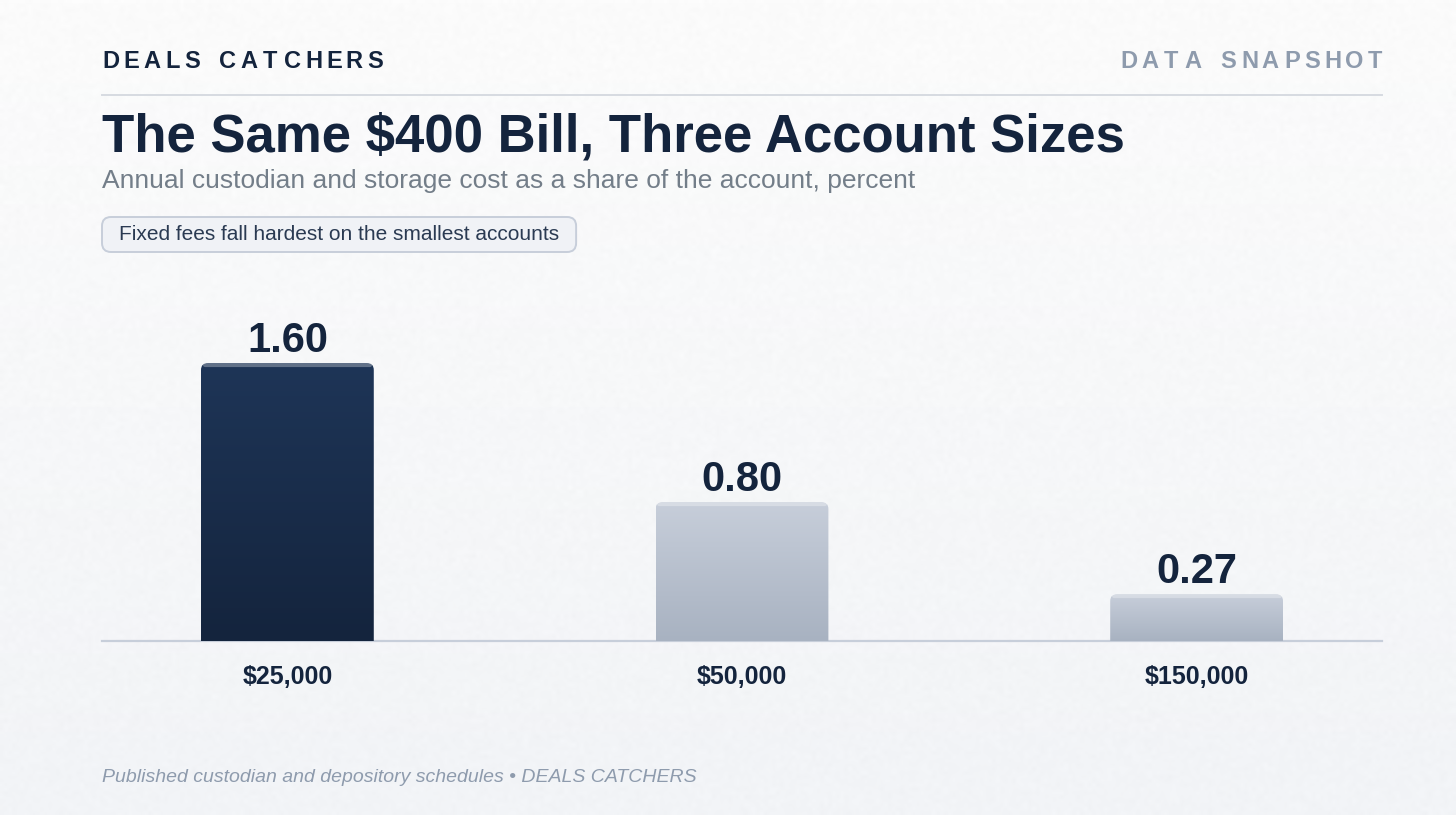
$400 — a typical annual custodian and storage bill on a gold IRA. On a $25,000 account that is 1.6% a year, taken from an asset that pays nothing.
Physical Gold in an IRA is Legal, and the Rules Are the Price of Admission
You can hold bullion inside a retirement account. It is written into the tax code, it has been legal for decades, and the process works. What most people never see is the list of conditions attached, and every one of them exists for a reason worth understanding before you sign anything.
Start with what qualifies. Under section 408(m)(3)(B) of the code, gold must be at least 99.5% pure. Silver has to reach 99.9%, platinum and palladium 99.95%. Bars from recognised refiners qualify. So do Canadian Maple Leafs and Austrian Philharmonics.
The American Gold Eagle is the interesting exception. At 91.67% fineness it fails the purity test outright, and Congress exempted it by name in the statute. That single carve-out tells you these rules were negotiated rather than derived, which is useful context for the rest of them.
Then the part that catches people, and it catches them expensively.
You cannot keep it at home. IRA metals must sit with an IRS-approved depository — Delaware Depository, Brink's, IDS of Texas and a handful of others — under a custodian's name. Take personal possession and the IRS treats the entire holding as a distribution: income tax on the full value, plus a 10% penalty if you are under 59 and a half.
That is not a theoretical risk. The Tax Court settled it in McNulty v. Commissioner, where a couple stored IRA-owned coins in a home safe and lost the argument along with the tax shelter. Anyone advertising a "home storage gold IRA" is describing something the courts have already ruled on.
The chain of custody is deliberately impersonal. Your custodian executes the purchase, the dealer ships directly to the depository by insured transport, the depository verifies the contents and logs them under your account name. You never touch the metal. That separation between you and the asset is the entire basis of the tax advantage — it applies to every IRA, whether it holds index funds or bullion.
Now the number nobody leads with.
Setup runs $50 to $250. Annual custodian fees run $75 to $300. Storage runs $100 to $300 flat, or 0.30% to 1.5% of value. Total annual cost for a moderate account typically lands between $200 and $500, before any dealer premium on the metal itself.
Call it $400, and watch what happens as the account size changes. On $150,000 that is 0.27% a year, comparable to a managed fund. On $50,000 it is 0.80%. On $25,000 it is 1.60%, every year, on an asset that produces no income to pay it with. The fee comes out of principal or appreciation, and it does not scale down.
That is the honest frame. The tax treatment is real and the rules are followable. Whether it makes sense depends almost entirely on account size, because the fixed costs do the deciding.
Two more things worth knowing. The 2026 contribution limit is $7,500, or $8,600 if you are 50 or over. And setting one of these up takes two to three weeks, which matters if you were planning to move on a headline.
Today's Jobs Report Matters Less Than It Used To, and the Fed Has Said So
The Bureau of Labor Statistics releases August employment at 8:30 this morning, an hour before the opening bell. Consensus expects 53,000 new jobs and unemployment holding at 4.1%.
Set that against what came before.
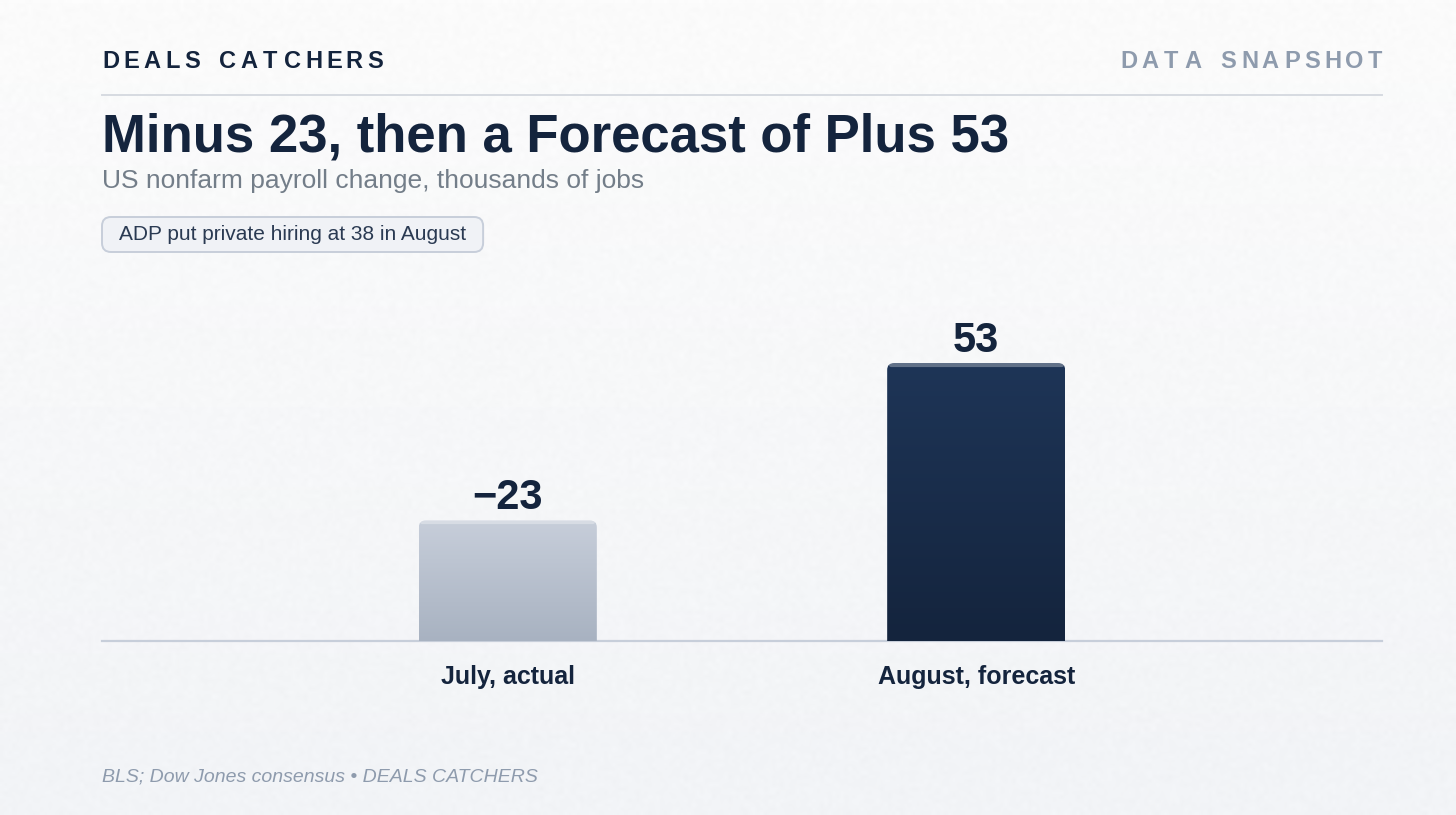
July payrolls fell by 23,000. June and July together produced a net loss of 3,000 jobs. ADP put private hiring at 38,000 in August, below its own expectations and the weakest reading in seven months. A number in the fifties would not be a recovery. It would be a smaller decline.
Then there is the revision problem, which deserves more attention than it gets.
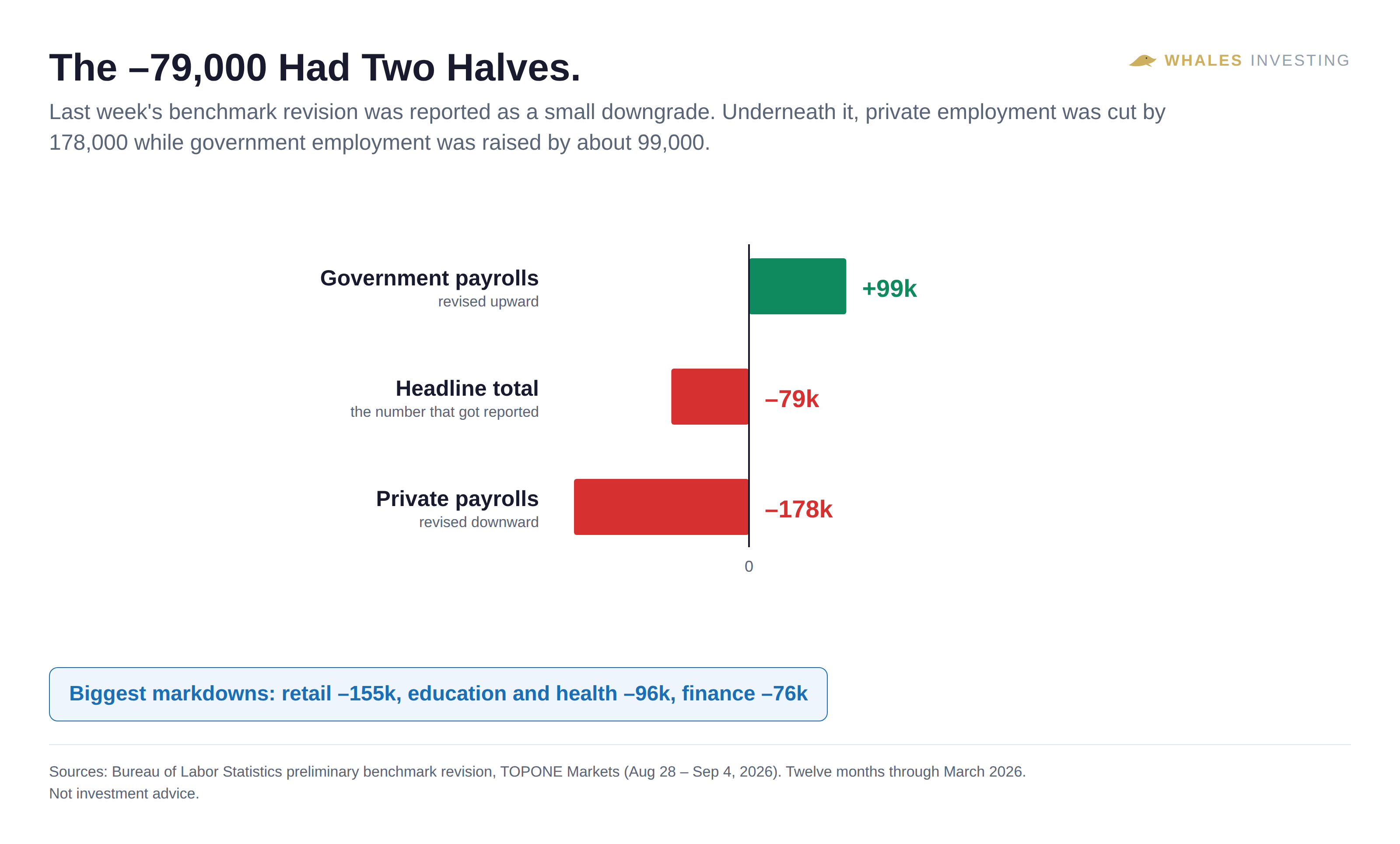
May was revised down by 66,000. June was revised down by 37,000. On August 28 the BLS published a preliminary annual benchmark knocking a further 79,000 off the March total. And initial August figures have been revised lower in each of the past four years.
So the number arriving this morning is a first estimate of a month that historically gets marked down, in a series where the last two months were already marked down by six figures combined. Treat it as a draft.
Here is what makes this report different from the ones that moved markets last year. The Fed has effectively told you it is not the constraint. Governor Michael Barr called the labour situation "stable" this week. Governor Christopher Waller said the jobs picture is in "satisfactory shape". Neither is enthusiasm. Both are the language of officials who have moved on to a different problem.
That problem is inflation, and the market now prices roughly a 70% chance of a rate rise this month — a number driven up by oil and a hawkish Jackson Hole speech rather than by anything in the labour data.
Which produces an unusual asymmetry for a jobs Friday. A hot print reinforces the hike. A soft print does not remove it, because the case is being made on the price side. If you are drawing income from savings and watching for a signal, the reaction to watch is not the headline number but the two-year Treasury yield in the minutes after 8:30.
One quiet detail sits underneath all of it. Labour force participation is 61.4%, down 0.7 percentage points since January. A shrinking labour force holds the unemployment rate down regardless of hiring, because people who stop looking stop being counted. That is part of why 4.1% has looked so stable through a summer that produced almost no jobs.
Four Companies Account for Most of an Index Everyone Owns
The concentration in American equities is not a forecast or an opinion. It is arithmetic, and it has been building for three years.
A handful of firms tied to artificial intelligence now make up an outsized share of the S&P 500 by weight, which means an index fund marketed as broad diversification delivers something considerably narrower than the name suggests. Someone holding a total-market fund and a technology fund and a growth fund may own the same five companies three times.
This is the part where the argument usually turns into a forecast about whether AI is a bubble, and that is the wrong conversation for most people to be having.
The useful question is narrower and answerable. If a small group of stocks fell 30%, what would that do to a portfolio you believe is diversified? That number is knowable today. It does not require predicting anything.
Most brokerages will show you a fund's top ten holdings and their combined weight in two clicks. Add the overlapping positions across the funds you hold. The figure that comes out is your actual concentration, as opposed to the concentration you assume you have.
For someone in their sixties drawing from a portfolio, that number matters more than any view on where the technology goes. Sequence risk — the damage done when a large drawdown lands early in retirement while you are withdrawing — is driven by how much falls at once, not by whether the fall was justified.
None of which is an argument for selling anything. It is an argument for knowing what you hold, which is a different and much cheaper exercise.
What is Scheduled
This morning, 8:30 — August employment. One hour before the bell.
Next week — August CPI.
15–16 September — the Federal Open Market Committee meets.
With the market at roughly 70% for a September rise and no reaction function published, CPI now carries more weight than payrolls. Core PCE — the inflation gauge the Fed actually targets, rather than the headline CPI most people see quoted — ran at 3.3% in July against 2.8% in February.
The ten-year Treasury sits near 4.79%, its highest since early 2025. Last week the long end finally moved alongside the short end, which reads as a market becoming less certain the inflation problem stays contained.
One Number
1.60% — the annual custodian and storage cost on a $25,000 gold IRA, assuming a $400 bill. The same $400 on a $150,000 account is 0.27%. Nothing about the gold changes. Only the arithmetic does.
Forget the hot picks — protect what you've already built, and work out what the fixed costs do at your account size before you decide whether something is worth owning. Because the best trade you'll ever make is the loss you never took.
- Mike Lee
Thanks for reading. Have a good weekend.