The Best Companies Never Let You In Anymore

 |
SpaceX Rang the Bell at $1.75 Trillion. You Weren’t Invited.
 By Mike Lee13 Jul 2026 · 9 min read
The biggest IPO in history came and went, and ordinary investors watched it from the outside — as they now watch most of the growth that matters. Tonight: why the public gets the last leg of the climb, the regulated doors that changed that, and what gold’s run says about where money hides.
⏱ The 60-Second Catch
• The biggest IPO ever priced this week — and by the time a company that size rings the bell, most of its growth is already in the price. The public buys the last leg.
• Regulation A+ is why private-share offers keep arriving: ordinary investors can now buy early-stage shares, with real SEC disclosure — and real, lasting illiquidity.
• Gold cleared $5,000, with some banks calling for higher. A reminder that the oldest asset still moves hardest when confidence in paper wobbles.
THE OPEN
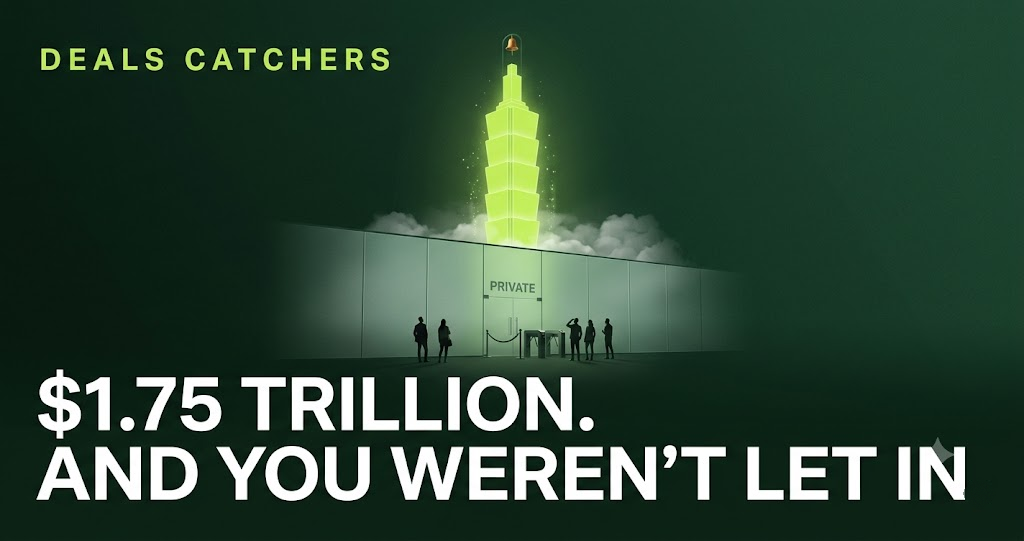
On June 12, a private company was worth more than every bank in America combined. You were not allowed to own a single share.
SpaceX priced its debut at $1.75 trillion — the largest the world has ever seen. And here is the part that should stop you cold: by the time your broker could fill the order, the fortune had already been made. Not by you. By the handful of people who got in years before any of us were invited.
If that stings a little, good. It should. Because it is not an accident, and it is not one company. It is the single most important shift in how wealth gets built in your lifetime — and almost nobody your advisor talks to has explained why.
Sponsored

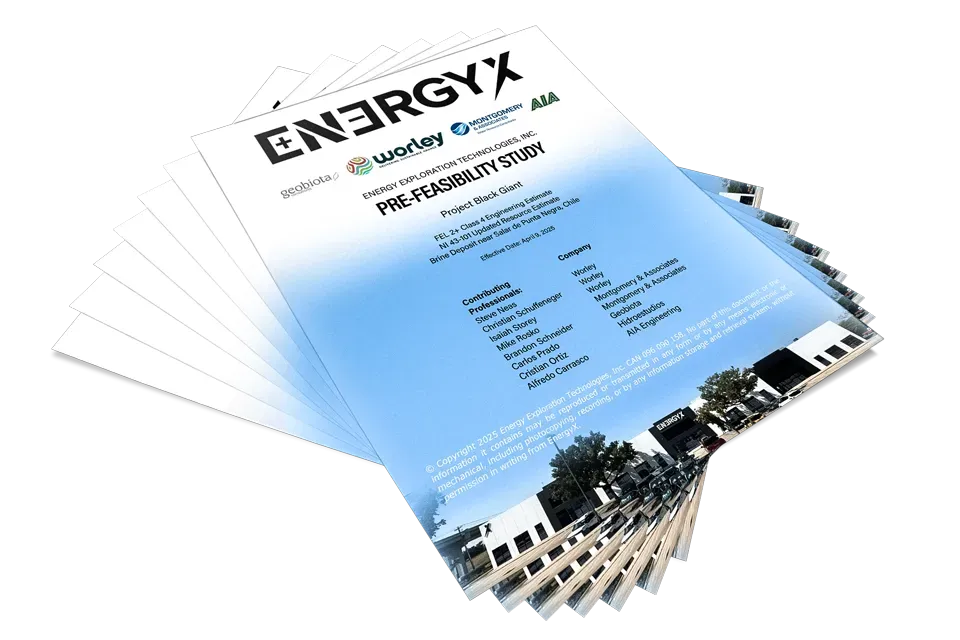
SpaceX Just IPO’d at $1.75 Trillion. You Couldn’t Buy In. This One You Can.*
On June 12, SpaceX IPO’d at a $1.75 trillion valuation, one of the largest debuts in market history. Early private investors made a fortune. Everyday investors? Locked out until the stock was already public and the easy money was gone.
It’s the same story with every giant. Uber, Airbnb, and the private titans still off limits today like OpenAI and ByteDance. The biggest gains happen before you can click “buy.”
It’s the same story with every giant. Uber, Airbnb, and the private titans still off limits today like OpenAI and ByteDance. The biggest gains happen before you can click “buy.”
EnergyX is breaking that pattern. It’s a private, pre-IPO American lithium company backed by General Motors, POSCO, Eni, and the U.S. Department of Energy.* Right now, everyday investors can own shares at $13 each.*
More than 50,000 investors have already committed over $180 million.* EnergyX’s patented GET-Lit™ technology recovers up to 3X more lithium than legacy methods, and its first U.S. plant is already producing battery grade lithium.*
More than 50,000 investors have already committed over $180 million.* EnergyX’s patented GET-Lit™ technology recovers up to 3X more lithium than legacy methods, and its first U.S. plant is already producing battery grade lithium.*
You can’t go back and buy SpaceX at the start. You can still get in on this one before the July 16 deadline.
The number nobody mentions
Companies Used to Go Public Young. Now They Go Public Rich.
Pull up the data and the story tells itself. In the 1980s and 90s, the typical company went public around six to eight years old. Professor Jay Ritter at the University of Florida has tracked this his entire career, and his latest numbers are startling: by 2024 the median company waited fourteen years to list.
Fourteen years. And it is not just time — it is size. In 1980, the median company going public had about $16 million in revenue. By 2024 that figure had exploded to $218 million. Read that again. The public is now handed businesses more than ten times larger, by the time it is finally allowed a seat.
There are more than 1,200 “unicorns” out there right now — private companies worth over a billion dollars — and BlackRock pegs the private market at $13 trillion, headed toward $20 trillion by 2030. That is where the growth moved. Quietly, and mostly without you.
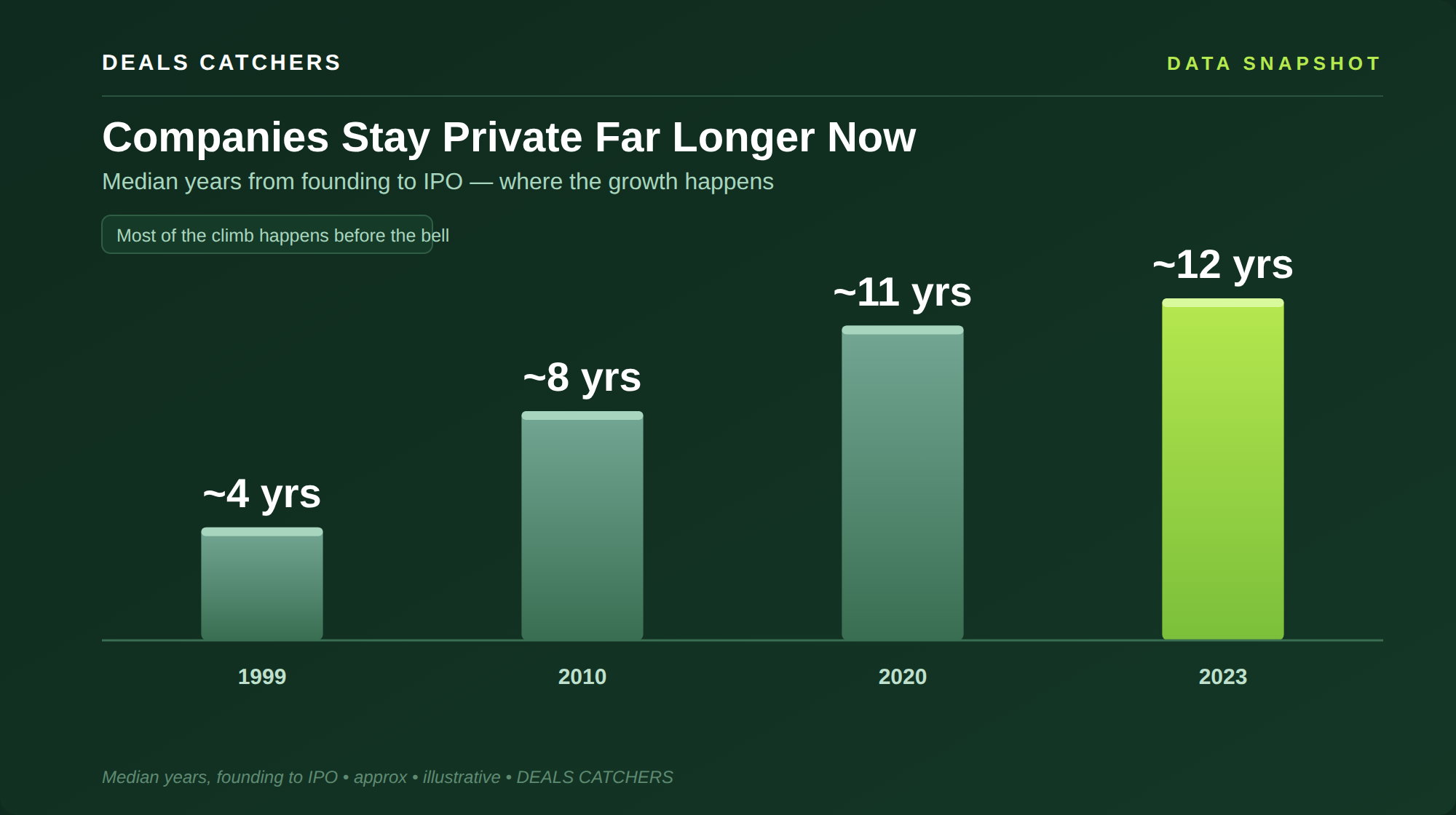
The climb keeps happening before the bell — median years from founding to IPO.
HOW THE DOOR CRACKED OPEN
For decades, the deal was simple and unfair: those private rooms were reserved for venture funds, insiders, and the already-rich. Everyone else waited for the IPO and bought the leftovers. Then the rules changed. A provision called Regulation A+ did something genuinely new — it let ordinary Americans buy into private companies before the bell, without needing to be a millionaire to qualify.
That is the current running underneath your inbox lately. When you see a pre-IPO lithium play like EnergyX below, or a pitch about Elon’s next venture, you are looking at that same door — the one that was bolted shut for a hundred years, now propped open a few inches.
One thing the excitement always leaves out: a private share is illiquid. There is often no way to sell it — not next week, maybe not for years, maybe never. The company sets the price. A reserved ticker is a hope, not a promise. Most companies that raise this way never list at all.
Sponsored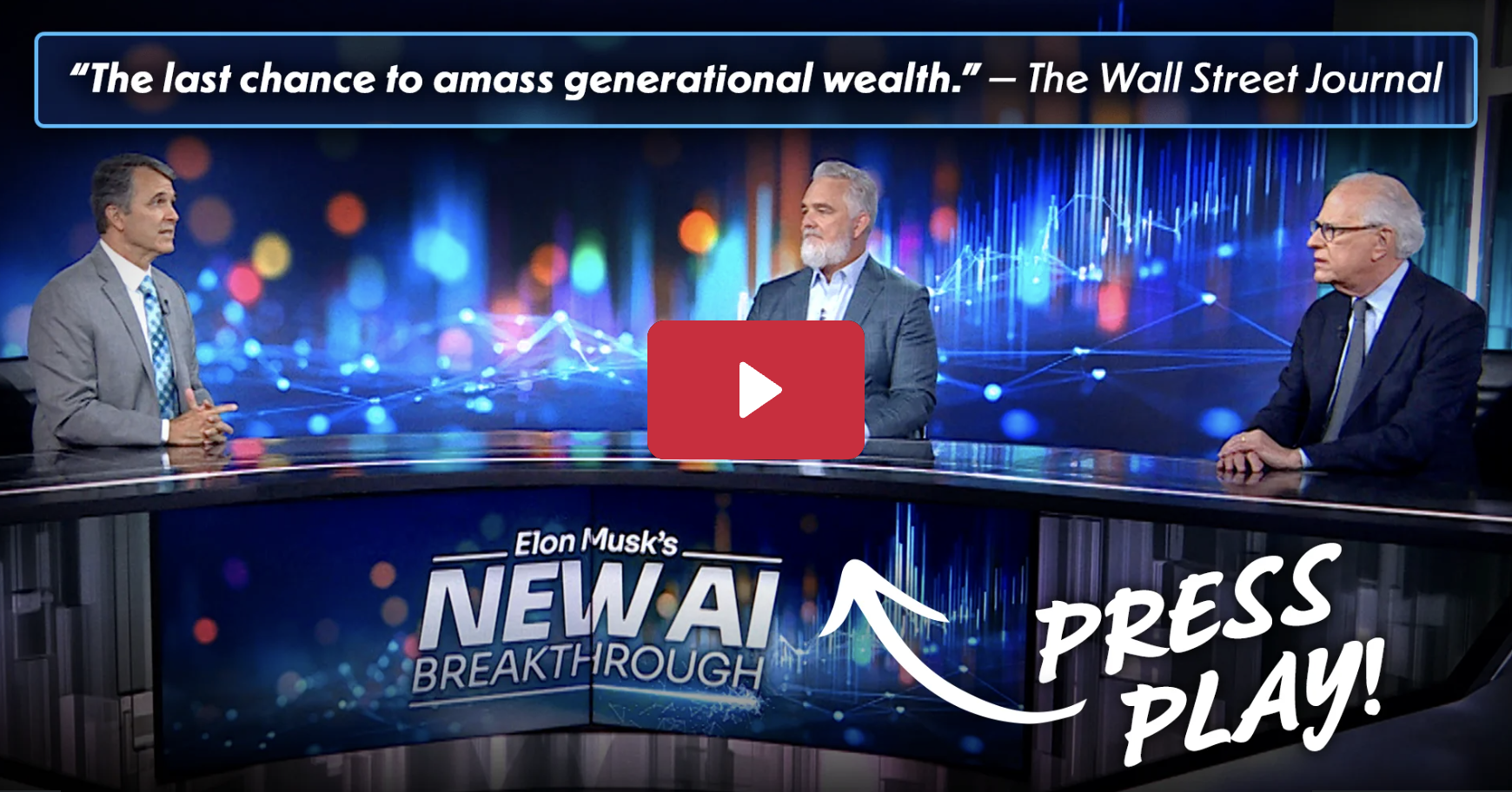
Forget SpaceX, This Is Elon’s Next Breakthrough
Editor’s Note: Jeff Brown and Marc Chaikin, two investment legends who picked Nvidia 10 years ago, are predicting that by the end of this month, Elon Musk’s new AI breakthrough will collide with a strange market pattern with a flawless 100% track record of massive market gains. Click here to see the details or read more below because the last time this happened everyday folks had a chance to turn $10,000 into as much as $350,000 in just about 12 months.
While everyone was distracted with the recent SpaceX IPO…
Elon Musk quietly filed a patent with the U.S. Patent and Trademark Office to protect what I believe will be his next breakthrough…
Something he called “the greatest tech invention in history.”
Elon is predicting this new AI breakthrough will unleash…
A $1 quadrillion new wealth wave.
That’s more than 30 times bigger than the entire U.S. economy.
That would be enough to send a check for $2.8 million to every single American.
Regards,
Jeff Brown
Founder & CEO, Brownstone Research
While everyone was distracted with the recent SpaceX IPO…
Elon Musk quietly filed a patent with the U.S. Patent and Trademark Office to protect what I believe will be his next breakthrough…
Something he called “the greatest tech invention in history.”
Elon is predicting this new AI breakthrough will unleash…
A $1 quadrillion new wealth wave.
That’s more than 30 times bigger than the entire U.S. economy.
That would be enough to send a check for $2.8 million to every single American.
Regards,
Jeff Brown
Founder & CEO, Brownstone Research
Meanwhile, in the oldest asset on earth
Gold Just Did Something It Has Only Done in a Crisis
While the private-market doors creak open, gold blew through $5,000 an ounce — a price that would have sounded insane two years ago. Bank of America has a $6,000 target on it. So does JPMorgan. So does Wells Fargo. When that many buttoned-up institutions land on the same number, they are not calling a price. They are saying something about the money in your wallet.
Here is the tell. Central banks bought over 1,000 tonnes of gold a year, three years running. China’s central bank has been stacking it month after month. A recent World Gold Council survey found 89% of central banks expect to keep adding. The people who print the currency are quietly trading it for metal. That should tell you something.
And why now? Follow the arithmetic: the U.S. national debt just crossed $39 trillion, with over a trillion a year in interest alone. When a government owes that much, there are only ever two ways out — default, or inflate. Gold is simply the world’s oldest bet on which one they will choose.
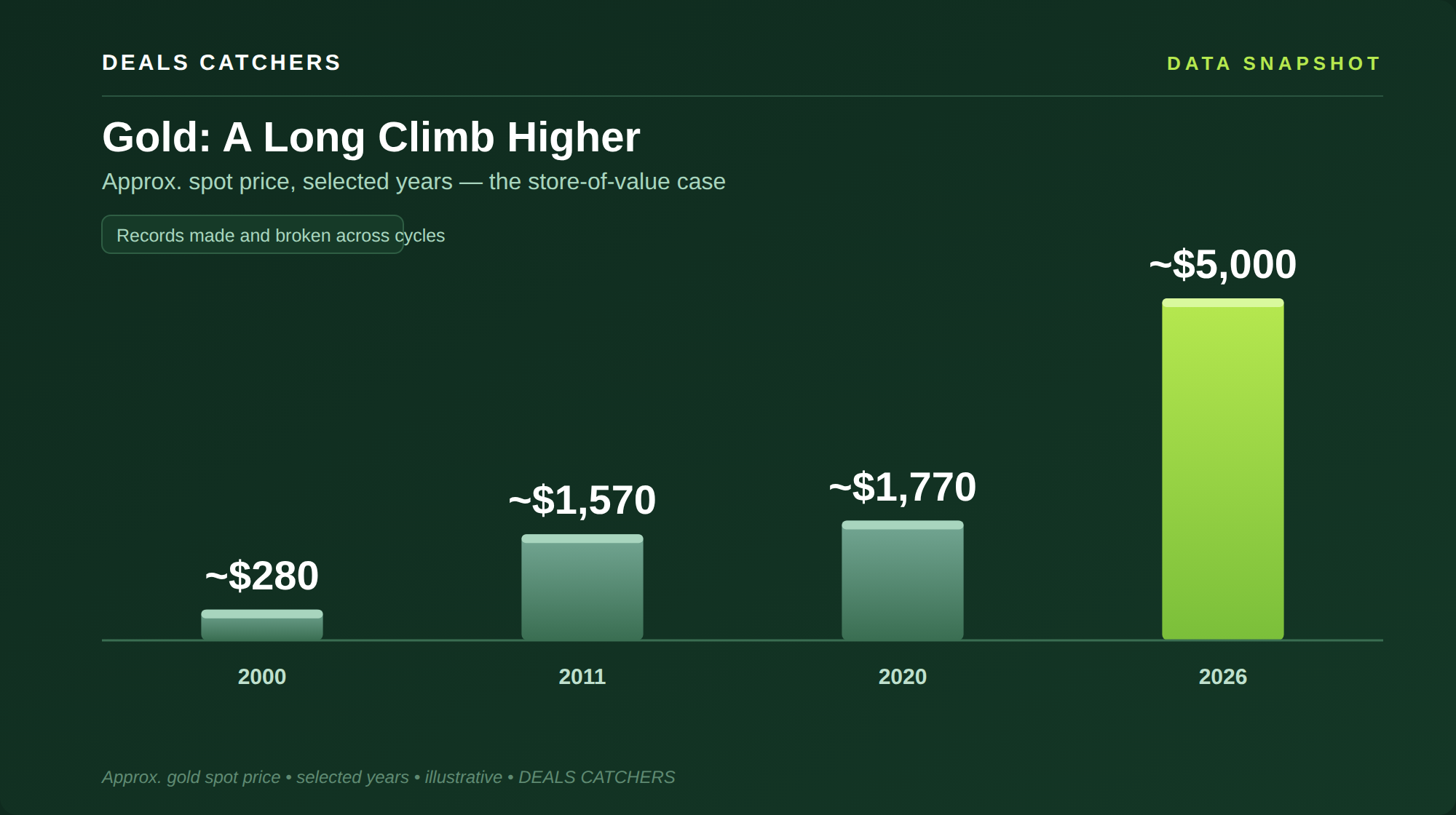
What a record price really tracks — gold’s long climb, selected years.
Sponsored
Bank of America Predicts Gold at $6,000. Here’s How to Get Paid Now
Gold just shattered $5,000 and analysts see it climbing even higher. But income expert Tim Plaehn isn’t waiting. He’s found a $15 fund that’s already delivering up to 64% in annual distributions while gold soars.
A powerful income play most investors have never heard of — paying monthly.
Discover this gold income breakthrough before the next payout arrives.
Discover this gold income breakthrough before the next payout arrives.
WHAT IT ADDS UP TO
So step back and see the whole board. The great fortunes are being made in private, behind a door that has only just cracked open for you — and the world’s smartest money is quietly buying insurance against its own currency. Those two facts are the same story told from opposite ends: the ground under “normal” investing is moving.
That does not mean chase everything. It means the opposite. When access is scarce and the dollar looks shaky, the discipline that protects you is not speed — it is knowing exactly what you own, and why. A private stake you cannot sell for a decade is a real decision, not an impulse. A record gold price is a reason to understand the metal, not a reason to grab the first thing with the word “gold” stapled to it.
The Catcher’s Watchlist
Four liquid ways to watch these same forces — the kind you can actually buy and sell on a Tuesday.
IPO (Renaissance IPO ETF)
The bell, in one ticker. Tells you whether Wall Street is cheering the new arrivals or throwing tomatoes.
The bell, in one ticker. Tells you whether Wall Street is cheering the new arrivals or throwing tomatoes.
NVDA
The yardstick. Every “next Nvidia” pitch is measured against the real one — worth watching just to keep the comparisons honest.
The yardstick. Every “next Nvidia” pitch is measured against the real one — worth watching just to keep the comparisons honest.
GLD (Gold)
The metal itself, no story attached. The cleanest way to own what the central banks are quietly buying.
The metal itself, no story attached. The cleanest way to own what the central banks are quietly buying.
GDX (Gold Miners)
Gold with the volume turned up. When the metal moves, the miners move harder — in both directions.
Gold with the volume turned up. When the metal moves, the miners move harder — in both directions.
Analyst’s Note
Thirty years ago, a working person with a brokerage account and some patience could buy a young company and grow with it. That deal is mostly gone — the growth happens in private now, and by the time you are invited, the easy money has a decade’s head start. That is not a reason to feel cheated. It is a reason to be deliberate. The doors that are opening are real, and so is the trap inside them: a private share you cannot sell is not a stock, it is a promise, and promises should be sized at what you can afford to lock away and forget. As for gold at $5,000 with the central banks piling in — that is the market telling you it does not fully trust the dollar either. Fair enough. Just remember that owning gold and owning something with the word gold in its name are not the same trade, and the difference is usually where the risk hides. Know what you own. Know why you own it. Everything else this week is noise dressed up as urgency.
— Lee
THE BOTTOM LINE
A private company was worth $1.75 trillion before you could buy a single share. The central banks are trading dollars for gold. Neither of those is a headline — they are the same quiet message, that the old rules of building wealth have shifted under our feet, and most people haven’t noticed yet.
You noticed. That is the whole edge. The doors into private markets are real, and the price of walking through is liquidity — the freedom to change your mind. Gold’s run is real, and the trick is telling the metal apart from everything sold in its name. Both are knowable before you commit a dollar.
Forget the hot picks — protect what you’ve already built, and never pay for early access or easy yield with money you might need back. Because the best trade you’ll ever make is the loss you never took.
— Lee
∗ Sources & Disclosures
∗ Energy Exploration Technologies, Inc. (“we”, “us”, “our”, and “EnergyX”) is conducting an offering of securities pursuant to Regulation A of the Securities Act of 1933, as amended. An offering statement covering this offering has been qualified by the U.S. Securities and Exchange Commission (the “SEC”). Neither this communication nor any of its content constitutes an offer to sell, solicitation of an offer to buy or a recommendation for any of our securities by our company or any third party. Offers and sales of the securities are being made solely by means of the qualified offering circular. Investing in our securities involves significant risks. Before investing, you should consult with your financial advisor, accountant, and/or attorney, and carefully review the qualified offering circular (including the “Risk Factors” section) and any offering circular supplements. The most recent qualified offering circular is available at sec.gov (Form 253G2), and can also be found on the SEC’s EDGAR filing database at sec.gov/edgar/search. Neither the SEC nor any federal or state securities commission or regulatory authority has approved or recommended our securities or determined that our offering circular is truthful or complete; any representation to the contrary is unlawful. We are not a broker-dealer or investment adviser. No communication made by us or any of our affiliates should be construed as a recommendation to purchase, sell, or hold any securities, or as investment, tax, financial, accounting, legal, regulatory, or compliance advice.
Forward-looking statements. Information presented herein may include forward-looking statements, estimates, or projections regarding anticipated future performance, subject to risks, uncertainties, and assumptions, and made pursuant to the Private Securities Litigation Reform Act of 1995. Such statements are based on current plans, estimates and expectations and may or may not occur; actual performance may be materially different, and there is no duty to update them.
EnergyX has engaged Dynamic Industries to publish this communication in connection with EnergyX’s ongoing Regulation A offering. Dynamic Industries has been paid in cash and may receive additional compensation. Dynamic Industries and/or its affiliates do not currently hold securities of EnergyX. This compensation and any current or future ownership interest could create a conflict of interest. Please consider this disclosure alongside EnergyX’s offering materials. Offers and sales may be made only by means of the qualified offering circular; before investing, carefully review the offering circular, including the risk factors. The offering circular is also available at invest.energyx.com. Comparisons to other companies are for informational purposes only and should not imply similar results.
Forward-looking statements. Information presented herein may include forward-looking statements, estimates, or projections regarding anticipated future performance, subject to risks, uncertainties, and assumptions, and made pursuant to the Private Securities Litigation Reform Act of 1995. Such statements are based on current plans, estimates and expectations and may or may not occur; actual performance may be materially different, and there is no duty to update them.
EnergyX has engaged Dynamic Industries to publish this communication in connection with EnergyX’s ongoing Regulation A offering. Dynamic Industries has been paid in cash and may receive additional compensation. Dynamic Industries and/or its affiliates do not currently hold securities of EnergyX. This compensation and any current or future ownership interest could create a conflict of interest. Please consider this disclosure alongside EnergyX’s offering materials. Offers and sales may be made only by means of the qualified offering circular; before investing, carefully review the offering circular, including the risk factors. The offering circular is also available at invest.energyx.com. Comparisons to other companies are for informational purposes only and should not imply similar results.