Tesla Stopped Building the Model S for a Robot That Can't Hold a Spoon

Three numbers to start
30% — how often a humanoid robot successfully picks up a screwdriver. On an apple it is close to 100%.
$9.32 — a pound of ground coffee at a US grocery store in July. In 2024 the average was $6.32.
65 hours — how long the stock market is shut between Friday's close and Monday's open. The news does not observe those hours.
Tesla stopped building the Model S to make room for a robot that cannot reliably hold a spoon
The last Model S and Model X rolled off the Fremont line this spring. Those bays are being cleared for Optimus, and the company has been open about the fact that it now sees the robot as its largest future product.
Here is the part that decides whether any of that happens: the hand.
Walking stopped being the hard problem years ago. Morgan Stanley's work on the humanoid ecosystem now ranks dexterity and fine manipulation as the top two constraints on scaling, with power third. Balance and locomotion are not even considered gating issues for pilot deployments any more. Everything hinges on what happens at the end of the arm.
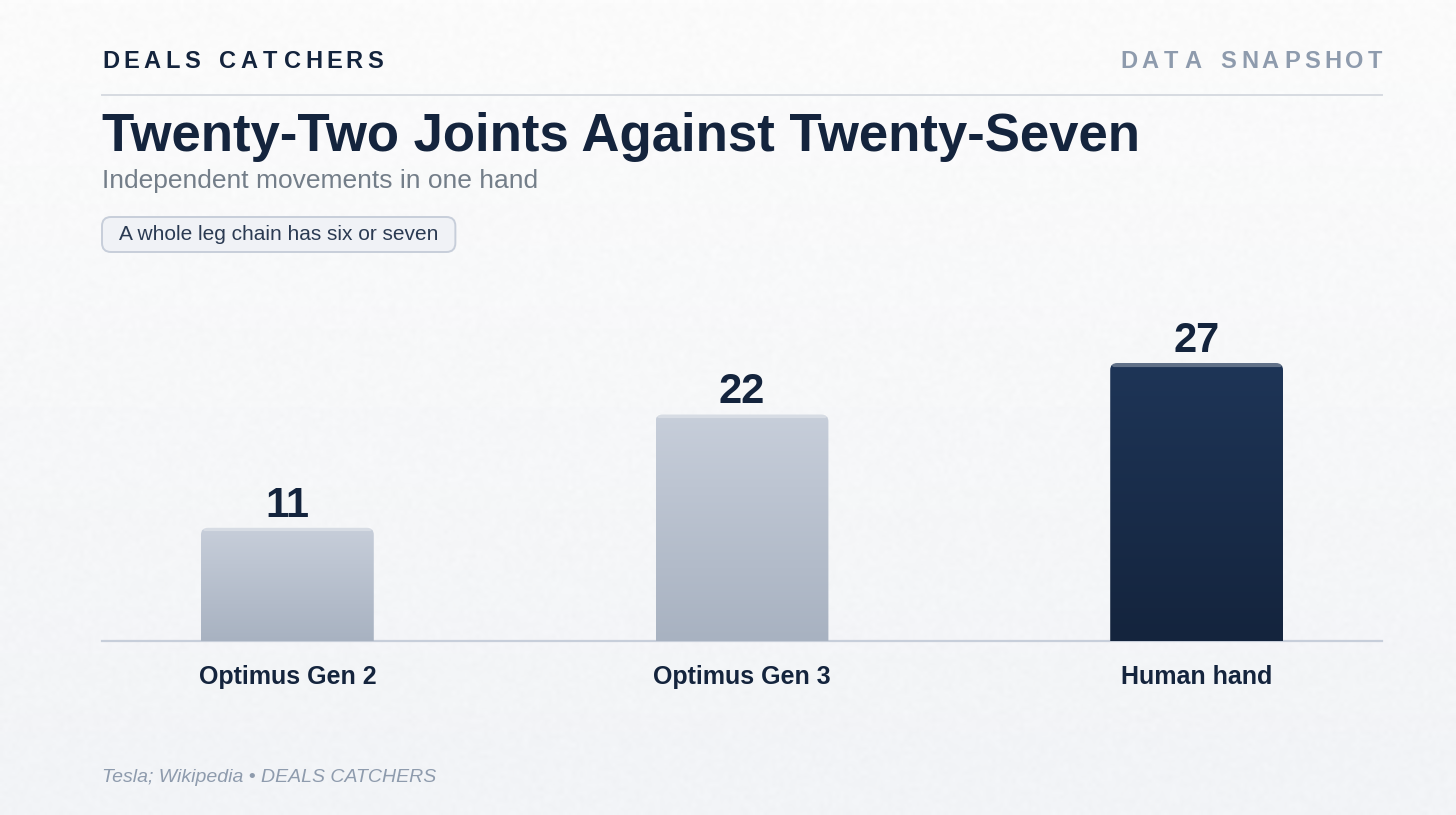
A human hand has roughly 27 degrees of freedom — meaning 27 independent ways it can move, each requiring its own control. The current Optimus hand has 22, up from 11 in the previous generation, driven by around 50 actuators. For comparison, an entire leg has six or seven. One hand carries three to four times the control complexity of a whole limb.
And the hand has to do all of that while weighing almost nothing. A human hand manages more than 20 joints, distributed touch sensing across the whole surface, and grip forces above 400 newtons, at roughly 0.4 kilograms. Every gram you add to a robot's hand is a gram the arm has to accelerate and the battery has to move.
The performance gap this produces is stark, and it is the number worth remembering.
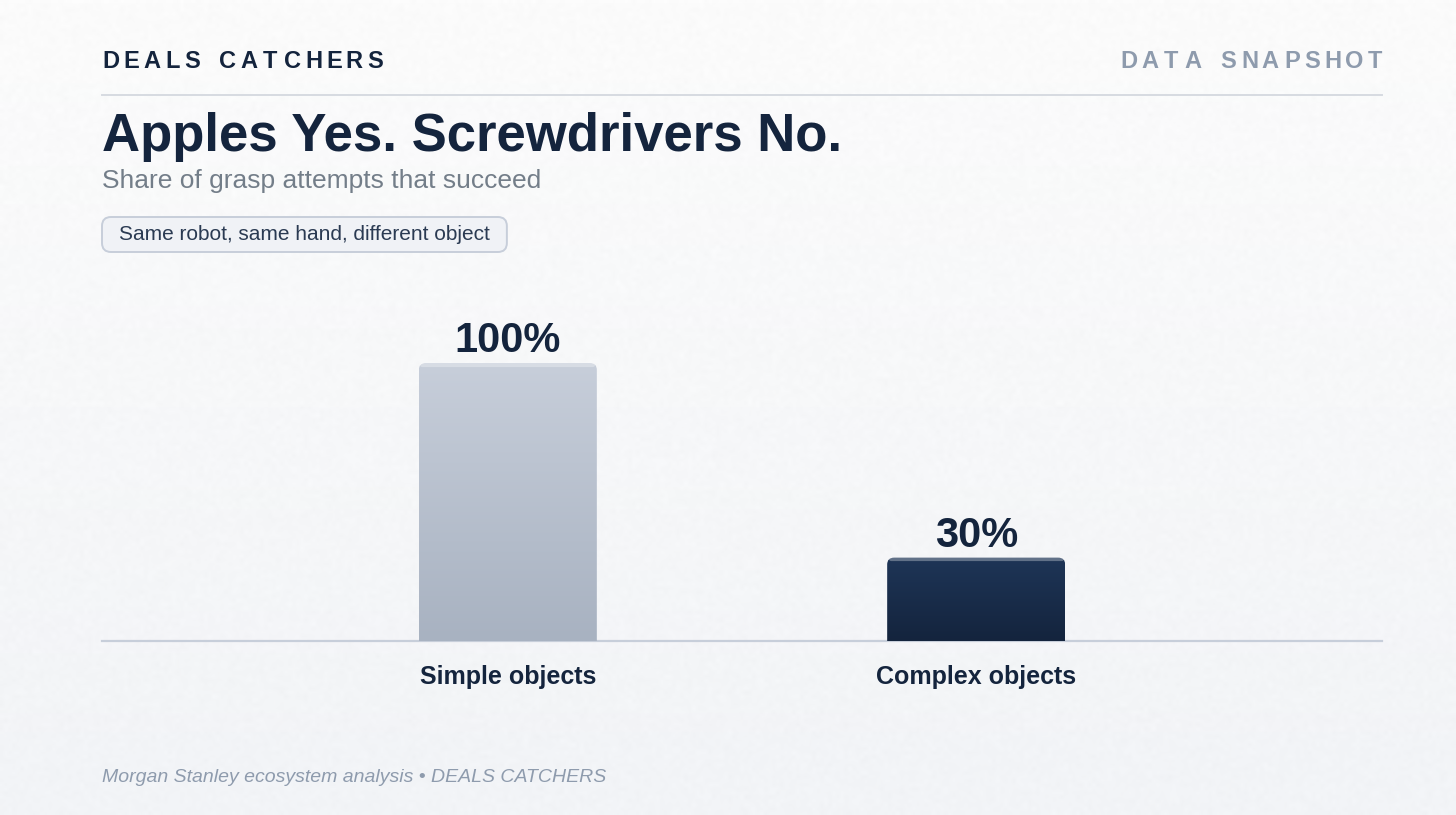
Humanoids pick up apples and tennis balls almost every time. Give the same machine a spoon, a screwdriver or a pair of scissors and success falls to around 30%. Those objects are thin, rigid, oddly balanced and meant to be held in one specific way. A robot that fails two times in three on a screwdriver is not a robot you put on a production line.
Touch is the other half of it, and it scales badly. Cameras get cheaper and better on a predictable curve. Tactile sensors do not — fewer than half of purpose-built humanoid hands have fully integrated touch sensing, and those that do tend to give up payload, speed or manufacturability to get it. You are not choosing how much to spend. You are choosing what to sacrifice.
There is a second reason the hand resists brute force, and it is anatomical. The human version does its work with muscles that sit in the forearm, pulling on tendons that run through the wrist. That keeps the weight off the fingers. Copy the arrangement and you inherit the complexity: thin cables routed through a joint that also has to rotate, each one a new thing that stretches, frays or slips.
This is why the hand is where the money quietly went. Palm cameras, fingertip sensor arrays, actuators relocated into the forearm and pulled by tendon cables so the heat and bulk sit somewhere else. Those read as small engineering tweaks. They are attempts to stabilise the subsystem that fails most.
For anyone weighing the humanoid story as an investment rather than a spectacle, that reframes the question. The demonstrations you see are chosen to show what already works. The constraint sits in a subsystem that is hard to film, and Goldman Sachs putting the humanoid market at $38 billion by 2035 depends entirely on somebody solving it.
Green coffee has fallen a quarter from its peak. Your grocery bill has not.
Arabica futures — the benchmark contract for the beans behind most of what Americans drink — traded at $3.28 a pound in mid-August. The record was $4.41 in February 2025. So the raw commodity is down roughly 26% from the top.
Now the shelf.
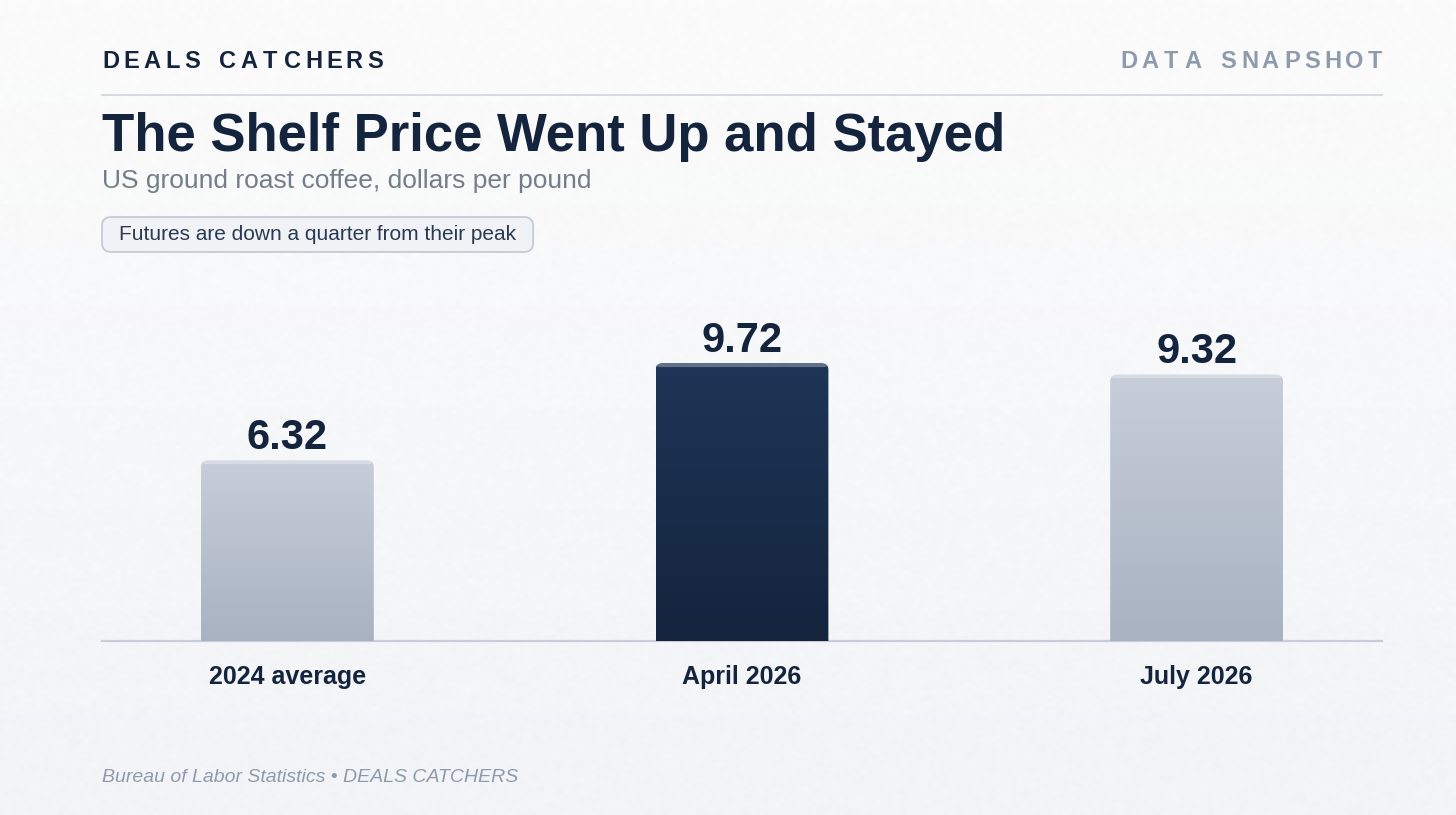
A pound of ground roast averaged $9.32 in July, according to Bureau of Labor Statistics data published on 12 August. That was down 1.5% from June, the first genuine month-over-month easing since April's record $9.72. Set that against the full-year 2024 average of $6.32 and you have a 47% increase that has barely started to reverse.
The mechanism is not a conspiracy. It is contract length and inventory. Roasters buy green coffee months forward, so today's shelf price reflects beans purchased when the market was near its highs. Packaging, freight and labour all rose alongside. And retail pricing is famously asymmetric — costs pass through to the consumer quickly on the way up and slowly on the way down, because nobody has to explain a price cut they did not make.
Supply is genuinely improving. The USDA forecasts record global output of 178.8 million bags this season, helped by recovery in Vietnam and record harvests in Indonesia and Ethiopia. The World Bank expects arabica to fall another 13% this year and 5% next.
But look at the stocks number underneath that, because it is the one that keeps this interesting. Global ending inventories are projected to drop to around 20.1 million bags even with record production. A market can grow its harvest and still have nothing in the warehouse, and that is a market where one bad season in Brazil undoes the entire forecast.
Colombia sits at the centre of the American side of this. It is the world's second-largest arabica producer and supplies roughly 30% of US coffee imports, with about 93% of what it grows going abroad. When Washington threatened Colombian goods with tariffs last year, arabica futures set a record within days.
One more number belongs in the picture. In Colombia the farmgate price — what the grower actually receives — stood at about $3.72 a kilogram in August, up 23.5% on the year. So the person growing the beans is getting more, the person buying the futures is paying less than a year ago, and the person at the till is paying nearly half again what they paid in 2024. Three prices, three directions, same crop.
If you drink coffee, the practical read is that the easing has begun and will be slow. If you are looking at the industry as an investment, the interesting position is not the bean — it is whoever owns the distance between $3.28 and $9.32.
Worth knowing
The market closes for 65 hours every weekend and the world does not. From Friday's 4pm bell to Monday's open, your positions are frozen and everything else keeps moving — central bank comments, geopolitical events, company announcements timed deliberately for Friday evening.
That gap has a name. A weekend gap is when Monday's opening price differs from Friday's close, and it happens because the price could not adjust while the market was shut. All the repricing that would normally happen gradually across three days arrives at once, in the first seconds of Monday trading.
Two consequences follow, and they point in opposite directions.
Stop-loss orders — instructions to sell automatically if a price falls to a set level — do not protect you across a gap. If you set one at $50 and the stock opens Monday at $42, you sell at $42. The instruction executes at the first available price, not at the price you chose. That surprises people who believed they had a floor.
The reverse is also true. A stock that gaps up gives you nothing to act on either, and anyone who was waiting to buy on a dip watches the dip happen while they are asleep.
This week that matters more than usual. The August jobs report lands Friday morning, and the next Federal Reserve decision is on the 15th and 16th. Whatever Friday's number says, the market gets three days to think about it before anyone can trade on the thought.
What's scheduled
Friday — August jobs report. The first of the two numbers that decide the September meeting.
Next week — August CPI.
15–16 September — the Federal Open Market Committee meets.
After Warsh spoke at Jackson Hole, the market moved the odds of a September rate rise from roughly 35% to about 60% on a speech that promised nothing at all. He gave no forward guidance and published no reaction function, which is precisely why those two releases now carry the whole decision.
Core PCE — the inflation gauge the Fed actually targets, rather than the headline CPI most people see quoted — ran at 3.3% in July against 2.8% in February. The two-year Treasury yield sits near 4.34% after jumping eleven basis points, that is eleven hundredths of a percentage point, on the day of the speech. The thirty-year barely moved.
That split is the most useful thing on the screen. Short rates price what the Fed does next. Long rates price whether it works. Traders raised their bet on a hike and left thirty-year inflation expectations almost alone, which reads as a market that believes action is coming and believes it will be enough.
One number
30% — the share of attempts in which a humanoid robot successfully grasps a complex object like a screwdriver or a pair of scissors. On simple objects it is close to 100%, and the difference between those two figures is the whole industry.
Forget the hot picks — protect what you've already built, and find out which subsystem actually gates the story before you buy the story. Because the best trade you'll ever make is the loss you never took.
- Mike Lee
Thanks for reading. See you tomorrow.