Sperm Oil Was $1.40 a Gallon. Kerosene Arrived at 75 Cents.

 |
6 SEPTEMBER 2026
 By Mike Lee
sponsored What Happened to the Whalers |
Editor’s Note: Make time for this today – Porter’s explosive new documentary exposes the President’s plans to replace the U.S. dollar. If you have retirement savings, a stock portfolio, or a family depending on you financially, you need to watch it right now. In the early 19th century, whale oil was among the most valuable commodities on Earth. It lit the lamps of America. It lubricated the machines of the Industrial Revolution. Entire coastal economies like New Bedford, Nantucket, and New London thrived because of it. The scarcity was real. Whales were finite after all – and the expertise to hunt them, process them, and bring the oil to market took decades to develop. That scarcity underpinned an entire monetary ecosystem. Then in 1859, Edwin Drake struck oil in Titusville, Pennsylvania. Kerosene arrived. It was cheaper, more abundant, and much more powerful. The whalers didn’t disappear overnight. The compression was gradual – and then suddenly catastrophic. Within two decades, the whaling industry had effectively collapsed. The scarcity hadn’t disappeared. It had migrated. And the fortunes built on whale oil migrated with it – to the men who understood where scarcity had moved. This is what another great repricing looks like. A friend of mine, financial writer Garrett Baldwin, has a phrase for what happens to the people who don’t move in time. He calls it the “flooding layer.” Every time the scarcity underpinning an entire industry evaporates, it creates two groups of people: those who own the new chokepoint, and those standing in the flooding layer – watching everything they built get washed away. The brutal truth is that the people in the flooding layer almost never see it coming. Porter Stansberry believes we are living through the most ambitious monetary reset in modern history – and that this is where scarcity is migrating. He calls it Trump’s Silicon Dollar. The full case is laid out in my new briefing.  |
Three Numbers From a Week of Repricing
$1.40 | what a gallon of sperm oil cost in 1860. Kerosene was 75 cents. Within a decade kerosene was 26. |
289 | tonnes of gold central banks bought in the second quarter, a record, while the price fell 16%. |
74% | of reserve managers who expect to hold fewer dollars within five years. 89% expect to hold more gold. |
ad The scarcity hadn’t disappeared. It had migrated. And the fortunes built on whale oil migrated with it. Get the full story here |
Sperm Oil Was $1.40 a Gallon. Kerosene Arrived at 75 Cents.
New Bedford’s whaling fleet peaked in 1856 at 329 vessels out of an American total of 593, employing more than 10,000 men. Whaling was the fifth-largest industry in the country. The town was, by some measures, the richest per head in the world.
Then on 27 August 1859, a former railroad conductor named Edwin Drake hit oil at 69 and a half feet outside Titusville, Pennsylvania. His backers had already written to tell him to stop and come home. The letter arrived after the strike.
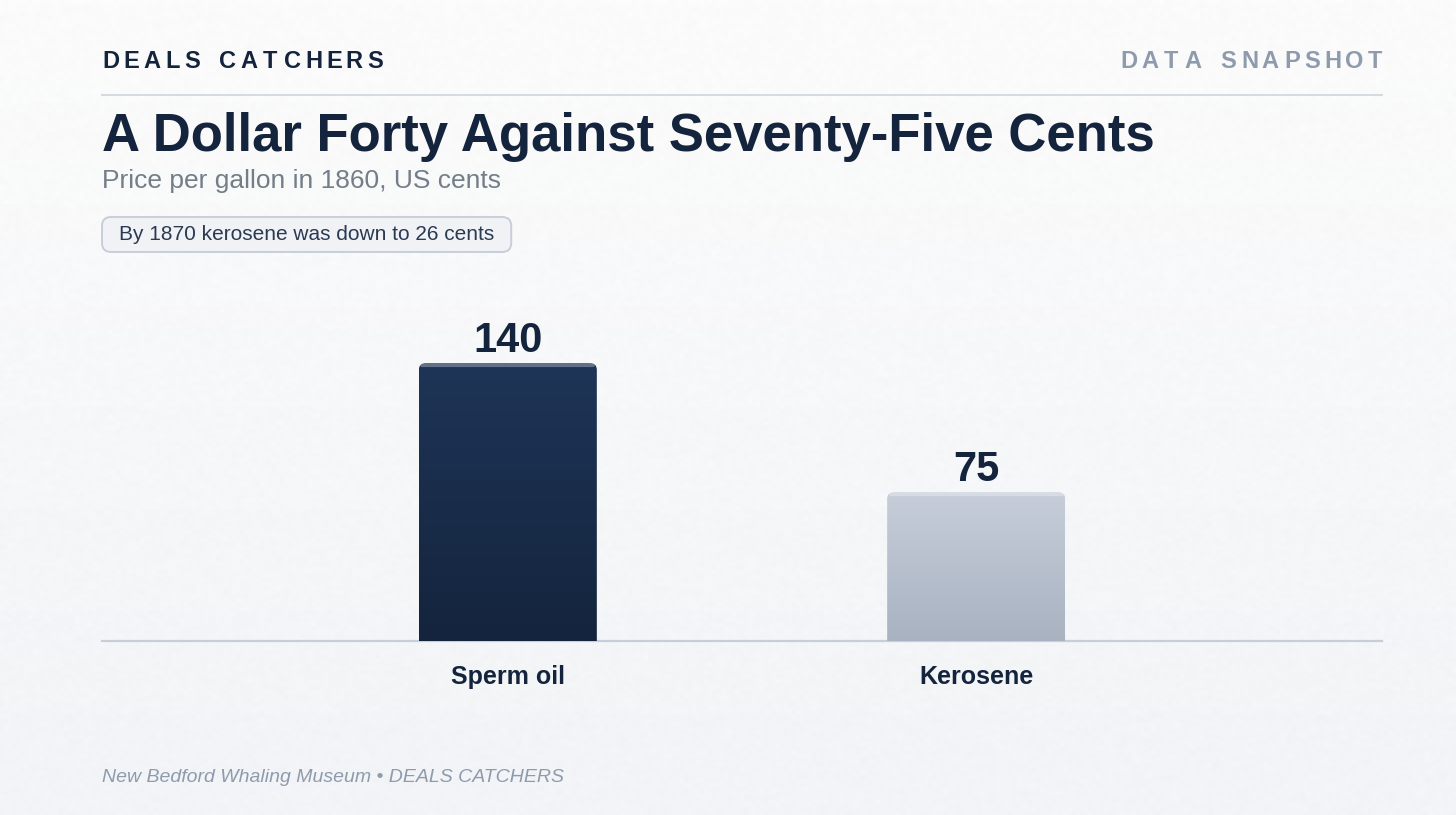
By 1860 sperm oil sold for $1.40 a gallon and kerosene for 75 cents. That gap alone would have been survivable. What followed was not. Kerosene fell to 58 cents by 1865, 26 cents by 1870, and as low as 8 cents in the decade after that.
American crude output went from roughly 2,000 barrels in 1859 to more than 20 million barrels a year by the 1870s. Titusville went from 250 people to nearly 10,000.
Here is the part the tidy version of this story usually leaves out, and it matters.
Whaling was already in trouble before Drake drilled. Whales near North America had been hunted out, so voyages ran longer and cost more. The catch per unit of effort for American whalers fell from 0.179 in the 1850s to 0.111 by the 1870s — more ships, more men, fewer whales. Coal oil and vegetable oils were already taking share. Kerosene was the final blow to an industry that had been weakening for a decade.
That sequence is the useful part. The substitute did not create the vulnerability. It found one that already existed, and then finished the job quickly enough that the people inside the industry never got a decision point that felt urgent until it was over.
Notice also who captured the new value. Not the whaling families, who had capital, expertise and a century of relationships in exactly the business of extracting and selling lamp fuel. The money in kerosene went to people in Pennsylvania who had never been to sea. Domain expertise in the old thing turned out to be worth nothing in the new one, because the constraint had moved from hunting to drilling and refining.
New Bedford kept sending ships. The last one sailed in 1927, sixty-eight years after Drake. By then whale oil was a specialty product for a handful of industrial uses and the capital had long since gone to Pennsylvania.
Central Banks Bought a Record 289 Tonnes While the Price Fell 16%
In the second quarter of this year the gold price had its worst quarter since 2013, down about 16% from the first quarter’s elevated levels.
Central banks responded by buying more of it than in any quarter on record.
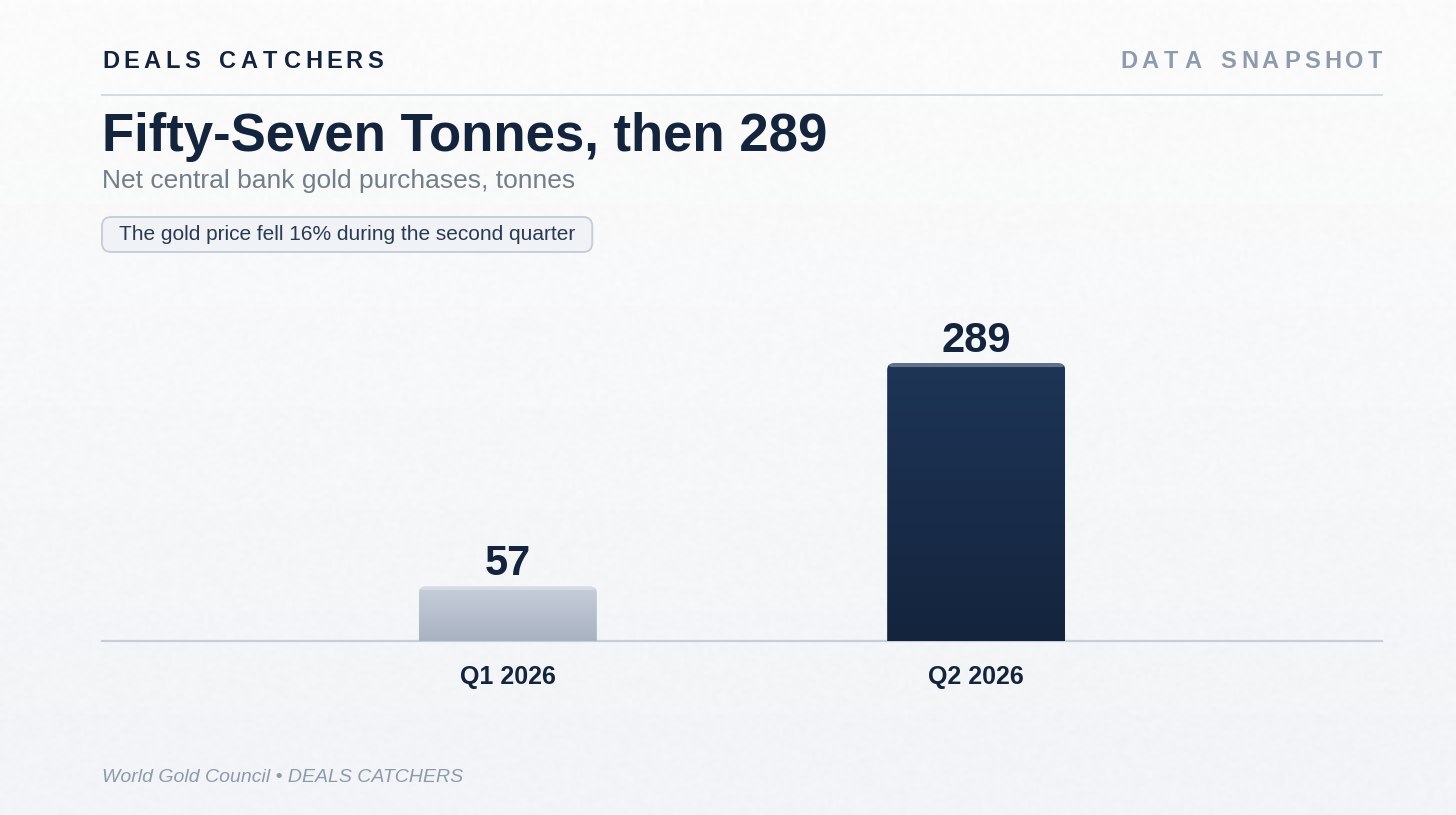
Net purchases came to 288.9 tonnes, according to the World Gold Council’s Gold Demand Trends report published on 30 July. That is up about 62% on the same quarter last year, and more than five times the revised first-quarter figure of 57 tonnes.
Poland led with 51 tonnes, taking its holdings to 632. China added 33, its largest quarterly purchase since late 2023, lifting reserves to 2,346 tonnes. Uzbekistan took 16, Kazakhstan 15, Jordan and the Czech Republic six each.
Buying more of something because it got cheaper is ordinary behaviour for a long-term allocator and unusual behaviour for a market participant. A hedge fund cuts a losing position. A central bank with a fifty-year horizon does not have a stop-loss.
The selling side is worth reading too, because it says something different from what it appears to say. Russia sold 22 tonnes and Turkey and Azerbaijan also reduced holdings — but those were budget decisions rather than views on gold. Strip out the forced sellers and the underlying appetite is stronger than the headline half-year figure of 345 tonnes suggests.
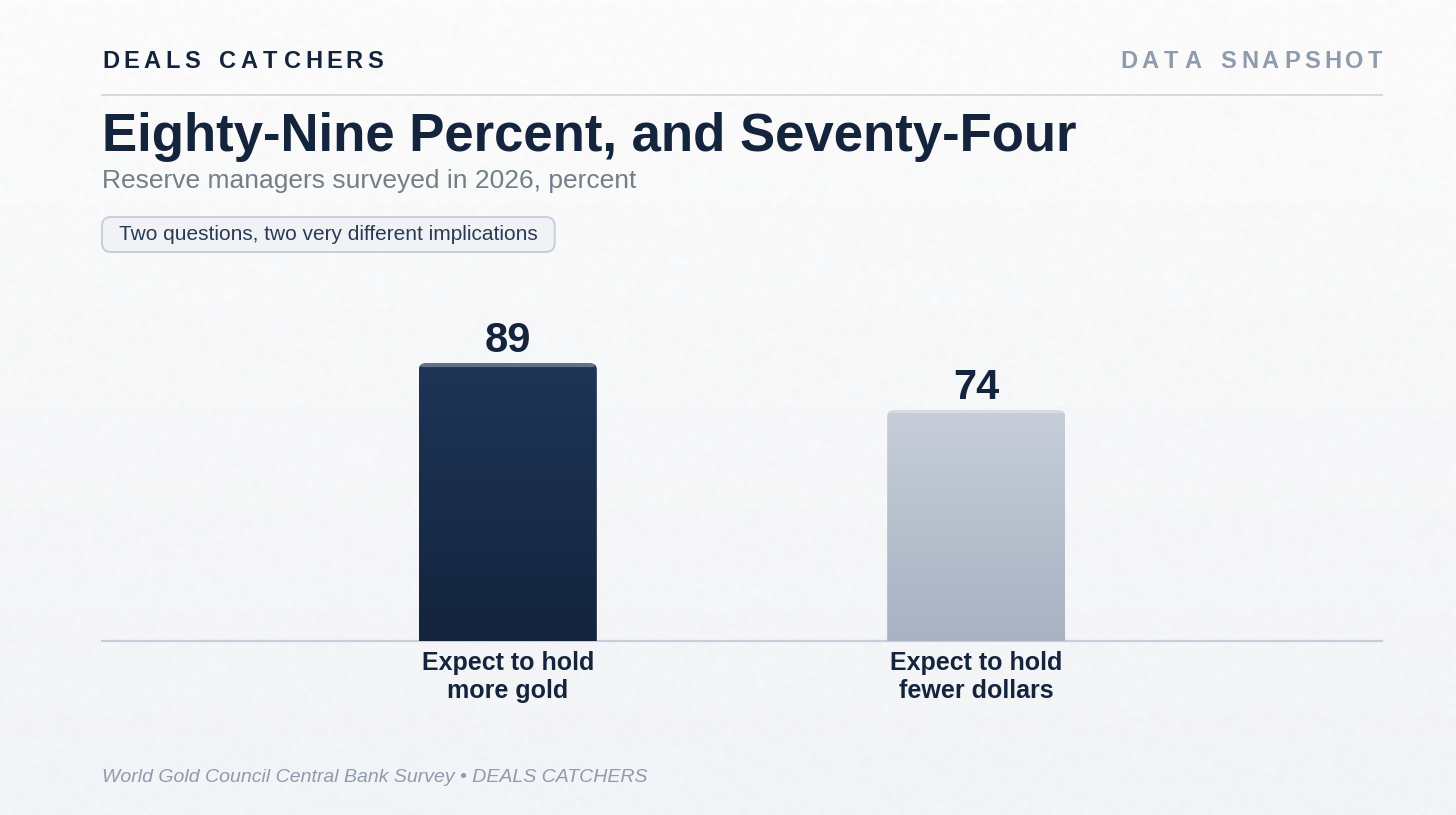
The Council’s annual survey of reserve managers found 89% expect global gold holdings to rise over the next twelve months, and 74% expect to hold fewer dollars within five years.
Those two numbers describe intentions rather than transactions, and intentions in surveys are cheap. But the purchase data has now run at roughly a thousand tonnes a year for four consecutive years, double the pace of the preceding decade. That is not a survey. That is a decade-long reallocation showing up in the ledger.
There is a second reading worth taking from this quarter, and it is about what a price signal means when the buyer does not care about price. Roughly a thousand tonnes a year of purchasing that does not slow when the market falls puts a floor under demand that has nothing to do with sentiment. It also means the price tells you less about the metal than it usually would, because a meaningful share of the bid is not responding to it.
For an individual, the practical read is narrower than the headline suggests. Central banks buy gold to reduce counterparty and sanctions risk on reserves they cannot easily move. A household holds gold for a different reason and pays custody costs a central bank does not. The behaviour is informative. It is not a template.
sponsored A Formerly Classified Document From 1974 |
Take a look at this formerly classified document. Most people, professionals included, have never heard of it… But it’s been quietly protecting the value of your savings, your retirement, and every dollar in your wallet for the last 50 years. Created under Henry Kissinger in 1974… It had a name only Washington could love: The U.S.–Saudi Arabia Joint Commission on Economic Cooperation. And this little-known arrangement helped anchor one of the most important financial relationships on earth: Saudi oil… U.S. dollars… And America’s ability to fund its power. For half a century, it helped tie global oil trade to the U.S. dollar… keeping demand for dollars artificially high… And protecting the purchasing power of every American who ever saved money, owned a home, or built a retirement account. On June 9, 2024… It ended quietly. Now, the war in Iran is shining a huge spotlight on its downfall. What comes next is a complete reset of the dollar system — one that could hit your money from every direction. Stocks crushed 40% to 80% in real terms. Real estate cut in half as buyers vanish. Inflation grinding at 10% to 15% — month after month, year after year. Please understand – if you own stocks, bonds, real estate, cash, or a retirement account tied to the U.S. dollar… you need to read this short presentation now. It could be the difference between being blindsided by the reset… and positioning yourself in the tiny group of gold stocks I believe could soar as the dollar system cracks. 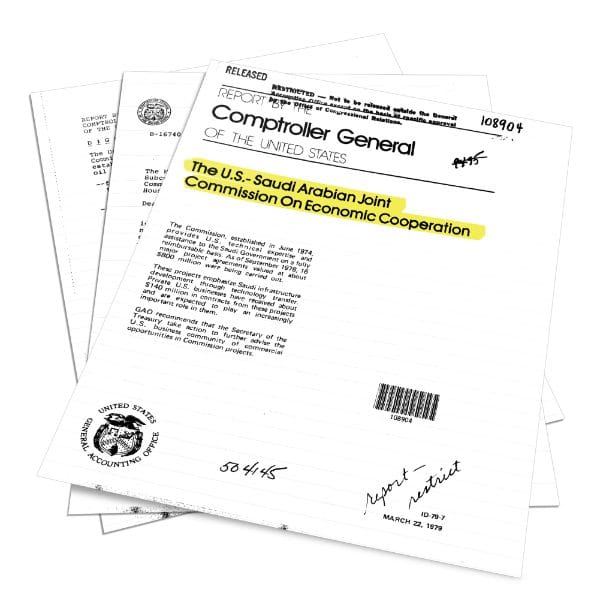 Garrett Goggin, CFA, CMT Lead Analyst and Founder, Golden Portfolio |
Financial Plumbing Takes Years to Replace, and the Dates Are Published
Banks are moving deposits onto blockchain rails. That much is happening and the names are large: Wells Fargo said this summer it would offer tokenised deposits to corporate clients this autumn, and BlackRock introduced two tokenised money market products last month.
What is worth understanding is how long this kind of change actually takes, because financial infrastructure moves on a timescale most coverage ignores.
Right now every one of those launches is an island. A token issued by one bank cannot be paid to a customer of another, which makes a tokenised deposit a faster ledger inside a single institution rather than a payment system. Connecting them is the hard part, and the industry has put a date on it: The Clearing House is building an interbank network with a reported target of the first half of 2027, with multinational corporations as the first users.
Set that against the scale of what actually sits on public chains today. Real-world assets total roughly $24 billion — triple where they stood at the start of 2023, and a rounding error against a $27 trillion Treasury market. Tokenised money market funds are around $8.7 billion. Tokenised Treasuries about $6.7 billion.
Forecasts for 2030 range from $2 trillion to $16 trillion depending on which consultancy you ask, and a spread that wide tells you the direction is agreed and the magnitude is a guess.
The regulatory clock runs alongside. Stablecoin licensing, capital and custody rules under last year’s legislation carry deadlines through this year, and the broader market-structure rules from the SEC and CFTC are expected to bite in late 2026 or 2027. Firms are being told to classify assets and prepare for registration now, before the framework is fully live.
The 2027 date is worth diarising for a reason that has nothing to do with owning anything. Interbank settlement is the layer where bank costs actually sit, and a working network changes the economics of correspondent banking, foreign exchange margins and the float that institutions earn on money in transit. Those are large, boring revenue lines, and they belong to the banks whose shares plenty of readers already hold in an index fund.
The distinction that matters for anyone holding assets: tokenisation changes how something moves, not what it is worth. It cannot create liquidity where none exists, and it does not turn a wrapper into the thing it tracks. What it does change is settlement speed and operating cost, and those show up in bank margins long before they show up in anything a household notices.
sponsored The Fuel That Powers Every Transaction |
Editor’s Note: As the co-founder of Meridian Capital and co-creator of APP digital asset platform, veteran tech investor Andy Howard has helped over 23k people (from 128 countries) navigate nearly every market cycle. Today, he’s identified a potential explosive opportunity in the scarce fuel powering Trump’s New American Money Grid. The same infrastructure BlackRock, JPMorgan, and Vanguard are already betting billions on. Click here to get the trade or read below. While everyone else is fawning over Elon’s next IPO which may or may not live up to the hype… BlackRock, JPMorgan, Goldman Sachs and Fidelity are hoarding shares of one specific scarce resource. And for good reason. It’s the fuel that powers every transaction on Trump’s new $382 trillion Money Grid. If you haven’t been paying attention, I’ll catch you up to speed. President Trump recently signed into law a total overhaul of America’s financial infrastructure. BlackRock CEO Larry Fink calls it “the next major evolution in market infrastructure.” By law every bank account, every stock trade, every wire transfer in America must run on this new digital infrastructure by April of 2027. And one scarce resource fuels the entire infrastructure. Right now, $909 billion is migrating onto Trump’s new money grid… Every. Single. Day. That’s the entire GDP of Switzerland, moving onto new digital rails daily. This isn’t something that might happen. This is happening. The new digital Money Grid is being built right now — in fact $3 trillion already lives on these new digital rails. $382 trillion on the grid by April 2027. That’s a 12,000% increase in demand. And historically speaking, when supply can’t keep up, prices don’t slowly creep up — they surge. |
CPI Lands This Week and the Fed Has No Framework
This wk | August CPI. The second of the two numbers that decide the meeting. |
15–16 | September — the Federal Open Market Committee meets. |
70% | the market’s odds of a rate rise, up from 35% two weeks ago. |
Friday’s jobs report has landed and the case for a September move was never really being made on the labour side. It is being made on prices, which puts this week’s CPI in an unusually decisive position.
Core PCE — the inflation gauge the Fed actually targets, rather than the headline CPI most people see quoted — ran at 3.3% in July against 2.8% in February. The ten-year Treasury sits near 4.79%, its highest since early 2025, and the long end has now started moving alongside the short end rather than shrugging.
Warsh has published no reaction function and given no forward guidance, so there is no framework against which to test whatever the number says. The market will price the response itself, in the minutes after the release.
ad Every time the scarcity underpinning an entire industry evaporates, it creates two groups of people. Get the full story here |
From $1.40 a Gallon to Eight Cents
8¢ | what a gallon of kerosene cost by the 1870s, against $1.40 for sperm oil in 1860. The whalers had capital, expertise and a century of relationships. None of it transferred, because the constraint had moved from hunting to drilling. |
Forget the hot picks — protect what you’ve already built, and watch what the patient buyers do when the price falls rather than what the loud ones say when it rises. Because the best trade you’ll ever make is the loss you never took. Mike LeeDeals CatchersThanks for reading. See you tomorrow. |
Forwarded this? Get it every morning. |