SpaceX Went Public Today, Kevin Warsh Now Runs the Fed, and Immersed’s $0.79 Round Is Closing

Three stories define this week for retirement investors, and they pull in very different directions. SpaceX went public this morning. Kevin Warsh was sworn in as the new chair of the Federal Reserve a few weeks ago, and the market is still digesting what his “regime change” approach means. And a pre-IPO AR/VR company, Immersed, is closing a round at $0.79 a share. Three advertisers tie into these threads — their copy runs as written, with our editorial notes separating what’s verifiable from what’s marketing.

What SPCX’s Debut Actually Tells Pre-IPO Investors
SpaceX’s first day is a useful real-time lesson for anyone weighing pre-IPO offerings like Immersed. SPCX priced at $135, opened at $150, and closed near $161 — a strong debut, up roughly 19% from the IPO price. But notice what that means in practice: the investors who captured that 19% on day one were the ones who held shares before the opening bell. A retail buyer who bought at the $176 intraday high was already underwater by the close. That’s the recurring pattern of hyped IPOs — the asymmetric gains accrue to pre-IPO holders, and day-one chasers carry the most risk. It’s exactly the dynamic that makes pre-IPO rounds appealing in theory, and exactly why the structure and price of any specific pre-IPO offering deserve careful scrutiny.
What this means for your retirement accounts: SPCX’s 19% pop is the pre-IPO thesis made visible — but it’s also a reminder that a strong debut for one company says nothing about whether any other pre-IPO offering is fairly priced. Immersed at $0.79 is a completely separate, much earlier-stage, far higher-risk bet than owning pre-IPO SpaceX shares ever was.
Immersed: Real Traction, Real Reg A+ Risk
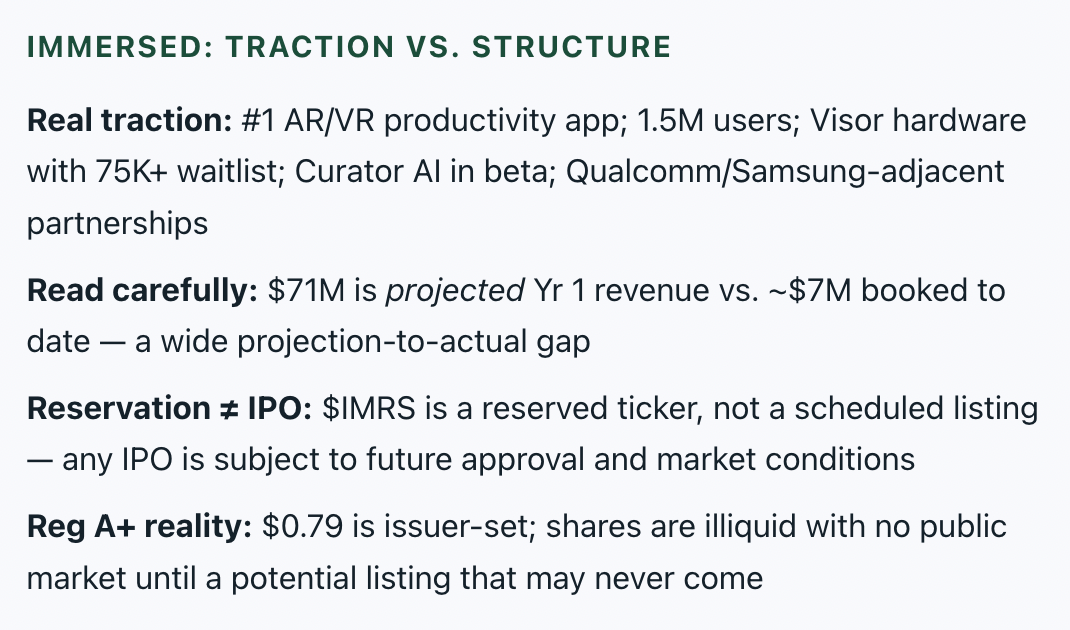
Immersed’s claimed traction is specific and, in its product metrics, genuine: the #1 productivity app in AR/VR, 1.5 million users on Apple and Meta headsets, its own Visor hardware with a 75,000-person waitlist, a Curator AI assistant in beta, and partnerships in the orbit of major hardware names. The pitch frames it as software, hardware, and AI in one pre-IPO entry. What a careful reader separates out: the “$71 million” is projected first-year revenue against roughly $7 million booked to date — a large gap between projection and actuals. The $IMRS Nasdaq ticker is reserved, which is not the same as a scheduled IPO. And the $0.79 share price is set by the company under Reg A+, with no public market and full illiquidity until any potential listing.
What this means for your retirement accounts: Immersed is a real company with real product adoption, not vaporware. But a $0.79 Reg A+ share sits at the high-risk end of the spectrum — illiquid, issuer-priced, and IPO-dependent. For most retirement savers, a position here belongs only in a small speculative sleeve, if at all, sized so that a total loss wouldn’t matter to the core plan.
The Bigger Force Moving Every Market: A New Fed Chair
Underneath every individual trade this week sits a larger shift: the Federal Reserve has a new chair. Kevin Warsh was sworn in on May 22, 2026, succeeding Jerome Powell after one of the most divisive confirmation votes in modern history (54–45). Warsh is a genuine break from the recent Fed — he has openly called for “regime change” at the central bank, and President Trump has made clear he expects a more aggressive path on rate cuts. That’s a real, consequential development with real implications for bonds, the dollar, gold, and equity valuations. The next advertiser builds on this reality — though, as you’ll see, it wraps the genuine event in some considerably larger numbers.
What this means for your retirement accounts: A change in Fed leadership genuinely can move every asset class, because the Fed sets the price of money. That part is not hype. The discipline is to separate the real macro shift — a new, more dovish-leaning chair — from any specific prediction about exactly how many trillions will move where, which no one can know in advance.
Trump’s Fed Takeover: The $7 Trillion Money Migration
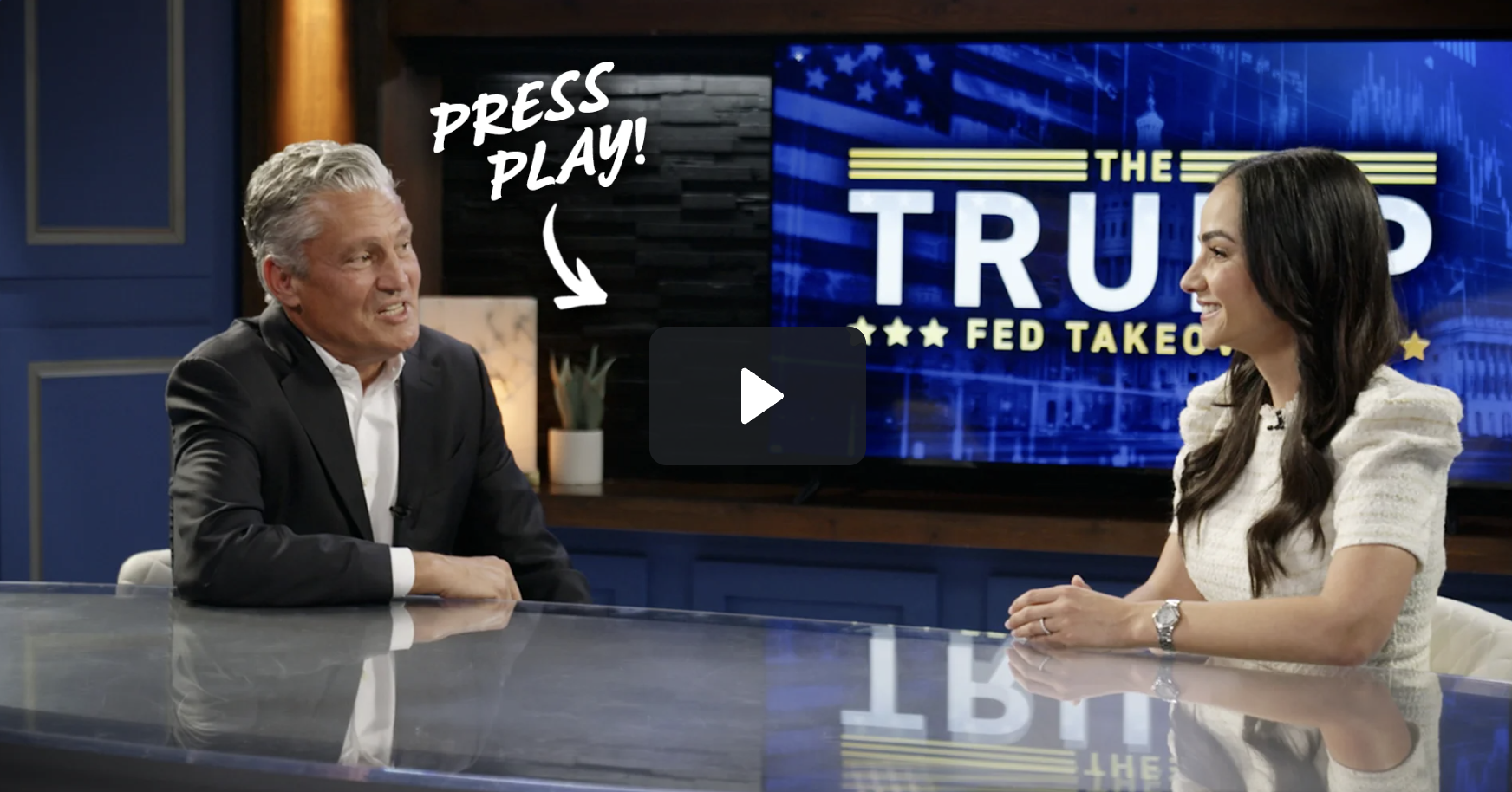
No president in history has moved the financial markets quite like Donald Trump. We saw it with the Stargate AI announcement. We saw it with banking deregulation. But his latest move is on a completely different scale.
Trump is taking over the Federal Reserve.
By appointing a new, radical Fed chief, he is forcing a complete regime change. Wall Street is in total confusion, calling it the “Warsh Shock.” Just the announcement alone wiped $7 trillion from global markets in 48 hours and caused gold and silver to make historic moves.
“Volatility doesn’t destroy wealth. It just moves it from one place to another.”
— Larry Benedict, 40-year trading legend
Trillions of dollars are moving right now. If you don’t know where that money is headed, your portfolio is a sitting duck. But if you know the pattern, this could be the clearest window to make game-changing money in the next 20 years.
| Watch the Briefing — See Where the Money Is Flowing → |
Separating the Warsh Reality From the “$7 Trillion” Framing
This pitch is a good case study in mixing the real with the inflated. What’s real: Kevin Warsh is the new Fed chair, he genuinely has used the phrase “regime change” about the central bank, Trump genuinely pushed hard for his appointment and for lower rates, and a leadership shift at the Fed genuinely matters for every asset class. What’s the advertiser’s framing: “Trump is taking over the Federal Reserve” overstates it — Warsh was Senate-confirmed and, at his swearing-in, Trump publicly said he wanted him “totally independent.” The specific claims of “$7 trillion wiped in 48 hours” and a market event called the “Warsh Shock” are dramatic figures that aren’t established fact — they’re the marketing’s amplification. Larry Benedict’s underlying point about volatility moving wealth rather than destroying it is a reasonable trader’s observation; the “clearest window in 20 years” is salesmanship.
What this means for your portfolio: Forget the hot picks — protect what you’ve already built. A new Fed chair is a real reason to review your bond duration, your rate-sensitive holdings, and your overall allocation — calmly, not in a panic. The genuine takeaway is “a regime change at the Fed warrants a portfolio review,” not “trillions are moving this instant, act now.”
Three products. One company.
Immersed is building a three-vertical platform — software, hardware, and AI — around the #1 productivity app in AR/VR, with 1.5 million users, a Visor headset with a 75,000-person waitlist, and a Curator AI assistant in beta. Its Reg A+ round is at $0.79/share with a reserved $IMRS Nasdaq ticker, $7M revenue to date against $71M projected. High-risk, early-stage, and closing soon.
The IPO Happened. The $0.52 Round Is Still Open.
Now that SPCX is publicly trading, the “get in before SpaceX” window is objectively closed — the company is public, the price is set by the market, and the day-one pop has already happened. That reframes the third advertiser’s pitch. Mode Mobile is a separate pre-IPO company — profitable, with $11.8 million in actual 2025 EBITDA, 490 million users on its EarnOS platform, and Deloitte’s #1 fastest-growing software ranking in North America — offering shares at $0.52 entirely outside the SpaceX trade. The advertiser’s framing is that SpaceX made the noise while Mode quietly stays open at fifty-two cents. With SPCX now trading near $161, that contrast is sharper than ever: one window has closed, and a very different, much-earlier-stage one remains open.
Why “Still Open” Doesn’t Mean “Better”
It’s worth being clear-eyed about what the Mode pitch is and isn’t. “Still open at $0.52” is a real fact, and Mode’s profitability genuinely sets it apart from most pre-IPO offerings, which burn cash. But “still open” is not the same as “better than SPCX” — it’s a different instrument with different risks. SPCX is now a liquid, publicly-traded megacap; Mode is an early-stage Reg A+ position that is illiquid, issuer-priced, and dependent on an IPO that’s reserved but not scheduled. The profitability is a genuine point in its favor; the illiquidity and execution risk are genuine points to weigh against it. Neither the closed window nor the open one is automatically the right move — they’re simply different.
Bottom Line
Three setups, three different things to actually do about them. SpaceX went public today — SPCX priced at $135, opened at $150, and closed near $161, up roughly 19% in a record debut. Kevin Warsh was sworn in as Fed chair three weeks ago, a genuine regime change at the central bank that matters for every asset class. And two pre-IPO offerings sit on this page: Immersed at $0.79 and Mode Mobile at $0.52, each with real traction and real Reg A+ risk. The advertiser copy ran as written; the editorial job was to mark where the verifiable facts end and the marketing begins.
On the Immersed side, the traction is genuine — the #1 AR/VR productivity app, 1.5 million users, a Visor headset with a 75,000-person waitlist, a Curator AI in beta. But read the structure carefully: $71 million is projected first-year revenue against roughly $7 million booked to date, the $IMRS ticker is reserved rather than scheduled, and the $0.79 price is issuer-set under Reg A+ with full illiquidity until any listing. Real company, high-risk structure — a small speculative-sleeve position at most.
On the Warsh side, the new Fed chair is real and consequential, and Larry Benedict’s observation that volatility moves wealth rather than destroying it is a fair trader’s point. But “Trump is taking over the Fed” overstates a Senate-confirmed appointment that Trump himself framed as independent, and the “$7 trillion wiped in 48 hours / Warsh Shock” figures are marketing amplification, not established fact. The sound takeaway is modest and real: a regime change at the Fed is a reason to calmly review your rate-sensitive holdings, not to chase a “clearest window in 20 years.”
And on the Mode side, the SpaceX IPO genuinely happened today — which means the “get in before SpaceX” window is objectively closed, and SPCX is now a liquid public megacap near $161. Mode is a separate, profitable, early-stage pre-IPO company at $0.52, with the standard Reg A+ caveats: illiquid, issuer-priced, IPO reserved-not-scheduled. “Still open” is a real fact; it isn’t the same as “better.” Forget the hot picks — protect what you’ve already built. Read the offering circulars, weigh the structures honestly, size any speculative position so a total loss wouldn’t hurt the core, and decide where you stand before the calendar decides for you. Because the best trade you’ll ever make is the loss you never took.