SpaceX Is Public Now. The $0.52 Round Beside It, the Supplier Play Beneath It, and the Thesis Wall Street Isn’t Watching

With SPCX now trading, this week’s three advertisers all pivot to the same question: if the SpaceX headline window has closed, where does the opportunity go next? One says: a separate pre-IPO company at $0.52. One says: the supplier SpaceX now visibly depends on. And one, from a veteran futurist, says: a wafer-scale computing thesis that has nothing to do with SpaceX at all. Their copy runs as written; the editorial notes mark where the verifiable facts end and the marketing begins.

The Headline Window Closed Two Days Ago
The framing of this entire issue rests on a fact that’s now settled: SpaceX is public. SPCX priced at $135, opened at $150, and closed near $161 on June 12, a record debut up roughly 19%. That means the “get in before SpaceX” pitch that dominated the last several weeks is over — the company trades on the open market, and the day-one pop has already been captured by the investors who held shares before the bell. Every advertiser this week has adjusted to that reality. Mode Mobile’s pitch is that it’s the pre-IPO window that’s still open. The Jeff Brown pitch is that the real opportunity moved “one layer below,” to SpaceX’s suppliers. And George Gilder’s pitch sidesteps SpaceX entirely. The common thread: once the obvious trade is public and priced, attention shifts to the adjacent and the overlooked.
What this means for your retirement accounts: “The window closed” is genuinely true for the SpaceX pre-IPO trade — but be careful with how that fact gets used. The fact that one window closed does not, by itself, make any of the adjacent windows good. Each of the three needs to stand on its own merits, not on the borrowed urgency of the SpaceX headline.
Mode at $0.52: Profitable, Pre-IPO, and Genuinely Separate
Of the three, Mode is the most concrete because its numbers are verifiable and its profitability is unusual for a pre-IPO company. Mode operates the EarnOS platform, which pays users for everyday smartphone activity, and the figures hold up: 490 million users, $115 million+ in lifetime revenue, $11.8 million in actual 2025 EBITDA — not projected — and Deloitte’s #1 fastest-growing software ranking in North America. There’s even a real thread connecting it to the SpaceX story: as Starlink eliminates connectivity dead zones globally, the addressable market for a smartphone-rewards platform expands into regions traditional telecom never reached. The shares are offered at $0.52 under Reg A+, with the standard caveats — issuer-set valuation, illiquidity until any potential listing, and a reserved (not scheduled) $MODE ticker.
What this means for your retirement accounts: Mode’s actual profitability genuinely distinguishes it from the typical cash-burning pre-IPO pitch — that’s a real point in its favor. The risks are the standard Reg A+ ones: illiquidity, issuer-set pricing, and dependence on an IPO that’s reserved but not guaranteed. A reasonable framing is “profitable early-stage company, speculative-sleeve sizing,” not “last chance before it’s gone.”
The Layer Below: What the 10-K Just Made Visible
The second pitch makes a genuinely sharp observation: SpaceX going public didn’t just enrich insiders — it put the company’s financials on the public record for the first time. Its revenue, Starlink subscriber count, launch cadence, and supplier relationships are now visible in SEC filings in a way they never were as a private company. That visibility is the catalyst the pitch points to: the suppliers SpaceX depends on now have a newly public, multi-trillion-dollar customer whose order flow is documented. Wall Street, the argument goes, is busy reading SpaceX’s first 10-K; almost no one is reading its supply chain. Jeff Brown of Brownstone Research — with documented early calls on Nvidia and Tesla — says he identified the key supplier before the IPO.
What this means for your retirement accounts: The structural logic here is sound: a newly public megacap does make its supply chain more analyzable, and supplier order flow from a multi-trillion-dollar customer is a real thing to evaluate. The specific company is Brown’s gated research, and the “$20 billion insider / $1 billion IPO order” detail traces to a single Yahoo Finance article. The thesis is reasonable; the specific pick is one analyst’s, sold through a subscription.
Why “The Stock Hasn’t Reflected It Yet” Cuts Both Ways
The supplier thesis hinges on a claim worth examining: that the market hasn’t yet priced in the supplier’s SpaceX-driven order flow. Sometimes that’s genuinely true — markets do take time to connect a newly public company’s disclosures to its second- and third-tier suppliers, and that lag can be a real opportunity. But “the stock hasn’t reflected it yet” is also the single most common line in every undervalued-stock pitch ever written, and sometimes the stock hasn’t reflected it because the thesis is wrong or the order flow is smaller than claimed. The 30-day refund on the underlying subscription genuinely lowers the cost of finding out, which is a fair point in the pitch’s favor. But the discipline is to treat the supplier pick as a hypothesis to research, not a fact to act on because an ad said the window is closing.
What this means for your portfolio: Forget the hot picks — protect what you’ve already built. A supplier-order-flow thesis is researchable: once you have a name, you can check the actual customer concentration, the backlog disclosures, and the valuation yourself. That independent verification — not the ad’s urgency — is what should drive any decision.
The SpaceX play that doesn't require fighting for IPO day shares
SpaceX is public, but Mode Mobile is still pre-IPO at $0.52 — a profitable company with $11.8M in actual 2025 EBITDA, 490 million EarnOS users, and Deloitte’s #1 fastest-growing software ranking in North America. As Starlink eliminates connectivity dead zones, Mode’s addressable market expands into regions traditional telecom never reached. Reg A+ at $0.52, closing soon.
The Third Pitch Leaves SpaceX Behind Entirely
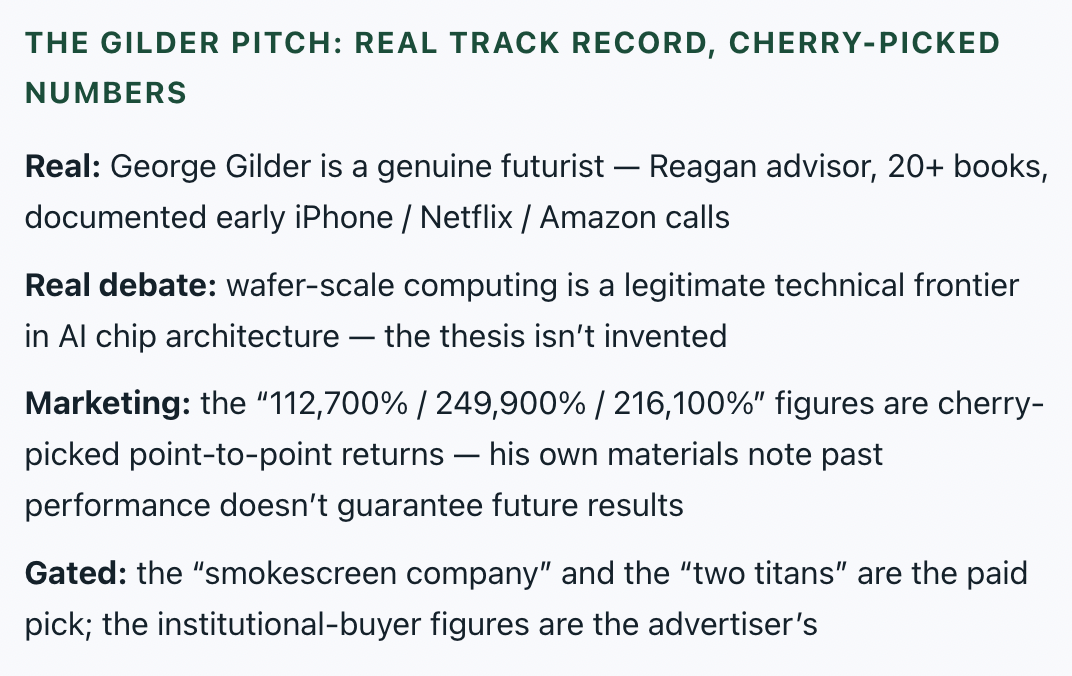
The final advertiser comes from George Gilder, a genuine veteran of technology forecasting — a Reagan-era advisor, author of more than twenty books, and someone with a documented history of flagging the iPhone, Netflix, and Amazon years before they became mainstream. His current thesis, which he markets as the “Trillion Dollar Triangle,” centers on wafer-scale computing: the argument that a small, under-the-radar chipmaker is testing technology that could make today’s AI data centers obsolete, while its visible “public” business serves as a kind of decoy. He frames it as a convergence of three companies. Gilder’s forecasting credentials are real and his wafer-scale thesis ties to a genuine technical debate about the limits of current chip architectures. The specific return figures in the pitch, though, are the cherry-picked, point-to-point kind that even his own marketing materials caveat.
How to Weigh a Futurist’s Pitch
A genuine track record like Gilder’s deserves real respect and real skepticism at the same time. The respect: he has, verifiably, identified transformative technologies early, and the wafer-scale-computing frontier he’s pointing at is a real one that serious chip engineers are actively working on. The skepticism: a list of past winners always omits the predictions that didn’t pan out, the eye-watering percentages are point-to-point peaks rather than typical investor outcomes, and “a company hiding its real business behind a public decoy” is a narrative device that makes any stock sound like a hidden treasure. The useful posture is to take the underlying technical thesis seriously enough to research wafer-scale computing yourself, while treating the specific stock pick and the return figures as the marketing layer they are.
One Company’s Been Hiding This in Plain Sight

One of the most important companies in the world right now is hiding behind a smokescreen. Its “public” business? A decoy. Meanwhile — right under Wall Street’s nose — it’s been testing a revolutionary technology that could make today’s AI data centers completely obsolete.
I’m George Gilder. I predicted Netflix in ’94, the iPhone in ’91, and Amazon in ’96 — years before the gains of 112,700%… 249,900%… and 216,100% followed. This could be bigger. MUCH bigger.
This company is one of three forming what I call the “Trillion Dollar Triangle” — a convergence that could end the data center era entirely. Nobody on CNBC is talking about it. But Vanguard ($101B), BlackRock ($82B), and Morgan Stanley ($17B) have quietly moved in. They see it. Most investors don’t. Not yet.
| See the “Smokescreen Company” and the Two Titans Converging With It → |
Bottom Line
SpaceX is public now — SPCX debuted June 12 at $135, closed near $161, up roughly 19%. That single fact reshapes all three pitches on this page, because the “get in before SpaceX” window is objectively closed. What’s left are the adjacent and overlooked plays: a pre-IPO company at $0.52, a supplier the public filings just made visible, and a wafer-scale-computing thesis from a veteran futurist. All three briefings are free or refundable to read; the discipline is to judge each on its own merits, not on borrowed SpaceX urgency.
On the Mode side, the standout fact is profitability: $11.8 million in actual 2025 EBITDA is genuinely unusual for a pre-IPO company, and the verifiable metrics — 490 million users, Deloitte’s #1 ranking, a reserved $MODE ticker — are real. The Starlink connectivity thread is a plausible tailwind. The risks are the standard Reg A+ ones: illiquid, issuer-priced, IPO reserved-not-scheduled. Profitable early-stage company, speculative-sleeve sizing — not “last chance.”
On the supplier side, the observation is genuinely sharp: SpaceX going public put its financials and supply relationships on the SEC record for the first time, and the market can be slow to connect a megacap’s disclosures to its suppliers. That lag can be real opportunity. But “the stock hasn’t reflected it yet” is also the oldest line in the undervalued-stock playbook, the specific pick is gated, and the “$20 billion insider” detail traces to one article. The 30-day refund lowers the cost of checking; independent research, not the ad’s urgency, should drive any decision.
And on the Gilder side, the respect-and-skepticism balance is the whole game. George Gilder is a real futurist with documented early calls, and wafer-scale computing is a legitimate technical frontier — that’s the part worth taking seriously. The “112,700%”-style figures are cherry-picked peaks his own materials caveat, the “public business is a decoy” framing is a narrative device, and the actual pick is paid. Take the technology seriously; treat the numbers as marketing. Forget the hot picks — protect what you’ve already built. Read the filings, research the theses yourself, size any speculation so a total loss wouldn’t hurt the core, and decide where you stand before the calendar decides for you. Because the best trade you’ll ever make is the loss you never took.