
One Law, Written in 1920


 |
9 SEPTEMBER 2026
 By Mike Lee
sponsored They Didn’t Have a Warning. You Do. |
In 1934, the government executed a legal maneuver that transferred billions in wealth overnight. Most Americans had no idea it was coming. A small group who saw it early walked away wealthy. Everyone else paid for it. Trump has the same legal authority today. Advisors close to the administration believe he’s considering using it. If he does, the transfer happens fast — and the window to be on the right side of it is already closing. We put together a free report on exactly what this move is, why the timing points to now, and the one step ordinary Americans can take to position themselves before it happens. It costs nothing. Takes 30 seconds to request. The people who moved early in 1934 didn’t have a warning. You do.  |
Three Numbers to Start
$220m | the cost of building an LNG carrier in an American yard. Abroad it is about $30 million, which is why zero compliant vessels exist. |
180 | commercial ships fly the US flag, out of roughly 43,000 worldwide. |
1971 | the year the dollar stopped being legally defined as a weight of gold. That definition is what made 1934 work. |
ad The people who moved early in 1934 didn’t have a warning. You do. Send me the free report |
The 1934 Manoeuvre Needed One Thing That No Longer Exists
We went through the mechanics of 1934 a fortnight ago: Executive Order 6102, gold surrendered at $20.67 an ounce, the Gold Reserve Act repricing it at $35 nine months later, and a $2 billion profit that capitalised a fund the Treasury could run without the Federal Reserve.
What that account left out is the piece that made the whole thing function, and it is the piece that has since been removed.
In 1934 the dollar was legally defined as a weight of gold. Not backed by, not related to — defined as. The Gold Standard Act of 1900 set the dollar at 25.8 grains of gold, nine tenths fine. That definition is what turned a change in the gold price into a change in the currency itself.
So when the government moved the official price from $20.67 to $35, it was not marking up an asset it happened to own. It was redefining the dollar, by statute, to contain 59% of the gold it had contained the previous spring. Everyone holding dollars took that loss simultaneously, whether or not they had ever touched a gold coin. That is what made it a transfer rather than a trade.
The mechanism required all three parts working together. A legal definition of the dollar in gold. Government possession of the metal. And the authority to change the number.
The first of those ended in 1971, when the dollar’s convertibility was suspended, and formally in the years after. Since then the dollar has no gold definition at all. Its value is set by what it buys, not by a weight written into law.
Which changes what a revaluation would even mean. If the Treasury declared gold to be worth some new figure tomorrow, it would be restating the book value of metal it already holds. That has a real effect on the government’s balance sheet and on the accounting behind its gold certificates. It does not, by itself, alter what a dollar in your account buys, because nothing legally connects the two any more.
There is a second difference worth knowing. Private gold ownership was made legal again on 31 December 1974, after four decades of prohibition. The 1934 order worked partly because holding gold was about to become a crime. Any modern equivalent would be operating in a country where roughly fifty years of legal private ownership has built an entire industry of dealers, custodians and depositories.
None of which says nothing can happen. Governments have many tools and they use them. It says the specific 1934 mechanism — buy at one price, redefine the currency, keep the difference — needed a legal architecture that was dismantled over the following forty years. Any modern version would have to work differently, and the useful question is what that different thing would look like rather than whether the old one is coming back.
Boston Imports Gas From Trinidad Because No Legal Ship Exists
A tanker docks at Everett, just outside Boston, carrying liquefied natural gas from Trinidad and Tobago, 2,272 miles away. A few hundred miles inland sits the Marcellus Shale, one of the largest gas fields on earth, in a country that became a net exporter of natural gas in 2017 for the first time since 1957.
The reason is a law from 1920, and the arithmetic behind it is unusually clean.
The Jones Act requires that any vessel moving cargo between two American ports be built, flagged, owned and crewed in the United States. That applies to LNG like anything else.
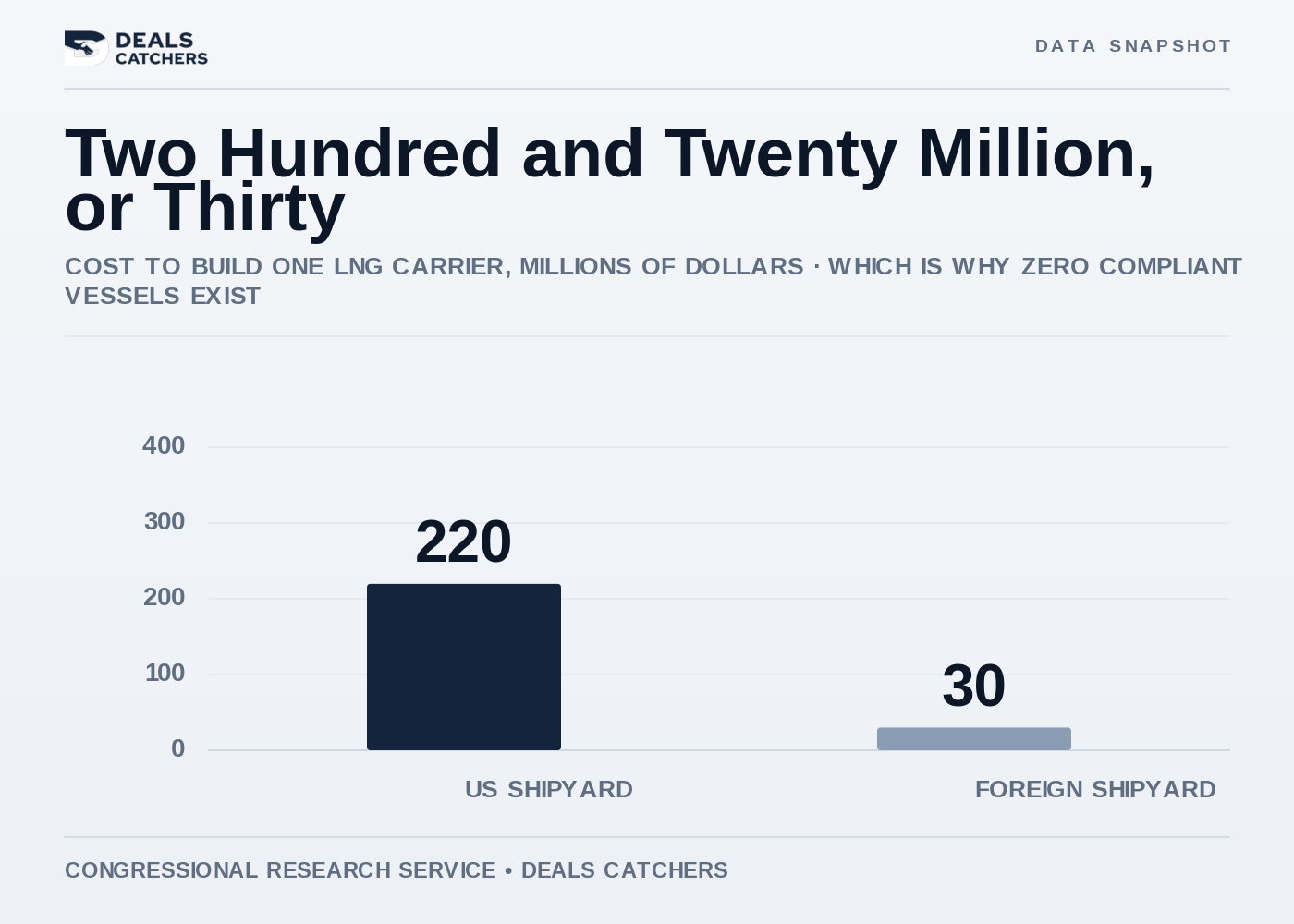
Building an LNG carrier in an American yard costs somewhere between $190 and $250 million, according to Congressional Research Service data. A comparable vessel built abroad costs about $30 million. At seven times the price, nobody has ever ordered one.
The result is that not one Jones Act-compliant LNG tanker exists anywhere in the world. Not a shortage. Zero. Which means an export terminal at Cove Point in Maryland or Elba Island in Georgia is legally barred from sending a cargo up the coast to Massachusetts, while a tanker from Trinidad may dock there freely.
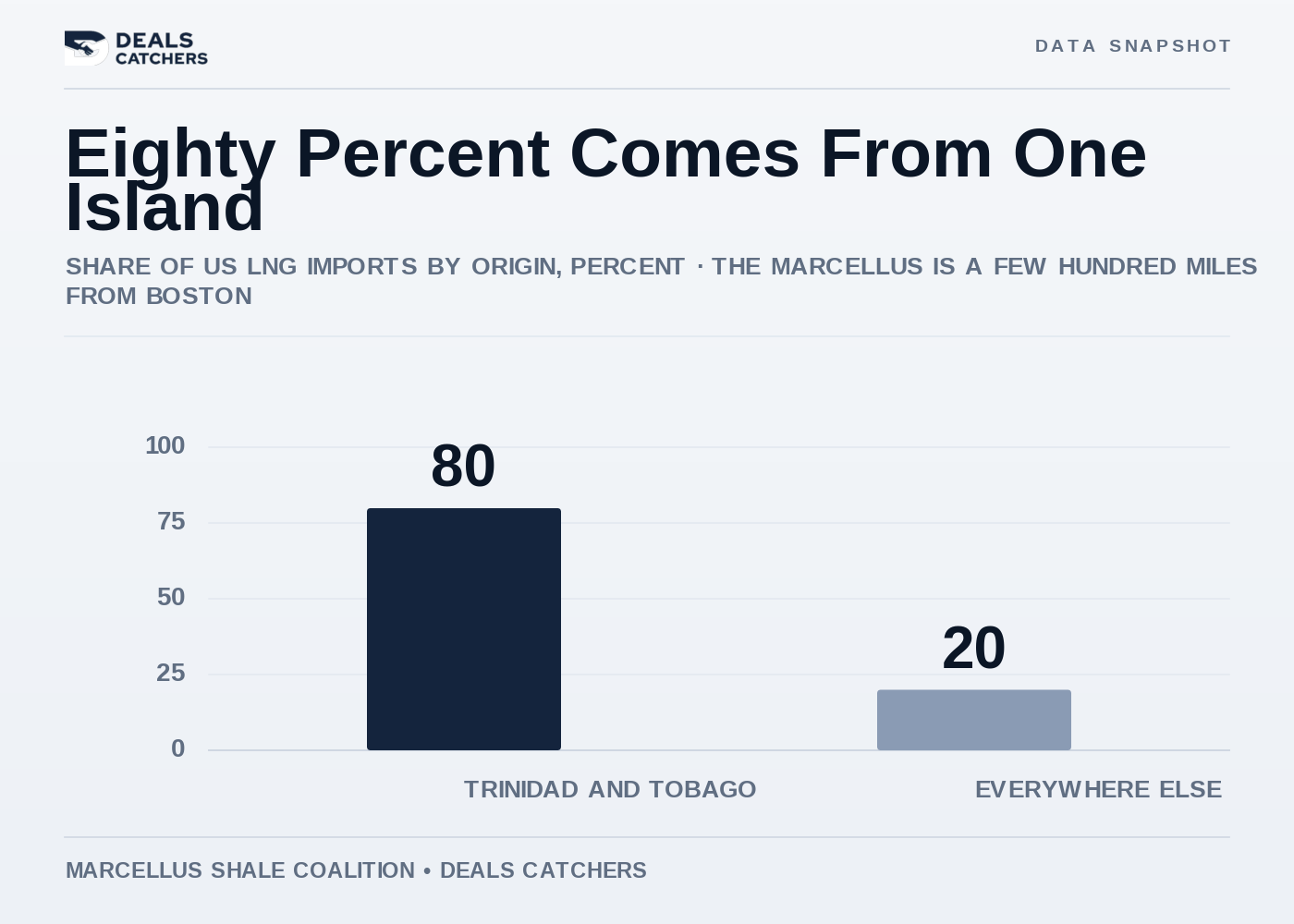
Nearly 80% of American LNG imports come from Trinidad and Tobago. In January 2018 a cargo containing gas from Russia’s Yamal plant was offloaded at Everett, having been reloaded in the United Kingdom first. The Everett terminal has been running since 1971 and supplies around a fifth of New England’s gas demand.

The broader picture is starker than the LNG case alone. Roughly 180 commercial ships fly the American flag, out of about 43,000 worldwide. A law written in 1920 to protect a large merchant marine now governs a fleet of four ships in every thousand.
Two things are true at once here, and the argument usually collapses them. Pipeline capacity into New England is genuinely constrained, and several proposed lines were blocked for reasons that had nothing to do with shipping. That constraint is real. But it is the shipping rule that makes the workaround illegal, and the workaround exists a few hundred miles down the same coast.
For anyone holding energy assets, the transferable point is that regulation determines the map. Where gas can physically go is a question about pipelines. Where it is permitted to go is a question about a statute, and the second one is what sets the price differential between two American cities.
sponsored Why Did Boston Ship Gas From Trinidad? |
I’ve exposed some of the biggest financial myths and manias of the last three decades. I told my readers “Peak Oil” was a lie all the way back in 2006. A couple years later, I warned readers that the U.S. housing market was on the verge of triggering a stock market crash. In 2010, I described in near-perfect detail many events of the last decade – riots, lockdowns, rampant inflation, the collapse of civil discourse and society, and the decline of the dollar – in a 77-minute video presentation called “End of America”. Until recently, I thought I’d seen the extent of human stupidity and graft. I didn’t think it was possible for policymakers and establishment elites to steal and mismanage more than they already had. Then I saw this… This is the tanker Iberica Knutsen arriving in Boston a few years ago. This ship has delivered liquefied natural gas from Trinidad and Tobago – 2,272 miles away. LNG is the main fuel for powering electrical grids and heating homes in the winter. But the United States has near-endless supplies of natural gas… a huge portion of it is in the Marcellus Shale which is just a few hundred miles from Boston. So why did Boston pay to ship natural gas from places like Trinidad and Tobago? I’ve spent years researching this story. What I’ve uncovered will astound you… but what it all means for the American way of life may terrify you.  Good investing, Porter Stansberry |
A 34% Distribution Rate Is a Statement About the Payout, not the Return
A weekly cheque from a fund holding technology shares that pay no dividends is a real thing, and the arithmetic behind it is worth understanding before the number is treated as a yield.
The usual structure is a covered-call fund. It holds a basket of shares and sells call options against them — contracts giving somebody else the right to buy those shares at a set price within a set window. The buyer pays a premium for that right. The fund collects the premium and distributes it.
That is where the cash comes from. Not dividends, not interest, not asset sales. Somebody paying for the option to buy your shares if they rise.
Which produces the trade-off that defines these products. You have sold the upside. If the shares rise past the strike price, they get called away and the fund keeps the premium instead of the gain. If they fall, you own the decline in full, cushioned only by the premium collected. The pattern is steady income, capped gains, and largely unchanged downside.
Two things about the headline number deserve care.
A distribution rate is not a total return. It measures cash paid out against the share price. It does not net off what happened to the share price itself. A fund can pay 34% and be worth less at the end of the year than at the start, and both statements can be printed truthfully in the same document.
An annualised rate from a weekly payout is a projection. Take one week’s distribution, multiply by 52, divide by the price. That is the standard method and it assumes the next 51 weeks resemble the last one. Option premiums depend on volatility, and volatility moves. A high rate quoted during a turbulent month is describing that month.
There is also the composition question, and it is answerable. Fund distributions carry a breakdown — how much was income, how much was capital gains, and how much was return of capital, which is your own money coming back and is not a gain at all. That breakdown appears in the fund’s Section 19 notices and in the annual tax statement.
None of which makes these funds bad. They do something specific: convert an uncertain capital return into a steadier income stream, at the cost of the upside. For somebody drawing money monthly who values predictability over maximum growth, that trade can be entirely sensible. It is simply a different instrument from a dividend payer, and the number on the front of the brochure is measuring a different thing.
sponsored Paid Every Thursday |
I’ve just found a way to collect $1,051 in a single month from artificial intelligence stocks. Not from selling shares. Not from trading options. Just from owning one small fund, and letting it deposit cash into my account every Thursday. That’s a 34% annualized distribution rate from AI stocks that pay no dividends. I recorded a full presentation explaining exactly how this works… And how you could collect your first payout as soon as this Thursday. To your income, Tim Plaehn Chief Income Strategist, Investors Alley Information contained in this email and websites maintained by Magnifi Communities LLC (dba Investors Alley) are for educational purposes only and are neither an offer nor a recommendation to buy or sell any security. Past performance is not necessarily indicative of future results. Trading and investing involve risk, and you may lose your principal investment. |
CPI Lands This Week and the Odds Sit at 70%
This wk | August CPI. The number that now carries the September decision. |
15–16 | September — the Federal Open Market Committee meets. |
70% | the market’s odds of a rise, up from 35% three weeks ago. |
The employment report is behind us and the case for a September move was never resting on the labour side. It rests on prices, which makes this week’s inflation reading unusually decisive for a single release.
Core PCE — the gauge the Fed actually targets, rather than the headline CPI most people see quoted — ran at 3.3% in July against 2.8% in February. The ten-year Treasury sits near 4.79%, its highest since early 2025, and the long end has been moving with the short end rather than shrugging as it did through August.
Energy sits underneath that reading, which is why the shipping story above is not a curiosity. Regional gas price differences inside one country feed into utility bills, and utility bills feed into the number the Fed is watching.
ad A small group who saw it early walked away wealthy. Everyone else paid for it. Send me the free report |
Zero Compliant Ships in a Fleet of 43,000
0 | Jones Act-compliant LNG tankers in existence anywhere in the world. Not a shortage — none have ever been built, because an American yard charges roughly seven times what a foreign one does. A law meant to protect American shipping now routes American gas through Trinidad. |
Forget the hot picks — protect what you’ve already built, and find out which law is drawing the map before you try to read it. Because the best trade you’ll ever make is the loss you never took. Mike LeeDeals CatchersThanks for reading. See you tomorrow. |
Forwarded this? Get it every morning. |