Nvidia Is Now Investing in Power Plants, Not Just Chips.

Share
Nvidia Is Now Investing in Power Plants, Not Just Chips.

Deals Catchers
Deals Catchers • August 16, 2026
Mike LeeBy Mike Lee · 16 Aug 2026

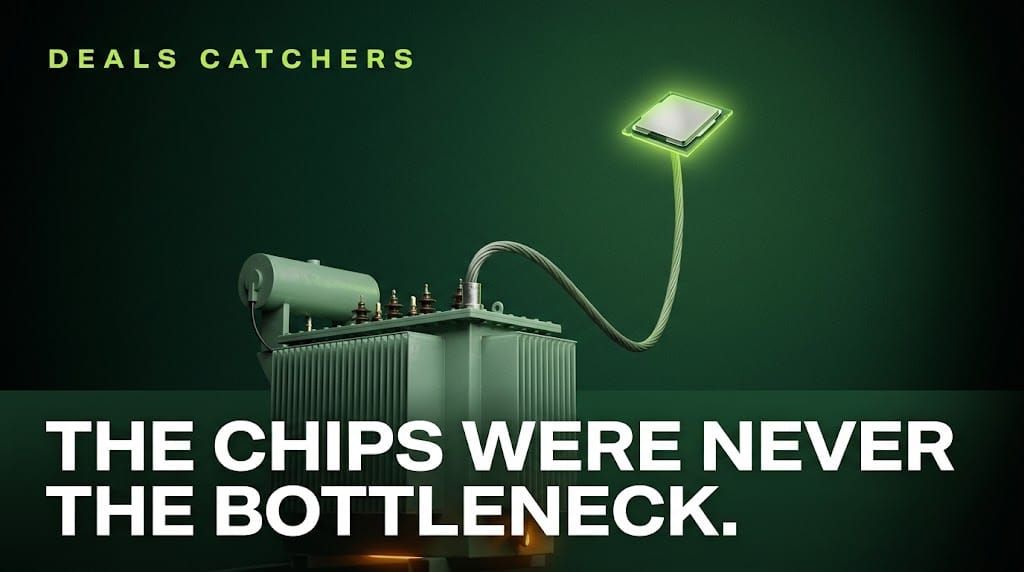
The company that makes the chips is now putting money into the power plants. That tells you which part of the AI buildout has become the bottleneck.
A perfect storm of operational breakthroughs and policy shifts has the potential to directly impact this company’s valuation.  Become a Frontieras Shareholder Before the Opportunity Ends on August 27.  Ad
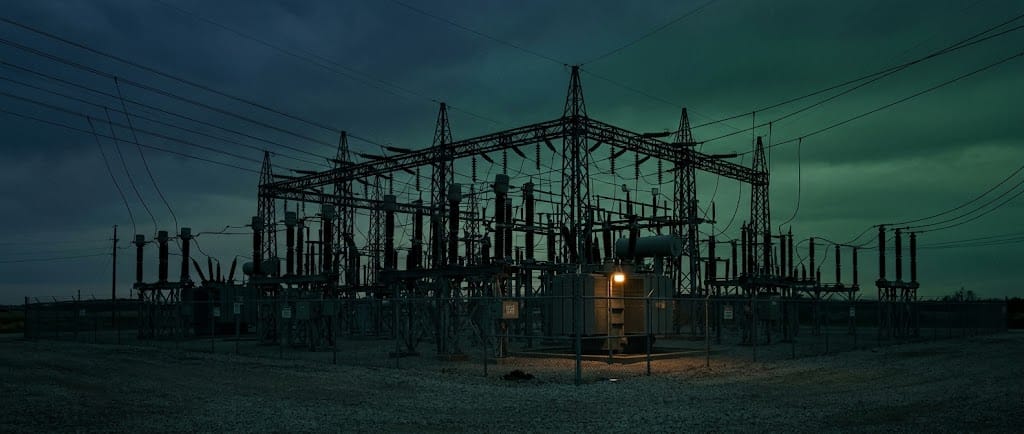
An electrical substation silhouetted at dusk
Featured
ENERGY / AIReported Saturday
Nvidia Is Now Investing in Power Plants, Not Just Chips
The Information reports Nvidia is in talks to put as much as $3 billion into SB Energy, a SoftBank subsidiary developing a large planned data centre in Ohio for OpenAI.
Read what that actually means. The most valuable chip company in the world is considering writing a cheque not for silicon, not for research, but for the electricity supply that its customers need before a single one of its chips can be switched on.
It follows a week in which Nvidia was reported to be helping mobilise more than $500 billion of third-party capital for AI infrastructure. The pattern in both is the same: the constraint on this buildout has moved from processors to power.
The arithmetic behind that shift is unforgiving. A single large AI data centre can draw as much electricity as a small city, and the grid it plugs into was designed decades before anyone imagined the load. Building generation takes years. Building a data centre takes months. That mismatch is now the binding constraint on the entire sector.
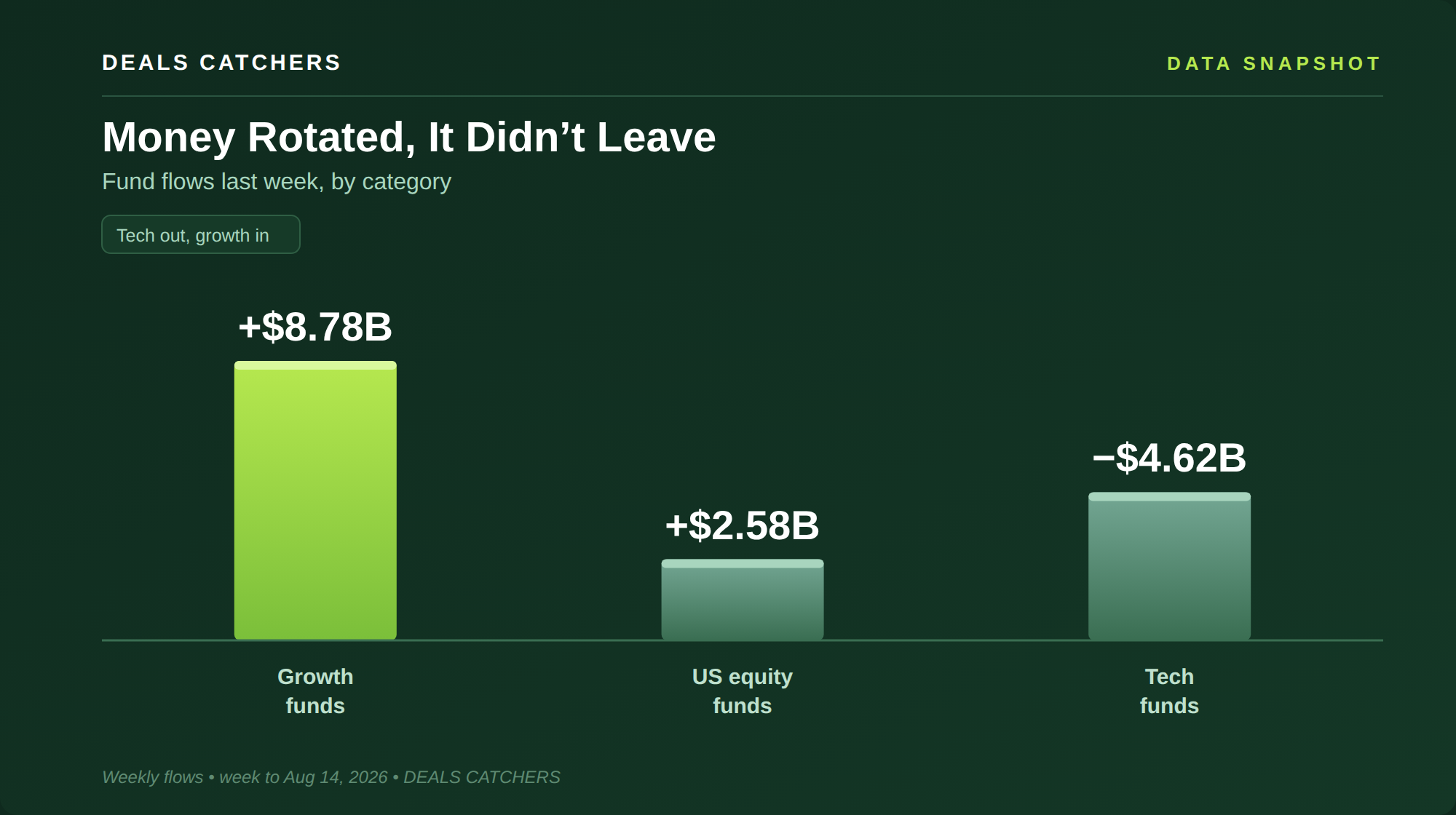
Money rotated, it didn’t leave
Fund flows last week, by category.
Investor money is already moving on it, though not in a straight line. Technology funds saw $4.62 billion of outflows last week after six consecutive weeks of inflows, while growth funds took in $8.78 billion and US equity funds $2.58 billion. That is rotation within the theme, not an exit from it.
Here’s why it lands on your desk: for two years the way to own this story was to own the chip makers. If the bottleneck has genuinely moved upstream to fuel, generation and grid, then the next stretch of it gets decided somewhere most portfolios are not currently looking.
Source: The Information / CNBC / TechStock
Sponsored
A Rockefeller Moment, With Coal Instead of Oil
Frontieras North America logo
In the 1800s, John D. Rockefeller started refining oil into the world’s most valuable fuel. Now, another innovator is creating its own “Rockefeller Moment” with one of the world’s most abundant energy resources: coal.

This is more important than ever right now, because a perfect storm of operational breakthroughs and policy shifts has the potential to directly impact this company’s valuation.

What’s creating this “Rockefeller Moment” for coal?

Using their patented FASForm technology, Frontieras North America can transform coal into high-value commodities like hydrogen, diesel, jet fuel, and fertilizer, without burning it.

They’re targeting a $2.1 Trillion total addressable market* where demand for these commodities is virtually unlimited.

Reaching just 2% of the global coal market could mean a trillion-dollar valuation for Frontieras.

That’s why the institutional investors are already moving. Frontieras has secured a $150 million investment commitment from GEM and raised over $45 million from private investors.

But here’s why 2026 is shaping up to be such a historic year for this company:
•  NASDAQ ticker reserved: Frontieras has officially reserved the “FASF” ticker, a major step toward a public listing.
•  The “Big Beautiful Bill”: Under a White House that favors domestic energy, Frontieras is positioned for rapid scale.
•  Real-world infrastructure: Frontieras just broke ground on their $850 million flagship facility in Mason County, West Virginia.
Two men in ties standing over blueprints
Frontieras is creating what could be a pivotal moment for the future of energy on the world stage.
Latest StoriesSee all →
A mine headframe silhouetted against an overcast sky
PRECIOUS METALSFriday close
Silver Hit a Six-Week High and Berkshire Started Buying Again
Spot silver rose 5% on Friday to $64.57 an ounce, its best weekly performance since February. Gold moved higher alongside it.
The drivers were mechanical rather than emotional. Softer hiring data and lower oil prices pushed rate expectations down, and precious metals move inversely to real yields. Futures now price only about a 30% chance of a quarter-point hike in September, down from roughly 55% two weeks ago.
Separately, Berkshire Hathaway became a net buyer of equities for the first time in 15 quarters, purchasing nearly $20 billion more than it sold. After nearly four years of accumulating cash, the most patient large allocator in the market started putting it to work.
The part that gets less attention is what happens inside a metals bull market rather than to the metal itself. Producers carry operating leverage: when the price of what they dig up rises faster than the cost of digging it, margins expand disproportionately. And in the later stages of these cycles, the larger producers have historically bought the smaller ones rather than explore from scratch.
Scale matters here too. Silver at $64.57 is a long way from where it sat two years ago, and the companies that pull it out of the ground did not double their costs over that stretch. That spread between a rising sale price and a roughly fixed cost base is where the leverage lives, and it is invisible if you only watch the commodity quote.
The distinction worth holding: the metal price and the companies that produce it are related but not the same investment, and they behave very differently at different points in a cycle. Which point this is remains an open question, but it is the right question to be asking.
Source: CNBC / Bloomberg
Sponsored
Two Hundred Sixteen Percent a Year, Compounded
Video
I’m not saying this to brag – I want you to understand how much money you can make if you get in early on a massive bull market in gold: Warren Buffett’s best stretch across sixty years never broke 36% a year… my top-performing portfolio returned 216% a year, compounded. Put $10,000 in at the start of 2024 and today it’s worth about $131,000. I’m not smarter than Buffett — I just understand one thing he doesn’t track: what happens to the best small miners when a bull market hits its buyout phase.
SPACEThis month
SpaceX Clawed Back to Its IPO Price. The Sector Followed.
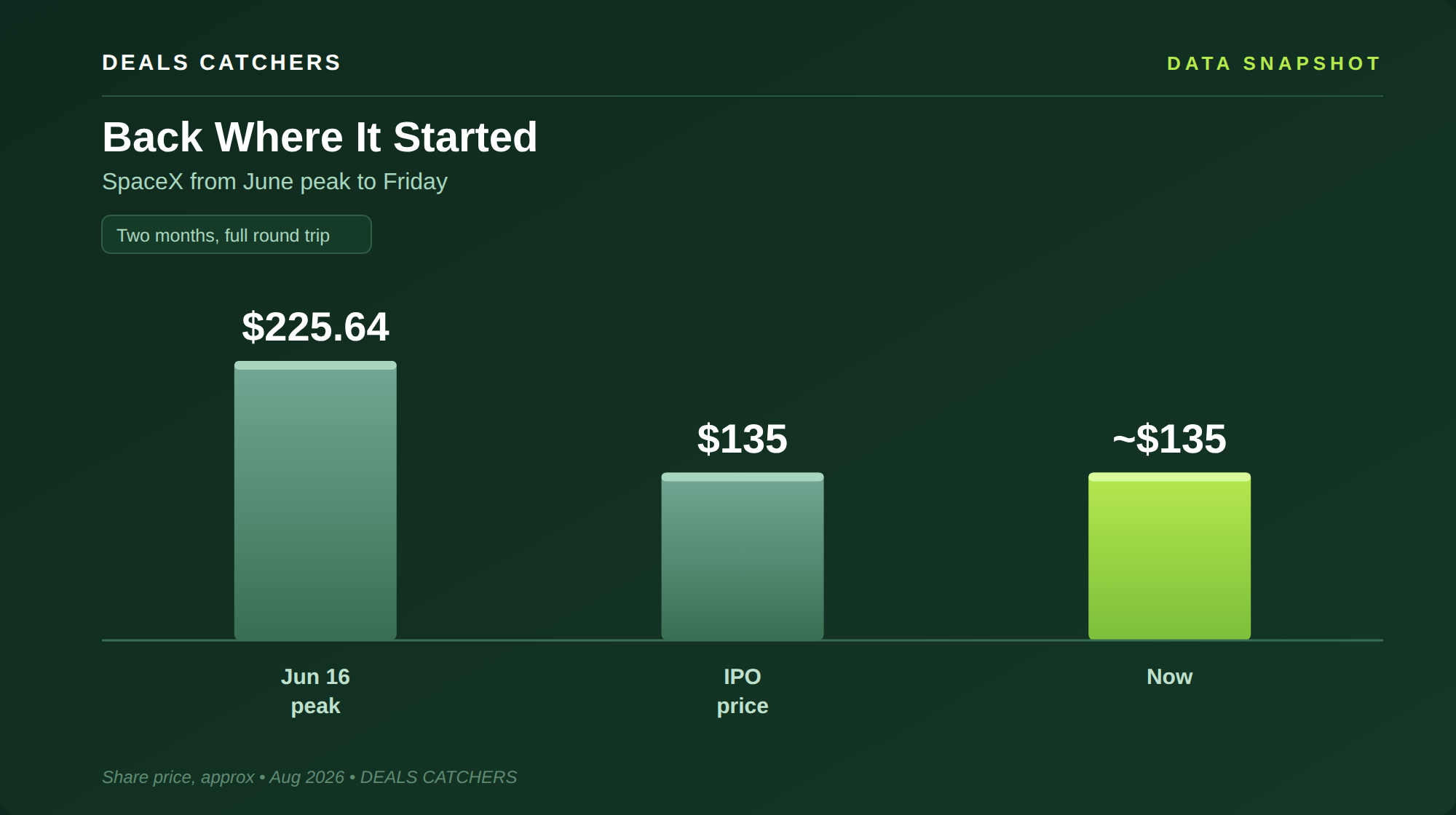
The shares briefly recovered to $135 after quarterly results reaffirmed analyst confidence — a full round trip from the $225.64 peak in June.
Two months ago that listing was the largest in history. Then the stock fell more than 50% from its high, dropped below the offer price, and spent weeks with roughly a third of its tradeable float sold short. Recovering to breakeven counts as a recovery only against that backdrop.
Back where it started
SpaceX from June peak to Friday.
What the round trip obscures is that the underlying activity never wobbled. Revenue grew 92% year on year in the quarter, the order backlog stood at $47.5 billion, and the AI segment grew 250%. The share price was arguing about valuation, not about whether rockets were launching.
Underneath the headline names, the commercial space economy has kept compounding regardless of what any single listing did. Launch cadence, satellite manufacturing and the supply chain that feeds both have grown through the entire episode, and almost none of that sits in companies most people have heard of.
The pattern is familiar from every infrastructure cycle: the famous name captures the attention and the volatility, while the parts suppliers underneath capture a steadier share of the actual spending. Neither is automatically the better investment. They are simply different bets on the same growth.
Source: CNBC / TradingKey
Sponsored
Six Days After the Filing, Congress Started Buying
Video
Six days after the largest IPO filing in space history, Washington insiders did something unusual.

At least six members of Congress immediately bought shares of a tiny, unknown defense supplier.

Five of them sit on committees overseeing defense, satellite communications, and AI.

They know something Wall Street hasn’t figured out yet:

Space is no longer a science experiment — it’s a $686 Billion critical infrastructure race. Commercial space spending just hit $544 Billion, outspending all world governments 4-to-1.

And U.S. commercial satellite manufacturing is exploding — up 67% year-over-year.

There’s just one massive problem: launching these satellites is still too expensive.

Even Elon Musk admitted it:

“There are only three casting companies in the world that make these parts.”

But a tiny, publicly traded company in Florida just cracked the code to cheap space launches.

Their CEO recently stated:

“We are twice as fast as our competition, and ten times cheaper.”

They’ve created what insiders are calling a “launch cheat code” that SpaceX, Blue Origin, and Rocket Lab desperately need to stay profitable.

The Pentagon is already doubling its space budget to $126 Billion… and this $4 company holds the monopoly.

Robert Kiyosaki’s “Financial 007” believes this stock won’t stay under $5 once the mainstream financial press catches on.
P.S. When politicians on defense committees buy a stock before a major licensing milestone, it’s rarely an accident. See the research before the crowd moves in.
An abandoned shopping trolley in an empty car park
THE CONSUMERFriday and the week ahead
Retail Sales Fell the Most in Over a Year. Sentiment Went With Them.
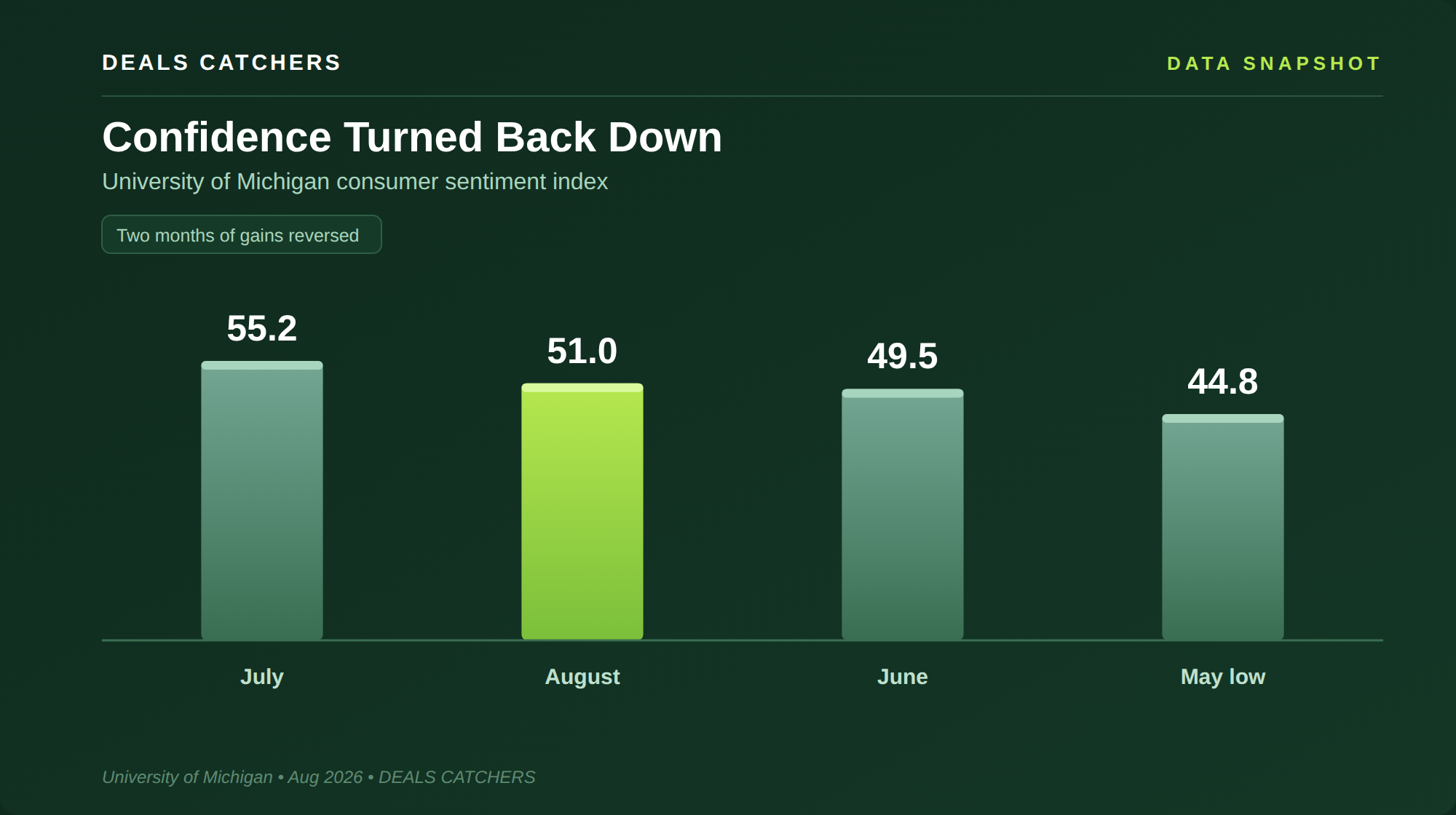
Census Bureau data released Friday showed the sharpest monthly drop in retail sales in more than a year. Consumer sentiment fell to 51.0 in August from 55.2 in July.
The sentiment reversal is the part that stings. The index had climbed from a historic low of 44.8 in May to 49.5 in June and 55.2 in July. Two months of repair, undone in one reading.
Confidence turned back down
University of Michigan consumer sentiment index.
The market has been signalling this for a while, quietly. The retail sector ETF is up roughly 4% in 2026 against a gain of nearly 14% for the S&P 500. Consumer-facing companies have been left behind by a rally driven almost entirely by technology and infrastructure.
This week resolves it. Home Depot reports Tuesday, TJX, Target and Lowe’s on Wednesday, and Walmart on Thursday. Between them they cover home improvement, discount, mid-market and everyday grocery — effectively the full range of American household spending.
If you are drawing income from savings, these four matter more to your year than Nvidia does. Consumer spending is roughly two thirds of the economy, and the gap between an index at record highs and a sentiment reading at 51.0 has to close in one direction or the other.
Source: Census Bureau / University of Michigan / CNBC
Reaching just 2% of the global coal market could mean a trillion-dollar valuation for Frontieras.  Become a Frontieras Shareholder Before the Opportunity Ends on August 27.  Ad
The Week Ahead
The Fed publishes minutes Wednesday from the July meeting, where rates were held at 3.50–3.75% for a fifth time with three officials dissenting in favour of a hike. With Warsh having abandoned conventional forward guidance, the minutes are the clearest read available on how wide the hawkish camp has become.
Earnings season has been extraordinary. Blended growth across the S&P 500 is running at 50.4%, the highest since 2021. The index sits 0.4% below its record after a third consecutive weekly gain.
Nvidia reports on August 26, a week from Wednesday. Bank of America has kept a buy rating and called the memory and circular-financing concerns overblown, expecting a beat and a raised outlook.
Monday brings the Empire State manufacturing index and the NAHB housing index; Tuesday housing starts and import prices. A thin data week by design, which leaves the retail reports carrying the whole narrative.
Silver at $64.57 is worth watching alongside gold this week. It is the more volatile of the two and tends to move first when the rate outlook shifts.
 
Stat of the Day
Consumer sentiment in August, down from 55.2 in July and reversing two months of gains
51.0
University of Michigan
Forget the hot picks — protect what you’ve already built, and watch where the bottleneck moves rather than where the headline sits. Because the best trade you’ll ever make is the loss you never took.
— Lee
Thanks for reading. See you tomorrow.
✱ Sources & Disclosures
This is a paid advertisement for Frontieras’s Regulation A offering. Please read the offering circular at https://invest.frontieras.com/

Reservation of the ticker symbol is not a guarantee that we will be listed on the NASDAQ. Listing on the NASDAQ is subject to approvals.

Under Regulation A, a company may change its share price by up to 20% without requalifying the offering with the Securities and Exchange Commission.

Sources* The global market for our products is worth a combined value of over $2.1 trillion
Read more

The Stretch Lasted 36 Years. Heirs Now Have Ten.

The Stretch Lasted 36 Years. Heirs Now Have Ten.

The tape is watching the next industrial project. The inherited-IRA deadline is 101 days out, and a missed withdrawal is now a 25% bill.͏ ͏ ͏ ͏ ͏ ͏ ͏ ͏ ͏ ͏ ͏ ͏ ͏ ͏ ͏ ͏ ͏ ͏ ͏ ͏ ͏ ͏ ͏ ͏ ͏ ͏ ͏ ͏ ͏ ͏ ͏ ͏ ͏ ͏ ͏ ͏ ͏ ͏ ͏ ͏ ͏ ͏ ͏ ͏ ͏ ͏  21 SEPTEMBER 2026 By Mike Lee sponsoredThis Tesla Demo Shocks EveryoneThis Tesla Demo Shocks Everyone"Hi, I'm Jeff Brown...I'm

By Mike Lee
Forty-Five Percent, Against a Record of Twenty-Seven

Forty-Five Percent, Against a Record of Twenty-Seven

AI-linked stocks are 45% of the S&P 500 against a previous record of 27%. Goldman now attributes half the index's earnings growth to the same spending.͏ ͏ ͏ ͏ ͏ ͏ ͏ ͏ ͏ ͏ ͏ ͏ ͏ ͏ ͏ ͏ ͏ ͏ ͏ ͏ ͏ ͏ ͏ ͏ ͏ ͏ ͏ ͏ ͏ ͏ ͏ ͏ ͏ ͏ ͏ ͏ ͏ ͏ ͏ ͏ ͏ ͏ ͏ ͏ ͏ ͏ ͏ ͏ ͏ ͏ ͏ ͏ ͏ ͏ ͏ ͏ ͏ ͏ ͏ ͏  18 SEPTEMBER 2026 By Mike Lee sponsoredThe Hidden Middleman Cut in Every CupSUPPLY CHAIN ANALYSISThe Hidden Middleman Cut Built

By Mike Lee
The Fed Raised Rates, and the Chair Still Will Not Say Where He Stands

The Fed Raised Rates, and the Chair Still Will Not Say Where He Stands

The Fed raised rates for the first time since 2023, unanimously, and then published a dot plot on which nobody agrees about what comes next. The chair again withheld his own.͏ ͏ ͏ ͏ ͏ ͏ ͏ ͏ ͏ ͏ ͏ ͏ ͏ ͏ ͏ ͏ ͏ ͏ ͏ ͏ ͏ ͏ ͏ ͏ ͏ ͏ ͏ ͏ ͏ ͏ ͏ ͏ ͏ ͏ ͏ ͏ ͏ ͏ ͏ ͏ ͏ ͏ ͏ ͏ ͏ ͏ ͏ ͏ ͏ ͏ ͏ ͏ ͏ ͏ ͏ ͏ ͏ ͏ ͏ ͏  17 SEPTEMBER 2026 By Mike Lee sponsoredA Promiscuous Robot (Only Today — Invest Before 9/17 or Miss This Price

By Mike Lee
The List of Weak Banks Already Exists

The List of Weak Banks Already Exists

Every bank above a billion dollars publishes its uninsured deposit ratio every quarter. That number predicted the 2023 failures, and it is free to look up.͏ ͏ ͏ ͏ ͏ ͏ ͏ ͏ ͏ ͏ ͏ ͏ ͏ ͏ ͏ ͏ ͏ ͏ ͏ ͏ ͏ ͏ ͏ ͏ ͏ ͏ ͏ ͏ ͏ ͏ ͏ ͏ ͏ ͏ ͏ ͏ ͏ ͏ ͏ ͏ ͏ ͏ ͏ ͏ ͏ ͏ ͏ ͏ ͏ ͏ ͏ ͏ ͏ ͏ ͏ ͏ ͏ ͏ ͏ ͏  16 SEPTEMBER 2026 By Mike Lee sponsoredWhy Is This NVIDIA Collaborator Robot Called Flippy?Why’s This NVIDIA Collaborator Robot Called Flippy? (Invest by

By Mike Lee