More Than 400 Companies Listed in 1992. You Have Heard of Six.

 |
8 SEPTEMBER 2026
 By Mike Lee
sponsored This Tesla Demo Shocks Everyone |
 “Hi, I’m Jeff Brown…I’m about to get in this Tesla and let it take me a few miles to show you Elon Musk’s next Big Project today… What happens next will shock you…” Sincerely, Jeff Brown Founder, Brownstone Research |
Three Numbers to Start
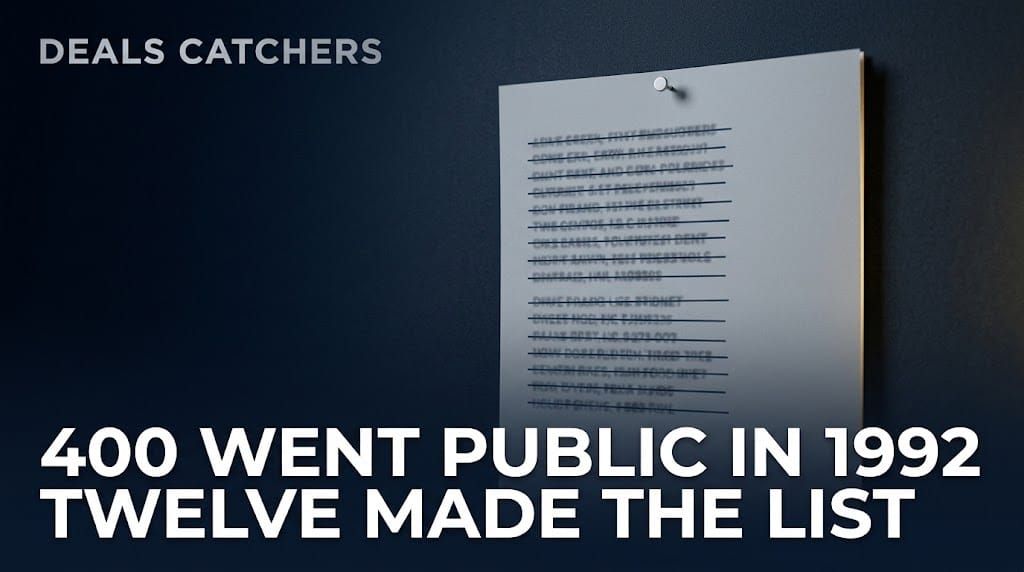
400+ | companies went public in 1992. The lists of that year’s best IPOs contain about a dozen. |
217 | of the 242 investors Howard Schultz approached turned him down before Starbucks listed. |
6% | a common dealer premium over spot on a one-ounce gold coin, paid before the metal moves at all. |
ad “I’m about to get in this Tesla and let it take me a few miles to show you Elon Musk’s next Big Project.” See what happened |
A Demonstration and a Product Are Different Objects
A demonstration is engineered to succeed. That is not an accusation, it is the definition. Somebody chooses the route, the conditions, the vehicle, the time of day and the moment to start filming. Every one of those choices removes a variable that a customer would encounter and cannot control.
None of which makes a demo dishonest. It makes it a proof of concept, which is a real and necessary stage. The error is treating it as a proof of readiness.
Yesterday I went through the registration records behind the Cybercab launch: 45 vehicles authorised for driverless operation in Texas, out of 420 across the state, none registered anywhere else. The demo was real. The fleet is 45 cars in one city.
There is a detail from that launch worth pulling out on its own, because it is the cleanest illustration of the gap. The software running in the robotaxi fleet is a different build from the one in customer vehicles. A demonstration can run code that is not shipping, on a car that is not for sale, along a route that has been driven a thousand times in testing.
Three questions turn any demo into information:
Who chose the conditions? A vehicle that drives itself down a mapped route in clear weather in a city where the operator has spent two years collecting data is demonstrating something narrower than the same vehicle in an unfamiliar town in rain.
What is registered, and where? Vehicle authorisations, spectrum licences, facility permits and regulatory filings are public, dull and much harder to stage than a video. They are also where the actual scale of a deployment is recorded.
What is the ramp, not the launch? Pilot production began at Giga Texas in February. Seven months later the number is 45. That trajectory tells you more about the next two years than any footage does.
The pattern repeats across categories with dull regularity. A drug shows a striking result in a small trial and then fails in a larger one. A battery chemistry performs in a laboratory cell and cannot be manufactured at scale. A humanoid robot picks up an apple on stage and manages a screwdriver three times in ten. In each case the demonstration was accurate and the extrapolation was not.
This applies well beyond one company. Every technology story you are shown arrives as a demonstration first, and the interval between the demonstration and the product is where most of the money is either made or lost.
More Than 400 Companies Listed in 1992. You Have Heard of Six.
Starbucks went public on 26 June 1992 at $17 a share. Six two-for-one splits later that works out at about 27 cents on a split-adjusted basis, and a $1,000 investment held since would be worth somewhere near $450,000.
The number is real. What it is used to prove usually is not.
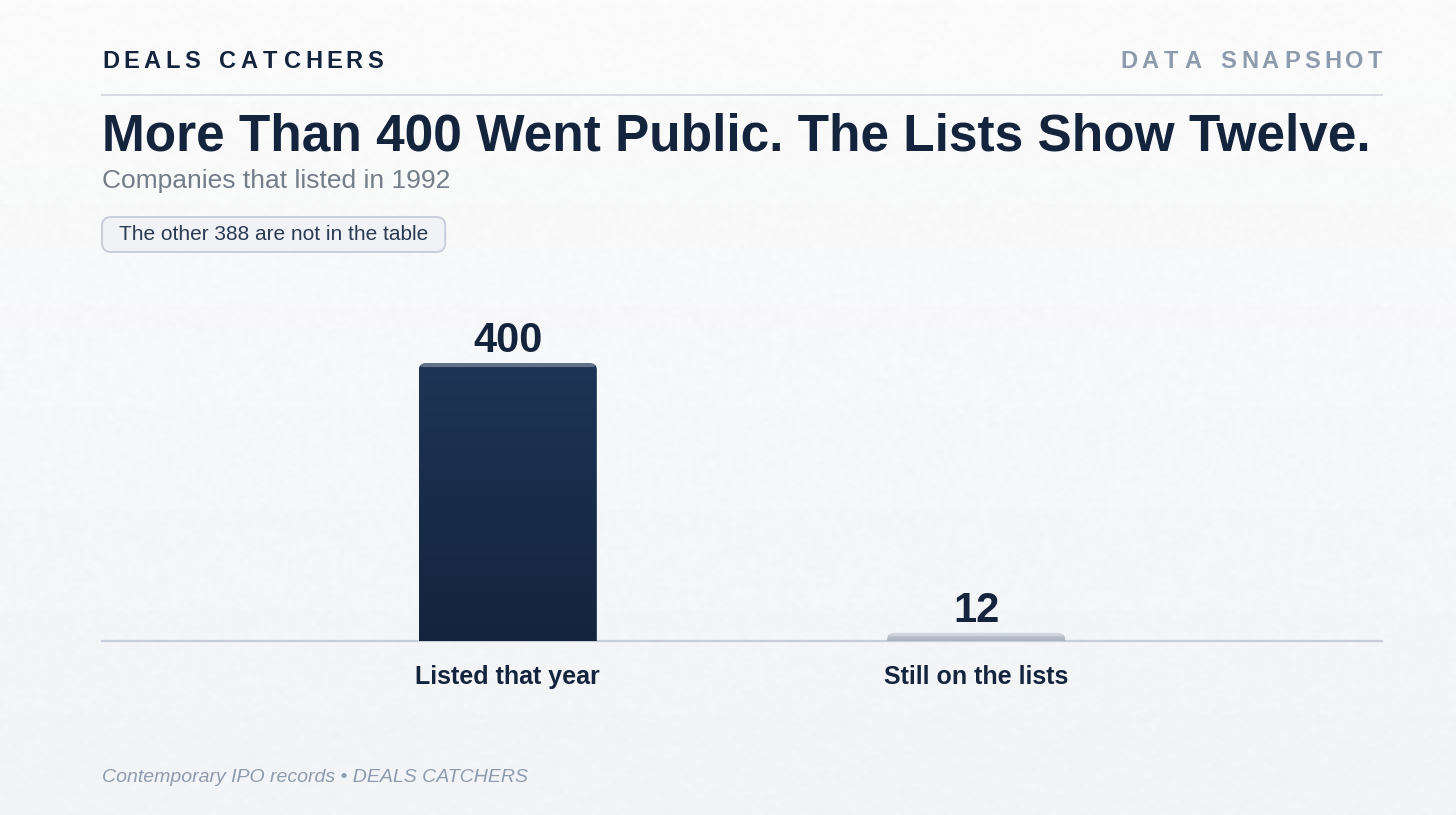
More than 400 companies listed on American exchanges in 1992. The lists you find of that year’s best IPOs contain roughly a dozen names — Starbucks, Gilead, D.R. Horton, Synopsys, Boston Scientific, Kohl’s and a few others. Those lists are usually titled something like “companies that IPO’d in 1992 and are still public”, and that qualifier is doing enormous work.
The other roughly 388 were acquired, taken private, delisted or went bankrupt. Bed Bath & Beyond was in that 1992 class too. It filed for bankruptcy in 2023 and its shareholders received nothing.
This is survivorship bias, and it is the most expensive statistical error in retail investing. You are shown the distribution of outcomes with the failures removed, then invited to reason about the odds.
The same distortion runs through almost every track record you will ever be shown. Mutual fund tables report the funds that still exist; the ones that closed after poor years are removed from the industry averages entirely. Trading systems are advertised on the accounts that worked. Even the phrase “this strategy has returned X since 1990” usually describes a portfolio assembled with the benefit of knowing which names survived.
Run it the other way. If you had bought every 1992 IPO in equal amounts, you would hold a handful of extraordinary winners, a larger group of ordinary performers, and a long tail of zeroes. The average is a perfectly reasonable number. It is nothing like 27,807%.
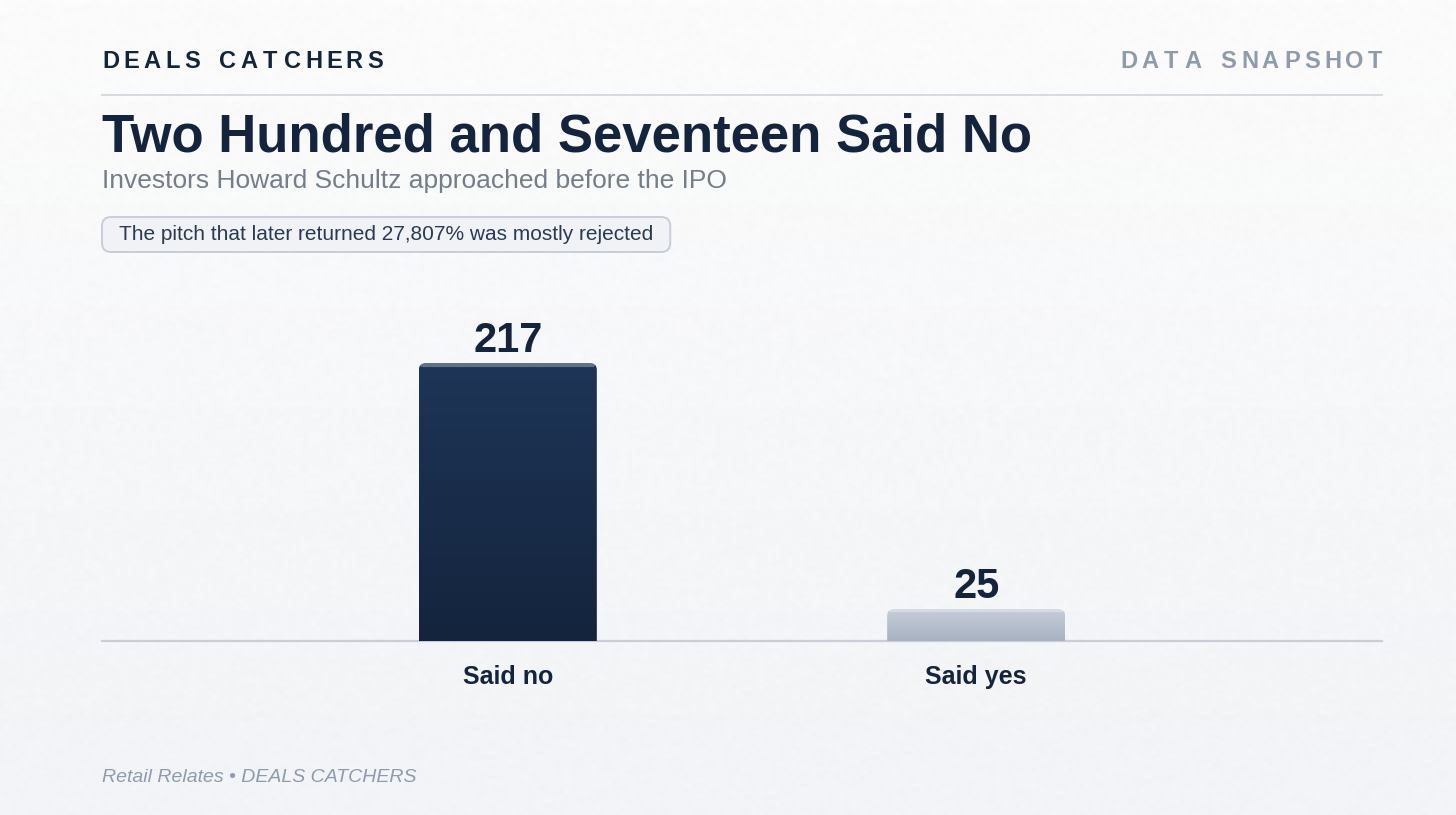
There is a human version of the same point, and it is my favourite fact in this story. Before the IPO, when Howard Schultz was raising private money to buy the company from its founders, he pitched 242 investors. 217 of them said no.
Those 217 were not fools. They were looking at a small Seattle chain selling expensive coffee, and the proposition — that Americans would pay four dollars daily for something they could make at home — was genuinely hard to believe in 1987. They were wrong, and the reasoning that made them wrong was sound at the time.
Which is the honest lesson buried under the 40,000%. Not that early investing makes you rich, but that the people closest to the opportunity, with the most information and the strongest incentive to get it right, rejected it nine times out of ten. Anyone selling you certainty about which small company becomes the next one is claiming a skill that 217 professional investors did not have.
sponsored Starbucks Went Public at 27 Cents |
 In 1992, Starbucks went public at a split-adjusted price of approximately $0.27. Today, its stock trades above $108. That’s a gain of roughly 40,000%. Put another way… That turns $100 into $40,000… $500 into 200,000 dollars… And a tiny stake of $1,000 into almost half a million dollars. But unless you invested in Starbucks back in 1992, that opportunity is already gone. The bigger question is: Where could coffee’s next major growth story come from? The global coffee market is projected to reach approximately $380 billion by 2033. And its next breakout company may not be built around thousands of cafés. It may begin with the farms… And that’s the opportunity that could dwarf Starbucks returns. Click here to see what a $1,000 stake buys today – and why this company believes the next big coffee story is moving from farm to shelf. Meet Green Coffee Company. It owns approximately 45 Colombian farms and 10 million coffee trees. It also holds exclusive third-party rights to Juan Valdez coffee products across U.S. and Canadian retail and institutional channels. Those products are already reaching Target, Walgreens and thousands of North American retail locations. And individual investors can now own a stake while the company is still private. No accreditation required.  This is a paid advertisement for Green Coffee Company’s Regulation A offering. Please read the offering circular at https://invest.greencoffeecompany.com/. Timelines are subject to change. Listing on the NASDAQ is contingent upon necessary approvals. |
You Cross the Spread Twice, and Both Crossings Cost You
On Friday we went through the rules for holding physical gold in a retirement account: the 99.5% purity threshold, the prohibition on home storage, the custodian and depository requirements, and annual fees that typically run $200 to $500.
There is a cost that sits underneath all of those and gets mentioned even less often. It is the largest one.
Physical metal does not trade at spot. Spot is the price for a large, standardised, institutional transaction. What a retail buyer pays is spot plus a premium covering fabrication, distribution, insurance and the dealer’s margin. On a one-ounce sovereign coin that premium commonly runs several percent, and on smaller denominations it runs considerably higher.
Then, when you sell, the same dealer buys back below spot. That gap is the second crossing.
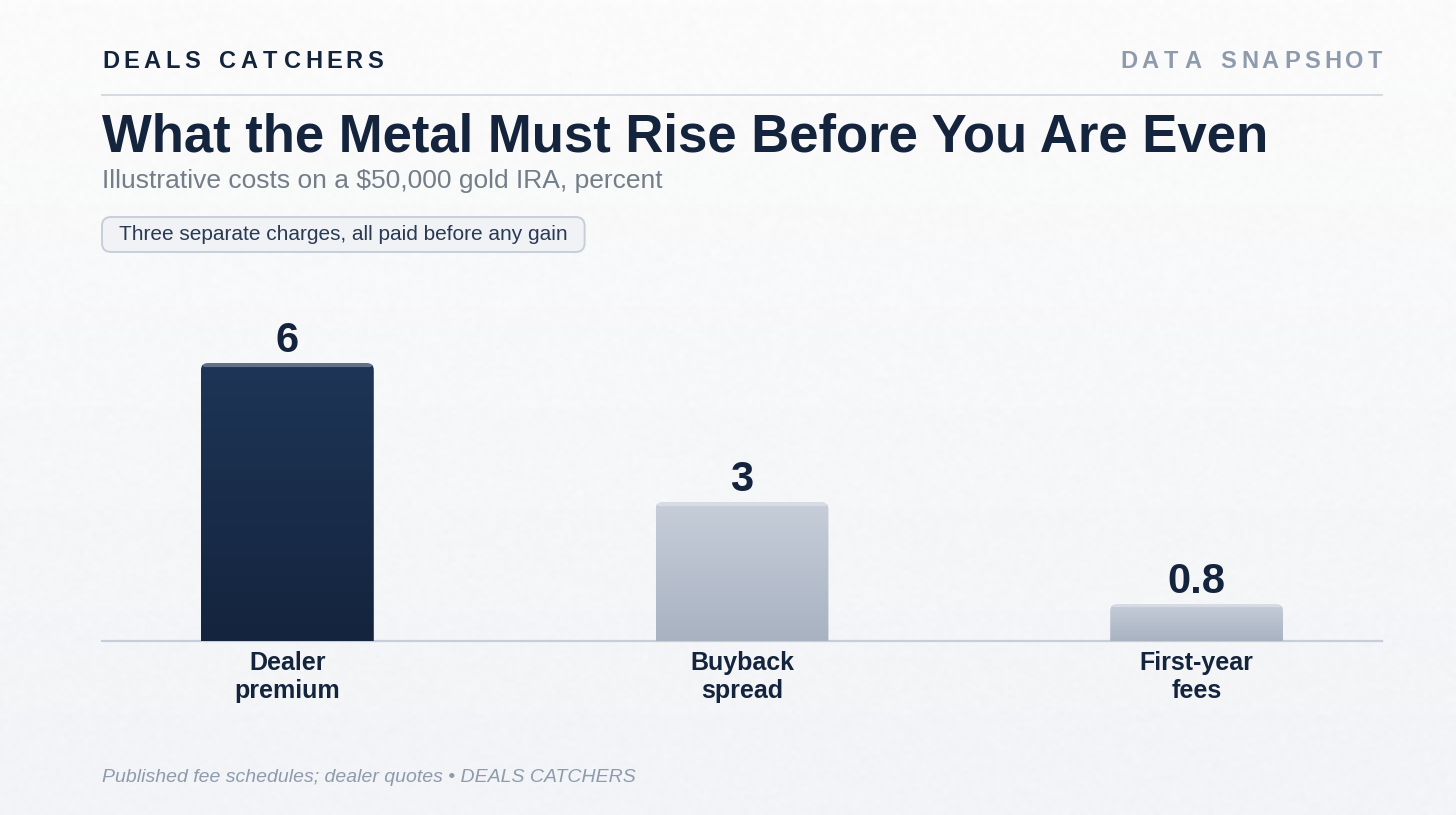
Work an illustrative case. Buy at 6% over spot, sell at 3% under, pay $400 of custodian and storage fees in the first year on a $50,000 account. The metal has to appreciate close to ten percent before the position is worth what you put in.
It is worth separating this from the fees we covered on Friday, because they behave differently. Custodian and storage charges are annual and visible on a statement. The spread is one-off, invisible, and paid at the moment of purchase when attention is lowest. A buyer who negotiates the annual fee down by fifty dollars and accepts an extra two percent on the premium has moved backwards.
That is not a criticism of gold and it is not evidence of anything improper. Every physical good has a retail spread — you would not expect to sell a car for what the dealer charged. The point is that the spread on bullion is rarely stated in percentage terms in the marketing, and it is the single largest cost in the transaction.
Two practical consequences follow. Fractional coins carry the worst arithmetic. A quarter-ounce coin costs more per ounce to make and to distribute, so the premium is proportionally larger. Buying ten quarter-ounce coins instead of two and a half one-ounce coins can cost meaningfully more for identical metal content.
And the holding period does the work. A ten percent round-trip cost is severe over eighteen months and modest over fifteen years. Physical metal is a long-duration instrument by construction, whatever the urgency of the advertisement that introduced it.
The question to ask any dealer, in writing, is simple: what is your premium over spot on this specific product today, and what is your buyback price on the same product today. Both numbers exist. A dealer who will quote one and not the other has answered a different question.
sponsored The Goal To Send 1,000 Copies |
A copy of the FREE Wealth Protection Playbook is ready for you. But you still haven’t requested yours. Before making another move with your retirement savings, I’d read this first. Click here to see what’s inside. It explains why more Americans are looking at physical gold as debt, inflation and market uncertainty pile up… Plus, how eligible retirement funds may be moved into physical gold using an IRS-approved process — while preserving the tax advantages of the account. There’s no charge for the guide. Just enter your information and we’ll send it to you. Yes, Send Me My FREE Wealth Protection Playbook. Sincerely, Cedar Gold Group  |
CPI Lands This Week and the Odds Sit at 70%
This wk | August CPI. The number that now carries the September decision. |
15–16 | September — the Federal Open Market Committee meets. |
70% | the market’s odds of a rise, up from 35% three weeks ago. |
Friday’s employment report is behind us and the case for a September move was never resting on the labour side. It rests on prices, which makes this week’s inflation reading unusually decisive for a single data point.
Core PCE — the gauge the Fed actually targets, rather than the headline CPI most people see quoted — ran at 3.3% in July against 2.8% in February. The ten-year Treasury sits near 4.79%, its highest since early 2025, and the long end has been moving with the short end rather than shrugging as it did through August.
Warsh has published no reaction function and given no forward guidance. There is no stated framework against which to test whatever the number says, so the market will price its own interpretation in the minutes after the release.
ad What happens next will shock you. See what happened |
388 Companies That Are Not on the List
388 | the rough number of 1992 listings that do not appear in any “best IPOs of 1992” table, because the tables are built from companies still trading. Every backtest you are shown has had its failures removed by the same mechanism. |
Forget the hot picks — protect what you’ve already built, and ask what was removed from the list before you were shown it. Because the best trade you’ll ever make is the loss you never took. Mike LeeDeals CatchersThanks for reading. See you tomorrow. |
Forwarded this? Get it every morning. |