Half a Trillion in Borrowed Money Is Funding the AI Boom.

Share
Half a Trillion in Borrowed Money Is Funding the AI Boom.
Deals Catchers
Deals Catchers • August 14, 2026
Mike LeeBy Mike Lee · 14 Aug 2026

The market closed at a record last night. Underneath it, the money funding the AI buildout got harder to see — and there is now roughly twelve dollars of financing behind every dollar the biggest customer earns.
The Bellweather Signal — 7 warning signs that predicted every major economic collapse since 1929.  Claim Your Free Copy Before It’s Gone →  Ad
Dense scaffolding lattice against a dark sky
Featured
CREDITReported this morning
Half a Trillion in Borrowed Money Is Funding the AI Boom
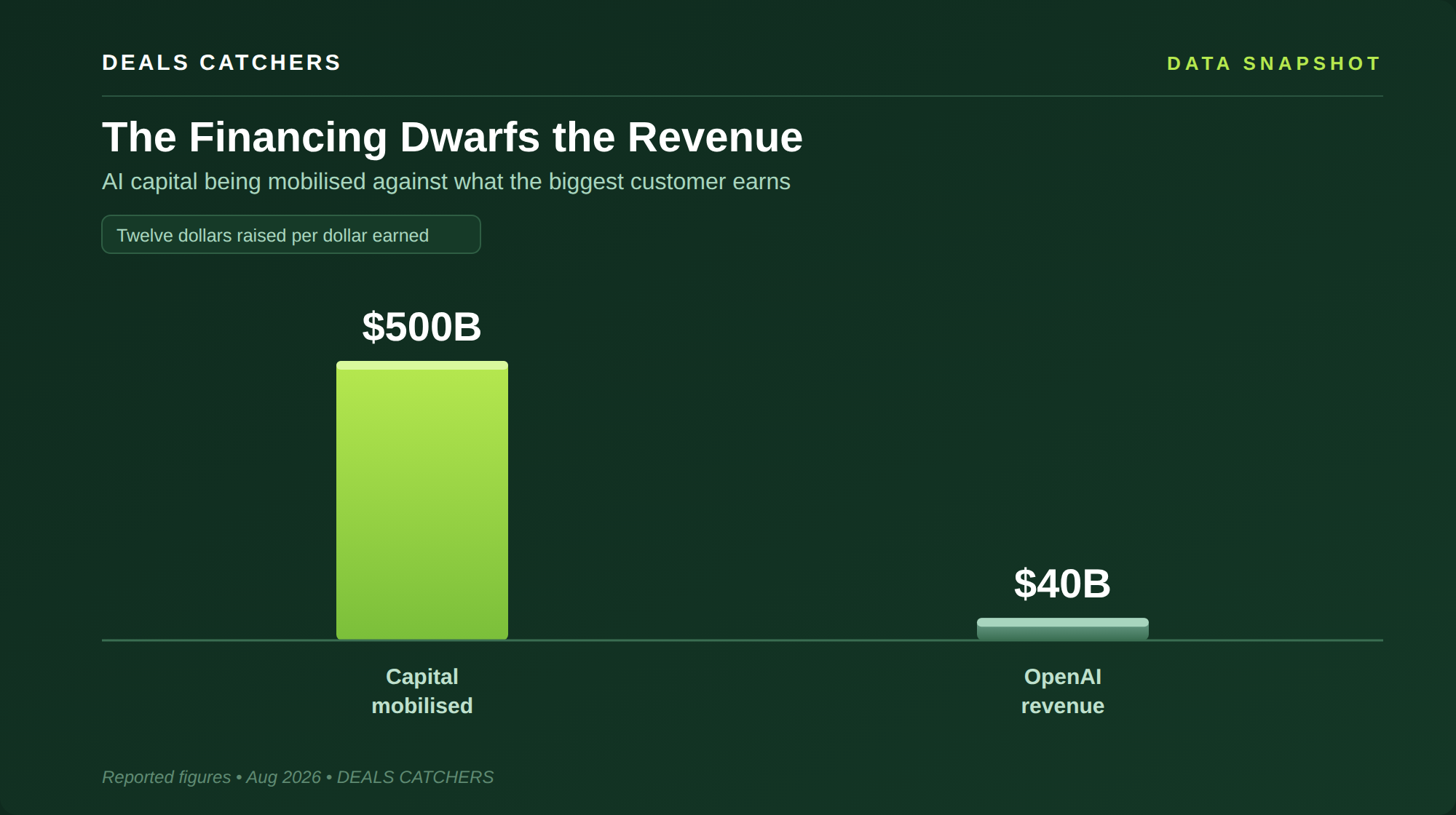
Nvidia is partnering with Wall Street firms to mobilise more than $500 billion of third-party capital for AI infrastructure. OpenAI, the customer that buildout is largely for, earns $40 billion a year.
The structures doing the funding are the part worth understanding. Hyperscalers and their backers are no longer paying out of operating profit alone. They are using bond markets, joint ventures, leases and other arrangements to spread the cost — and each of those keeps a portion of the obligation off the balance sheet where you would normally look for it.
At the same time, leverage is climbing on the investor side. Hedge funds and other institutions are using prime brokerage borrowing and derivatives to amplify their exposure to the same boom. So borrowed money is building the data centres, and borrowed money is buying the shares of the companies building them.
The financing dwarfs the revenue
AI capital being mobilised against what the biggest customer earns.
None of this is illegal, hidden, or even unusual for an infrastructure cycle. Railways, telecoms and housing were all built this way. What each of those had in common was that the leverage became visible only after the cycle turned — because the structures that spread risk in good years are the same structures that obscure it.
There is a second number worth sitting with. Nvidia reports on August 26, and its results will be read as the verdict on all of this. But a chip maker’s quarterly sales tell you what was ordered and paid for. They tell you nothing about how the buyer financed the order, which is the question this week actually raised.
Here’s why it lands on your desk: the tell in every previous cycle was never the price of the asset. It was the plumbing behind the price — how much of the buying was borrowed, and how hard that borrowing was to see from outside. That is the signal worth learning to read before you need it.
Source: CNBC / Reuters
Sponsored
Seven Signals, and All Seven Are Red
Book cover with warning triangle
I need to be upfront with you.

This report normally sells for $97.

Investment firms pay $5,000+ for the same intelligence inside it.

But today — for a limited number of readers —

I’m sending it to you completely free.

Here’s what’s inside:

The Bellweather Signal — 7 warning signs that predicted every major economic collapse since 1929.

Right now, all 7 are flashing red.

I’ve spent 15 years helping conservative Americans protect their wealth from government overreach and economic manipulation.

After watching millions of hardworking families get wiped out in 2008, I made a promise:

Never again would I let good people get blindsided by a crisis the insiders saw coming.

This report is that promise kept.

Financial newsletters charge $97-$297 for research like this.

Today it’s yours free.

But I can only send it to the next group of readers who claim it — after that, it goes back to full price.
Latest StoriesSee all →
A velvet rope stretched across a dark doorway
PRIVATE MARKETSReported yesterday
OpenAI Doubled Revenue to $40 Billion and Pushed Its IPO to 2027
Bloomberg reports annualised revenue has passed $40 billion, double where it stood at the end of 2025. The listing, once expected this autumn, has slipped by more than a year.
That decision is the pattern, not the exception. The largest private technology companies are staying private for longer than any generation before them, and the growth that used to happen after a listing now happens before it.
When they do arrive, the arithmetic has often already been collected. Circle listed at $31 last year, ran to roughly $300, and trades at $71.28 today — still more than double the offer price, but down about 75% from the high. SpaceX went public in June at $135 and now sits below it.
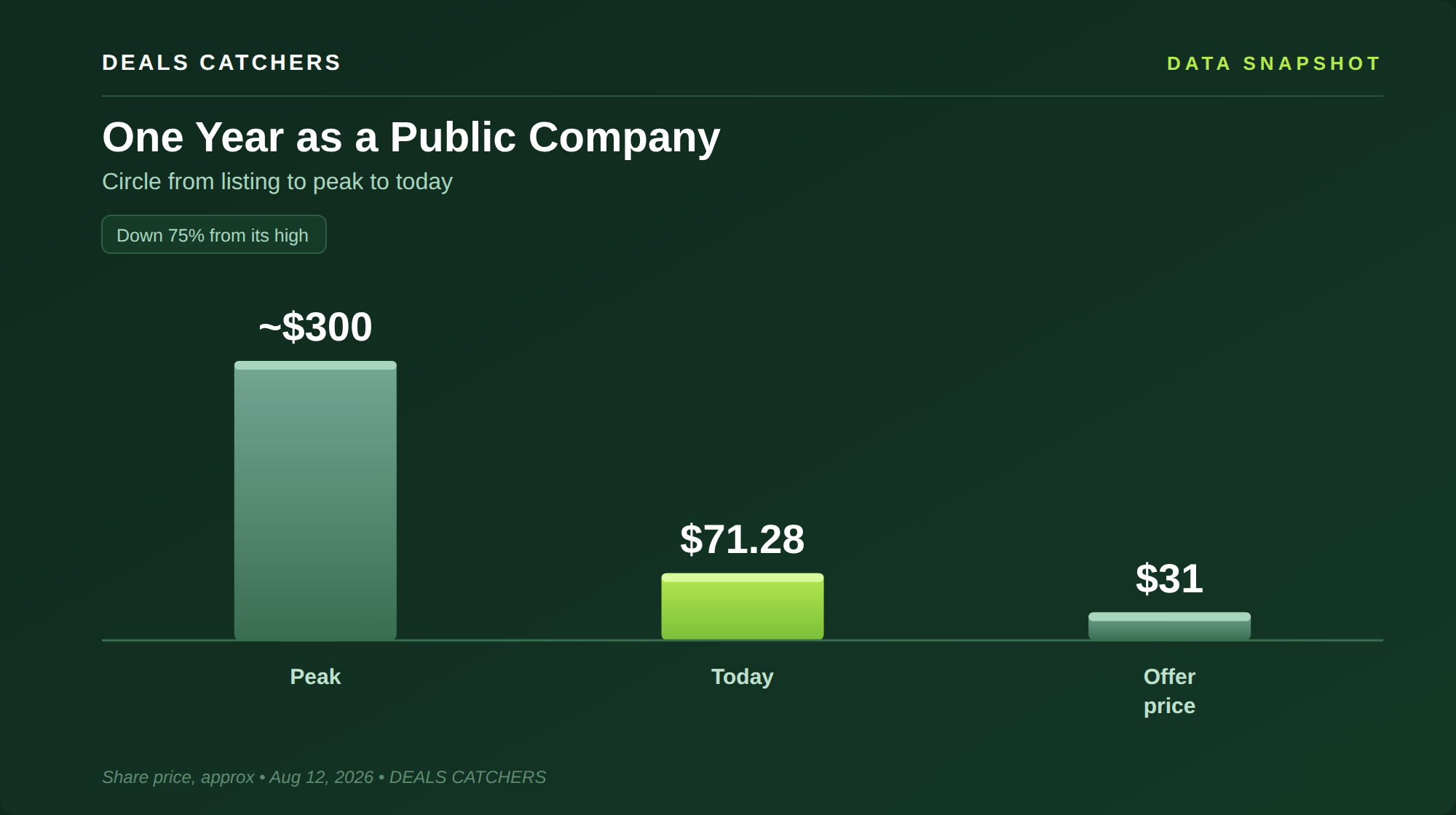
One year as a public company
Circle from listing to peak to today.
The consequence for an ordinary investor is structural rather than dramatic. For most of the last century, buying a company early meant buying it at the IPO. That entry point has moved, and it has moved into a part of the market that public shareholders historically could not reach.
The scale involved is what makes it matter. OpenAI at $40 billion of annualised revenue would sit comfortably inside the S&P 500 today if it were listed. Anthropic is reported to be weighing a listing as soon as October at a valuation approaching $2 trillion. Neither is currently something a retirement account can hold through a normal brokerage.
The distinction worth holding onto: staying private longer is a choice companies make for their own reasons, and it changes when the value accrues rather than whether it does. Where you can participate is now a question with a different answer than it had ten years ago.
Source: Bloomberg / New York Times / TradingKey

Sponsored
Apple Just Removed the Dead Zones
video
Apple’s Starlink Update Sparks Huge Earning Opportunity

Apple just secretly added Starlink satellite support to iPhones through iOS 18.3.

One of the biggest potential winners?

Mode Mobile.
video
Mode’s EarnPhone already reaches 490M+ users that have earned over $1B, and that’s before global satellite coverage. With SpaceX eliminating "dead zones" worldwide, Mode’s earning technology can now reach billions more in unbanked and rural populations worldwide.

Their global expansion is perfectly timed, and you still have a chance to invest in their potentially pre-IPO offering before it closes.

59,000+ investors participated in Mode’s previously sold out offering and limited space remains in the current round.

With their recent 32,481% revenue growth and newly reserved Nasdaq ticker, Mode is one step closer to a potential IPO.
Banner
Please read the offering circular and related risks at invest.modemobile.com. This is a paid advertisement for Mode Mobile’s Regulation A+ Offering.

Mode Mobile recently received their ticker reservation with Nasdaq ($MODE), indicating an intent to IPO in the next 24 months. An intent to IPO is no guarantee that an actual IPO will occur.

The Deloitte rankings are based on submitted applications and public company database research, with winners selected based on their fiscal-year revenue growth percentage over a three-year period.
Brass calipers resting on a dark surface
SEMICONDUCTORSYesterday’s close
Applied Materials Beat on Everything and Fell Five Percent
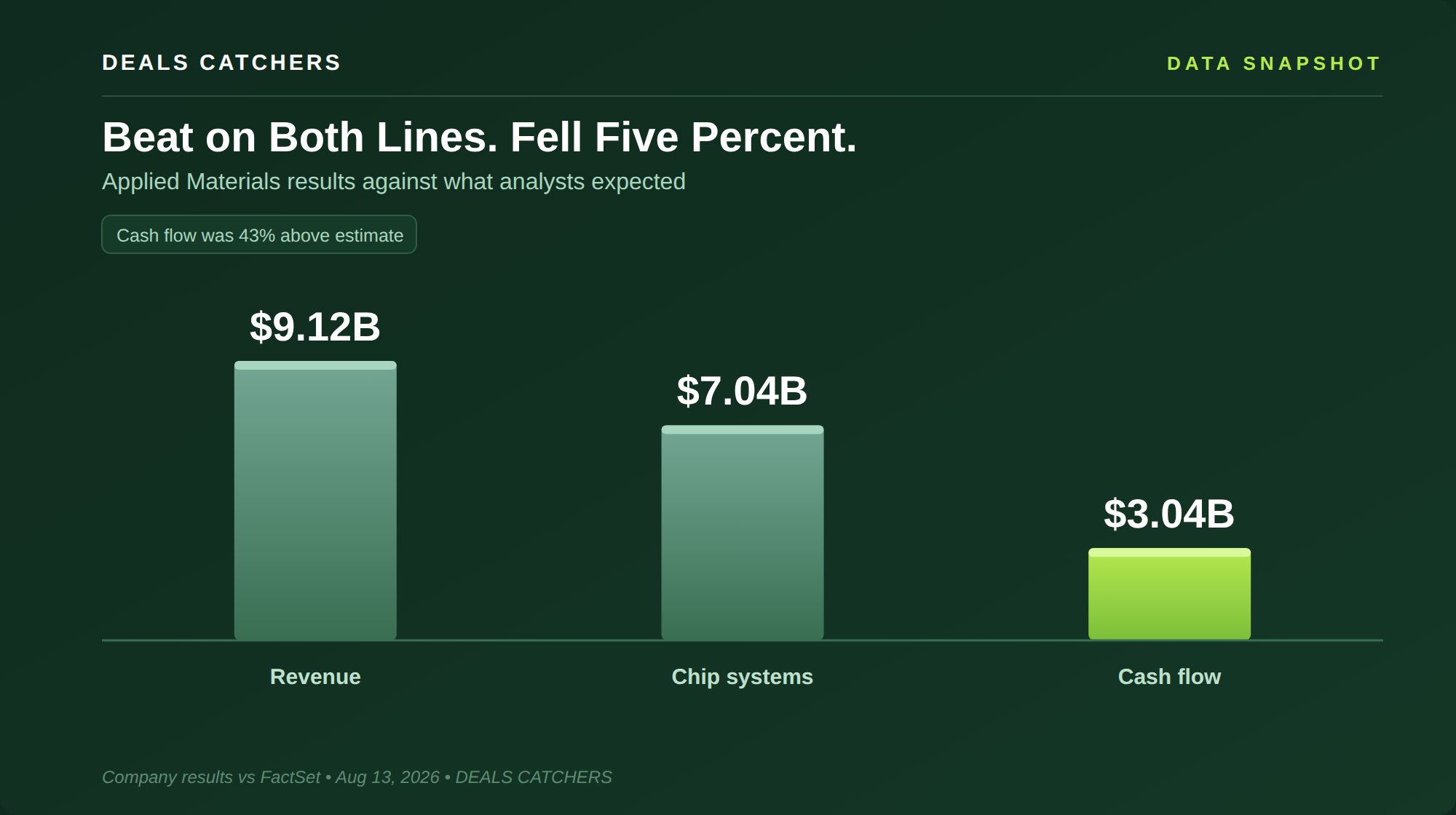
Adjusted earnings of $3.50 a share on revenue of $9.12 billion. Cash flow from operations came in at $3.04 billion against a $2.13 billion estimate. The stock dropped 4.9% to $508.30.
The detail that did the damage sits one layer down. Sales in the semiconductor systems division — the part that actually matters — were $7.04 billion against a consensus of $6.96 billion. A beat of barely one percent, in the line investors care about most.
Its forward earnings multiple already sits below three major equipment competitors, which tells you the market was not paying a premium here to begin with. It was paying for growth in one specific division, and that division delivered adequately rather than impressively.
Beat on both lines, fell five percent
Applied Materials results against what analysts expected.
Compare it with the same week’s other results. Nu Holdings rose nearly 12% after quarterly net income passed $1 billion for the first time. Reddit gained 10.4% on news it joins the S&P 500 before the bell on August 18. SanDisk added 7% on an analyst upgrade alone.
None of those four moves came from the quarter itself. Reddit rose on an index committee decision. SanDisk rose on one analyst changing a number in a spreadsheet. Applied Materials fell on unrealised investment losses that have nothing to do with selling equipment. The businesses did not change in any of the four cases.
The lesson running through all four: within the same sector, in the same week, the market rewarded and punished companies for reasons that had almost nothing to do with whether they beat. Sorting which is which has become the entire job, and it is not the job most people think they are doing when they buy a theme.
Source: CNBC / TheStreet / ts2.tech
Sponsored
The System That Flagged Nvidia in 2005
Editor’s Note: Louis Navellier’s Stock Grader system helped him flag Nvidia before its 82,000% run — and has identified the top S&P 500 stock 12 years running. Today, he’s giving away his #1 AI stock pick for 2026, free. Click here to get the name and ticker or read more below.
Factory
I want to give you a free stock pick today.

No strings attached. No credit card required. Just the name, ticker, and my full analysis.

Here’s what I can tell you right now:

This company’s sales are up 28% year over year. It holds over 30,000 patents in wireless and video technology. And it just earned an A-rating in my proprietary Stock Grader system.

That’s the same system that helped me flag Nvidia back in 2005 — before its 82,000% run.

In fact, this system has identified the top-performing S&P 500 stock for 12 years running. Over the years, it has cost me $9 million to build and maintain. And right now, it’s flashing its highest possible rating on this AI play.

Click here to see which AI stock my $9 million system is flagging right now, free.

But this pick is just the beginning…

I’ve also identified three more AI stocks my system shows have the same early-stage characteristics as Nvidia did in 2005.
Regards,
Louis Navellier
Senior Investment Analyst, InvestorPlace

P.S. My Stock Grader system has cost $9 million to build and maintain. It helped me flag Nvidia at $1 split-adjusted. Today it’s flashing its highest rating on one AI stock and I’m giving you the name free. Click here before this briefing comes down.
THE CONSUMERThis morning and next week
Retail Sales Were Forecast at Plus Zero Point One
The July figure landed at 8:30 this morning, with the University of Michigan sentiment reading following at ten. They are the only real check this week on whether households are still spending.
The context makes them matter more than usual. Wage growth came in at 3.2% against inflation of 3.4%, so pay is losing to prices. July payrolls contracted by 23,000, and revisions removed another 103,000 jobs from May and June. Yet retail stocks have quietly outperformed, with the S&P Retail ETF up more than 2.5% on the week.
Next week resolves the tension directly. Target and Walmart both report, and between them they cover a substantial share of American household spending across every income band. Walmart in particular has become the cleanest single read on trade-down behaviour, because shoppers move toward it when budgets tighten rather than away.
If you are drawing an income from savings, these two reports matter more to your year than any chip earnings. Consumer spending is roughly two thirds of the economy, and it is the variable that decides whether the slowdown in the jobs data turns into something broader.
Source: CNBC / TheStreet
Right now, all 7 are flashing red.  Claim Your Free Copy Before It’s Gone →  Ad
Quick Hits
July producer prices came in flat, against expectations of a rise. Combined with Wednesday’s consumer price reading of plus 0.1%, that has taken most of the September rate hike fear out of the market for now.
Retail sales landed at 8:30 this morning, with economists expecting a rise of 0.1% month over month. The University of Michigan sentiment reading follows at ten. Together they are the week’s only real check on whether the consumer is still spending.
The Nasdaq Composite closed Thursday at 26,803.03, up 0.81%, with the S&P finishing at a record. Futures were mixed this morning as the market waited on the data.
Copper is trading near historic highs around $14,070 a tonne. It is the least glamorous indicator on this list and historically one of the more reliable ones, because almost nothing gets built without it.
New US tariffs on drones lifted domestic defence shares, while Middle East tensions kept a floor under oil. Neither story moved the broad index, but both moved specific sectors sharply.
Next week brings Target and Walmart, the two clearest reads on household spending in the calendar. Nvidia reports the week after, on August 26 — the single biggest event left in this earnings season.
 
Stat of the Day
Third-party capital being mobilised for AI infrastructure, against $40B of customer revenue
$500B
roughly twelve to one
Forget the hot picks — protect what you’ve already built, and learn to read the plumbing behind a price rather than the price itself. Because the best trade you’ll ever make is the loss you never took.
— Lee
Thanks for reading. Have a good weekend.

Read more

The Stretch Lasted 36 Years. Heirs Now Have Ten.

The Stretch Lasted 36 Years. Heirs Now Have Ten.

The tape is watching the next industrial project. The inherited-IRA deadline is 101 days out, and a missed withdrawal is now a 25% bill.͏ ͏ ͏ ͏ ͏ ͏ ͏ ͏ ͏ ͏ ͏ ͏ ͏ ͏ ͏ ͏ ͏ ͏ ͏ ͏ ͏ ͏ ͏ ͏ ͏ ͏ ͏ ͏ ͏ ͏ ͏ ͏ ͏ ͏ ͏ ͏ ͏ ͏ ͏ ͏ ͏ ͏ ͏ ͏ ͏ ͏  21 SEPTEMBER 2026 By Mike Lee sponsoredThis Tesla Demo Shocks EveryoneThis Tesla Demo Shocks Everyone"Hi, I'm Jeff Brown...I'm

By Mike Lee
Forty-Five Percent, Against a Record of Twenty-Seven

Forty-Five Percent, Against a Record of Twenty-Seven

AI-linked stocks are 45% of the S&P 500 against a previous record of 27%. Goldman now attributes half the index's earnings growth to the same spending.͏ ͏ ͏ ͏ ͏ ͏ ͏ ͏ ͏ ͏ ͏ ͏ ͏ ͏ ͏ ͏ ͏ ͏ ͏ ͏ ͏ ͏ ͏ ͏ ͏ ͏ ͏ ͏ ͏ ͏ ͏ ͏ ͏ ͏ ͏ ͏ ͏ ͏ ͏ ͏ ͏ ͏ ͏ ͏ ͏ ͏ ͏ ͏ ͏ ͏ ͏ ͏ ͏ ͏ ͏ ͏ ͏ ͏ ͏ ͏  18 SEPTEMBER 2026 By Mike Lee sponsoredThe Hidden Middleman Cut in Every CupSUPPLY CHAIN ANALYSISThe Hidden Middleman Cut Built

By Mike Lee
The Fed Raised Rates, and the Chair Still Will Not Say Where He Stands

The Fed Raised Rates, and the Chair Still Will Not Say Where He Stands

The Fed raised rates for the first time since 2023, unanimously, and then published a dot plot on which nobody agrees about what comes next. The chair again withheld his own.͏ ͏ ͏ ͏ ͏ ͏ ͏ ͏ ͏ ͏ ͏ ͏ ͏ ͏ ͏ ͏ ͏ ͏ ͏ ͏ ͏ ͏ ͏ ͏ ͏ ͏ ͏ ͏ ͏ ͏ ͏ ͏ ͏ ͏ ͏ ͏ ͏ ͏ ͏ ͏ ͏ ͏ ͏ ͏ ͏ ͏ ͏ ͏ ͏ ͏ ͏ ͏ ͏ ͏ ͏ ͏ ͏ ͏ ͏ ͏  17 SEPTEMBER 2026 By Mike Lee sponsoredA Promiscuous Robot (Only Today — Invest Before 9/17 or Miss This Price

By Mike Lee
The List of Weak Banks Already Exists

The List of Weak Banks Already Exists

Every bank above a billion dollars publishes its uninsured deposit ratio every quarter. That number predicted the 2023 failures, and it is free to look up.͏ ͏ ͏ ͏ ͏ ͏ ͏ ͏ ͏ ͏ ͏ ͏ ͏ ͏ ͏ ͏ ͏ ͏ ͏ ͏ ͏ ͏ ͏ ͏ ͏ ͏ ͏ ͏ ͏ ͏ ͏ ͏ ͏ ͏ ͏ ͏ ͏ ͏ ͏ ͏ ͏ ͏ ͏ ͏ ͏ ͏ ͏ ͏ ͏ ͏ ͏ ͏ ͏ ͏ ͏ ͏ ͏ ͏ ͏ ͏  16 SEPTEMBER 2026 By Mike Lee sponsoredWhy Is This NVIDIA Collaborator Robot Called Flippy?Why’s This NVIDIA Collaborator Robot Called Flippy? (Invest by

By Mike Lee