
Congress Left Six Thousand Dollars on Your Tax Return


 |
Congress Left Six Thousand Dollars on Your Table. You Have Four Years to Take It.
 By Mike Lee17 Jul 2026 · 8 min read
Thirty-four million Americans over 65 just became eligible for a deduction most of them haven’t claimed. It is worth up to twelve thousand dollars a year to a married couple, it is not automatic, and it vanishes after 2028. Here are the numbers.
⏱ The 60-Second Catch
• The new senior deduction is worth $6,000 per person — $12,000 for a couple where both are 65+. It runs for tax years 2025 through 2028, then disappears. 33.9 million Americans qualify.
• Separately: the AI buildout has quietly become a supply-chain story. The bottleneck is no longer ideas — it is who physically makes the hardware everything else depends on.
• A few little-known companies control the supply chain. Anyone who wants this tech - be it Sam Altman or even Elon himself - must go through these companies to get it. Click here to see how you could back Elon Musk’s next venture from your regular brokerage account. Ad
THE OPEN
There is six thousand dollars sitting on your tax return that you have to reach out and take. Nobody mails it to you. Nobody calls.
It’s called the senior deduction, and it came out of the tax law signed last July. If you are 65 or older, it is worth $6,000 off your taxable income. If you are married and you are both 65 or older, that is $12,000. Every year, for four years.
Here is the part that costs people money: it is not automatic. It has to be claimed on your return. The Council of Economic Advisers reckons 33.9 million seniors qualify. A great many of them won’t claim a dollar of it, because nobody told them it existed.
So let’s do the arithmetic properly, because this is real money and the clock is genuinely running.
Sponsored
Elon Musk’s New Invention Will Blow You Away
Elon Musk did it again! After self-driving cars…
Reusable rockets that land themselves…
And brain chips that let paralyzed people control computers with their minds…
Elon just filed this patent (click here and see it for yourself) to protect his new invention…
A new form of AI so powerful he called it an “infinite money glitch.”
Reusable rockets that land themselves…
And brain chips that let paralyzed people control computers with their minds…
Elon just filed this patent (click here and see it for yourself) to protect his new invention…
A new form of AI so powerful he called it an “infinite money glitch.”
What it’s actually worth
The Numbers, Plainly
The deduction stacks. It sits on top of the standard deduction and on top of the old age-65 add-on that already existed. And it works whether you itemize or not — which is rare, and worth knowing.
Includes the base standard deduction, the existing age 65+ add-on, and the new senior deduction. 2025 tax-year figures.
Look at that bottom row. A retired couple can now shield $46,700 of income before the IRS takes a cent. For a household living on Social Security and a modest pension, that can mean a federal tax bill of roughly zero.
The government’s own economists put the average benefit at about $670 a year in extra after-tax income. Middle-income seniors see around $220; upper-middle sees closer to $300. Not life-changing. But it is yours, and it is sitting there.
THE TWO NUMBERS THAT DECIDE IT
There are exactly two thresholds you need to know, and they are the whole ballgame.
The deduction is full if your modified income is under $75,000 single, or $150,000 married filing jointly. Above that it shrinks — by six cents for every extra dollar you earn. It hits zero at $175,000 single and $250,000 joint.
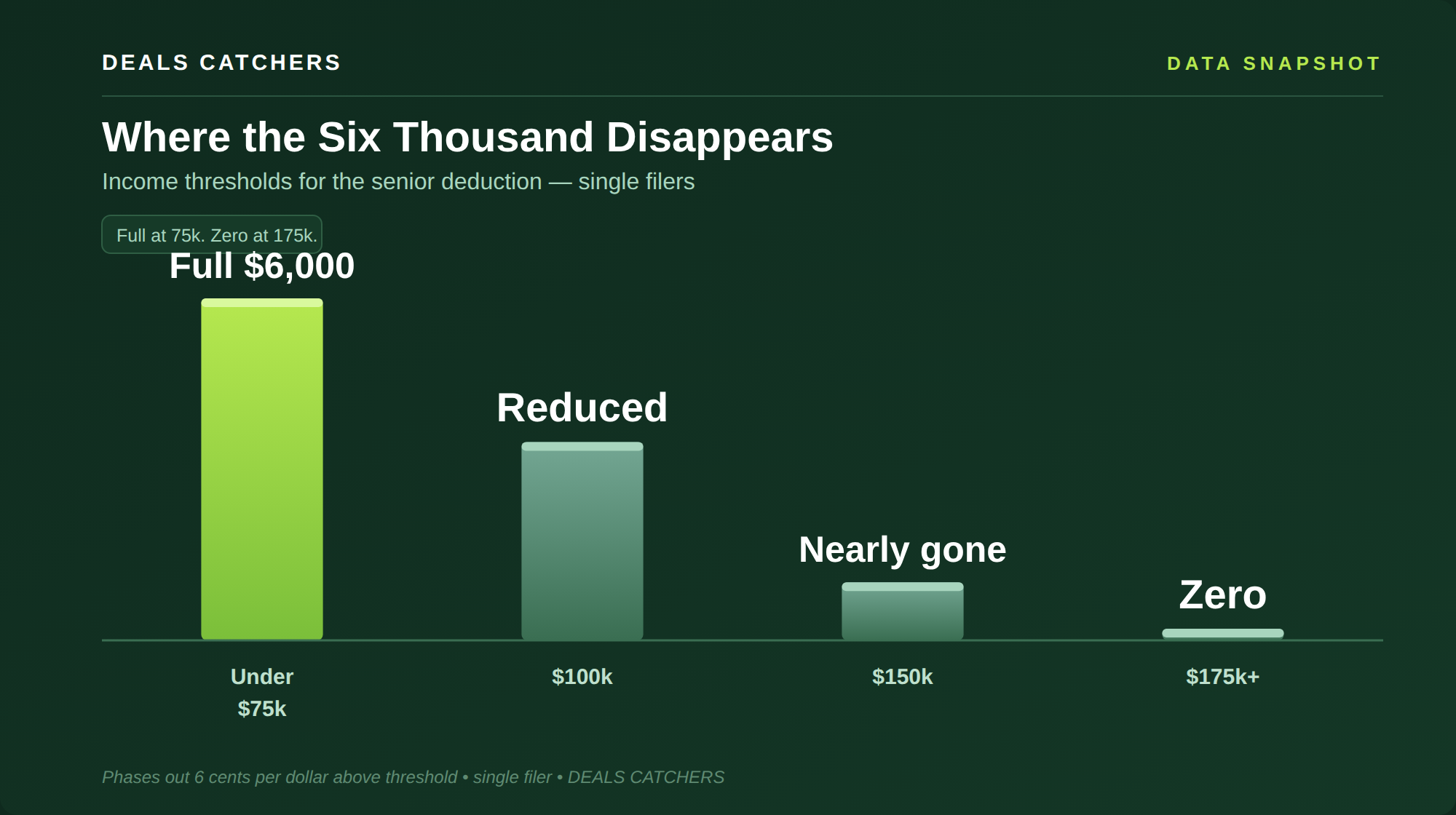
Full under seventy-five thousand, gone by one seventy-five — single filers.
That six-cents-per-dollar taper is why timing matters more than people realize. A big IRA withdrawal, a capital gain, a Roth conversion done in the wrong year — any of them can quietly push you up the ramp and shave the deduction without you ever seeing a line item explaining why.
Which is the real lesson here: for the next four years, when you take income matters as much as how much you take.
Sponsored


Trump Takes Emergency Action - Plus Elon Musk’s New Venture
Without most people noticing, Elon Musk has started a new venture that has nothing to do with rockets, EVs, Neuralink, or tunnels.
Trump has personally issued emergency support to roll this underlying tech out as fast as possible.
It’s already live in multiple states.
Behind the scenes, demand for this is already spiking...
The Financial Times says Sam Altman is begging people on the phone to build this for him and OpenAI.
Trump has personally issued emergency support to roll this underlying tech out as fast as possible.
It’s already live in multiple states.
Behind the scenes, demand for this is already spiking...
The Financial Times says Sam Altman is begging people on the phone to build this for him and OpenAI.
And the best part for you and your wealth is:
A few little-known companies control the supply chain.
Anyone who wants this tech - be it Sam Altman or even Elon himself - must go through these companies to get it.
You can simply buy their stocks right now... before this news becomes common knowledge.
A few little-known companies control the supply chain.
Anyone who wants this tech - be it Sam Altman or even Elon himself - must go through these companies to get it.
You can simply buy their stocks right now... before this news becomes common knowledge.
But you ought to move fast. Because leaked satellite images are already showing up online...
Regards,
Joel Litman
Chief Investment Officer, Altimetry
Joel Litman
Chief Investment Officer, Altimetry
The clock nobody mentions
Four Years. Written Into the Law.
The deduction covers tax years 2025 through 2028. That is not a prediction — it is in the statute. After 2028 it expires unless Congress renews it, and Congress renews nothing quietly.
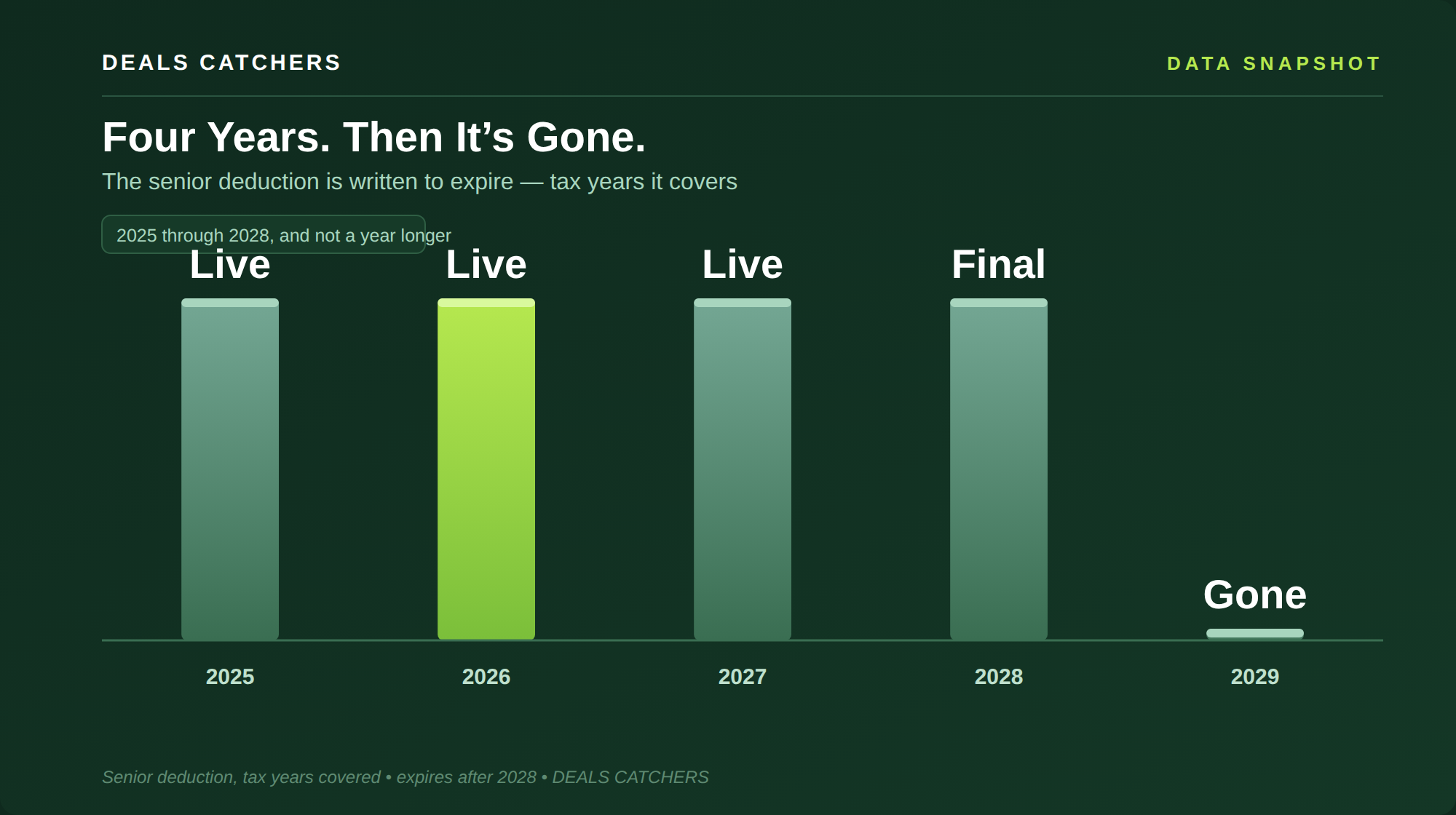
The senior deduction is written to expire after the 2028 tax year.
Four windows. One of them — the 2025 return — is already behind most people, and plenty missed it because the law landed halfway through the year. Three left.
And there is a second clock behind that one. The federal debt is closing on $39 trillion, with interest alone running near a trillion a year. Every analysis of this deduction, including the friendly ones, notes that it adds to that pile. Which tells you something about the odds of it being extended, and something about where fiscal pressure eventually lands.
Sponsored
Trump’s “One Big Beautiful Bill” Reshapes Retirement
Hardworking American,
The July 2025 law extended tax cuts with a $6K senior deduction — but rising federal debt is fueling concerns about long-term retirement stability.
Tax changes may narrow certain IRA strategies after Q3, leaving traditional accounts exposed to future policy shifts.
Retirement vehicles could face new limitations just as fiscal pressure builds toward 2026.
Preparation matters.
Our FREE 2026 Wealth Protection Guide explains diversification approaches — including how gold may fit into tax-advantaged planning before new rules fully take effect.
The July 2025 law extended tax cuts with a $6K senior deduction — but rising federal debt is fueling concerns about long-term retirement stability.
Tax changes may narrow certain IRA strategies after Q3, leaving traditional accounts exposed to future policy shifts.
Retirement vehicles could face new limitations just as fiscal pressure builds toward 2026.
Preparation matters.
Our FREE 2026 Wealth Protection Guide explains diversification approaches — including how gold may fit into tax-advantaged planning before new rules fully take effect.
P.S. Legislative “wins” can carry hidden consequences — review your protection options before implementation is complete.
THE THROUGH-LINE
Two very different stories today, one shape underneath them.
A tax deduction with an expiry date. A technology buildout where a handful of firms sit on the only path to the hardware. In both cases the advantage belongs to whoever knows the specifics before the crowd does — the taper threshold, the expiry year, the bottleneck, the supplier list. Not the headline. The mechanics underneath it.
That is what this letter is for. The details are where the money is.
You can simply buy their stocks right now... before this news becomes common knowledge. Click here to see how you could back Elon Musk’s next venture from your regular brokerage account. Ad
The Catcher’s Watchlist
Four liquid ways to watch the same forces — ones you can sell on a Tuesday if you change your mind.
SMH (Semiconductor ETF)
The bottleneck, in one ticker. If the AI story is really a supply-chain story, this is where it shows up first.
The bottleneck, in one ticker. If the AI story is really a supply-chain story, this is where it shows up first.
NVDA
The benchmark. Every “next big thing” in AI gets measured against it — worth watching just to keep score.
The benchmark. Every “next big thing” in AI gets measured against it — worth watching just to keep score.
TLT (20+ Year Treasuries)
The debt trade. The most direct read on what the market thinks a thirty-nine-trillion-dollar balance sheet is worth.
The debt trade. The most direct read on what the market thinks a thirty-nine-trillion-dollar balance sheet is worth.
GLD (Gold)
The old answer. What people reach for when fiscal pressure keeps building and nobody wants to say the word.
The old answer. What people reach for when fiscal pressure keeps building and nobody wants to say the word.
Analyst’s Note
Do the deduction first. Before you think about a single ticker, before you move a dollar anywhere, make sure you are actually claiming the six thousand that Congress already handed you — and if you are married and both over 65, the twelve. It is the highest guaranteed return available to you this year, because it is not a return at all: it is money you already earned that you are simply keeping. Then look at the taper. Seventy-five thousand single, one-fifty joint, six cents off for every dollar above. If you are anywhere near those lines, the order in which you take income over the next three years is worth more than most investment decisions you will make. A Roth conversion in the wrong year can cost you more than a bad stock pick. Talk to whoever does your return, and talk to them before December, not in April. As for the rest of it — the AI buildout, the supply chain, the thirty-nine trillion in debt — those are real forces and they will still be here next quarter. Protect what you have built. Then let the arithmetic tell you where the rest goes.
— Lee
THE BOTTOM LINE
Six thousand dollars a person. Twelve for a couple. Thirty-four million Americans eligible, and most of them have no idea. It stacks on top of everything else, it works whether you itemize or not, and it dies after the 2028 return unless Congress acts.
Two numbers decide whether you get it: seventy-five thousand if you file single, one hundred fifty if you file jointly. Above those, it tapers six cents on the dollar until it is gone. That means when you take income now matters as much as how much — and almost nobody is telling retirees that.
Forget the hot picks — protect what you’ve already built, and start by keeping the money that’s already yours. Because the best trade you’ll ever make is the loss you never took.
— Lee