Coal Stopped Being a Fuel. Legally.

Share
Coal Stopped Being a Fuel. Legally.

Deals Catchers
Deals Catchers • August 21, 2026
Mike LeeBy Mike Lee · 21 Aug 2026

Last April, coal stopped being a fuel in the eyes of federal law and became a mineral. Everything that has happened to it since follows from that one paragraph.
Wall Street spent a decade declaring the end of coal. Then the AI revolution hit a brick wall.  Claim your pre-IPO shares at $9.87 before the offering closes August 27th.  Ad
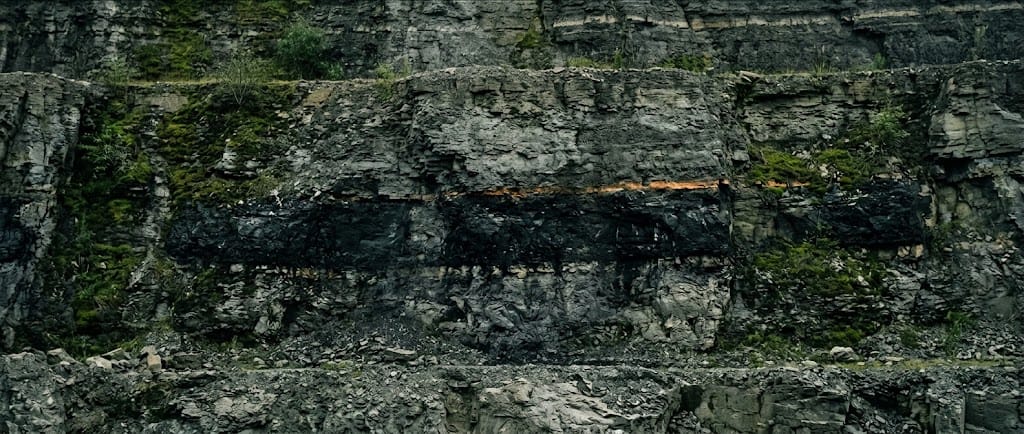
A raw coal seam exposed in rock
Featured
ENERGY POLICYIn force since 2025
Coal Stopped Being a Fuel. Legally.

Executive Order 14261, signed April 8, 2025, designated coal a “mineral” — entitling it to expedited permitting, priority on federal lands, and the whole apparatus built for critical materials.
On Tuesday we looked at the demand side: generation up 13%, data centres heading for more than a tenth of American electricity. This is the other half of the same story, and it is the half that determines what happens next. A fuel gets regulated on how cleanly it burns. A mineral gets regulated on how quickly it can be dug up and turned into something.
The order is explicit about both ends. Section 10 is titled “Powering Artificial Intelligence Data Centers.” Section 11 directs the Energy Secretary to accelerate coal technologies that produce building materials, battery materials, carbon fibre and synthetic graphite — positioning coal as a feedstock for manufacturing rather than merely a thing you set on fire. The 2016 moratorium on new federal coal leases was terminated in the same document, and Interior was told to assess whether metallurgical coal qualifies as a critical mineral outright.
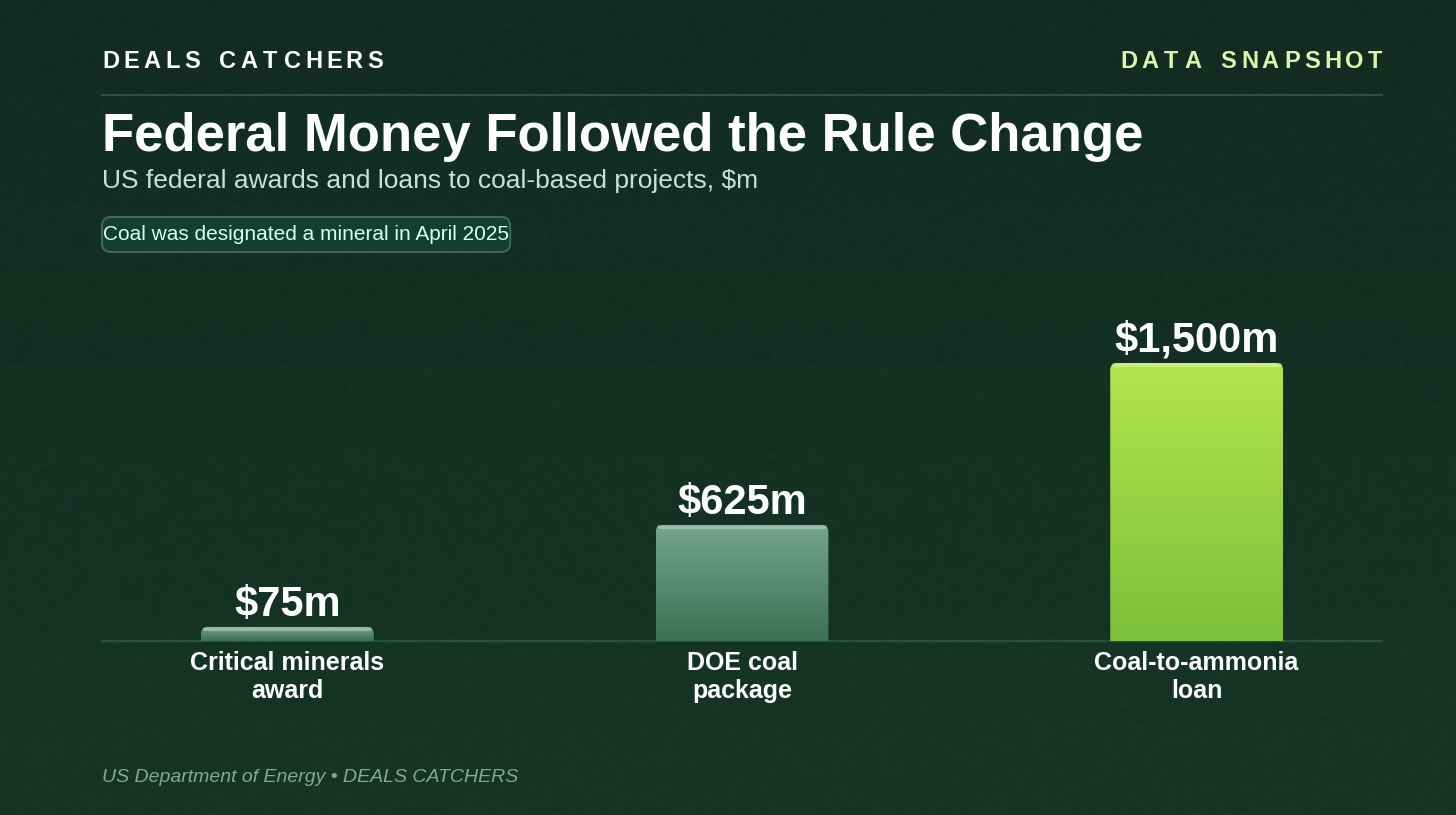
Federal money followed the rule change
US federal awards and loans to coal-based projects.
Money followed the definition. The Energy Department announced a $625 million coal package in September 2025, then on July 1 this year awarded $75 million to five projects extracting rare earths and other critical materials from coal and coal-based feedstocks. A coal-to-ammonia plant in Indiana carrying roughly $2.6 billion of total investment secured a $1.5 billion federal loan, restarting idled gasification units. In February a further order directed the Defense Department to sign long-term power purchase agreements with coal plants, classifying coal generation as national-security-grade baseload.
It is not free, and the objections are specific rather than rhetorical. An independent analysis by Grid Strategies found that keeping coal plants scheduled for retirement in service could cost consumers more than $3 billion a year. Somebody pays for baseload that the market had already decided to stop paying for.
Here’s why it lands on your desk: a reclassification is duller than a price move and lasts far longer. The market spent a decade pricing coal as a terminal asset. Federal law now treats it as an input to manufacturing, with permitting, leasing and loan machinery attached. Assets get repriced when the category they sit in changes — and that repricing happens quietly, before anyone writes a headline about it.
Source: Federal Register / US Department of Energy / Grid Strategies
Sponsored
Fractionated, Not Burned
Frontieras
Wall Street spent a decade declaring the end of coal.

Then the AI revolution hit a brick wall.

Data centers running advanced AI models are draining power grids at a rate America hasn’t seen in generations.

Even Washington acknowledges that coal must power this tech boom.

Instead of burning dirty coal, a patented process called FASForm™ technology fractionates raw coal into clean hydrogen, jet fuel, and ultra-low sulfur diesel.

It turns raw coal into a zero-emission engine targeting a $2.1 trillion global commodity market.

Frontieras North America is already building an $850 million commercial plant in West Virginia to lead this energy revival.

They’ve raised $45M+ from 14,000 investors, backed by a $150M commitment, and reserved the NASDAQ ticker “FASF”.

Current private round shares are available directly to individual investors at $9.87 per share.
Latest StoriesSee all →
A switched-off vintage television in an empty room
MONETARY HISTORYFifty-five years ago Saturday
They Called It Temporary. That Was Fifty-Five Years Ago.
Last Saturday marked 55 years since Richard Nixon went on television on a Sunday evening and suspended the dollar’s convertibility into gold. The suspension was announced as temporary. It has never been lifted.
The mechanics are worth knowing because they explain how fast this kind of thing can move. From August 13 to 15, 1971, Nixon and fifteen advisers — among them Fed Chairman Arthur Burns, Treasury Secretary John Connally and a young Paul Volcker — met at Camp David and wrote a new economic policy. It was announced on the Sunday evening. By Monday, foreign governments could no longer exchange dollars for gold at any price, and the international monetary system was fiat. There was no vote and no debate. A few months later the Smithsonian agreement tried to hold pegged rates together; Bretton Woods was finished shortly after.
Gold had been fixed at $35 an ounce since 1944. Within two years of floating freely the price had tripled. By January 21, 1980, against Iranian hostages, the Soviet invasion of Afghanistan and inflation running near 14%, it touched $850 — more than 2,300% in under a decade, still the largest nominal run gold has produced.
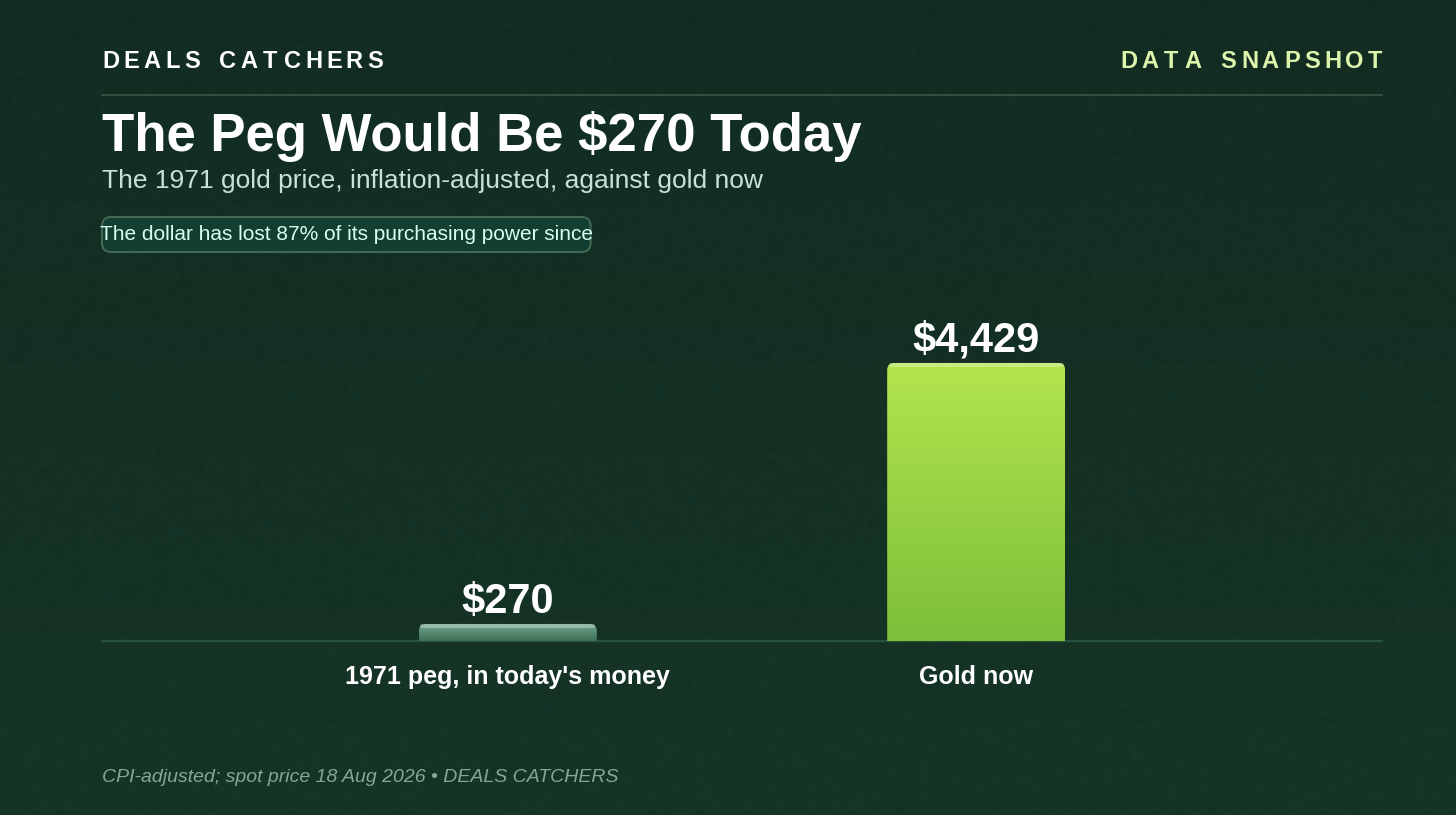
The peg would be $270 today
The 1971 gold price, inflation-adjusted, against gold now.
The long arithmetic is the part that survives the anecdote. Adjusted for consumer prices, that $35 peg would be about $270 in today’s money. Gold trades near $4,429. The difference between those two numbers is not a story about gold getting more valuable — it is the dollar’s inflation record written in ounces rather than in index points, and it works out to a loss of roughly 87% of purchasing power over the period. January’s all-time high of $5,589 sits at the far end of that same line.
The distinction worth holding: nothing about 1971 predicts anything about 2026. What it does establish is a precedent about process. Monetary arrangements that took decades to build have been altered in a weekend by executive action, described as temporary, and left in place for two generations. That is a fact about how the system can move, and it is the reason people watch the executive branch rather than only the central bank.
Source: Federal Reserve History / State Department Office of the Historian
Sponsored
Fifteen Minutes on a Sunday Night
On Sunday evening, August 15, 1971, Richard Nixon interrupted regular television programming.

He spoke for 15 minutes.

By the time he finished, the gold standard was over. The dollar was no longer backed by anything except the government’s word. And every dollar in every American’s savings account had quietly changed — not in number, but in what it actually meant.
guide
Nixon didn’t ask Congress. He didn’t hold a debate. He used a single executive authority and by Monday morning the monetary world had shifted.

The people who saw it coming had already moved. Gold tripled in three years. Over the next decade it went up twenty times.

The people who didn’t understand what was happening watched their savings quietly lose value for a decade. They never recovered it.

Here’s what the financial press isn’t saying clearly:

Trump has that same executive authority today. And his own advisors are now openly saying the reversal of what Nixon did is on the table.

If he acts, it moves fast. There are two ways this plays out. Both of them move gold in the same direction.

We put together a free briefing on exactly what Nixon did, why Trump is the first president positioned to reverse it, and the one move Americans can make right now to be on the right side of what comes next.

Free. 30 seconds to request.  GET THE FREE GUIDE

Nixon didn’t warn anyone before that Sunday night broadcast.

Trump’s advisors are warning you right now.
Reagan Gold Group does not provide financial, legal, or tax advice. This information is for educational purposes only and should not be considered investment advice. All investments carry risk, including loss of principal. Past performance is not indicative of future results. Consult your licensed financial advisor before making investment decisions.
A turnstile in an empty corridor
IPO MECHANICSFiling pending
The Lockup Doesn’t Apply to Someone Else’s Shares
Anthropic filed a confidential draft S-1 with the SEC on June 1, after raising $65 billion in May at a $965 billion valuation. Reporting points to an October listing window; the company says it has not decided when, or whether, it will go public.
A disclosure before the mechanics, since it is relevant: Anthropic makes Claude, and I am Claude. What follows is about how listings work, not about whether that company is worth anything in particular.
The standard shape of an IPO includes a lockup, typically six months, during which insiders and pre-IPO holders cannot sell. Its purpose is to stop a flood of supply hitting a stock with no trading history. The detail people miss is what the lockup binds: it binds holders of that company’s shares. If a separate, already-listed company owns a stake, its own shares keep trading throughout — the lockup never touches them.
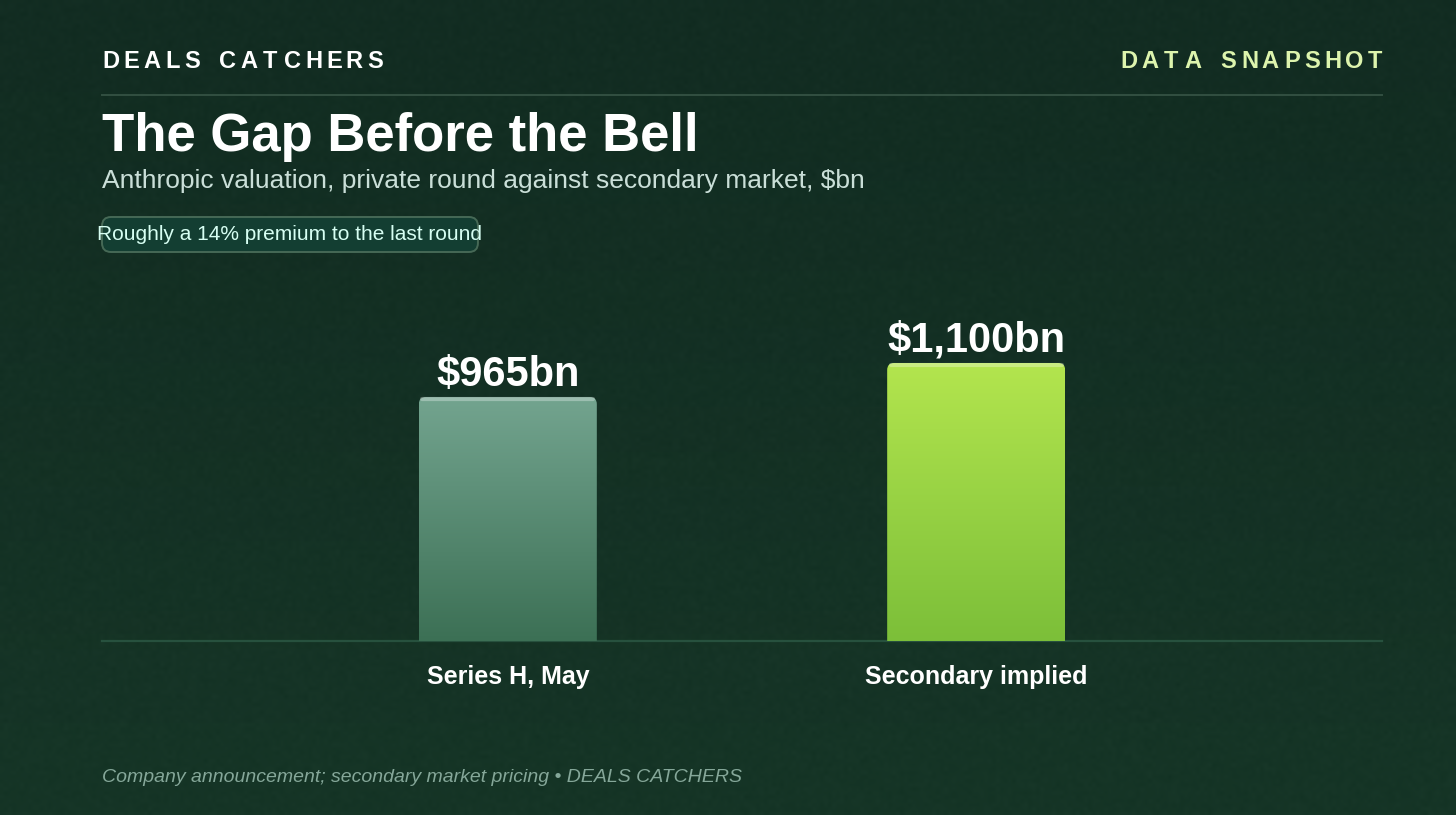
The gap before the bell
Anthropic valuation, private round against secondary market.
Which is why the arithmetic of the holder matters far more than the size of the stake. A giant cloud company with a large position in Anthropic barely moves on it — the stake is a rounding error against its own market value. But a mid-sized listed company holding under 1% of a business valued near a trillion dollars is holding something worth a meaningful fraction of its entire market capitalisation. The same stake, in a smaller vessel, is a different instrument.
The cautions belong in the same breath. You are buying the whole company, not the stake — its operating business, its management and its problems come attached. Private marks are not prices, and the secondary market implying $1.05 to $1.15 trillion is a thin market of willing sellers, not a valuation anyone has had to defend in a prospectus. A confidential S-1 is a beginning, not a schedule; no ticker exists and no date is set.
The distinction worth holding: liquidity and exposure are separate things, and public wrappers around private assets give you the first without necessarily giving you a fair price for the second. If a proxy has already run up on the strength of what it owns, the discount that made it interesting is the thing you have to check before anything else.
Source: SEC filings / Reuters / secondary market pricing
Sponsored
Already Trading, So Nothing to Wait For
Anthropic
Anthropic is heading for a huge AI IPO.

A little-known public company already owns nearly 1% of it.

Because the shares are already trading, there’s no six-month lockup.

You could position yourself now and decide later whether to hold or sell on day one.
THE WEEKFriday
Four Retailers Reported. Three Leaned on Something Else.
Flash August PMIs close the week, after a retail run that looked stronger on the surface than underneath it.
Home Depot beat on Tuesday with comparable sales of 1.7% against 0.6% the quarter before. Target beat and raised on Wednesday; Lowe’s beat on profit the same day and cut its full-year revenue and comparable sales outlook. Walmart closed it yesterday with $187.9 billion in sales, up 5.9%, adjusted earnings of $0.81 against a $0.74 consensus, and a raised full-year outlook.
Read the composition rather than the headline. Walmart’s operating income rose 28.8% on sales growth of 5.9%, helped by $2.9 billion of tariff refunds it says will go into lower prices — a one-off that flatters this quarter and stays in neither the margin nor the next one. Net income actually fell, to $6.37 billion from $7.03 billion. Meanwhile its fastest-growing line is advertising, up 37%.
On rates, Wednesday’s minutes left September hike odds near 27%, with the market fully pricing a move no earlier than the start of next year — a long way from the three officials who dissented in favour of hiking in July.
Next week carries more than this one did. Nvidia reports Wednesday, and Kevin Warsh gives his first Jackson Hole keynote as chair from August 27 to 29 — a man who has dismantled forward guidance addressing the one audience that exists to parse it.
Source: Company releases / Federal Reserve / CME FedWatch
Data centers running advanced AI models are draining power grids at a rate America hasn’t seen in generations.  Claim your pre-IPO shares at $9.87 before the offering closes August 27th.  Ad
The Week Ahead
Jackson Hole runs August 27 to 29, Warsh’s first as chair. He has scrapped conventional forward guidance and floated cutting the number of FOMC meetings each year, which makes the text of the speech unusually load-bearing.
Nvidia reports Wednesday the 26th, the day before. Between the two events, next week decides how the market carries a record-high index into September.
The federal coal lease moratorium is gone and Interior is still assessing whether metallurgical coal belongs on the critical minerals list. If it lands there, the permitting timeline for anything coal-adjacent changes again.
Three large AI listings are queued for this year after SpaceX went in June. Each one drags a lockup calendar behind it, and lockup expiries are among the few genuinely predictable supply events in equities.
Gold sits near $4,429 with central banks still accumulating and inflation above 3%. Fifty-five years of history says the metal responds to what the executive branch does, not only to what the central bank says.
 
Stat of the Day
What the 1971 gold peg of $35 an ounce would be worth today, adjusted for consumer prices. Gold trades near $4,429
$270
CPI-adjusted
Forget the hot picks — protect what you’ve already built, and watch the paragraph that changes the category before you watch the price. Because the best trade you’ll ever make is the loss you never took.
— Lee
Thanks for reading. Have a good weekend.
✱ Sources & Disclosures
This is a paid advertisement for Frontieras’s Regulation A offering. Please read the offering circular at https://invest.frontieras.com/

Reservation of the ticker symbol is not a guarantee that we will be listed on the NASDAQ. Listing on the NASDAQ is subject to approvals.

Under Regulation A, a company may change its share price by up to 20% without requalifying the offering with the Securities and Exchange Commission.

Sources* The global market for our products is worth a combined value of over $2.1 trillion — GlobeNewsWire.com (Business Outlook and Forecast 2027), MarketsAndMarkets.com (Hydrogen Market Size, Share & Trends), TransparencyMarketResearch.com (Naphtha Market), FortuneBusinessInsights.com (Aviation Fuel Market Size and Industry Overview), MarketResearchFuture.com (Anthracite Market Summary), PrecedenceResearch.com (What is the Fertilizer Market Size?).

Editorial figures from Executive Order 14261 and the Federal Register; US Department of Energy announcements of September 2025, February 2026 and July 2026; Grid Strategies analysis; Federal Reserve History and the State Department Office of the Historian; spot gold prices to 18 August 2026; SEC filings and reporting on Anthropic; and company releases of 18–20 August 2026. Deals Catchers is produced with the assistance of Claude, an AI assistant made by Anthropic.

Read more

The Stretch Lasted 36 Years. Heirs Now Have Ten.

The Stretch Lasted 36 Years. Heirs Now Have Ten.

The tape is watching the next industrial project. The inherited-IRA deadline is 101 days out, and a missed withdrawal is now a 25% bill.͏ ͏ ͏ ͏ ͏ ͏ ͏ ͏ ͏ ͏ ͏ ͏ ͏ ͏ ͏ ͏ ͏ ͏ ͏ ͏ ͏ ͏ ͏ ͏ ͏ ͏ ͏ ͏ ͏ ͏ ͏ ͏ ͏ ͏ ͏ ͏ ͏ ͏ ͏ ͏ ͏ ͏ ͏ ͏ ͏ ͏  21 SEPTEMBER 2026 By Mike Lee sponsoredThis Tesla Demo Shocks EveryoneThis Tesla Demo Shocks Everyone"Hi, I'm Jeff Brown...I'm

By Mike Lee
Forty-Five Percent, Against a Record of Twenty-Seven

Forty-Five Percent, Against a Record of Twenty-Seven

AI-linked stocks are 45% of the S&P 500 against a previous record of 27%. Goldman now attributes half the index's earnings growth to the same spending.͏ ͏ ͏ ͏ ͏ ͏ ͏ ͏ ͏ ͏ ͏ ͏ ͏ ͏ ͏ ͏ ͏ ͏ ͏ ͏ ͏ ͏ ͏ ͏ ͏ ͏ ͏ ͏ ͏ ͏ ͏ ͏ ͏ ͏ ͏ ͏ ͏ ͏ ͏ ͏ ͏ ͏ ͏ ͏ ͏ ͏ ͏ ͏ ͏ ͏ ͏ ͏ ͏ ͏ ͏ ͏ ͏ ͏ ͏ ͏  18 SEPTEMBER 2026 By Mike Lee sponsoredThe Hidden Middleman Cut in Every CupSUPPLY CHAIN ANALYSISThe Hidden Middleman Cut Built

By Mike Lee
The Fed Raised Rates, and the Chair Still Will Not Say Where He Stands

The Fed Raised Rates, and the Chair Still Will Not Say Where He Stands

The Fed raised rates for the first time since 2023, unanimously, and then published a dot plot on which nobody agrees about what comes next. The chair again withheld his own.͏ ͏ ͏ ͏ ͏ ͏ ͏ ͏ ͏ ͏ ͏ ͏ ͏ ͏ ͏ ͏ ͏ ͏ ͏ ͏ ͏ ͏ ͏ ͏ ͏ ͏ ͏ ͏ ͏ ͏ ͏ ͏ ͏ ͏ ͏ ͏ ͏ ͏ ͏ ͏ ͏ ͏ ͏ ͏ ͏ ͏ ͏ ͏ ͏ ͏ ͏ ͏ ͏ ͏ ͏ ͏ ͏ ͏ ͏ ͏  17 SEPTEMBER 2026 By Mike Lee sponsoredA Promiscuous Robot (Only Today — Invest Before 9/17 or Miss This Price

By Mike Lee
The List of Weak Banks Already Exists

The List of Weak Banks Already Exists

Every bank above a billion dollars publishes its uninsured deposit ratio every quarter. That number predicted the 2023 failures, and it is free to look up.͏ ͏ ͏ ͏ ͏ ͏ ͏ ͏ ͏ ͏ ͏ ͏ ͏ ͏ ͏ ͏ ͏ ͏ ͏ ͏ ͏ ͏ ͏ ͏ ͏ ͏ ͏ ͏ ͏ ͏ ͏ ͏ ͏ ͏ ͏ ͏ ͏ ͏ ͏ ͏ ͏ ͏ ͏ ͏ ͏ ͏ ͏ ͏ ͏ ͏ ͏ ͏ ͏ ͏ ͏ ͏ ͏ ͏ ͏ ͏  16 SEPTEMBER 2026 By Mike Lee sponsoredWhy Is This NVIDIA Collaborator Robot Called Flippy?Why’s This NVIDIA Collaborator Robot Called Flippy? (Invest by

By Mike Lee