China Digs Up a Tenth of It. And Owns the Rest.

 |
China Digs Up a Tenth of It. And Controls Almost All of It.
 By Mike Lee14 Jul 2026 · 8 min read
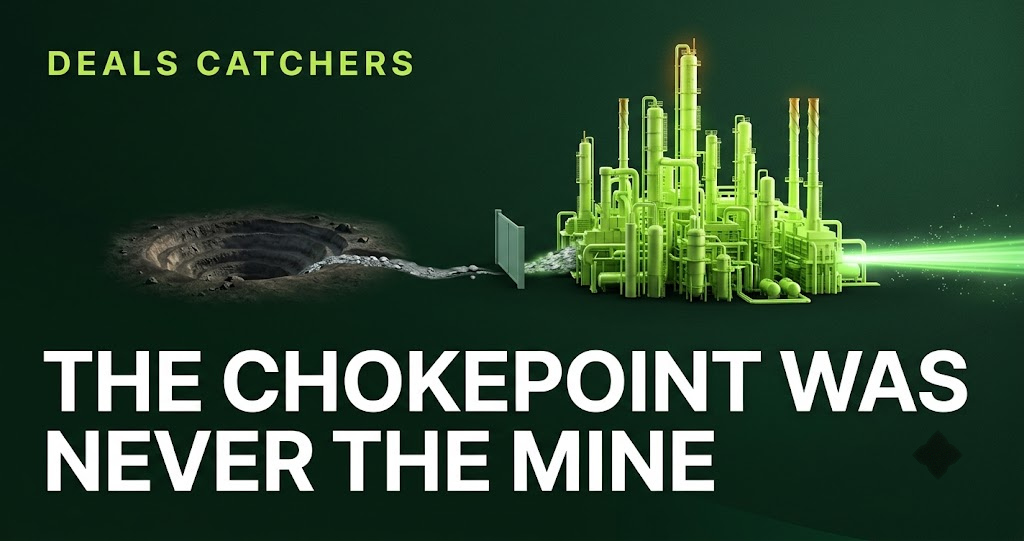
Everyone argues about who owns the mines. That argument is fifty years out of date. The real leverage was never in the ground — it is in the unglamorous factories that turn rock into something useful, and one country quietly bought almost all of them.
⏱ The 60-Second Catch
• China mines only about a tenth of the world’s lithium — but refines most of it, and builds roughly 80% of all batteries. The chokepoint was never the mine.
• America is 100% import-dependent for a dozen critical minerals, and imports more than half its supply of 29 others. Washington now treats that as a defense problem, not a trade one.
• The response has gone from speeches to cheque-writing — permits fast-tracked, the Defense Production Act invoked, and the government taking equity stakes in mining companies.
THE OPEN
Here is a number that rearranged how I think about the whole minerals fight: China digs up about ten percent of the world’s lithium.
Ten percent. That is it. For years I assumed Beijing’s grip came from owning the ground — that somewhere out there was a vast Chinese mine we’d all somehow missed. There isn’t. Australia digs up more than half of it. Chile is second. The rocks are mostly in friendly hands.
And yet China decides who gets lithium. Not because of what it owns, but because of what it built: the unglamorous, filthy, capital-hungry factories that turn a grey rock into something a battery can actually use. That is the whole game, and almost nobody outside the industry understands it.
Sponsored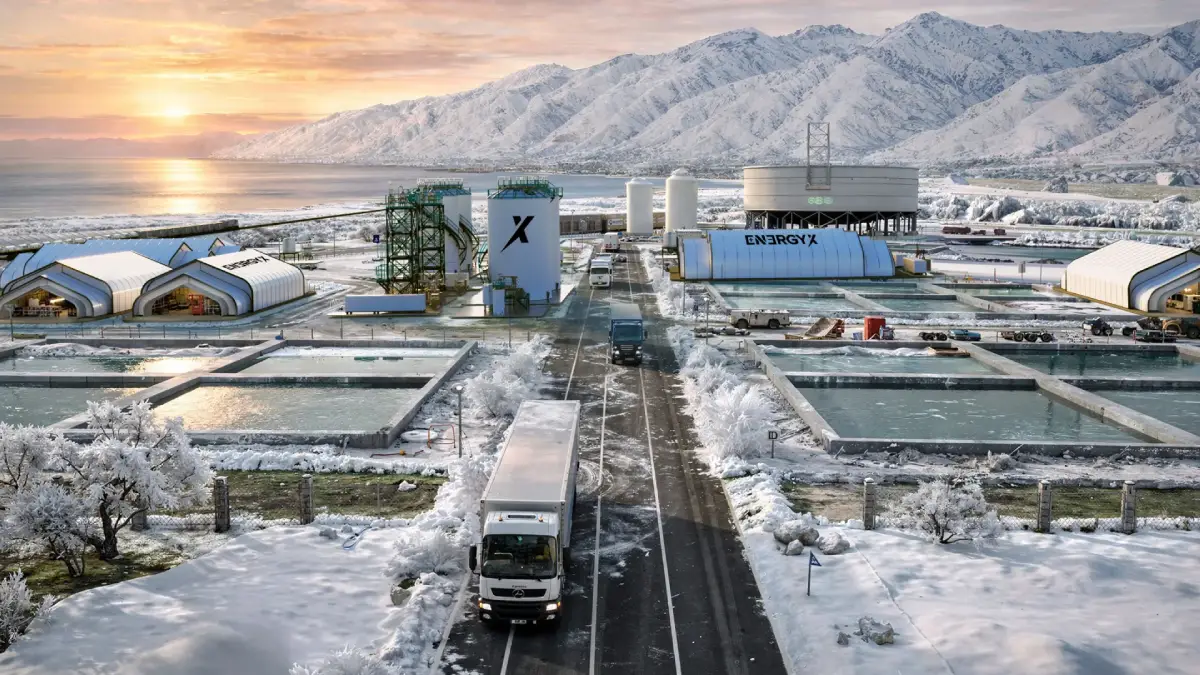
Trump Declared War on China’s Mineral Monopoly. This Stock Sits in the Crosshairs.
America Is Racing to Break China’s Grip on Lithium. EnergyX Is Already Producing It.
China controls an estimated 75% of the world’s lithium processing, the material inside every EV, phone, drone, and missile. Washington has decided that’s a national security problem.
Since 2025, the Trump administration has signed executive orders treating critical minerals as a defense priority: fast tracking permits, invoking the Defense Production Act, and steering federal financing toward American producers. In February 2026, 54 nations met in Washington to coordinate against China’s mineral dominance.
China controls an estimated 75% of the world’s lithium processing, the material inside every EV, phone, drone, and missile. Washington has decided that’s a national security problem.
Since 2025, the Trump administration has signed executive orders treating critical minerals as a defense priority: fast tracking permits, invoking the Defense Production Act, and steering federal financing toward American producers. In February 2026, 54 nations met in Washington to coordinate against China’s mineral dominance.
EnergyX is exactly the company that push was built for. It’s an American lithium producer backed by the U.S. Department of Energy ($5M grant), with a $690M project finance LOI from the U.S. Export-Import Bank and Goldman Sachs advising. Its GET-Lit™ tech extracts up to 3X more lithium than legacy methods, on U.S. soil.
GM, POSCO, and Eni are already in. 50,000+ investors have backed it with $180M+. You can join them at $13/share before July 16.
GM, POSCO, and Eni are already in. 50,000+ investors have backed it with $180M+. You can join them at $13/share before July 16.
∗
The part everyone gets wrong
The Chokepoint Was Never the Mine
A lithium rock out of the ground is worthless. To become battery-grade material it has to be crushed, leached, purified, and converted — a brutal industrial process with thin margins and ugly waste. The West spent thirty years deciding that was somebody else’s job. Beijing took the job.
~10% of the world’s lithium China actually mines | ~65-70% of the world’s lithium China refines | ~80% of the world’s batteries China builds |
Across cobalt, graphite, and rare earths the pattern repeats: someone else owns the dirt, China owns the conversion. Analysts at CSIS put Beijing’s processing share for key battery materials somewhere between 40 and 90 percent depending on the mineral. When you control the only door every rock has to walk through, you don’t need to own the quarry.
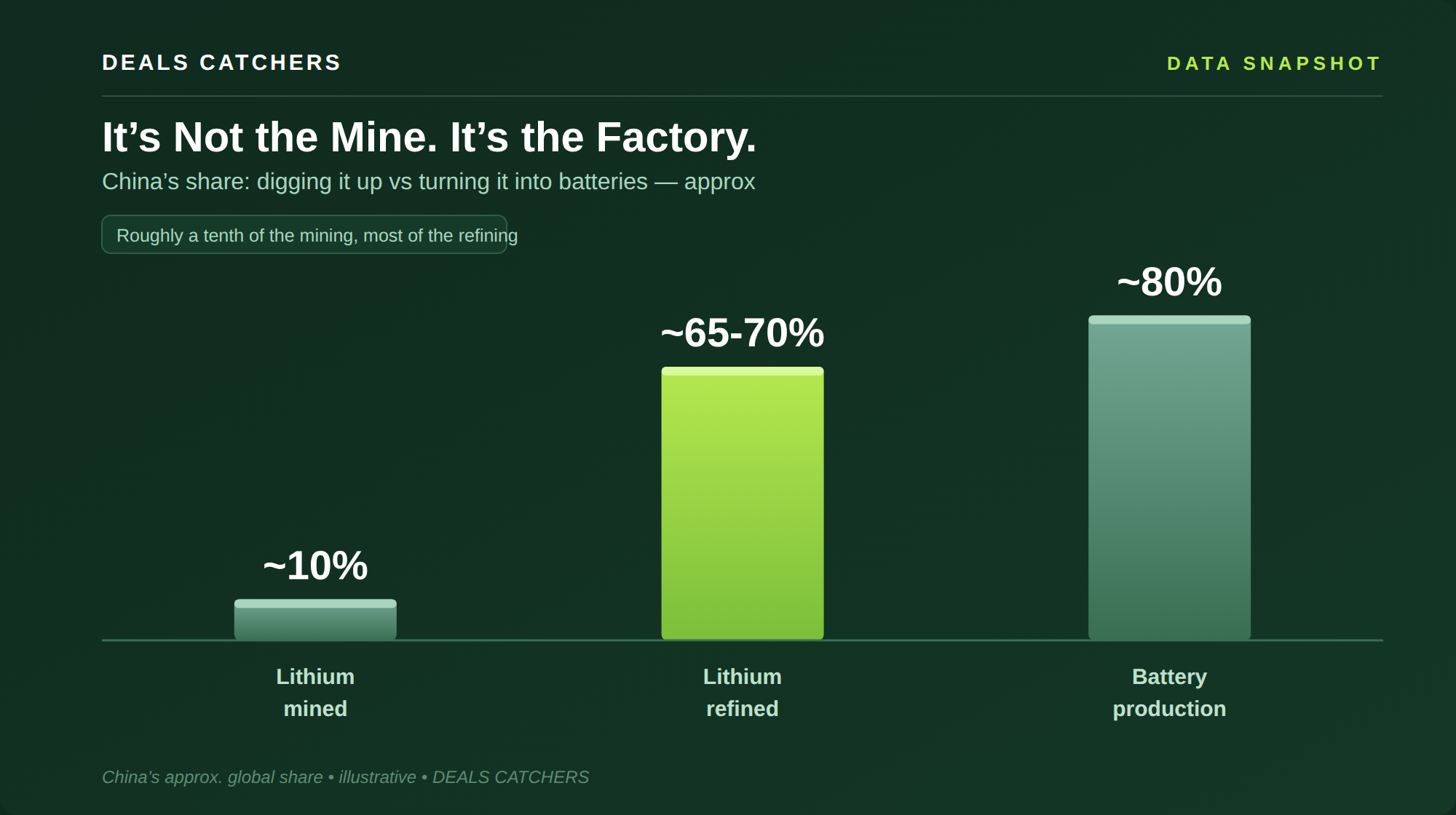
Digging it up versus turning it into batteries — approximate global share.
WHAT AMERICA WOKE UP TO
The exposure is not a talking point. The United States is fully import-dependent for twelve critical minerals and imports more than half its supply of twenty-nine others. Those materials sit inside every fighter jet, missile, data center, and phone in the country. For decades that was filed under “trade.” Now it is filed under “defense.”
What changed is the seriousness. Executive orders now treat processed minerals as a security matter. The Defense Production Act — a Korean War-era law — has been dusted off for mining. Federal money is being steered at domestic producers, and in a genuine break with tradition, the government has started taking equity stakes in mining companies outright. Washington isn’t lobbying the market. It is joining it.
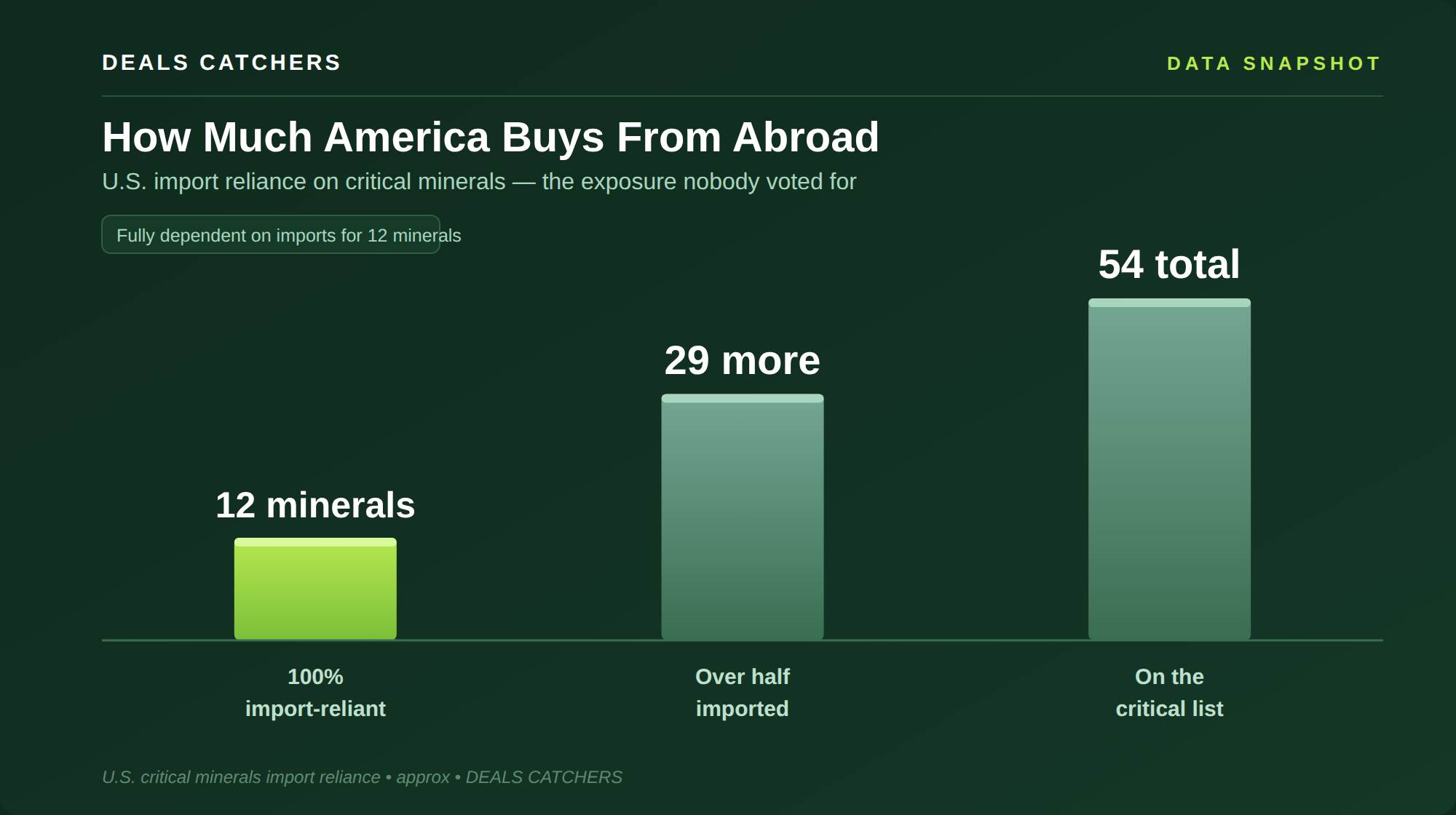
The exposure nobody voted for — U.S. import reliance on critical minerals.
This is the current running under tonight’s first story. When you see an American lithium producer like EnergyX below making its case, it is standing in the middle of that policy shift — the one place Washington has decided it cannot afford to lose.
Sponsored
My #1 Stock Pick for 2026 (Free Ticker Inside)
This stock recently triggered the exact same proprietary signal that flashed before Nvidia, Apple, and every other member of the Magnificent Seven soared dramatically.
Right now, Marc Chaikin is telling his 800,000 followers to BUY this $40 stock - before the end of the month.
You can get the name and ticker symbol, 100% free, by watching my urgent interview with Marc before it goes offline.
Right now, Marc Chaikin is telling his 800,000 followers to BUY this $40 stock - before the end of the month.
You can get the name and ticker symbol, 100% free, by watching my urgent interview with Marc before it goes offline.
The uncomfortable arithmetic
Buying the Factories Back Takes a Decade
Here is what nobody campaigning on this likes to say out loud: you cannot fix a thirty-year head start in one presidential term. A new mine takes seven to ten years to permit and build in America. A refinery isn’t much faster. The expertise, the engineers, the tolerance for the mess — all of that moved overseas and has to be rebuilt from something close to scratch.
Which means this is not a headline that resolves. It is a decade-long re-industrialisation, with real money behind it and real bipartisan appetite — the rare kind of trend that survives an election. It also means the loudest, fastest-moving stories about it will usually be the least useful ones.
The slow version is the real one: permits, plants, offtake contracts, boring quarterly progress. That is where the value gets built, and it is exactly the part that never makes a good headline.
Sponsored
This Startup Is Growing 23X Faster Than Nvidia
See this document below?
Elon Musk just revealed what I believe is the biggest investment opportunity of the year when he filed this official document with the SEC.
Because on page 146 he revealed the name of a startup that’s set to be…
The next monster IPO on Wall Street. (Click here to get the details.)
Even though this has nothing to do with robots, self-driving cars, or rockets…
This startup is growing faster than Tesla…
Faster than SpaceX…
And it’s even growing 23 times faster than Nvidia.
That’s why The Atlantic called it…
“The fastest-growing business in the history of capitalism.”
These types of explosive IPO opportunities are normally off-limits to everyday folks like you.
They’re reserved for rich people on Wall Street and Silicon Valley.
But I found a way for you to claim your stake before the IPO… starting for less than $50.
Elon Musk just revealed what I believe is the biggest investment opportunity of the year when he filed this official document with the SEC.
Because on page 146 he revealed the name of a startup that’s set to be…
The next monster IPO on Wall Street. (Click here to get the details.)
Even though this has nothing to do with robots, self-driving cars, or rockets…
This startup is growing faster than Tesla…
Faster than SpaceX…
And it’s even growing 23 times faster than Nvidia.
That’s why The Atlantic called it…
“The fastest-growing business in the history of capitalism.”
These types of explosive IPO opportunities are normally off-limits to everyday folks like you.
They’re reserved for rich people on Wall Street and Silicon Valley.
But I found a way for you to claim your stake before the IPO… starting for less than $50.
The Catcher’s Watchlist
Four liquid ways to watch the reshoring push — no private round required.
LIT (Lithium ETF)
The whole theme in one ticker. Owns the miners and the processors together, which is the honest way to hold this.
The whole theme in one ticker. Owns the miners and the processors together, which is the honest way to hold this.
ALB (Albemarle)
The American incumbent. The largest U.S.-listed lithium name — the benchmark every newcomer gets measured against.
The American incumbent. The largest U.S.-listed lithium name — the benchmark every newcomer gets measured against.
MP (MP Materials)
The reshoring test case. Rare earths, not lithium, but it is the clearest example of Washington putting money where its mouth is.
The reshoring test case. Rare earths, not lithium, but it is the clearest example of Washington putting money where its mouth is.
GLD (Gold)
The patience asset. What you hold while a decade-long industrial rebuild grinds along on its own schedule.
The patience asset. What you hold while a decade-long industrial rebuild grinds along on its own schedule.
Analyst’s Note
The ten-percent number is the one I want you to keep. It reframes the entire argument: this was never a story about who got lucky with geology, it is a story about who was willing to do the dirty industrial work while the West outsourced it and called that progress. Undoing that takes a decade, not a news cycle — permits, plants, engineers, offtake deals, quarter after unglamorous quarter. And that is precisely why I’d be careful with anything promising you a shortcut through it. The trend is about as durable as trends get; there is bipartisan money behind it and a defense rationale under it, and it will still be here in five years. But durable is not the same as fast, and a ten-year rebuild does not owe you a payoff on your schedule. Own it in a form you can sell if you change your mind, keep your position small enough that being early is merely annoying rather than painful, and let the slow version of the story do the work. The slow version is usually the true one.
— Lee
THE BOTTOM LINE
China mines a tenth of the world’s lithium and controls where nearly all of it goes. That single fact explains the executive orders, the summits, the government buying stakes in mining companies, and every “American lithium” pitch landing in your inbox this month. The leverage was never in the ground. It was in the factories nobody wanted to build.
Washington has finally noticed, and is spending accordingly. But a thirty-year head start does not close in a news cycle — it closes over a decade of permits and plants and patience. That is the opportunity and the trap in the same sentence: the trend is real, the timeline is long, and everything sold to you as urgent is fighting that arithmetic.
Forget the hot picks — protect what you’ve already built, and let a decade-long trend pay you on its schedule instead of someone else’s deadline. Because the best trade you’ll ever make is the loss you never took.
— Lee
∗ Sources & Disclosures
∗ Energy Exploration Technologies, Inc. (“we”, “us”, “our”, and “EnergyX”) is conducting an offering of securities pursuant to Regulation A of the Securities Act of 1933, as amended. An offering statement covering this offering has been qualified by the U.S. Securities and Exchange Commission (the “SEC”). Neither this communication nor any of its content constitutes an offer to sell, solicitation of an offer to buy or a recommendation for any of our securities by our company or any third party. Offers and sales of the securities are being made solely by means of the qualified offering circular. Investing in our securities involves significant risks. Before investing, you should consult with your financial advisor, accountant, and/or attorney, and carefully review the qualified offering circular (including the “Risk Factors” section) and any offering circular supplements. The most recent qualified offering circular is available at sec.gov (Form 253G2), and can also be found on the SEC’s EDGAR filing database at sec.gov/edgar/search. Prospective investors should note that neither the SEC nor any federal or state securities commission or regulatory authority has approved or recommended our securities or determined that our offering circular is truthful or complete. Any representation to the contrary is unlawful. We are not a broker-dealer or investment adviser registered under the Securities Exchange Act of 1934 or the Investment Advisers Act of 1940. No communication made by us or any of our affiliates, through this communication or any other medium, should be construed as a recommendation to purchase, sell, or hold any securities, or as investment, tax, financial, accounting, legal, regulatory, or compliance advice. The content presented here is provided for general information purposes only and is not intended to solicit the purchase of securities or to be used as investment, legal or tax advice.
Statement Regarding Forward-Looking Statements. The information presented herein may include forward-looking statements, estimates, or projections regarding our anticipated future performance. If present, these statements are subject to risks, uncertainties, and assumptions. In some cases, you can identify these statements by forward-looking words such as “may”, “might”, “will”, “should”, “expect”, “plan”, “anticipate”, “believe”, “estimate”, “predict”, “potential”, “future” or “continue”, the negative of these terms, and other comparable terminology. Such forward-looking statements are based on current plans, estimates and expectations and are made pursuant to the Private Securities Litigation Reform Act of 1995. These statements, estimates and projections, if any, are based upon various assumptions made concerning our anticipated results and industry trends, which may or may not occur. We are not making any representations as to the accuracy of any such forward-looking statements, estimates or projections. Our actual performance may be materially different from any such statements, estimates or projections. We are under no duty to update any of these forward-looking statements to conform them to actual results or revised expectations.
Statement Regarding Forward-Looking Statements. The information presented herein may include forward-looking statements, estimates, or projections regarding our anticipated future performance. If present, these statements are subject to risks, uncertainties, and assumptions. In some cases, you can identify these statements by forward-looking words such as “may”, “might”, “will”, “should”, “expect”, “plan”, “anticipate”, “believe”, “estimate”, “predict”, “potential”, “future” or “continue”, the negative of these terms, and other comparable terminology. Such forward-looking statements are based on current plans, estimates and expectations and are made pursuant to the Private Securities Litigation Reform Act of 1995. These statements, estimates and projections, if any, are based upon various assumptions made concerning our anticipated results and industry trends, which may or may not occur. We are not making any representations as to the accuracy of any such forward-looking statements, estimates or projections. Our actual performance may be materially different from any such statements, estimates or projections. We are under no duty to update any of these forward-looking statements to conform them to actual results or revised expectations.