
A Real IRS Gold Rule, Elon’s X Money Launch, and an AI Options Tool: Three Very Different Pitches

408(m) Revealed

Did you know there’s an IRS rule — 408(m) — that may allow certain retirement savers to move part of a 401(k), IRA, TSP, or 403(b) into physical gold and silver… without triggering early-withdrawal penalties and while keeping retirement tax advantages intact?
Most Americans have never even heard of it.
Yet wealthy investors use strategies like this to protect gains, reduce exposure, and stay positioned when markets turn violent.
It’s a legal, IRS-recognized framework — one that can help you protect retirement wealth without selling everything into cash.
We broke it down step-by-step in a FREE 408(m) guide. Grab your FREE 408(m) Guide now.
Because when the next crash hits… The people who prepared early don’t panic.
P.S. Wall Street won’t advertise this. Insiders move first.
| Get the Guide Before the Window Gets Crowded → |

Three Pitches, Three Very Different Levels of Substance
This issue carries three advertisers, and they sit at genuinely different points on the substance spectrum — which is worth saying plainly up front. The first is built on a real, verifiable IRS rule: Section 408(m) of the Internal Revenue Code does in fact allow certain retirement accounts to hold physical gold and silver. The second is anchored to a real event — Elon Musk’s X Money payment system, which launched in 2026 — wrapped in some very large projection numbers. The third is a trading-software tool making claims about forecasting accuracy that, by their nature, can’t be verified in advance. As always, the promotional copy below runs as the advertisers wrote it; the editorial notes around it are where we separate what’s solid from what’s marketing.
What this means for your retirement accounts: The most useful skill a retirement investor can bring to a page like this is the ability to tell a real regulatory framework from a projection dressed up as one. The 408(m) rule is real. The X Money launch is real. Whether either is right for your situation — and whether the specific products being sold around them deliver — is a separate question entirely, and one worth bringing to a fee-only adviser rather than a sales funnel.
What 408(m) Actually Says — and What It Doesn’t
Because this is the one pitch on the page built on a genuine rule, it’s worth getting right. By default, the IRS prohibits retirement accounts from holding “collectibles.” But Section 408(m)(3) of the Internal Revenue Code — an exception Congress created in 1986 and expanded through the Taxpayer Relief Act of 1997 — carves out specific precious metals: gold of at least 99.5% fineness, silver at least 99.9%, and platinum and palladium at higher thresholds, provided they’re held by an approved trustee. In practice this is done through a Self-Directed IRA with a qualified custodian, and a properly executed rollover from a 401(k), IRA, TSP, or 403(b) into such an account does not trigger an early-withdrawal penalty or an immediate tax event. The American Gold Eagle is a notable exception to the purity rule — it’s only 91.67% pure but qualifies because it’s minted and guaranteed by the U.S. government.
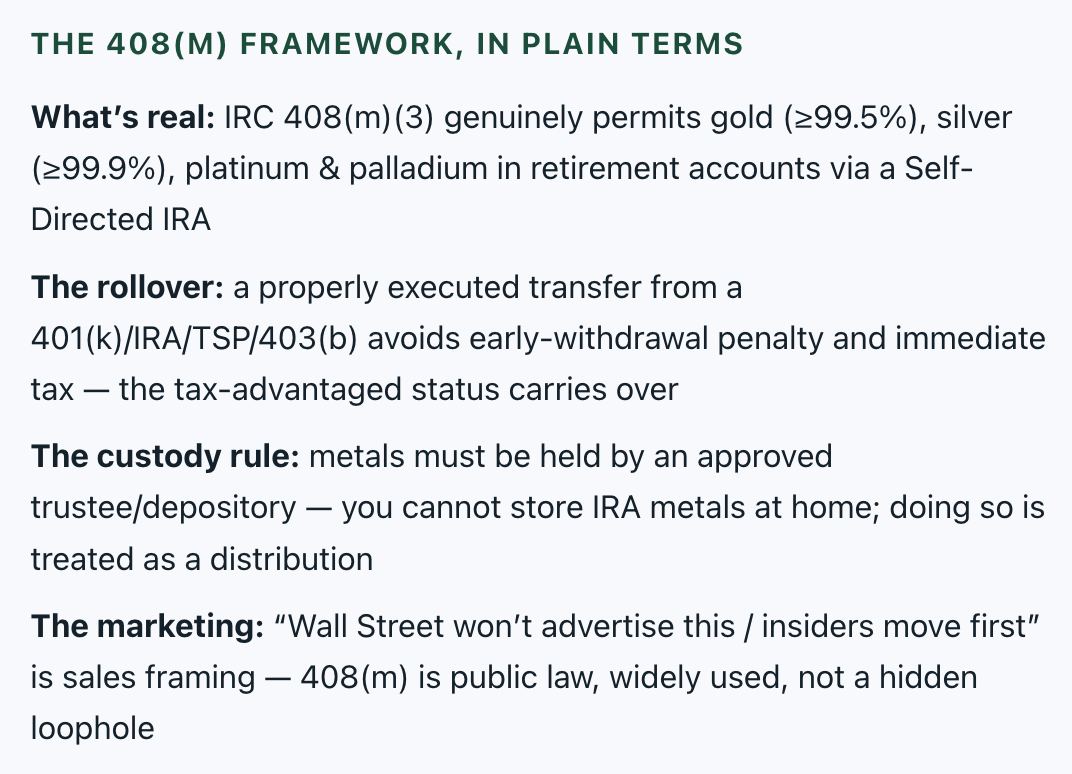
What this means for your retirement accounts: The framework is real and legitimate — but it comes with real costs and trade-offs the pitch glosses over: custodian and storage fees, dealer markups on the physical metal, and the fact that gold is a diversification and preservation tool, not a growth engine. The rule lets you do this; whether you should, and with which dealer, is where careful diligence matters most. Compare custodian fees and metal premiums before committing.
From a Real Rule to a Real Launch — With Bigger Numbers Attached
The second pitch shifts from regulation to a product launch that genuinely happened. Elon Musk’s X Money — a payment system built into the X platform — entered early public access in April 2026, with Visa Direct integration, money-transmitter licenses across more than 40 U.S. states, peer-to-peer transfers, a debit card, and a headline-grabbing 6% yield on balances. Musk has described it, in an internal presentation, as “the central source of all monetary transactions.” So the underlying event is real. What the advertiser does with it — framing it as a “$480 trillion disruption” and “the fastest way to make millions in America today” — is where the projection wildly outruns the verifiable facts. X Money is, by every credible account, a payments app competing with PayPal, Venmo, and Cash App. That’s a real and potentially large business; it is not a $480 trillion currency.
What this means for your retirement accounts: The gap between “Musk launched a payments app” and “$480 trillion disruption, fastest way to make millions” is exactly the gap a careful investor needs to notice. The launch is real; the trillion-dollar framing and the implied easy fortune are advertising. The specific “what to buy” pick is gated, and worth evaluating with that gap firmly in mind.
Is This the Fastest Way to Make Millions in America Today?
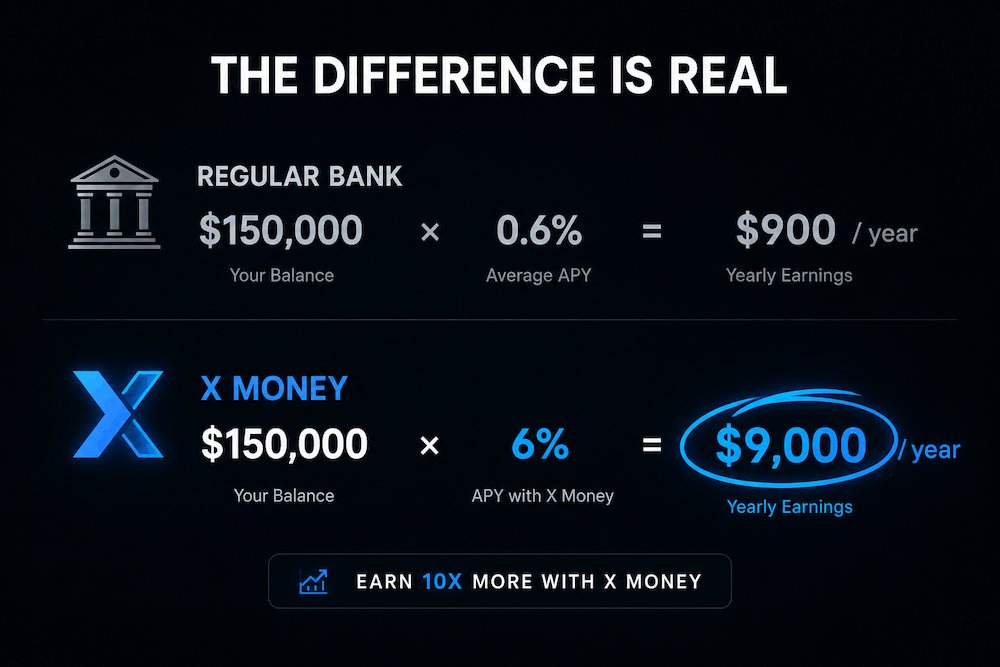
It’s bigger than SpaceX… xAI… or anything Tesla is working on. And it could launch a $480 trillion disruption, thanks to a massive rollout that’s already begun all over America.
Because Elon’s new move targets the biggest market of them all… He’s now launching a CURRENCY system.
| Here’s Exactly What to Buy to Profit → |
What X Money Actually Is — and What It Competes With
Stripped of the projection, X Money is a fintech product with a real and ambitious design. It launched first in the U.S. as X Payments LLC, holding money-transmitter licenses in 41 states, with Visa Direct powering peer-to-peer transfers and a planned debit card. The 6% yield on balances drew immediate regulatory attention — it competes directly with bank savings accounts and money-market funds, and arrived as Congress was already debating oversight of yield-bearing products from non-banks. Musk’s long-stated ambition is to turn X into a Western “everything app” on the WeChat model, combining messaging, content, and payments. That’s a genuinely significant fintech story with a 500-million-plus user base behind it. The honest question for an investor isn’t whether X Money exists — it does — but whether the publicly investable angle the advertiser is selling captures any of that value, or whether the “$480 trillion” framing is doing the heavy lifting.
What this means for your portfolio: Forget the hot picks — protect what you’ve already built. A real product launch and a sound investment thesis are not the same thing. X is privately held; xAI and SpaceX are privately held; the “what to buy” in the pitch is therefore some adjacent public proxy, and the burden is on the advertiser to show that proxy actually captures X Money’s upside rather than merely riding the headline.
408(m): The IRS-Approved Move That Changes the Game
There’s a real IRS rule — Section 408(m) — that allows certain retirement savers to move part of a 401(k), IRA, TSP, or 403(b) into physical gold and silver without triggering early-withdrawal penalties, while keeping retirement tax advantages intact. It’s a legal, IRS-recognized framework, broken down step-by-step in a free guide.
The Third Pitch: An AI Tool That Promises to Find What You Miss
The final advertiser sells a different kind of product entirely: a trading-software tool. Its pitch is built on a real and relatable frustration — that the best trade in any given week is often one you never saw, buried in a list of tickers you ran out of time to check. The software claims to be a patented AI forecasting engine analyzing intermarket data across thousands of global data streams, identifying high-probability stock and options setups and forecasting direction 72 hours in advance. The frustration it names is genuine; no individual can scan the entire market manually. The claim it makes — reliable directional forecasting 72 hours out — is the part that, by its nature, cannot be verified before you buy, and that every investor should treat with healthy skepticism regardless of how the engine is described.
How to Read Any “Forecasting Accuracy” Claim
When a tool claims to forecast market direction days in advance, the right questions are the ones the marketing rarely answers directly: forecast accuracy measured how, over what period, across how many trades, and net of what costs? A genuinely useful screening tool can save time and surface ideas worth researching — that’s a real and defensible value proposition. A tool that promises to reliably call direction 72 hours out is making a far stronger claim, one that runs against a great deal of evidence about how hard short-term price prediction actually is. The two can look identical in a sales page. The difference only shows up in independently verified, costs-included track records over time — which is exactly what to ask for before paying for any forecasting product.
What this means for your retirement accounts: Options trading is leveraged and carries real risk of rapid, total loss on individual positions — it’s a fundamentally different risk category from the buy-and-hold and capital-preservation approach most retirement savers should anchor to. A screening tool is only as good as the discipline of the person using it, and no software removes the underlying risk of the instrument.
How Many Great Options Trades Did You Miss This Week?

Be honest. The best trade today was probably one you never even saw coming, buried somewhere in a list of tickers you ran out of time to check.
That is the real cost of scanning the slow way. Not the losing trades, but the winning ones you never reached.
This patented artificial intelligence forecasting engine analyzes intermarket data across thousands of global data streams.
It identifies high probability Stock and Options setups before the crowd notices them, forecasting direction 72 hours in advance. It was built for speed.
It was built for you to close the gap.
| Show Me the Shortcut → |
Bottom Line
Three advertisers, three very different levels of substance — and telling them apart is the whole exercise. The first rests on a real IRS rule: Section 408(m)(3) genuinely allows gold and silver of specified purity inside a retirement account via a Self-Directed IRA, and a proper rollover from a 401(k), IRA, TSP, or 403(b) avoids the early-withdrawal penalty. The second is anchored to a real launch — Elon Musk’s X Money payment system went into early public access in April 2026 — wrapped in a “$480 trillion” projection that wildly outruns what a payments app competing with Venmo actually is. The third is a trading tool built on a real frustration and an unverifiable accuracy claim.
On the gold side, the honest version is the useful one: 408(m) is legitimate and widely used, not a hidden loophole that “Wall Street won’t advertise.” It lets retirement savers hold physical gold and silver with the tax advantages intact — but it comes with custodian fees, storage requirements, dealer markups, and the basic truth that gold is a preservation tool rather than a growth engine. The rule lets you do this; whether you should, and with which custodian and dealer, is where the real diligence lives.
On the X Money side, the launch is real and significant — Visa Direct, 41-state licensing, a 6% yield that drew a Senate Banking inquiry, a 500-million-user platform behind it. But “Musk launched a payments app” and “$480 trillion disruption, the fastest way to make millions” are separated by an enormous gap, and X itself is privately held — so whatever the pitch tells you to buy is some adjacent public proxy that may or may not capture the upside. And on the AI-tool side, a screening engine that surfaces ideas is a defensible product; a promise to forecast direction 72 hours out is a far stronger claim that demands an independently verified, costs-included track record before a dollar changes hands.
The thread connecting all three is the same discipline: a real rule, a real launch, and a real frustration can each be wrapped in claims that go well beyond what’s verifiable. Your job as an investor isn’t to dismiss the pitches or swallow them whole — it’s to separate the solid core from the marketing around it, and to bring the genuinely consequential decisions to a fee-only fiduciary rather than a sales funnel. Forget the hot picks — protect what you’ve already built. Read the rule, read the filings, ask for verified track records, and decide where you stand before the calendar decides for you. Because the best trade you’ll ever make is the loss you never took.