A Military Strike 7,000 Miles Away Just Repriced a Fed Decision

Three numbers to start
70% — the odds the market now puts on a September rate rise. Two weeks ago it was 35%, and the move that got it here came from Iran, not the Fed.
4.79% — the ten-year Treasury yield, its highest since early 2025. Last week the long end barely twitched. This week it moved.
1.35% — the share of insured deposits the FDIC's fund is legally required to hold. Not a scandal. A design choice, and worth understanding before somebody explains it to you in a hurry.
You cannot buy a private company. You can buy somebody's promise about one.
Anthropic has raised at a valuation near a trillion dollars and filed confidentially for a listing. Reports point at an October window. The company itself has not confirmed a date.
Which raises a question worth answering carefully, because the phrase gets used loosely: what does it actually mean to "buy in before the IPO"?
There are five real mechanisms, and every one of them is a different product with a different set of teeth.
A secondary marketplace matches you with an existing shareholder — usually a former employee — who wants cash now. The trade needs the company's consent, and most private companies of this size have right-of-first-refusal clauses that let them block or take the deal themselves. You are buying real shares, but the price is negotiated between two parties with no public benchmark, and you generally need to be an accredited investor to be in the room.
A special purpose vehicle is a fund set up to hold one position. You buy units in the fund, not shares in the company. That distinction matters when things go wrong, because you have no direct relationship with the issuer and no standing to enforce anything. SPVs also stack fees — a management fee, often a share of profits, sometimes a placement fee on the way in.
A pre-IPO fund or interval fund holds a basket of private companies and is available to ordinary investors. The catch is in the name: an interval fund lets you redeem only at set intervals, typically quarterly, and only up to a capped percentage of the fund. In a rush for the exit, the cap binds and you wait.
A closed-end fund holding private shares trades on an exchange, so you can buy it at 10am like anything else. What you get is a share of a portfolio, and closed-end funds routinely trade at premiums or discounts to the value of what they hold. In hot names the premium can be substantial, which means paying more than a dollar for a dollar of exposure.
Employee share purchases through a broker are the least visible route and the most legally fraught, because many equity plans prohibit transfer outright.
Now the part that decides whether any of it was worth doing.
Every route above has a valuation problem, and it is structural rather than anybody's fault. A private company has no continuous price. The last round is a number agreed between the company and a handful of investors, often with terms attached — liquidation preferences, ratchets, anti-dilution provisions — that make the headline valuation an incomplete description of what a share is worth. Secondary trades happen at whatever two parties agree, which is why the same company can show a 15% spread between quotes in the same week.
And there is the lock-up, which we looked at on Monday in a different context. Shares acquired pre-listing are typically restricted for 90 to 180 days after the IPO. You are early, and then you watch.
None of that makes these vehicles bad. It makes them a specific trade with specific costs, and the question to ask about any of them is not whether you get in early. It is what you paid in fees and spread for the privilege, and when you are permitted to leave.
Your deposit insurance fund holds two cents for every dollar it insures
Here is a fact that sounds alarming and is not: the FDIC's Deposit Insurance Fund is legally required to hold at least 1.35% of insured deposits, and the board has set a target of 2.0% for 2026.
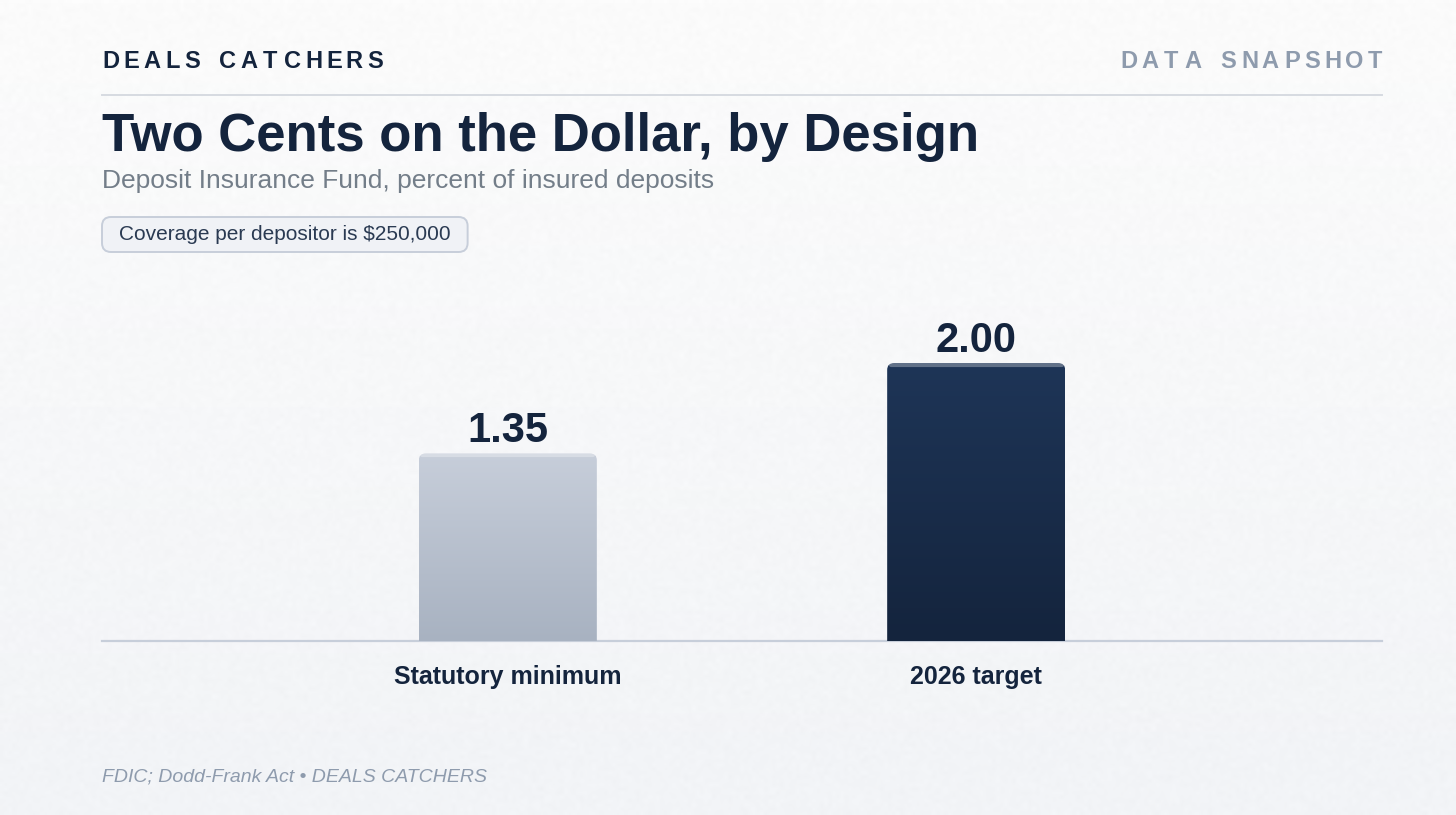
Two cents against every insured dollar. Read that cold and it looks like a system waiting to fail. Read it as an insurer would and it is unremarkable — no insurance fund on earth holds reserves equal to its total exposure, because doing so would mean charging premiums equal to the sum insured. Fire insurers do not hold the value of every house.
What the fund is sized against is expected losses in a normal cycle, not simultaneous failure of the entire banking system. The design assumption is that failures arrive one or a few at a time and the fund absorbs them while premiums replenish it. In 2023 that assumption was tested by three large failures in two months and the mechanism held, though it cost the fund heavily.
The number people rarely mention is the backstop behind the fund. The FDIC has borrowing authority at the Treasury, which is the actual answer to the question of what happens if the reserve runs dry. Whether you find that reassuring depends entirely on how you feel about the Treasury, but it is the part of the structure that gets left out of the frightening version.
Two things are worth knowing precisely.
The $250,000 limit is per depositor, per insured bank, per ownership category. That last clause does real work. A single person can hold far more than $250,000 of covered deposits at one bank by using different ownership categories — individual, joint, certain trusts, some retirement accounts. Most people who worry about the cap have never checked whether they are actually over it.
Deposits are legally a loan to the bank. This is true, it has always been true, and it is not a loophole. When you deposit money, the bank owes you that amount; it does not hold your specific dollars in a box. That relationship is the entire basis of banking, and deposit insurance exists precisely because of it.
The 2010 law people point to created an orderly liquidation process for failing institutions — a way to wind down a large bank without a disorderly collapse, in which shareholders and certain creditors absorb losses first. Insured depositors sit at the top of the priority ladder, which is the opposite end from where the frightening framing usually places them.
None of which means holding some savings outside the banking system is unreasonable. It means the reason to do it is diversification of counterparty risk, which is a real and boring argument, and not the imminent seizure of your checking account.
A military strike 7,000 miles away just repriced a Fed decision
Over the weekend the United States struck Iranian military targets for the first time since July. The president threatened further action if Iran retaliates. Brent crude rose 1.36% in a day and 3.69% across five sessions.
Then watch what that did to a domestic interest rate.
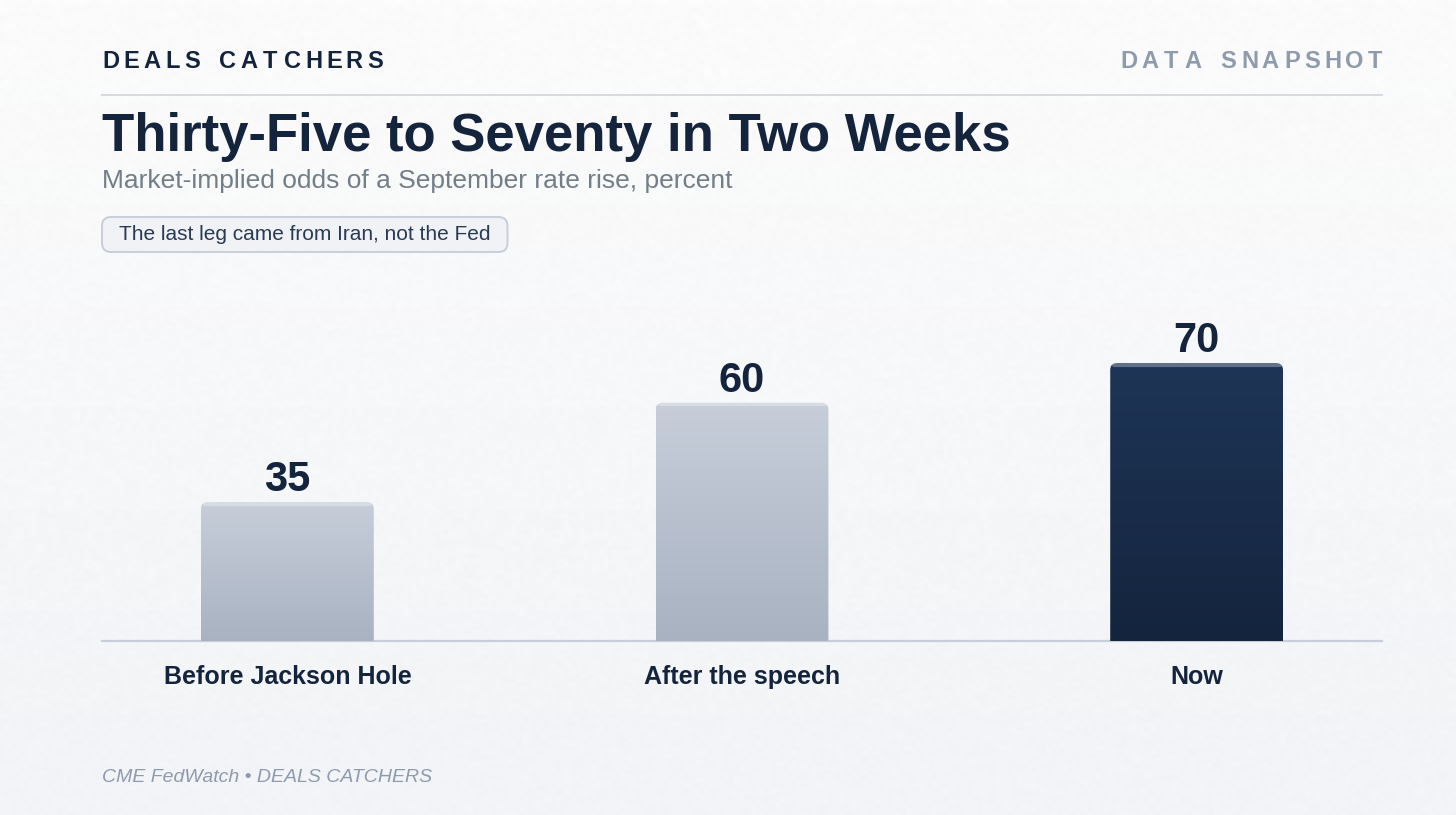
Markets now price roughly a 70% chance the Fed raises rates this month, up from about 60% after Warsh spoke at Jackson Hole and 35% before he did. The Fed said nothing new in between. What changed was the price of oil, because oil feeds fuel, fuel feeds freight, freight feeds the price of everything that moves, and the Fed has a mandate on that last number.
The bond market moved with it, and this part is genuinely new.
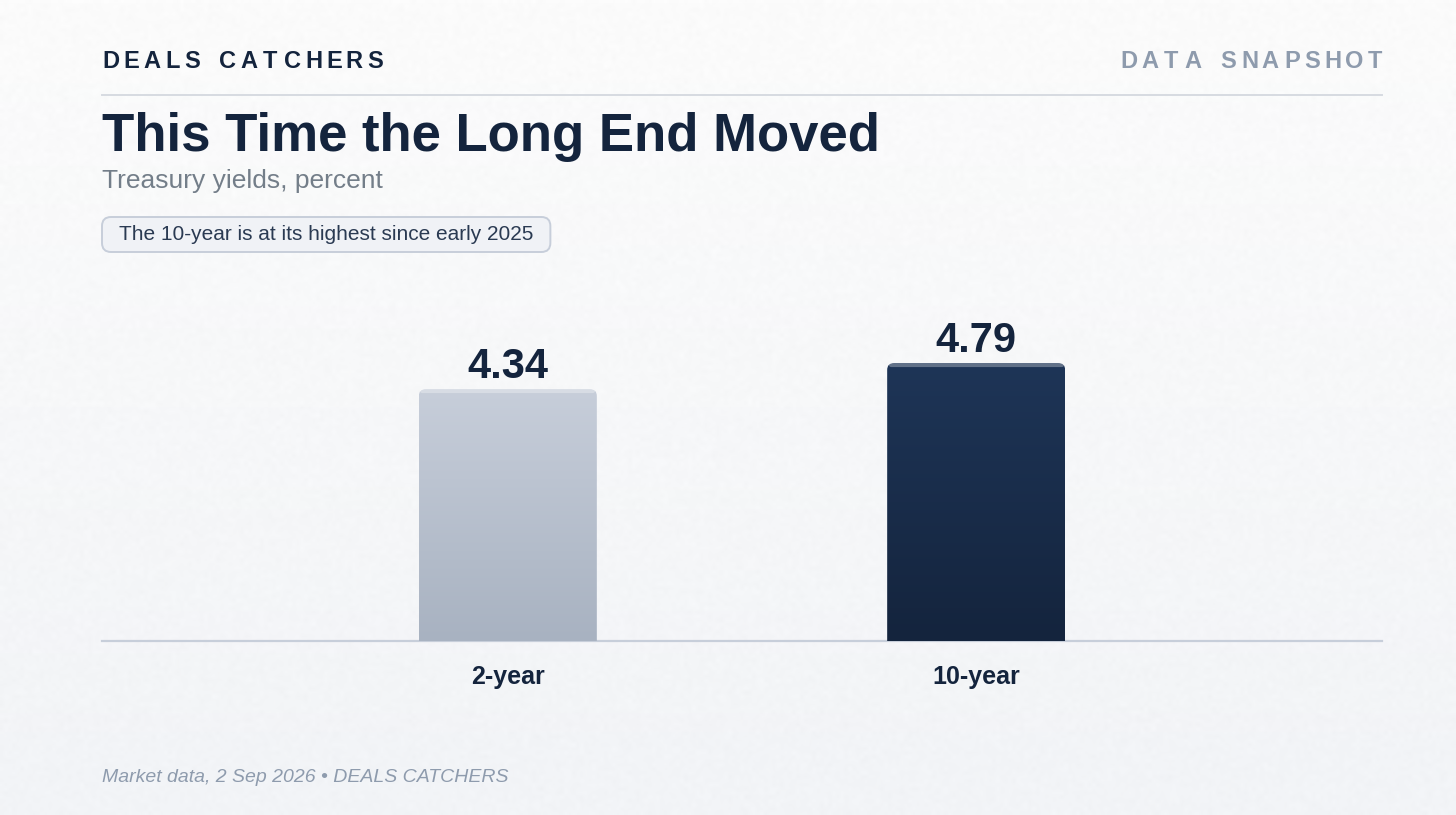
The ten-year Treasury yield pushed to about 4.79%, its highest since early 2025. Last week I pointed out that the two-year jumped eleven basis points on Warsh's speech while the thirty-year barely moved, and read that as a market confident the Fed would act and that acting would work. This week the long end moved too. That is the same market becoming less sure the problem is contained.
Gold, which had run all year on exactly this sort of risk, sat near a four-week low. Higher rates make metal that pays no interest less attractive, and the rate expectation overwhelmed the geopolitical bid. Two forces that usually point the same way pointed against each other, and rates won.
There is a broader pattern here that is worth naming, because it has been the story of this entire year. Government action, not company performance, has become the dominant repricing force in these markets. A strike reprices oil and rates. A tariff threat repriced coffee futures to a record within days last year. When Washington took equity stakes in a list of chipmakers and rare-earth firms, those shares moved on the announcement rather than on any change in what the businesses were doing.
For an ordinary investor that shifts what is worth watching. Earnings still matter. But the calendar that moves your portfolio most now contains fewer results dates and more policy dates, and almost none of them are scheduled in advance.
What's scheduled
Tomorrow — August jobs report. The first of the two numbers that decide the September meeting.
Next week — August CPI.
15–16 September — the Federal Open Market Committee meets.
With odds at 70% and no reaction function published, tomorrow's number carries more than a jobs report normally does. A soft print does not automatically remove the hike, because the case for one is now being made on the oil-and-inflation side rather than the labour side. A hot print more or less settles it.
Core PCE — the inflation gauge the Fed actually targets, rather than the headline CPI most people see quoted — ran at 3.3% in July against 2.8% in February.
One thing worth watching that gets no coverage. Warsh has five internal task forces reviewing how the Fed operates, one of them on communication itself. A chair who dislikes signalling and is formally studying how his institution signals is not going to drift back into forward guidance by accident, and whatever comes out of that review will shape how every future release gets read.
One number
70% — the market's odds of a September rate rise, up from 35% two weeks ago. The Fed has announced nothing in that window. Oil, a hawkish speech and a military strike did the work.
Forget the hot picks — protect what you've already built, and ask what you are actually buying when someone offers you access to something that has no price. Because the best trade you'll ever make is the loss you never took.
- Mike Lee
Thanks for reading. See you tomorrow.