$95 Billion. Two Votes. Zero Offsets.

Share
$95 Billion. Two Votes. Zero Offsets.
Deals Catchers
Deals Catchers • August 24, 2026
Mike LeeBy Mike Lee · 24 Aug 2026

Congress approved $95 billion by two votes and paid for none of it. Then it moved the shutdown deadline and went on holiday.
House lawmakers just advanced a $95 billion package. The vote was 216–214. No offsetting cuts were required.  Claim the FREE Wealth Protection Playbook.  Ad
An empty legislative chamber from the gallery
Featured
FISCALBefore the recess
Two Votes, $95 Billion, Nothing Paid For
On July 22 the House adopted a $95 billion budget resolution by 216 to 214. Every Democrat opposed it, joined by two Republicans and one independent. None of the spending is offset by cuts anywhere else.
That last detail is the one that matters, and it is not an interpretation — it is the reason fiscal conservatives in the majority voted against their own leadership. A budget resolution is a framework, not an appropriation; it unlocks the reconciliation process that lets a package pass the Senate on a simple majority. Passing one without offsets is a decision to add the full amount to the deficit and settle the argument later.
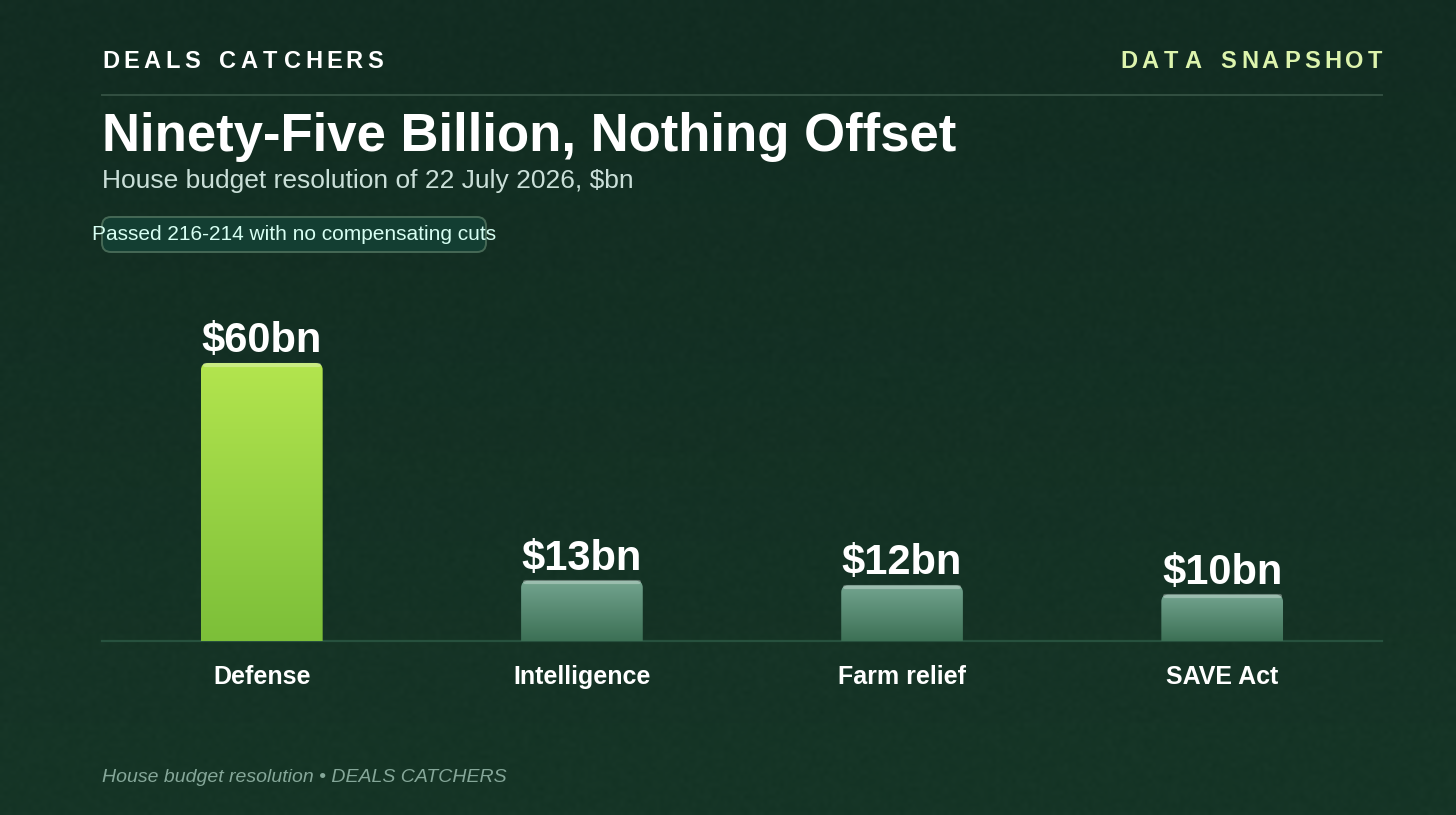
Ninety-five billion, nothing offset
House budget resolution of 22 July 2026.
The night before that vote, the same chamber passed a stopgap 220 to 205, extending existing funding levels to December 4 — about two extra months to finish appropriations for a fiscal year beginning October 1. Two weeks later Senate leaders announced their own continuing resolution, holding funding flat until December 11 and moving the shutdown risk past the midterm elections.
So within a fortnight: authorise $95 billion of new spending without paying for it, and separately push the deadline for funding the government into December. Neither action resolves anything. Both buy time, and the price of time is the only thing being decided.
The resolution is not law yet. The Senate majority leader has acknowledged he lacks the votes to advance it, and appropriations markups in his chamber have stalled. That is worth knowing before assuming the money is spent — but it does not change what the House vote demonstrated about the process, which is that the offset requirement is now optional when the votes are close enough.
Here’s why it lands on your desk: this is the mechanism that turns political stalemate into monetary consequence. Congress cannot agree on what to cut, so it agrees to borrow, and the burden of managing the result lands on a central bank that had no vote in the matter. Everything else — the rate path, the dollar, what your savings buy in five years — sits downstream of that arrangement.
Source: House roll call / NPR / Roll Call

Sponsored
Extend the Deadline, Borrow More
Capitol
House lawmakers just advanced a $95 billion package.

The vote was 216–214.

No offsetting cuts were required.

Lawmakers also passed another temporary funding bill. It only delays the next shutdown fight.

That’s Washington’s solution: extend the deadline, borrow more, and leave the Fed to handle the fallout.

See the numbers behind this spending mess.

And why some retirement savers are turning to this asset.
Learn how a properly structured Gold IRA could help diversify savings before Washington delivers its next massive spending bill.
Latest StoriesSee all →
An empty factory floor with bare mounting points
ROBOTICSLatest guidance
The Robot Danced. The Line Is Still Being Installed.
Tesla’s July guidance on Optimus production was “soon” and “later this year.” That replaced an earlier commitment to late July or August — and the swap happened before that window had even elapsed.
The physical work is real. The Fremont lines that built the Model S and Model X have been converted; the last of those cars rolled off in early May. The company says it is installing first-generation Optimus lines now, with the first units going to training-data collection rather than customers. Consumer availability is targeted somewhere around the end of 2027, and the chief executive has described the initial ramp as long and flat.
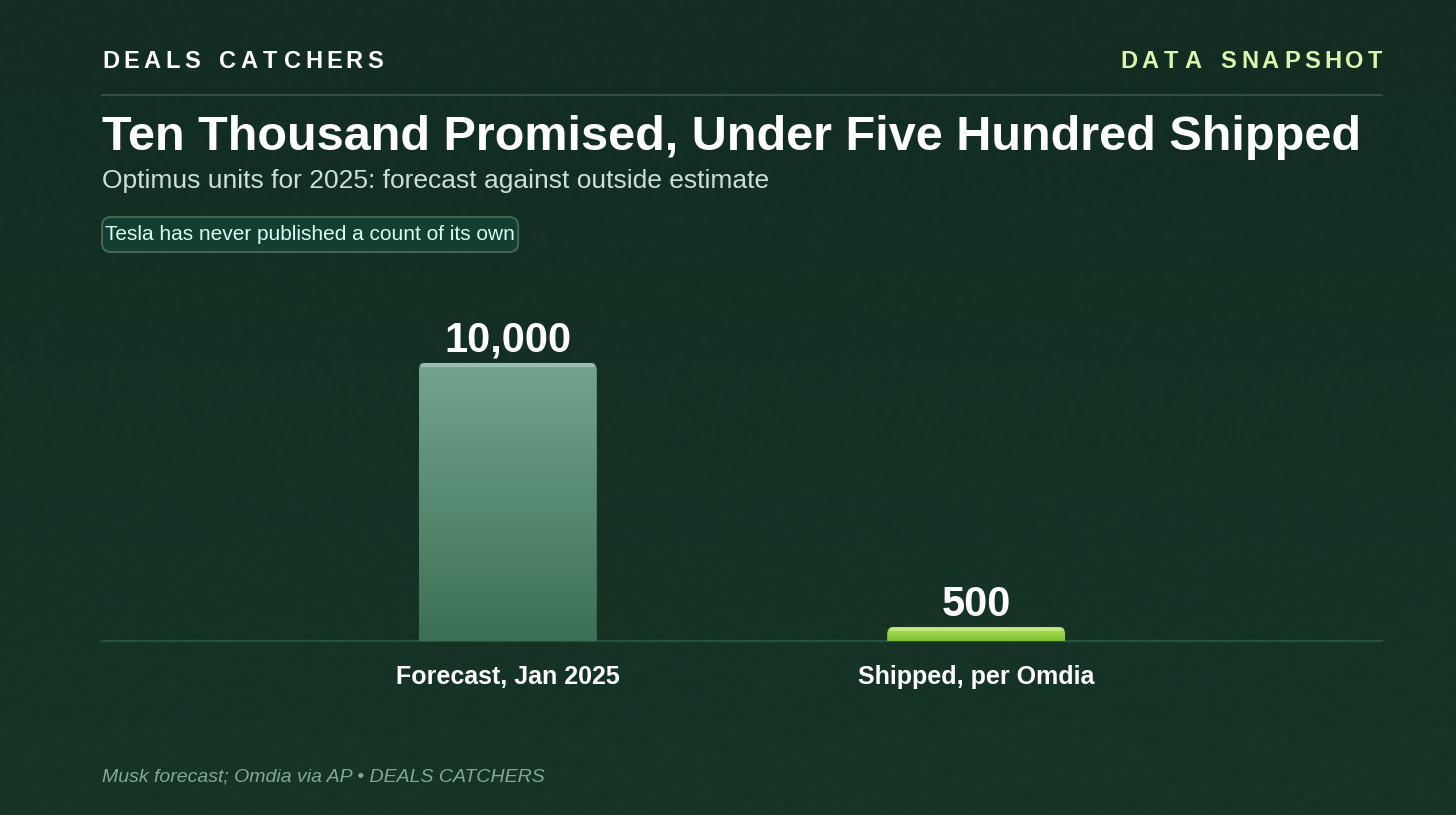
What makes this worth reading carefully is the forecasting record attached to it. In January 2025 the target was roughly 10,000 robots built that year. That target was missed entirely, and by January 2026 the admission was that none were doing useful work in Tesla’s own factories. A 50,000-unit goal for this year became, in the company’s words, impossible to predict. The third-generation reveal slipped from the first quarter to mid-year and then to later this year; as of two weeks ago it still had not happened.
Ten thousand promised, under five hundred shipped
Optimus units for 2025: forecast against outside estimate.
Nobody actually knows the count, which is its own signal. Tesla has never published one. The research firm Omdia told the Associated Press that fewer than 500 units shipped in 2025; supply-chain reporting put roughly 1,000 assembled by the middle of that year. Those are outside estimates that disagree with each other, and the company has confirmed neither.
The ambition behind it is not small. The Fremont line is designed for a million units a year, a second plant at Giga Texas is targeted for around summer 2027, and Wall Street is modelling negative free cash flow of roughly $5.19 billion at Tesla this year — a number the company is tolerating specifically in anticipation of robot revenue. For scale, one bank’s analyst put the entire humanoid market at 200,000 annual units by 2035.
The distinction worth holding: a demonstration is a capability claim, and a production line is a commitment with a cost attached. The demo is what gets filmed. The line item that tells you whether it is real is the one nobody puts on stage — and this year it reads as five billion dollars of cash going out against revenue that has not arrived.
Source: Tesla earnings calls / Omdia via AP / Electrek
Sponsored
The Robot Was the Distraction
Musk
Elon Musk brought out his humanoid robot…

It danced. It waved. It made headlines.

But that’s not what should’ve caught your eye.

Because right after the show, he revealed something bigger.

A quiet move the media barely touched… but insiders are whispering it could be his next Tesla-level explosion.

The robot? That was the distraction.

This is the real play — and it’s already in motion.

Before the talking heads catch up… Watch the video that slipped past 99% of the world.

Elon already knows where this is going…

Do you?
Sincerely,
Victoria Tino, Director
Behind the Markets
A wind tunnel throat seen head-on
DEFENCEContract awards
Capacity, Not Contracts, Is the Constraint
The United States is designing hypersonic weapons faster than it can build the places to test them. Access to flight tests is limited by cost, range availability and scheduling — and that, not funding, is what sets the pace.
The evidence is in the schedules. A government watchdog reported in July that the Air Force’s hypersonic cruise missile programme had been cut from seven planned test flights to five, and that there is effectively zero margin left in the timeline. One significant test failure and the five will not be completed inside the five-year prototyping window. Programmes are being descoped not because the designs are wrong but because there is nowhere to fly them often enough.
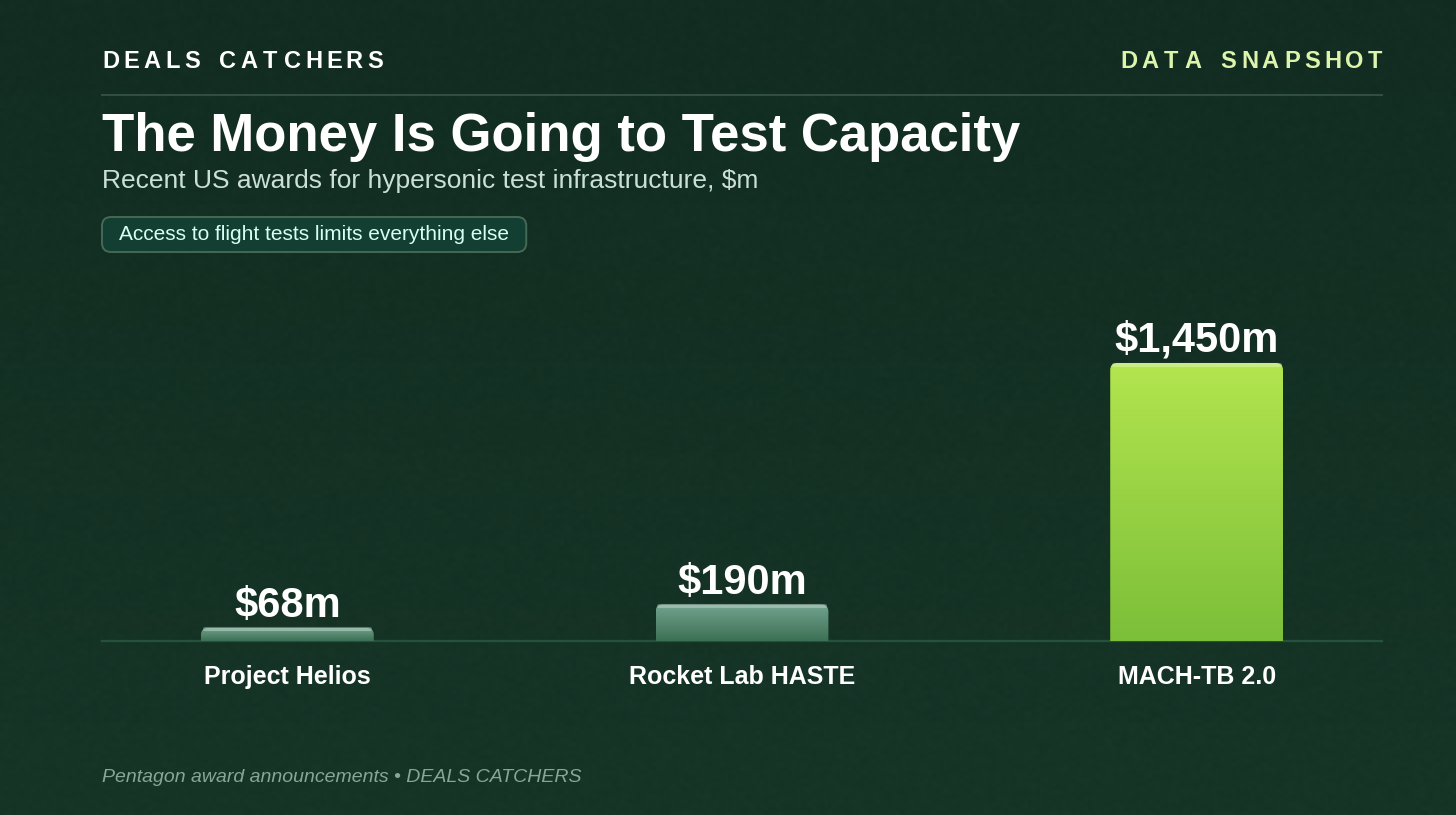
The response has been to buy capacity from the commercial sector rather than build more government ranges. The Pentagon’s Multi-Service Advanced Capability Hypersonic Test Bed programme awarded a prime contract worth up to $1.45 billion over five years, explicitly to raise the number of test flights by using commercial launch vehicles and reusable platforms. Under it, one launch provider took $190 million in March for twenty hypersonic test flights over four years — the largest single launch contract in that company’s history.
The money is going to test capacity
Recent US awards for hypersonic test infrastructure.
The ground side is moving too, and slowly. NASA recently finished its first major new wind tunnel in more than forty years. The Air Force, Navy and Army each carry line items for wind tunnel construction, reactivation or modernisation this fiscal year, and a federal notice seeking proposals to reactivate hypersonic test facilities drew a real industry response. Ground capacity runs on capital programmes measured in five to ten years, which is why the near-term answer has to come from somebody else’s aircraft and rockets.
The practical read: when a buyer with no alternative needs a service that only a handful of firms can supply, the pricing power sits with the supplier rather than the programme. That is a different kind of defence exposure than owning a prime contractor — narrower, more fragile, and dependent on contracts that are public documents.
Source: GAO / SpaceNews / Pentagon award announcements
Sponsored
Building Them Faster Than They Can Test Them
Video
The United States is losing the most important arms race of the century.

Russia and China already have hypersonic weapons.

Missiles that travel so fast that existing radar systems cannot even track them.

The Pentagon has officially admitted we are in third place.

And they are scrambling to catch up.

The hypersonic research budget has nearly tripled in just five years.

But there is a massive problem.

The military is building these weapons faster than they can build the places to test them.

My private intelligence contact just found the company the government is paying to solve this crisis.

It is a tiny, publicly traded company operating out of Florida.

They have a fleet of launch vehicles capable of testing hypersonic technology at extreme altitudes.

Lockheed Martin, GE Aerospace, and the United States Air Force are already paying them.

The stock is currently trading under $5.

But not for long.

Because this company also launches commercial satellites, and they are approaching a major licensing milestone.

When that happens, my “Financial 007” expects their valuation to hit $1.7 billion

Which would mean a 997% gain for early investors.

The government money is already flowing. The contracts are signed.
P.S. When the military is desperate, the companies providing the solutions get paid first.
THE WEEKWednesday and Thursday
Nvidia Wednesday. Warsh Thursday. Then We Find Out.
Two events sit back to back this week, and between them they will set the tone into September. Nothing else on the calendar competes.
Kevin Warsh takes the Jackson Hole podium for the first time as chair from Thursday to Saturday. The symposium exists as a venue for signalling, and this is a chair who has spent his tenure arguing that signalling is the problem — he has dismantled conventional forward guidance and floated cutting the number of policy meetings each year. Either he makes a policy statement or he demonstrates that he will not, and both are information.
The market comes into it relaxed. After last week’s minutes, the odds of a September hike sit near 27% with no move fully priced before the start of next year — despite three officials dissenting in favour of a hike in July. The index is at record highs and volatility near its 2026 lows.
Defence spending gives the week its backdrop. Congress approved $839 billion for the Pentagon this fiscal year, $8 billion above the request, and a separate $152 billion reconciliation plan directs $2.2 billion specifically at hypersonic defence and $5.6 billion at space-based interceptors. That money is already appropriated, which makes it a different kind of certainty from anything Nvidia says on Wednesday.
If you are drawing income from savings, the thing to watch is not the headline from either event but the gap between them. A record-high index priced for no rate rise, going into a speech from a chair who refuses to pre-commit, leaves very little room for a surprise in either direction.
Source: CME FedWatch / Federal Reserve / congressional appropriations
That’s Washington’s solution: extend the deadline, borrow more, and leave the Fed to handle the fallout.  Claim the FREE Wealth Protection Playbook.  Ad
The Week Ahead
Nvidia reports Wednesday, Jackson Hole opens Thursday. Back to back, which means a soft guide and a hawkish speech would compound rather than cancel each other out.
The $95 billion resolution is stuck in the Senate. The majority leader has said he lacks the votes and appropriations markups have stalled, so the framework may never become spending — but the December funding deadline arrives regardless.
Funding now runs to December 11 under the Senate’s continuing resolution, which places the next shutdown fight safely after the midterm elections. That timing was the point.
Tesla’s third-generation robot still has not been shown publicly, despite a reveal promised for the first quarter, then mid-year, then later this year. The next scheduled chance to update the timeline is the October earnings call.
The FAA licensed 205 commercial space operations in 2025, a 25% rise on the prior year. Regulatory throughput is quietly becoming the bottleneck behind the bottleneck.
 
Stat of the Day
The margin by which the House approved $95 billion of unoffset new spending, out of 430 votes cast
2 votes
House roll call, 22 July 2026
Forget the hot picks — protect what you’ve already built, and check what got promised against what got delivered. Because the best trade you’ll ever make is the loss you never took.
— Lee
Thanks for reading. See you tomorrow.

Read more

The Stretch Lasted 36 Years. Heirs Now Have Ten.

The Stretch Lasted 36 Years. Heirs Now Have Ten.

The tape is watching the next industrial project. The inherited-IRA deadline is 101 days out, and a missed withdrawal is now a 25% bill.͏ ͏ ͏ ͏ ͏ ͏ ͏ ͏ ͏ ͏ ͏ ͏ ͏ ͏ ͏ ͏ ͏ ͏ ͏ ͏ ͏ ͏ ͏ ͏ ͏ ͏ ͏ ͏ ͏ ͏ ͏ ͏ ͏ ͏ ͏ ͏ ͏ ͏ ͏ ͏ ͏ ͏ ͏ ͏ ͏ ͏  21 SEPTEMBER 2026 By Mike Lee sponsoredThis Tesla Demo Shocks EveryoneThis Tesla Demo Shocks Everyone"Hi, I'm Jeff Brown...I'm

By Mike Lee
Forty-Five Percent, Against a Record of Twenty-Seven

Forty-Five Percent, Against a Record of Twenty-Seven

AI-linked stocks are 45% of the S&P 500 against a previous record of 27%. Goldman now attributes half the index's earnings growth to the same spending.͏ ͏ ͏ ͏ ͏ ͏ ͏ ͏ ͏ ͏ ͏ ͏ ͏ ͏ ͏ ͏ ͏ ͏ ͏ ͏ ͏ ͏ ͏ ͏ ͏ ͏ ͏ ͏ ͏ ͏ ͏ ͏ ͏ ͏ ͏ ͏ ͏ ͏ ͏ ͏ ͏ ͏ ͏ ͏ ͏ ͏ ͏ ͏ ͏ ͏ ͏ ͏ ͏ ͏ ͏ ͏ ͏ ͏ ͏ ͏  18 SEPTEMBER 2026 By Mike Lee sponsoredThe Hidden Middleman Cut in Every CupSUPPLY CHAIN ANALYSISThe Hidden Middleman Cut Built

By Mike Lee
The Fed Raised Rates, and the Chair Still Will Not Say Where He Stands

The Fed Raised Rates, and the Chair Still Will Not Say Where He Stands

The Fed raised rates for the first time since 2023, unanimously, and then published a dot plot on which nobody agrees about what comes next. The chair again withheld his own.͏ ͏ ͏ ͏ ͏ ͏ ͏ ͏ ͏ ͏ ͏ ͏ ͏ ͏ ͏ ͏ ͏ ͏ ͏ ͏ ͏ ͏ ͏ ͏ ͏ ͏ ͏ ͏ ͏ ͏ ͏ ͏ ͏ ͏ ͏ ͏ ͏ ͏ ͏ ͏ ͏ ͏ ͏ ͏ ͏ ͏ ͏ ͏ ͏ ͏ ͏ ͏ ͏ ͏ ͏ ͏ ͏ ͏ ͏ ͏  17 SEPTEMBER 2026 By Mike Lee sponsoredA Promiscuous Robot (Only Today — Invest Before 9/17 or Miss This Price

By Mike Lee
The List of Weak Banks Already Exists

The List of Weak Banks Already Exists

Every bank above a billion dollars publishes its uninsured deposit ratio every quarter. That number predicted the 2023 failures, and it is free to look up.͏ ͏ ͏ ͏ ͏ ͏ ͏ ͏ ͏ ͏ ͏ ͏ ͏ ͏ ͏ ͏ ͏ ͏ ͏ ͏ ͏ ͏ ͏ ͏ ͏ ͏ ͏ ͏ ͏ ͏ ͏ ͏ ͏ ͏ ͏ ͏ ͏ ͏ ͏ ͏ ͏ ͏ ͏ ͏ ͏ ͏ ͏ ͏ ͏ ͏ ͏ ͏ ͏ ͏ ͏ ͏ ͏ ͏ ͏ ͏  16 SEPTEMBER 2026 By Mike Lee sponsoredWhy Is This NVIDIA Collaborator Robot Called Flippy?Why’s This NVIDIA Collaborator Robot Called Flippy? (Invest by

By Mike Lee