74% of Windows Still Open by Hand. In a Connected House.

Share
74% of Windows Still Open by Hand. In a Connected House.

Deals Catchers
Deals Catchers • August 28, 2026
Mike LeeBy Mike Lee · 28 Aug 2026

Your thermostat is connected. Your doorbell is connected. The thing hanging in every window is still worked by a cord, in three houses out of four.
92% of window shades are still manually controlled.  Explore the RYSE investment opportunity before August 31 →  Ad

A window blind half drawn in an empty room
Featured
SMART HOMECategory data
The Last Thing in the House Still Worked by Hand
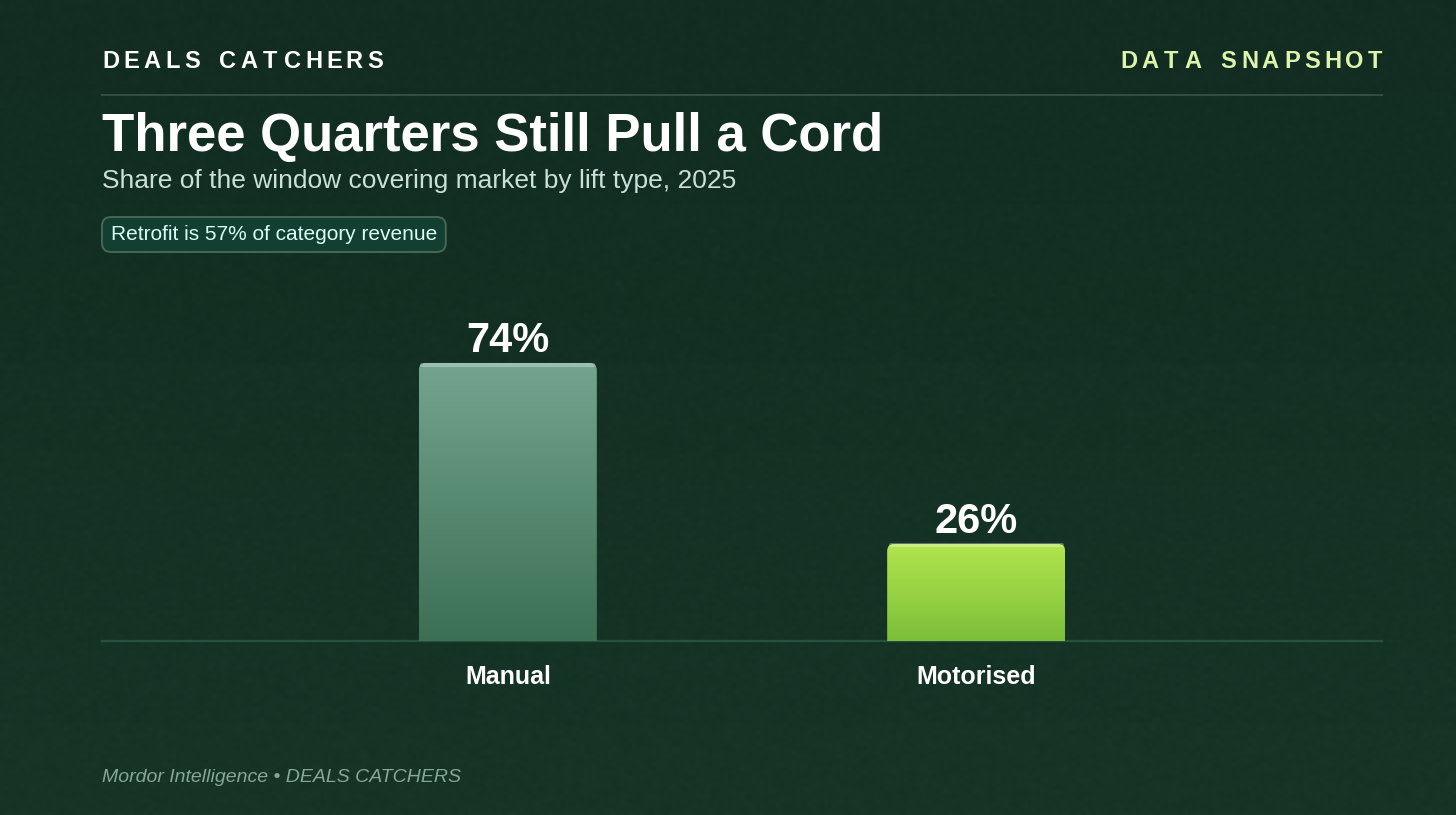
Manual lifts held 74% of the window covering market last year. Two thirds of American homes now own a smart device of some kind — and three quarters of their windows are still operated with a cord.
The gap is not about desire. It is about installation. A thermostat swap takes twenty minutes and two wires. A doorbell is a drill and an app. Motorising a window has historically meant replacing the entire covering, running power to a spot with no outlet near it, and in most cases hiring someone. The failure mode was never the technology. It was the electrician.
Three quarters still pull a cord
Share of the window covering market by lift type.
Which is why the retrofit number is the one that matters. Retrofit installations account for more than 57% of revenue in blinds and shades — the money is in existing windows, not new construction. Two things changed recently to make that reachable. Matter unified lift and tilt commands across brands, ending the era when every motor needed its own proprietary hub. And lithium-iron-phosphate packs roughly doubled battery life, which removes the wiring problem entirely for anything battery-driven.
The demographics point the same direction, and this part is not usually mentioned in market reports. Analysts tracking the category name a specific driver: a growing cohort of older homeowners determined to age in place, steering demand toward touch-free and voice-activated coverings. Cords are a reaching problem, a balance problem and, in houses with grandchildren, a safety problem. Residential owners already generate 69% of automated shade revenue.
The forecasts are modest, which is its own signal. Smart lift systems on Thread and Zigbee are projected to grow at about 6% a year against a category growing 3.7%. Nobody is calling this a boom. It is a slow substitution inside a market worth roughly $15.8 billion this year, where the incumbent product is a piece of string.
Here’s why it lands on your desk: the interesting categories are rarely the ones with the best technology. They are the ones where a large, boring, universal product has resisted change for a specific and solvable reason. Windows resisted because of installation. Whoever removes the installation problem inherits three quarters of a market that already exists.
Source: Mordor Intelligence / Grand View Research / Fortune Business Insights
Sponsored
No Walls Opened. No Electrician.
Smart thermostats went mainstream.

Smart doorbells followed.

But one major part of the home has barely been automated at all.

92% of window shades are still manually controlled.

RYSE is going after that gap with patented technology designed to automate the window coverings people already own.

No replacing every shade. No opening walls. No electrician required.

And RYSE has already sold more than 100,000 devices and generated $20 million+ in revenue, with 10 granted patents protecting its technology.

Now everyday investors can invest in RYSE at $2.50 per share.

That price has a deadline.

RYSE says its current share price is set to change August 31.
Latest StoriesSee all →
An empty office desk with the chair pushed in
AI & WORKSEC filings
Companies Are Firing for What AI Might Do
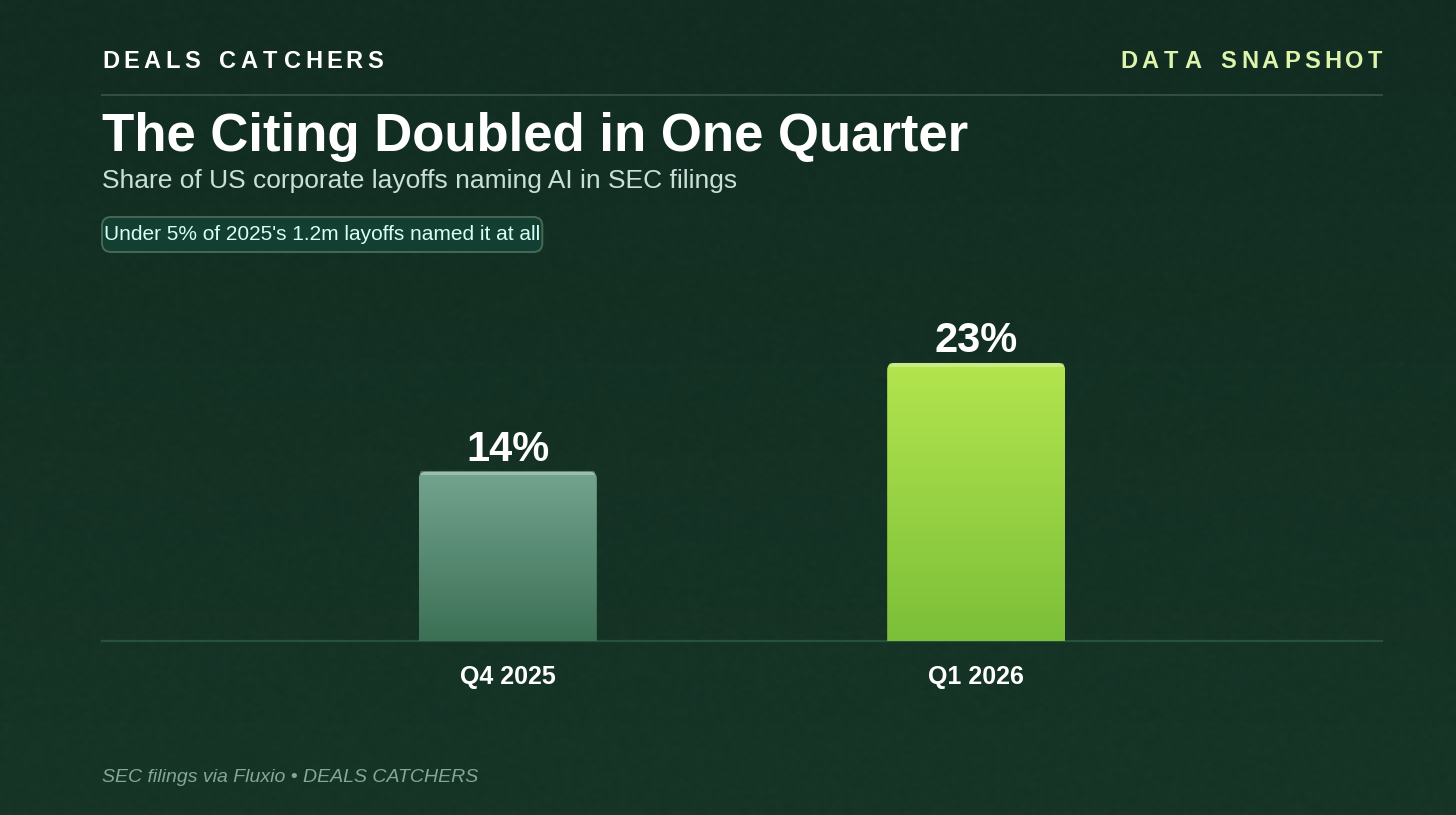
Of roughly 1.2 million US layoffs announced in 2025, fewer than 5% named AI as the cause. In the first quarter of this year, 23% of corporate layoffs cited it in SEC filings — up from 14% the quarter before.
Something changed fast, and it is worth being precise about what. The share of layoffs attributed to AI nearly doubled in three months. Whether AI actually did the work those people were doing is a separate question, and the answer is messier.
The citing doubled in one quarter
Share of US corporate layoffs naming AI in SEC filings.
The measured numbers are far smaller than the headlines. Goldman Sachs put net US job losses from AI at about 16,000 a month in April — roughly 192,000 a year in a labour force of 170 million — and estimates only about 2.5% of American employment is at near-term displacement risk. Built In found that just 9% of hiring managers say AI has fully replaced a role, while 45% say it has partly reduced the need for new hires.
The forecasts are enormous by comparison. One AI chief executive predicted half of entry-level white-collar jobs would go within five years and unemployment could reach 10 to 20%. Microsoft’s AI head said all white-collar work could be automatable within eighteen months. Amazon cut 16,000 corporate roles in January citing AI agents, with another 14,000 signalled in March.
Harvard Business Review named the gap in January: many companies are cutting because of AI’s potential rather than its current performance — preemptive restructuring driven as much by investor expectations as by anything a machine is actually doing. A layoff blamed on AI reads to the market as efficiency. The same layoff blamed on weak demand reads as trouble.
The distinction worth holding: where the displacement is real, it shows up as hiring that never happens rather than firing that does. Entry-level developer postings are down about 20%, and the door closes quietly on people who were never counted. That is a slower story than the forecasts and a harder one to reverse.
Source: SEC filings / Goldman Sachs / Challenger, Gray & Christmas
Sponsored
He Called 2000 and 2008
Editor’s note: Life in America is about to take a very strange turn, says one of Wall Street’s best-connected millionaires, who called the 2000 and 2008 crises, all while building his own $200 million hedge fund firm.

At Harvard, Whitney Tilson became close friends with billionaire hedge-fund manager Bill Ackman…

He took on radical socialist New York City mayoral candidate Zohran Mamdani in a public debate last year…

He accurately forecast the 2000 tech wreck and starred in an Emmy-winning 60 Minutes episode on the 2008 financial crisis…

And he’s one of the best-connected insiders in America today, with dozens of millionaire and billionaire friends. (He even bakes cookies for Warren Buffett at Christmas.)

I’m telling you this today because Tilson says the next six months are going to be a time of extreme change in our country.

He’s warning that America is in the early stages of a crisis that no one in our country can avoid. It’s connected to the huge (and rapid) changes we’ve seen as a result of AI and other radical new technology.

But Tilson isn’t merely warning of more job losses, or another big selloff in the stock market (though he says both of those things are highly likely in the near future).

He says we’re living through a permanent reset that’ll destroy the America you grew up in.

“I’m 59. I’m a father. And what’s coming in America’s near future keeps me awake at night, frankly,” he said.

That’s why he’s stepping forward publicly today.

If he’s right, 2026 will be a year like no other – and it’s crucial you prepare.

In fact, there are several things Tilson recommends you do immediately to get ready. (Step #1 alone could make you more than stocks, bonds, and even gold.)

I strongly encourage you to take a few minutes to hear Tilson’s latest prediction.

We’ve posted everything you need to know on our website, free of charge.
Regards,
Matt Weinschenk
Publisher and Director
VOLATILITYInto the weekend
The Market Priced This Week at Almost Nothing
Nvidia reported on Wednesday and a new Fed chair speaks this morning. Going into both, volatility sat near its lows for the year and the index sat at record highs.
That combination is worth understanding, because it is a statement with a number attached. Implied volatility is simply the size of move the options market is charging for — expressed as a percentage, for a set period. When it is low ahead of two scheduled events, the market is not saying nothing will happen. It is saying the price of protection against something happening is cheap.
You could see the mechanism working earlier in the week. Ahead of Home Depot’s results, the options market was pricing a move of about 4.3% in either direction, with put volume running well ahead of calls. That is not a forecast of direction. It is the cost of being wrong, quoted in advance, and anyone could read it before the print.
If you are drawing income from savings, none of this requires trading a single option. But the implied move on a stock you own is a free reading of how much uncertainty the professionals are pricing into the next two weeks — and it is published, daily, by every broker.
Source: Options market data / company results
Sponsored
Explained the Way a Friend Would
Options guide
Calls. Puts. Strikes. Premiums. Greeks.

If you’ve ever tried to learn options and your eyes glazed over by paragraph two… you’re not alone.

This free guide strips out the jargon.

No textbook talk. No confusing formulas. Just options explained the way a friend would explain it over coffee — with real trade examples you can copy into your own account.

Normally $29.97. Free today while the link works.
A microphone on an empty podium
THE FED10 a.m. Eastern today
Inflation Rose Half a Point. He Has Twenty Minutes.
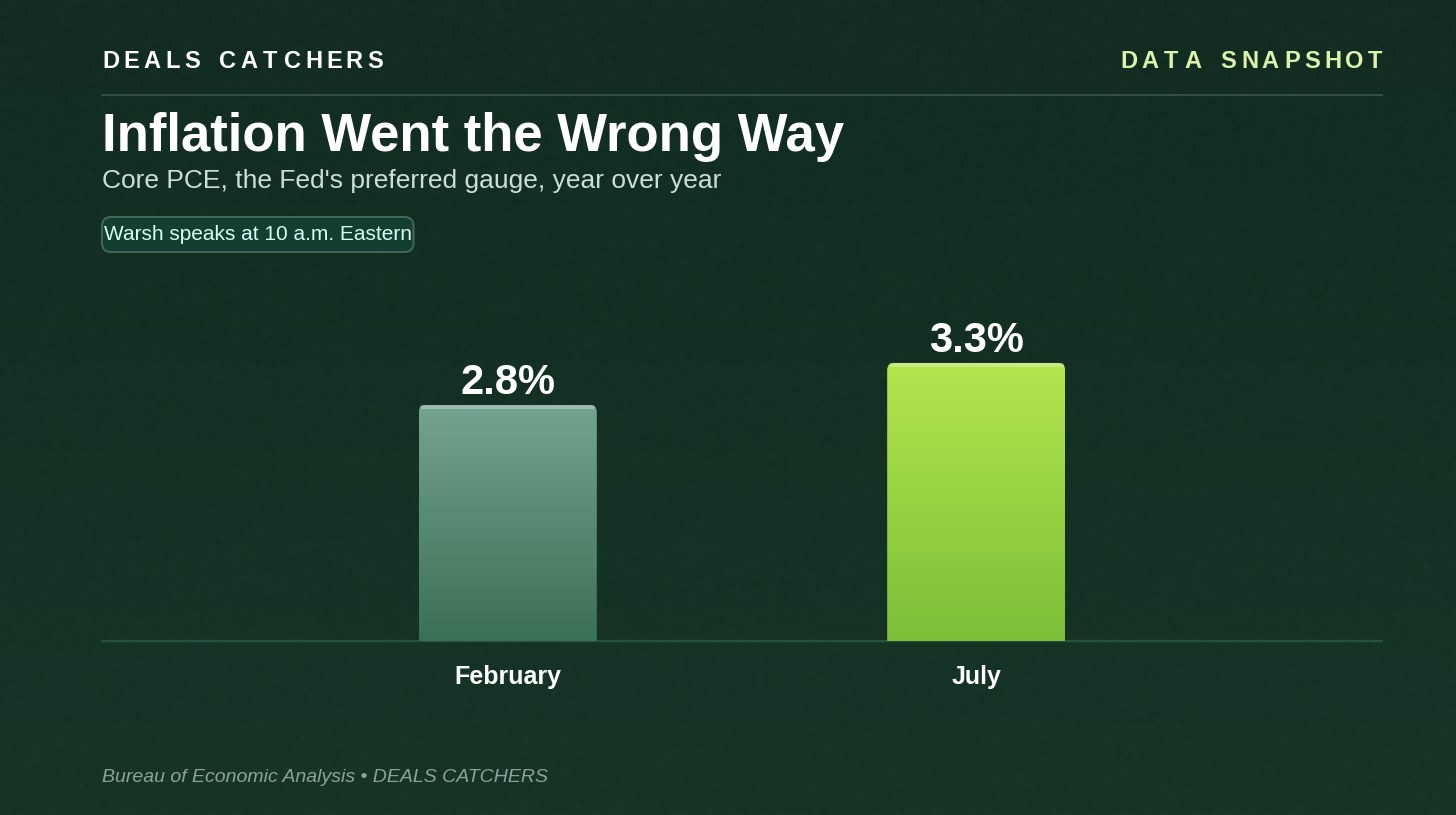
Core PCE, the gauge the Fed actually targets, ran at 2.8% in February. It came in at 3.3% for July. Kevin Warsh gives his first Jackson Hole keynote as chair this morning.
The half point in between is the conflict with Iran and what it did to energy. It is also the reason the speech carries more weight than the calendar suggests: no policy statement comes out of Jackson Hole, and the next actual decision is September 15 and 16.
Inflation went the wrong way
Core PCE, the Fed’s preferred gauge, year over year.
Warsh arrives with a communication problem of his own making. After July’s meeting, investors read his press conference as showing little resolve on inflation, and long-dated yields subsequently climbed to a two-decade high. He has five internal task forces reviewing how the Fed works, one of them on communication, and he may simply restate a commitment to price stability without saying how he plans to get there.
He also has cover. The August jobs report and August CPI both land between today and the September meeting, which gives him a genuine data-dependence argument for keeping every option open — and this chair has shown no appetite for pre-committing to anything.
If you are drawing income from savings, watch the long end rather than the headline. The thirty-year yield touched 5.337% this month, its highest since 2007, while the Treasury doubled buybacks trying to push it back down. Whatever he says at ten o’clock, that argument continues on Monday.
Source: Bureau of Economic Analysis / Kansas City Fed / Yahoo Finance
The Week Ahead
Warsh speaks at 10 a.m. Eastern. No policy statement comes out of Jackson Hole; the next decision is September 15–16, with the August jobs report and August CPI landing in between.
Nvidia beat by $4 billion and guided margin down to a 71–72% floor on memory costs its own customers created. Watch whether other hardware makers repeat that warning next month — that is how a company problem becomes an industry one.
Entry-level developer postings are down about 20%. Where AI displacement is real it looks like hiring that stops, not staff who leave — which never appears in a layoff statistic.
Matter unified lift and tilt commands across shade brands, ending the proprietary-hub era. Interoperability standards rarely make headlines and routinely decide which companies in a category survive.
The thirty-year at 5.337% is the highest since 2007. Mortgage rates, annuity pricing and every long-dated liability sit on that number, and the Treasury is actively fighting it.
 
Stat of the Day
Net US jobs Goldman Sachs measures as eliminated by AI each month — against forecasts of tens of millions
16,000
Goldman Sachs, April 2026
Forget the hot picks — protect what you’ve already built, and check whether the number describes what happened or only what someone expects. Because the best trade you’ll ever make is the loss you never took.
— Lee
Thanks for reading. Have a good weekend.
✱ Sources & Disclosures
Important disclosures. This is a paid advertisement for RYSE Inc. made pursuant to a Regulation A+ offering and involves risk, including the possible loss of principal. The valuation is set by the Company; there is currently no public market for the Company’s Common Stock. Nasdaq ticker “$RYSS” has been reserved by RYSE; any potential listing is subject to future regulatory approval and market conditions. Past share-price appreciation does not guarantee future returns. SEC qualification does not constitute SEC approval of the merits.

RYSE Inc., 96 Spadina Avenue, Suite 500, Toronto, ON M5V 2J6, Canada
Read more

The Stretch Lasted 36 Years. Heirs Now Have Ten.

The Stretch Lasted 36 Years. Heirs Now Have Ten.

The tape is watching the next industrial project. The inherited-IRA deadline is 101 days out, and a missed withdrawal is now a 25% bill.͏ ͏ ͏ ͏ ͏ ͏ ͏ ͏ ͏ ͏ ͏ ͏ ͏ ͏ ͏ ͏ ͏ ͏ ͏ ͏ ͏ ͏ ͏ ͏ ͏ ͏ ͏ ͏ ͏ ͏ ͏ ͏ ͏ ͏ ͏ ͏ ͏ ͏ ͏ ͏ ͏ ͏ ͏ ͏ ͏ ͏  21 SEPTEMBER 2026 By Mike Lee sponsoredThis Tesla Demo Shocks EveryoneThis Tesla Demo Shocks Everyone"Hi, I'm Jeff Brown...I'm

By Mike Lee
Forty-Five Percent, Against a Record of Twenty-Seven

Forty-Five Percent, Against a Record of Twenty-Seven

AI-linked stocks are 45% of the S&P 500 against a previous record of 27%. Goldman now attributes half the index's earnings growth to the same spending.͏ ͏ ͏ ͏ ͏ ͏ ͏ ͏ ͏ ͏ ͏ ͏ ͏ ͏ ͏ ͏ ͏ ͏ ͏ ͏ ͏ ͏ ͏ ͏ ͏ ͏ ͏ ͏ ͏ ͏ ͏ ͏ ͏ ͏ ͏ ͏ ͏ ͏ ͏ ͏ ͏ ͏ ͏ ͏ ͏ ͏ ͏ ͏ ͏ ͏ ͏ ͏ ͏ ͏ ͏ ͏ ͏ ͏ ͏ ͏  18 SEPTEMBER 2026 By Mike Lee sponsoredThe Hidden Middleman Cut in Every CupSUPPLY CHAIN ANALYSISThe Hidden Middleman Cut Built

By Mike Lee
The Fed Raised Rates, and the Chair Still Will Not Say Where He Stands

The Fed Raised Rates, and the Chair Still Will Not Say Where He Stands

The Fed raised rates for the first time since 2023, unanimously, and then published a dot plot on which nobody agrees about what comes next. The chair again withheld his own.͏ ͏ ͏ ͏ ͏ ͏ ͏ ͏ ͏ ͏ ͏ ͏ ͏ ͏ ͏ ͏ ͏ ͏ ͏ ͏ ͏ ͏ ͏ ͏ ͏ ͏ ͏ ͏ ͏ ͏ ͏ ͏ ͏ ͏ ͏ ͏ ͏ ͏ ͏ ͏ ͏ ͏ ͏ ͏ ͏ ͏ ͏ ͏ ͏ ͏ ͏ ͏ ͏ ͏ ͏ ͏ ͏ ͏ ͏ ͏  17 SEPTEMBER 2026 By Mike Lee sponsoredA Promiscuous Robot (Only Today — Invest Before 9/17 or Miss This Price

By Mike Lee
The List of Weak Banks Already Exists

The List of Weak Banks Already Exists

Every bank above a billion dollars publishes its uninsured deposit ratio every quarter. That number predicted the 2023 failures, and it is free to look up.͏ ͏ ͏ ͏ ͏ ͏ ͏ ͏ ͏ ͏ ͏ ͏ ͏ ͏ ͏ ͏ ͏ ͏ ͏ ͏ ͏ ͏ ͏ ͏ ͏ ͏ ͏ ͏ ͏ ͏ ͏ ͏ ͏ ͏ ͏ ͏ ͏ ͏ ͏ ͏ ͏ ͏ ͏ ͏ ͏ ͏ ͏ ͏ ͏ ͏ ͏ ͏ ͏ ͏ ͏ ͏ ͏ ͏ ͏ ͏  16 SEPTEMBER 2026 By Mike Lee sponsoredWhy Is This NVIDIA Collaborator Robot Called Flippy?Why’s This NVIDIA Collaborator Robot Called Flippy? (Invest by

By Mike Lee