$500 Into $2 Million Is 8.93 Percent a Year

 |
10 SEPTEMBER 2026
 By Mike Lee
sponsored Seven Signs, All Flashing Red |
Stop. Before you do anything else today — Grab this. It’s called The Bellweather Signal — a report that identifies 7 warning signs that have predicted every major economic collapse since 1929. All 7 are flashing red right now. Investment firms pay $5,000+ for intelligence like this. Financial newsletters sell it for $97. For the next few minutes — it’s free. No strings. No credit card. No catch. Just click below, tell me where to send it, and it’s yours instantly. I’ve helped conservative Americans protect their wealth for 15 years. This is the most important thing I’ve ever put together. And I refuse to let another good person get blindsided by a crisis the insiders already see coming. The free copies won’t last.  |
Three Numbers to Start
8.93% | the annual return implied by turning $500 into $2 million between 1929 and today. A broad index did roughly 10%. |
$100 | Brent crude, which broke through that level this week on renewed Middle East tension. |
8:30 | tomorrow morning, when August inflation lands. It is the last reading the Fed sees before it meets. |
ad Seven warning signs that have predicted every major economic collapse since 1929. All 7 are flashing red right now. Send me the free report |
An Indicator That Predicted Every Crash Was Chosen Because It Did
Any claim that a signal has called every downturn since 1929 is worth taking seriously for about thirty seconds, and the reason it fails is not that the person is lying. The record is usually accurate. The problem is how the record was assembled.
Start with the arithmetic of searching. Suppose you have a century of monthly data and several hundred candidate indicators — yield spreads, credit spreads, valuation ratios, money supply measures, sentiment surveys, housing starts, freight volumes. Test each one against the dozen or so recessions in that century and some will line up perfectly by chance alone. Not because they cause anything. Because you looked at enough of them.
This is overfitting, and it is the single most common error in market research. A rule tuned until it fits the past exactly has been fitted to the noise as well as to the signal, and noise does not repeat.
The second problem is the denominator. A signal that predicted every recession may also have predicted eleven recessions that never arrived. Both statements can be true at once, and only the first one appears in the marketing. Paul Samuelson made the joke in 1966 and it has aged well: the stock market has predicted nine of the last five recessions.
There is a specific version worth knowing because it costs people real money. An indicator that is genuinely good at calling downturns will fire early, sometimes years early, because it responds to conditions that build slowly. Someone who acted on a correct signal in 1996 or in 2015 would have sat out enormous gains waiting for a decline that eventually came and did not recover the difference.
Being right and being early are the same thing in prospect and completely different things in a brokerage account.
None of which means indicators are useless. It means the honest question about any of them is not whether it called past crashes. It is how many times it fired without one, how long the average lead was, and what it would have cost to sit in cash for that long. Those three numbers are almost never in the material, and any of them can be worked out by whoever assembled it.
A Patent Is a Claim, Not a Working Product
A recurring shape in investment promotions is the newly published patent, presented as evidence that something is about to happen. It is worth being precise about what a patent actually establishes, because it is less than people assume.
A patent grants exclusive rights to an invention. It does not certify that the invention works, that it can be manufactured at scale, or that anybody intends to build it. Patent offices assess novelty, non-obviousness and utility on paper. They do not run the machine.
There is a live example from this same company, and it is instructive. Earlier this year patents appeared describing a robotic hand mechanism, and coverage treated them as the breakthrough that would make humanoid robots commercially useful. Musk subsequently said publicly that the patented rolling-contact arrangement did not work in the real world despite working in simulation. The patent was real. The mechanism was not viable.
So when a promotion pairs a patent number with a growth projection, those two things are not connected by anything. The patent is a public document with a filing date. The projection is somebody’s opinion about a market that does not exist yet.
The useful question when a patent is presented as an investment case: has the company said it is shipping this, has anyone independent tested it, and does the filing describe a component or a whole system? A patent on one mechanism inside a machine is not a patent on the machine.
sponsored Elon Musk’s New Patent |
Editor’s Note: Jeff Brown and Marc Chaikin, two investment legends who picked Nvidia 10 years ago, are predicting that by the end of this month, Elon Musk’s new AI breakthrough will collide with a strange market pattern with a flawless 100% track record of massive market gains. Click here to see the details or read more below because the last time this happened everyday folks had a chance to turn $10,000 into as much as $350,000 in just about 12 months. Take a look at Elon Musk’s new patent below… Because it protects a new invention that could rewrite the future of wealth forever. I’m talking about a radical new form of AI I call “M.A.G.I.” One so revolutionary that Elon called it an “infinite money glitch.” Click here to see the details because he believes this is a once-in-a-generation opportunity to create wealth on a scale most people can’t even comprehend. What’s the upside potential here? I know this is going to sound crazy… But Elon is projecting growth of over 7,000,000%. Let that sink in. That’s enough to turn $100 into more than $7 million. This sounds absolutely insane. But then again… everything Elon has ever done sounded insane at first. Self-driving cars. Reusable rockets that land themselves. Brain chips that let paralyzed people control computers with their minds. Crazy ideas. But he turned them into trillion-dollar realities. So here’s the real question… Will you watch Elon build another empire from the sidelines… Or will you finally position yourself to potentially become one of the winners in his next trillion-dollar revolution? 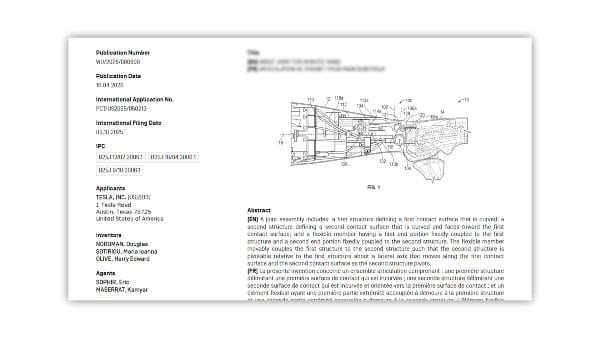 |
$500 Into $2 Million Is 8.93 Percent a Year
Here is a claim worth running the arithmetic on, because the arithmetic is the whole story and anybody can do it in a minute.
A young analyst turns $500 into what would be worth $2 million today, starting in 1929. The figure is presented as evidence of an extraordinary method.
From 1929 to now is 97 years. Turning $500 into $2 million means multiplying by 4,000. To find the annual return, take the 97th root of 4,000. It comes to 8.93% a year.
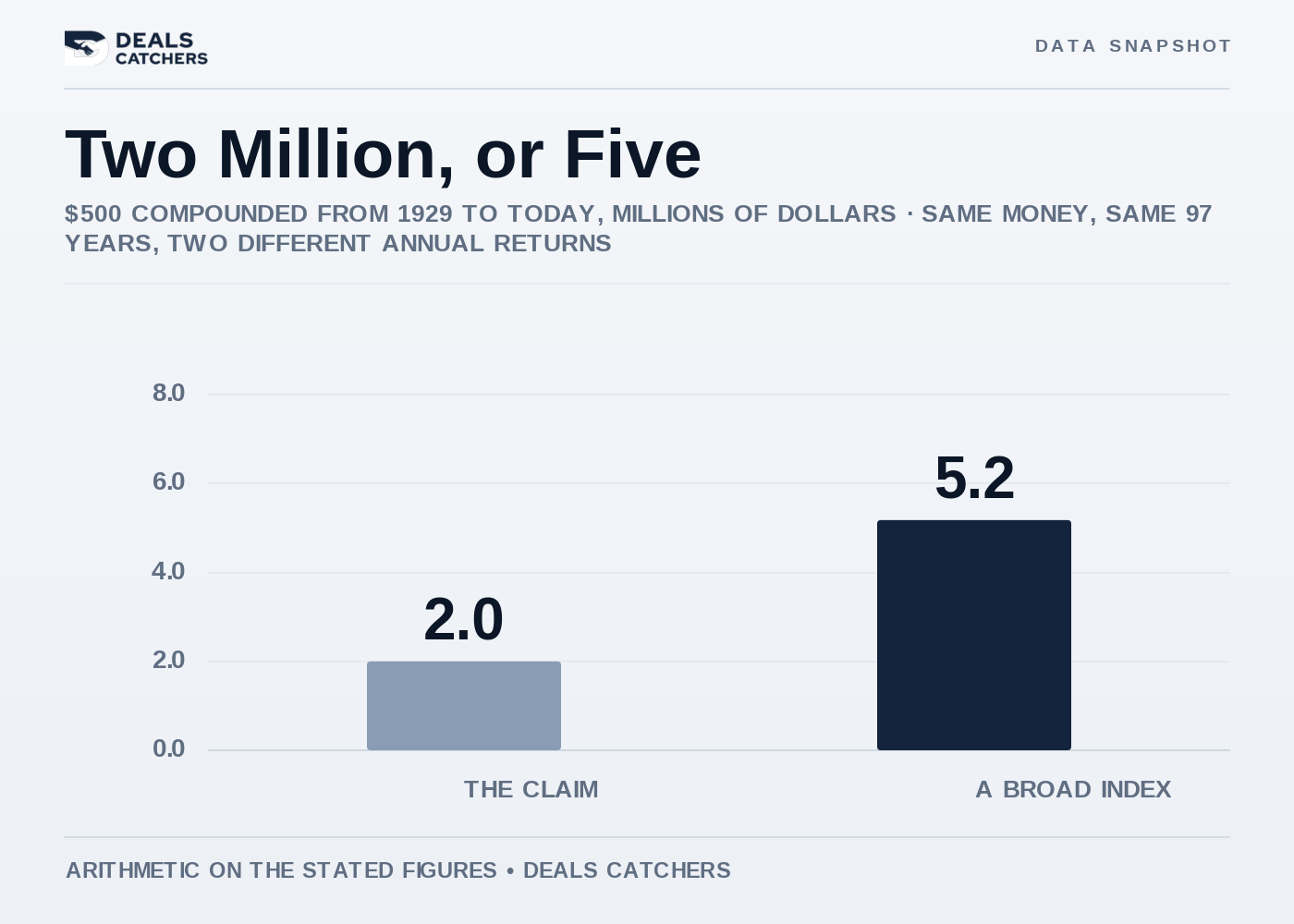
Now the comparison. A broad American stock index, held through the whole period with dividends reinvested, returned roughly 10% a year. Put $500 into that in 1929 and you finish with about $5.2 million.
The claimed result is a little over a third of what doing nothing in particular would have produced.
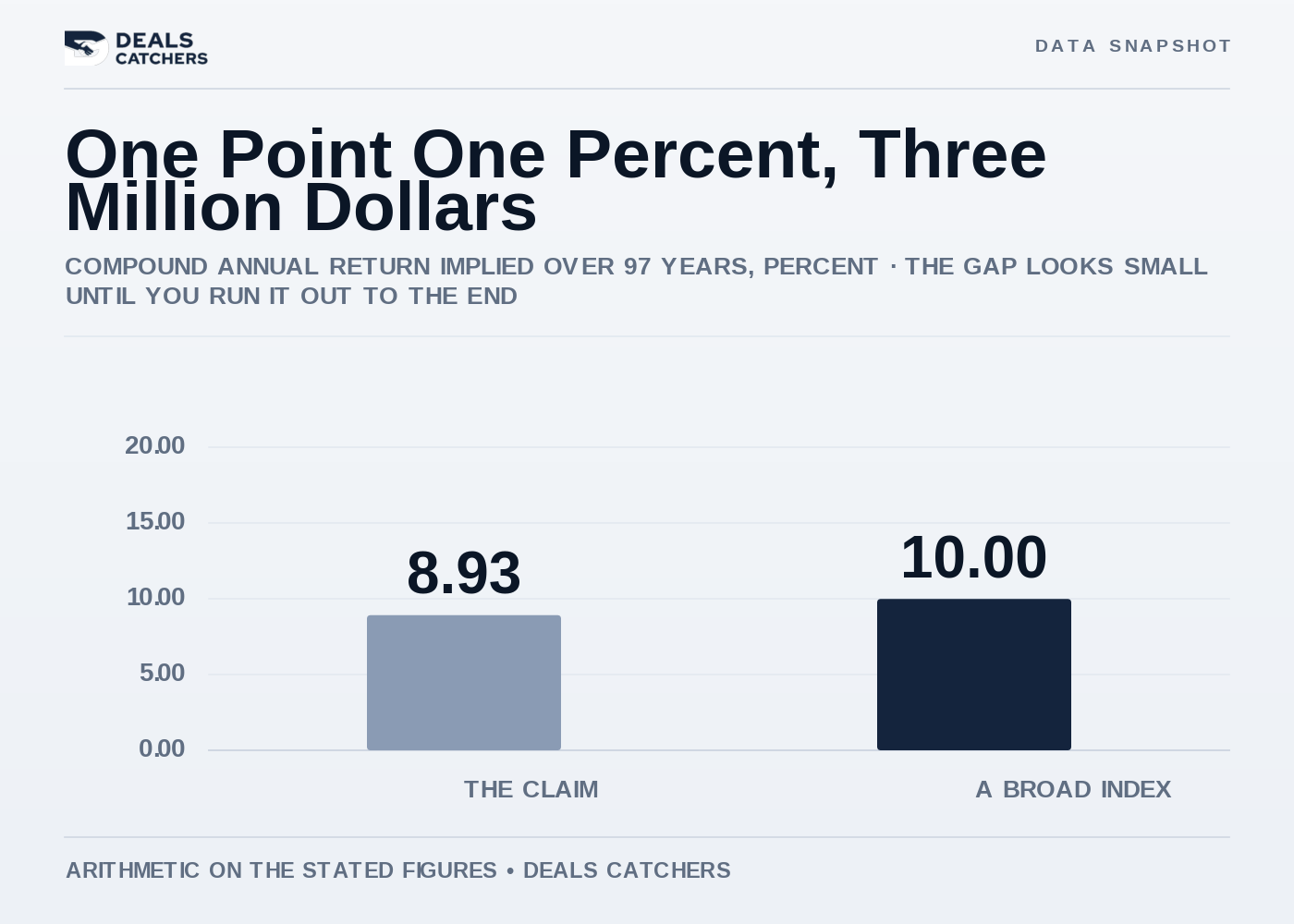
The gap between the two annual figures is 1.07 percentage points. Over 97 years that gap is worth about $3.2 million. This is the part of compounding that nobody has an intuition for, and it cuts both ways — it is why a one percent fee matters, and it is why an impressive-sounding total can describe an ordinary or below-ordinary result.
But it is presented as proof of a system, and the arithmetic says the system underperformed the index it was meant to beat.
The general rule is short enough to keep. Any before-and-after figure is meaningless without the number of years. Convert it to an annual rate, compare that to what an index did over the same period, and most extraordinary claims resolve into ordinary ones. The conversion takes a calculator and thirty seconds.
sponsored A Rookie Who Saw 1929 Coming |
 In 1929, a 20-something Wall Street rookie named Irving Weiss noticed something nobody else did. While brokers partied and shoeshine boys handed out stock tips, Irving buried himself in financial reports at the New York Public Library. What he found told him America was about to face one of the biggest financial disasters in history. He warned everyone. The veteran brokers laughed at him. Then came Black Monday. The Dow crashed nearly 13% — followed by another 12% the very next day. The investors who listened to Irving avoided the wipeout. He didn’t just sound the alarm. He also knew what would work. In fact, he was able to take $500 and turn it into what would be worth $2 million today. That strange secret Irving discovered became the foundation of what we know today as Weiss Ratings — the system a study published in The Wall Street Journal ranked #1 for investment performance. And right now, it’s flashing its most urgent warning in years. A radical shift could hit the market in the back half of 2026 — sending some of today’s most popular stocks crashing, while a handful of little-known names could soar. For a limited time only, we’re opening up full access to Weiss Ratings PLUS — including the names of the stocks to avoid and the ones we believe are set to surge — at our biggest discount ever. Regards, Tom Mustin Host, Weiss Ratings P.S. Weiss Ratings accurately called the Dot-Com Bust, the 2008 crisis, and the brief 2020 crash. Now it’s calling something entirely new. This special offer ends soon. |
Inflation Lands Tomorrow and Brent Has Crossed $100
Tomorrow | 8:30 in the morning — August consumer prices. The last reading before the meeting. |
15–16 | September — the Federal Open Market Committee meets. |
3.50% | the bottom of the current target range. Three members dissented in July in favour of a rise. |
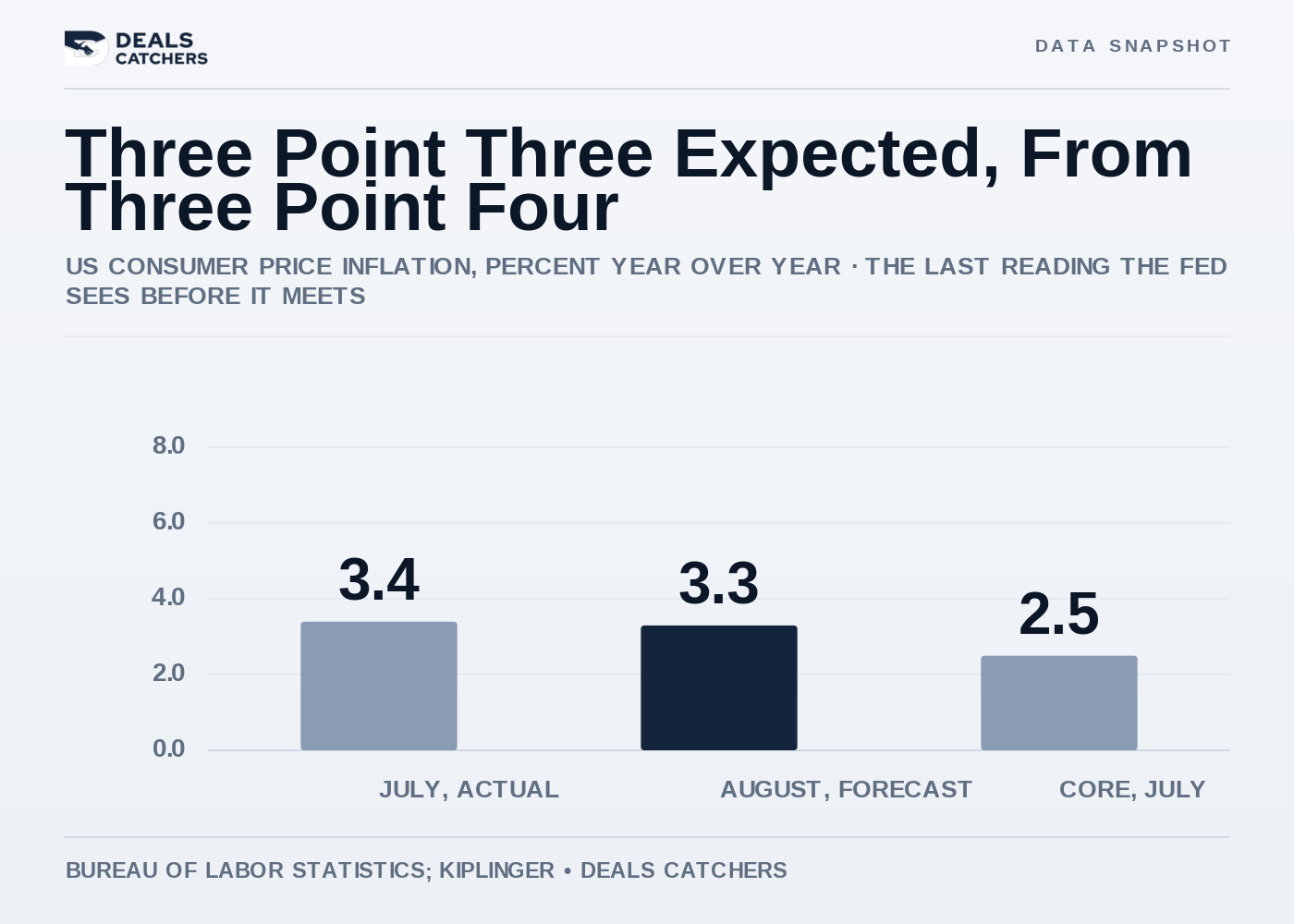
Headline inflation ran at 3.4% in July and is expected to ease slightly to 3.3%. Core prices, which strip out food and energy, are forecast to accelerate a little on the month.
That combination is awkward. A falling headline with firming core is the pattern that gives a central bank the least useful information, because the part that is falling is the part it does not control and the part that is firming is the part it does.
Underneath it sits energy. Brent crude has broken above $100 on renewed Middle East tension, and one strategist described the level as a psychological milestone with a bigger concern behind it — a prolonged oil shock keeping price pressure elevated and complicating the path for a central bank already in a difficult position.
The September meeting is genuinely open. The July vote produced three dissents in favour of a rise, Warsh has published no reaction function, and the futures market has moved back and forth all week. Tomorrow’s print is the last input.
If you are watching for a signal rather than a headline, the two-year Treasury yield in the minutes after 8:30 will tell you what the market concluded faster than any commentary will.
ad Investment firms pay $5,000+ for intelligence like this. For the next few minutes, it’s free. Send me the free report |
Ninety-Seven Years, and One Percentage Point
$3.2m | the difference between compounding $500 at 8.93% and at 10% over 97 years. The annual gap is barely one percentage point. Any before-and-after figure without a number of years attached is not yet information. |
Forget the hot picks — protect what you’ve already built, and turn every before-and-after number into an annual rate before you decide whether it is impressive. Because the best trade you’ll ever make is the loss you never took. Mike LeeDeals CatchersThanks for reading. See you tomorrow. |
Forwarded this? Get it every morning. |