340 Restaurants Run Robots. Warehouses Run 41,000



Three numbers to start
$27.6bn — federal money committed to equity stakes in 37 companies since January 2025. No consolidated ledger exists.
340 — American restaurant locations running robots. Warehouses run 41,000 units.
60% — odds of a September rate rise after Warsh spoke, up from 35% before he opened his mouth.
A hundred-year-old idea that keeps not working
The automat opened in Philadelphia in 1902. You put a nickel in a slot, a little glass door unlocked, and behind it sat a hot meal nobody had handed you. Horn & Hardart ran that business for seventy years.
We are still trying to rebuild it.
Walk the floor at a vending industry show this year and you will find eight companies selling robotic hot-food machines. Chick-fil-A, California Pizza Kitchen and White Castle all had branded units on display. Aramark showed one under the banner "Fresh Food, No Kitchen Required."
The trade press covering that same show wrote the honest verdict in its own summary: robotic restaurants continue to innovate, but have yet to scale. Whether they can scale, it said, remains an open question given the investment, the servicing and the real estate each machine requires.
So there are two facts here and they point opposite ways.
The labour case has never been stronger. Sixty-two percent of American restaurant operators say they cannot fill their open positions. The industry employs 15.5 million people and turns over a trillion dollars a year, and a meaningful share of those jobs are night shifts in airports, hospitals and campus buildings where a human has to be paid to stand somewhere quiet at three in the morning.
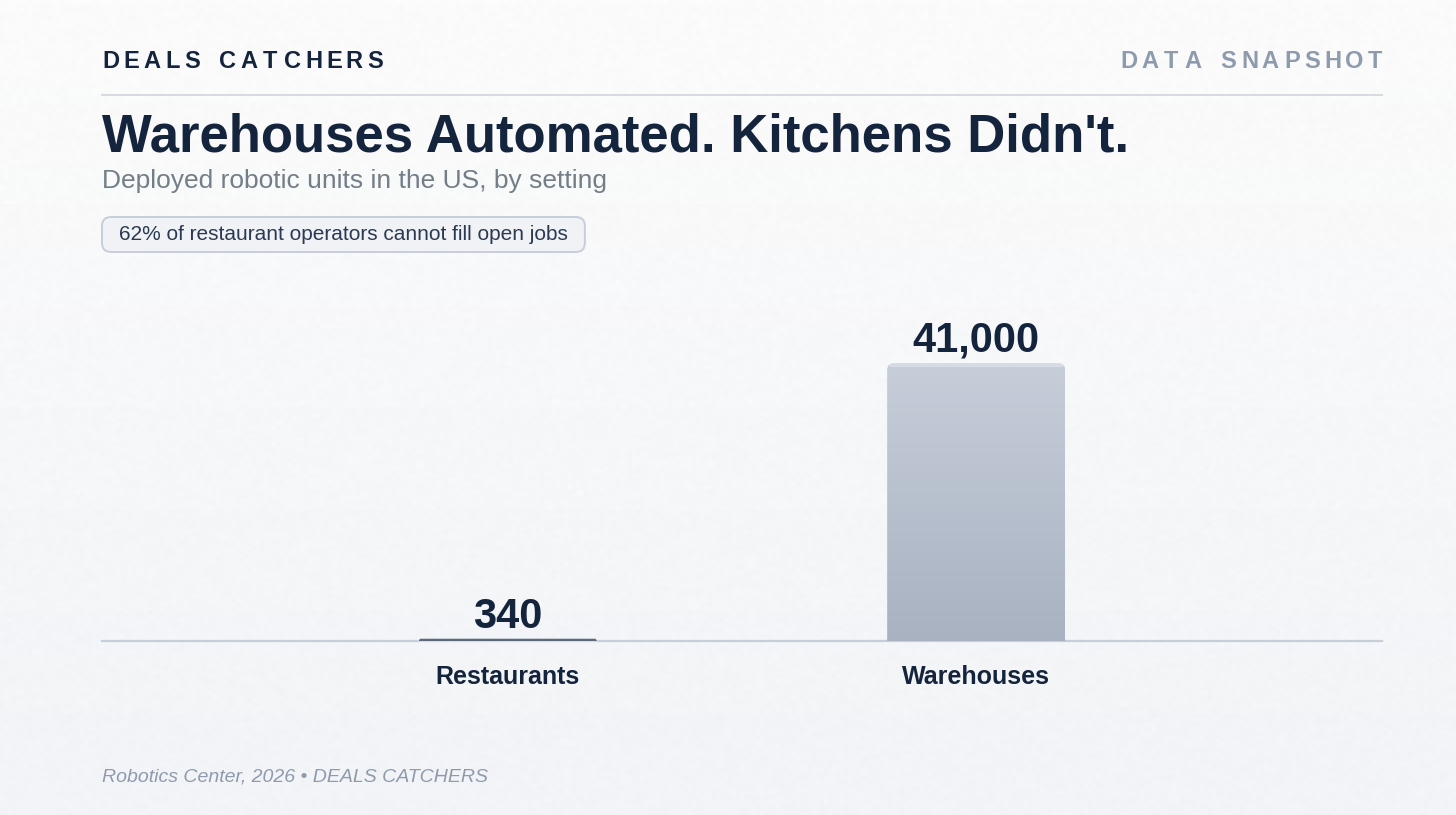
The deployment case is embarrassing. American restaurants have robots in roughly 340 locations. American warehouses have 41,000 units working. Same country, same labour market, same decade — one industry automated and the other held a conference about it.
Warehouses had an easier problem. A pallet does not care about temperature, texture or whether it arrives looking like the picture. A hot meal has to be held at food-safe temperature for hours, heated on demand in under two minutes, and come out the door resembling something a person wants to eat. That is a harder engineering brief than moving boxes, and it is why the sector has spent a decade in pilots.
There is also the customer. Roughly a third of diners say they would rather not watch a robot prepare their food. That objection weakens considerably at 3 a.m. in a hospital lobby where the alternative is a bag of crisps, which tells you where this technology actually lands first — not replacing restaurants, but filling the hours and places restaurants were never going to serve.
Look at the venues in that sentence and the shape of the business becomes clearer. Airports, hospitals, universities. Places with captive foot traffic, unpredictable hours and a landlord who already has a contract with somebody. Nobody is putting one of these on a high street competing with a sandwich shop.
What would change the picture is a contract holder rather than a clever machine. Aramark, Sodexo and Compass Group between them staff an enormous share of the world's cafeterias, and they are the ones with the venues, the service routes and the reason to care about unfilled night shifts. Distribution through those three is worth more than any improvement in the hardware.
Washington owns pieces of 37 companies and cannot tell you which
Since January 2025 the federal government has announced roughly $27.6 billion across 37 deals taking equity or quasi-equity stakes in public and private companies. Semiconductors and critical minerals account for more than 80% of the money.
That is not a proposal or a bill somebody introduced. It already happened.
The individual positions are striking on their own. Washington converted $8.9 billion of CHIPS Act grant money into roughly a tenth of Intel and is now that company's largest single shareholder. It put $400 million into MP Materials, the only rare earth miner in the country. It kept a "golden share" in U.S. Steel as a condition of the Nippon sale — one share carrying a veto over major corporate decisions. On a single day in May it took stakes in nine quantum computing companies.
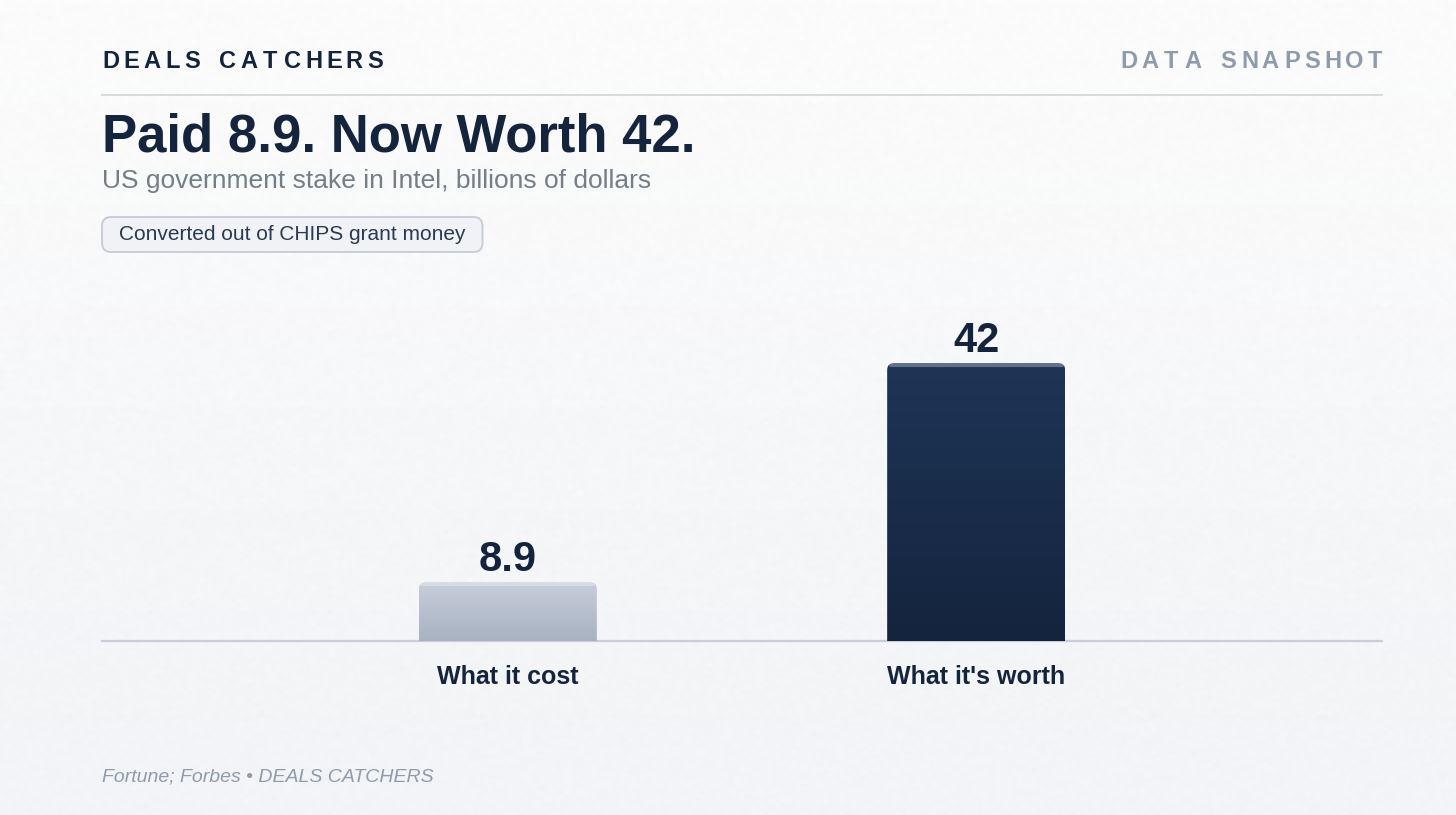
The Intel position alone has gone from $8.9 billion of cost to something like $42 billion of value. As an investment it has worked.
Here is the part that should interest anyone regardless of what they think about industrial policy: there is no consolidated ledger.
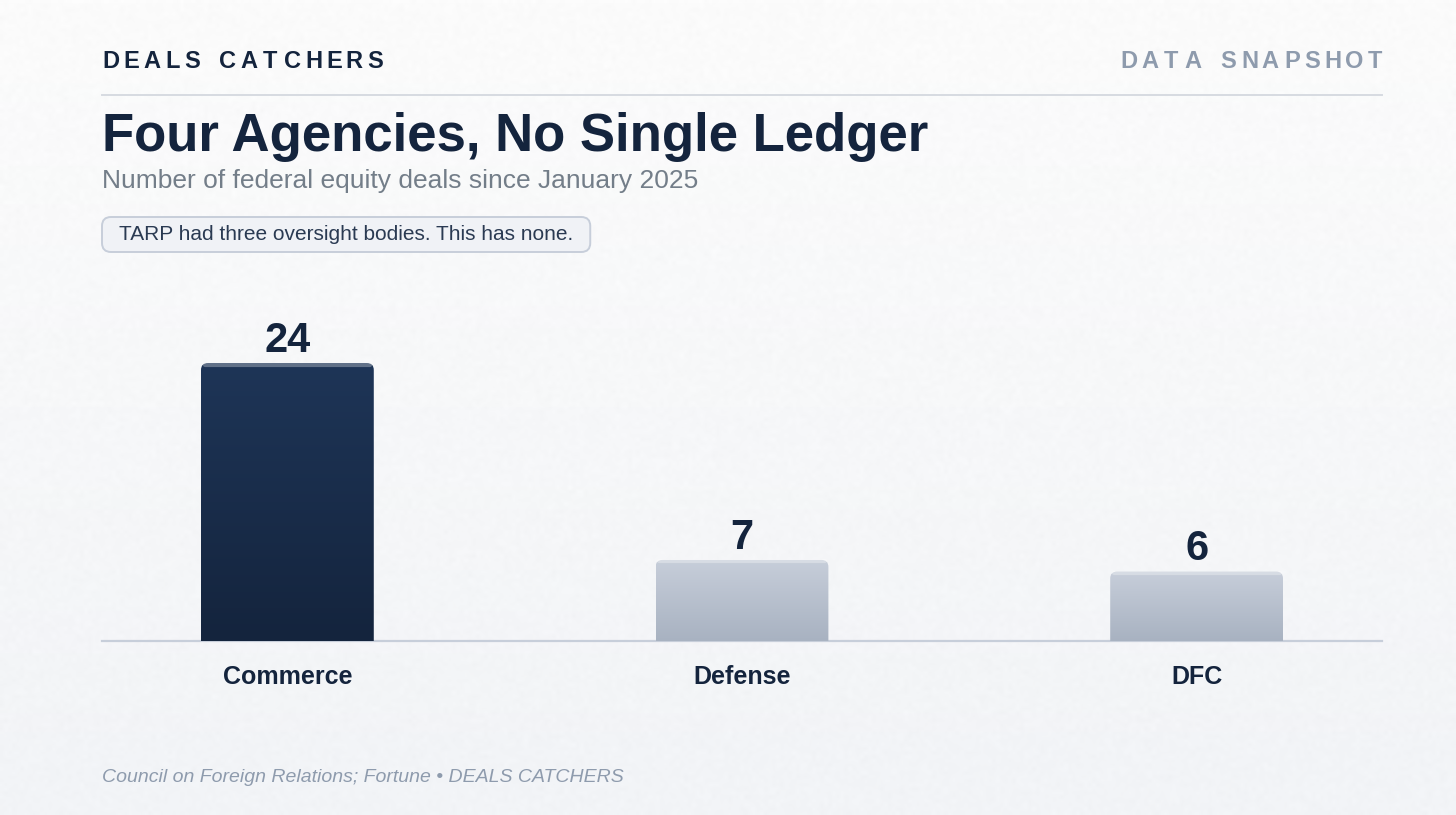
The stakes sit scattered across at least four agencies — twenty-four deals through Commerce, seven through Defense, six through the Development Finance Corporation. No single office holds the list. No quarterly statement goes to Congress. Nobody publishes a mark-to-market.
Compare that to the last time the government held corporate equity at this scale. TARP was $700 billion, and Congress attached a statutory special inspector general filing quarterly reports, a congressional oversight panel, and standing GAO audits. Three separate bodies watching one portfolio. Even then, the programme's own inspector general told Congress in 2009 that taxpayers were not being adequately told what recipients were doing with the money.
Today's portfolio has none of that apparatus, and the ceiling just went up. Congress raised the Development Finance Corporation's investment limit from $60 billion to $205 billion in December, extended its authority to domestic deals, and authorised a $5 billion equity revolving fund at Treasury. The National Economic Council director described what exists so far as a down payment on a sovereign wealth fund.
Whether you think government equity stakes are sound industrial strategy or a category error, the accounting question sits underneath both positions. Public money bought private shares. Somebody should be able to produce a statement.
Worth knowing
Rules beat judgement, and nobody likes hearing it. Jack Schwager published Market Wizards in 1989 after interviewing traders who had produced returns that should not have been possible. He kept looking for the shared secret — an indicator, a market, a way of reading charts.
There wasn't one. They traded different instruments on different timeframes using contradictory methods. What they had in common was narrower and duller: every one of them had written rules about when to get out, and they followed those rules on days when following them hurt.
The reason it holds is not mystical. A rule written on a calm Sunday is written by a version of you with no money on the line and no adrenaline in your system. The same decision taken live, mid-drawdown, is made by somebody frightened. Pre-commitment moves the decision from the worse decision-maker to the better one, and that is the entire mechanism.
The practical version is smaller than it sounds. Pick a number you will not go past on any one holding. Write down what you do when it gets hit. Then honour it the first time, because the first time is the one that sets whether the rule is real or theatre.
It also explains why so few people do it. A rule that never binds is decoration. A rule that works will, at some point, force you to sell something you are convinced is about to recover — and it will occasionally be wrong about that, in public, while you watch. The cost is real and it is paid in advance.
What's scheduled
Friday — August jobs report. The first of two numbers that decide the September meeting.
Next week — August CPI.
15–16 September — the Federal Open Market Committee meets.
After Warsh spoke at Jackson Hole, markets moved September rate-hike odds from about 35% to roughly 60% on a speech that committed to nothing at all. He gave no forward guidance and published no reaction function, which is why those two releases now carry the entire decision.
Core PCE ran at 3.3% in July against 2.8% in February. The two-year Treasury yield sits near 4.34% after jumping eleven basis points on the speech. The thirty-year barely moved.
That gap between the short end and the long end is the most useful thing on the screen right now. Short rates price what the Fed does next. Long rates price whether it works. Traders raised their bet on a hike while leaving thirty-year inflation expectations almost alone, which reads as a market that believes action is coming and believes it will be sufficient.
Nothing scheduled between now and the meeting will tell you more than Friday's number.
One thing worth watching alongside it. Warsh has five internal task forces reviewing how the Fed operates, one of them on communication itself. A chair who dislikes signalling and is formally studying how his institution signals is not going to drift back into forward guidance by accident. Whatever comes out of that review will shape how every future release gets read, and it will arrive with far less coverage than a rate decision.
One number
$27.6 billion in federal money committed to equity stakes across 37 companies since January 2025, spread over four agencies, with no consolidated public ledger.
Forget the hot picks — protect what you've already built, and ask who is keeping the books before you decide whether the numbers add up. Because the best trade you'll ever make is the loss you never took.
— Lee
Thanks for reading. See you tomorrow.