
🌎 What Happened in the World on October 7, 2025
Global Tensions Escalate: Bitcoin's Record Inflows, U.S. Senate Hearing, Ukraine's Strategic Strikes and U.S.-India Relations

SHORT INTRO
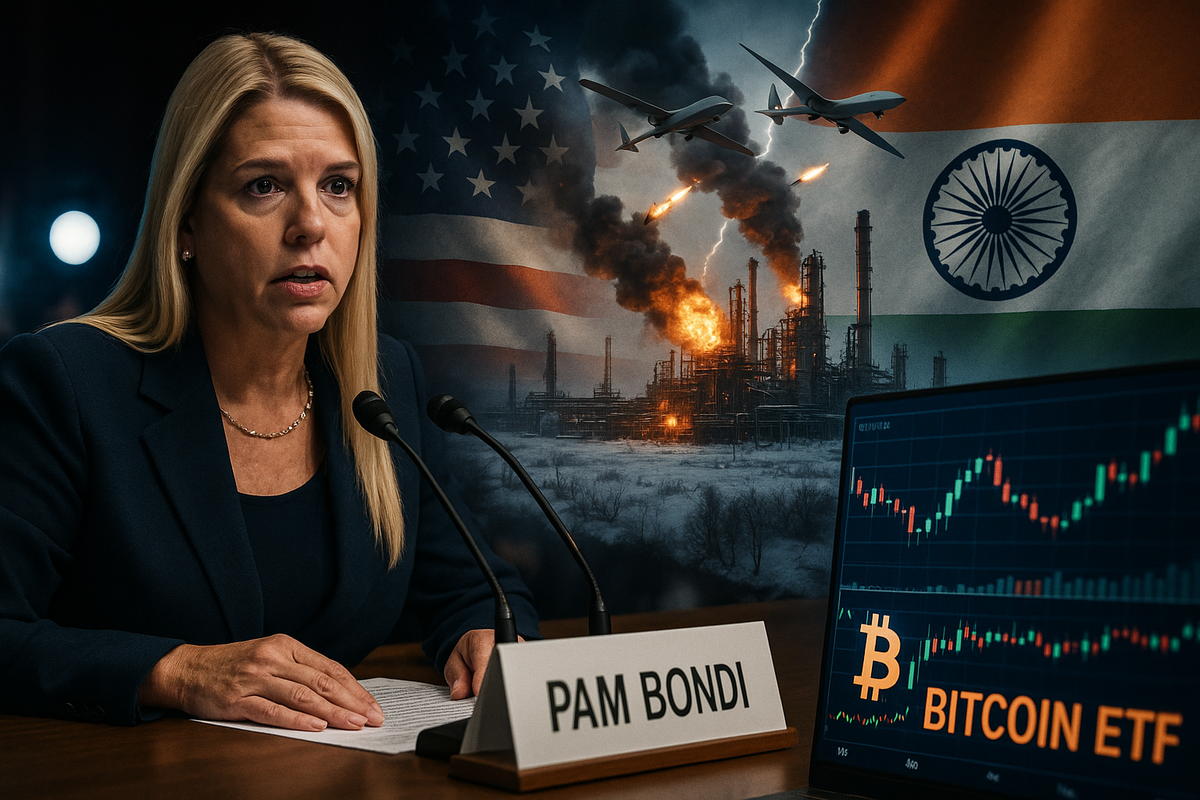
The global stage is witnessing significant developments today. U.S. Attorney General Pam Bondi faces intense questioning in a Senate hearing regarding the handling of high-profile cases. Ukraine's strategic strikes on Russian fuel infrastructure continue to escalate tensions. Meanwhile, U.S.-India relations experience a sharp downturn, and Bitcoin ETFs record unprecedented inflows, signaling strong investor confidence.
Welcome to your global update for October 7, 2025. We’re bringing you a clear and complete look at today’s defining stories — the ones that reveal how politics, markets, and security interconnect in real time.— Team Deals Catchers
MAIN PART
Bondi Faces Senate Scrutiny
U.S. Attorney General Pam Bondi appeared before a tense Senate Judiciary Committee hearing, where lawmakers grilled her over the Department of Justice’s handling of politically charged cases. The spotlight centered on the indictments of former FBI Director James Comey and the reopening of investigations linked to Jeffrey Epstein’s network of influence, both of which have stirred partisan division across Washington. Bondi defended her department’s independence, stating that “justice cannot serve political convenience.” Senators pressed for clarification on whether the DOJ coordinated with White House officials during these decisions — a claim Bondi flatly denied. The session lasted nearly six hours, with analysts noting that this could mark a pivotal moment for the Biden administration’s credibility on rule-of-law issues. The Justice Department plans to release further documentation this week to reinforce transparency amid growing public skepticism.
Ukraine’s Strategic Strikes Intensify
Ukraine’s long-range strikes on Russian fuel depots and refineries have entered a new phase, severely disrupting Moscow’s logistics and deepening its internal energy crisis. Over the past ten days, Ukrainian drones have hit at least four major refining complexes, knocking out up to 45 percent of Russia’s refining capacity. The impact has been immediate: fuel prices inside Russia are spiking, supply lines to front-line units have slowed, and emergency energy rationing is being discussed in several regions. Ukrainian military officials describe the campaign as part of a “systematic dismantling” of the Kremlin’s war infrastructure. Analysts in Europe say these attacks are forcing Russia to divert air defense systems from the battlefield to protect industrial assets — a strategic win for Kyiv. Meanwhile, Moscow accuses NATO of aiding targeting operations, a claim Western governments deny. Energy market observers warn that prolonged refinery outages could ripple through global fuel prices heading into winter.
U.S.–India Relations Deteriorate
Tensions between Washington and New Delhi have reached their lowest point in years after a series of sharp diplomatic exchanges and new trade measures. The United States recently imposed a fresh round of tariffs on Indian exports, citing unfair industrial practices, while pressuring India to cut energy imports from Russia. India, in turn, has pushed back hard, accusing Washington of undermining its sovereignty and long-standing policy of “strategic autonomy.” The friction extends beyond trade — U.S. intelligence concerns about India’s regional military cooperation and surveillance projects have added new strain. Despite the growing chill, both governments are trying to preserve limited cooperation in technology and defense. Indian analysts warn that continued U.S. pressure could drive New Delhi closer to alternative economic partners such as the UAE and China, reshaping the balance of power in South Asia.
TODAY’S BREAKTHROUGH
Ukraine’s Asymmetric Advantage
Ukraine’s evolving drone and missile strategy is proving to be one of the most effective asymmetric warfare tactics of the modern era. By striking at Russia’s energy infrastructure rather than its front lines, Kyiv is crippling both military logistics and domestic confidence inside Russia. Intelligence sources suggest that refinery disruptions could reduce Russia’s fuel exports by up to 60 percent in the coming months, significantly shrinking state revenues. This development has broader implications — not only weakening Moscow’s war machine but also reshaping global energy flows as Europe and Asia adjust their import strategies. The success of these operations underscores Ukraine’s growing technological sophistication and Western intelligence coordination.
Bitcoin ETFs See Record Inflows
The digital asset market is witnessing a surge of renewed optimism as U.S.-based Bitcoin exchange-traded funds (ETFs) logged their second-highest single-day inflows on record, surpassing $1.2 billion. This influx underscores institutional investors’ confidence in Bitcoin’s long-term resilience, even as global uncertainty mounts. The world’s largest ETF providers reported sustained demand from pension funds and hedge funds seeking to diversify amid inflation risks and volatile equities. Bitcoin itself is holding above $124,000, with analysts suggesting momentum could carry it higher before a potential correction later this quarter. Veteran trader Paul Tudor Jones described the market as being in a “pre-blowoff rally phase,” hinting that a major cycle peak could be near. Still, many see this as a sign that crypto assets are maturing, evolving from speculative tools into core components of diversified portfolios.
Strategic actions today shape the geopolitical landscape of tomorrow.Anonymous Analyst
CLOSING THOUGHTS
Today’s stories reveal a world in transition. In Washington, questions of justice and power are colliding in real time. In Eastern Europe, precision warfare is rewriting the rules of modern conflict. Across the Indo-Pacific, alliances are bending under the weight of competing national interests. And in financial markets, Bitcoin’s record inflows show how capital continues to seek refuge — and opportunity — amid instability. Together, these shifts signal that the balance between politics, technology, and global finance is being redefined once again.
Stay tuned — tomorrow’s headlines may look different, but the forces shaping them are already in motion.