Two Trains Down. The Repair Clock Says Three Years.

 |
2 OCTOBER 2026
 By Mike Lee
sponsored Sell This, Buy That |
I've just revealed a powerful investing strategy that boils down to " Sell This, Buy That." It's a way to rid yourself of overpriced AI stocks before the tech trade breaks down this summer... And instead move that money into smaller, lesser-known names that are showing real potential to dethrone the "Mag 7". I even give away a Hotlist and Hitlist of buy and sell ideas that you can act on right now. Like my recommendation I call "an upgrade to Tesla stock." It's a little-known company that just inked a groundbreaking partnership with the king of AI, Nvidia. This deal virtually hands this under-the-radar firm the keys to the self-driving industries' biggest customers, putting them miles ahead of Tesla in the autonomous vehicle race. That's why I want to put this stock on your radar before markets open. You can get the name and ticker symbol here. Sincerely, Marc Chaikin Founder, Chaikin Analytics |
Three Numbers to Start
17% | of Qatar’s LNG export capacity has been offline since March, after missile strikes on two of the fourteen trains at Ras Laffan. |
3 years | the repair estimate the operator gave on 21 September, narrowed from the three-to-five years quoted in the spring. |
48 | the number of months quoted for delivery of the replacement gas turbines the repairs depend on. |
ad A way to rid yourself of overpriced AI stocks before the tech trade breaks down. And instead move that money into smaller, lesser-known names. See the hotlist and hitlist |
Two of Fourteen Trains, and a Three-Year Clock
The largest liquefied natural gas export facility in the world has been running short since March, and the repair estimate has now been pinned down.
Missile strikes hit Ras Laffan on 18 and 19 March. They damaged two of the site’s fourteen LNG processing trains and one of its two gas-to-liquids plants. Nobody was hurt. The capacity taken offline amounts to about 12.8 million tonnes a year, roughly 17% of Qatar’s export capability, and the operator put the revenue loss at about $20 billion a year.
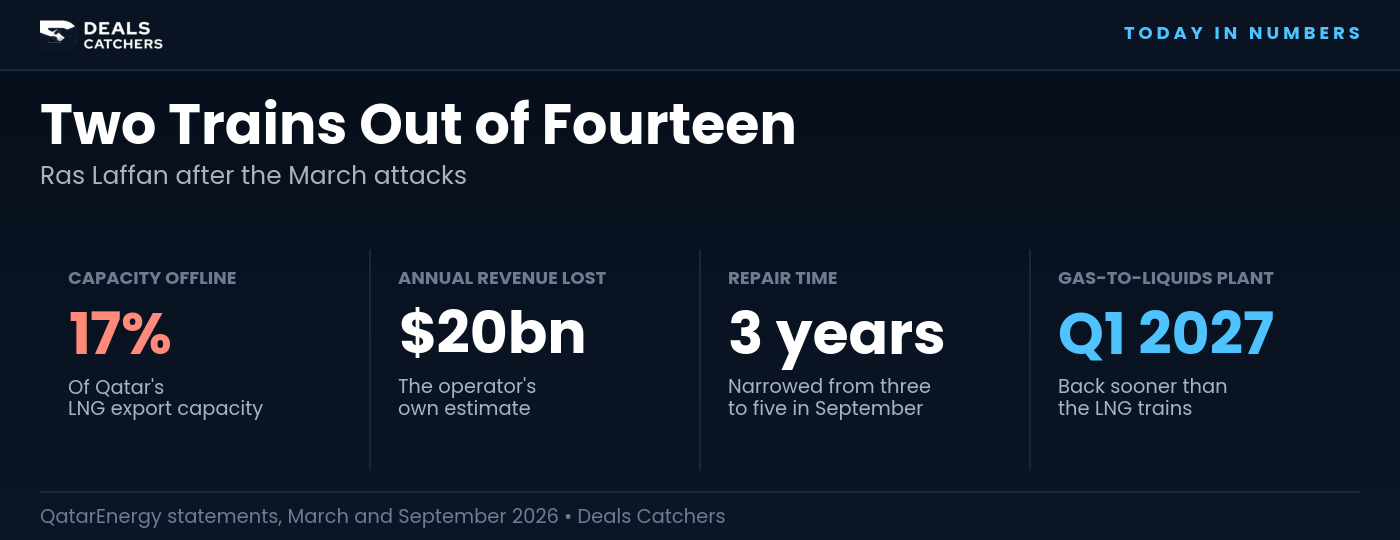
In March the company said repairs would take three to five years and declared force majeure on some long-term contracts, affecting buyers in South Korea, China, Italy and Belgium. On 21 September its chief executive narrowed that to three years for the two LNG trains, with the gas-to-liquids plant back in the first quarter of 2027.
One Italian buyer with a 25-year contract for 6.4 billion cubic metres a year has replaced fourteen of twenty-one missing cargoes from elsewhere. That is the market scrambling for tonnes that Ras Laffan is not shipping. Seven cargoes are still missing. A buyer hunting replacements is not the same thing as a plant that is back.
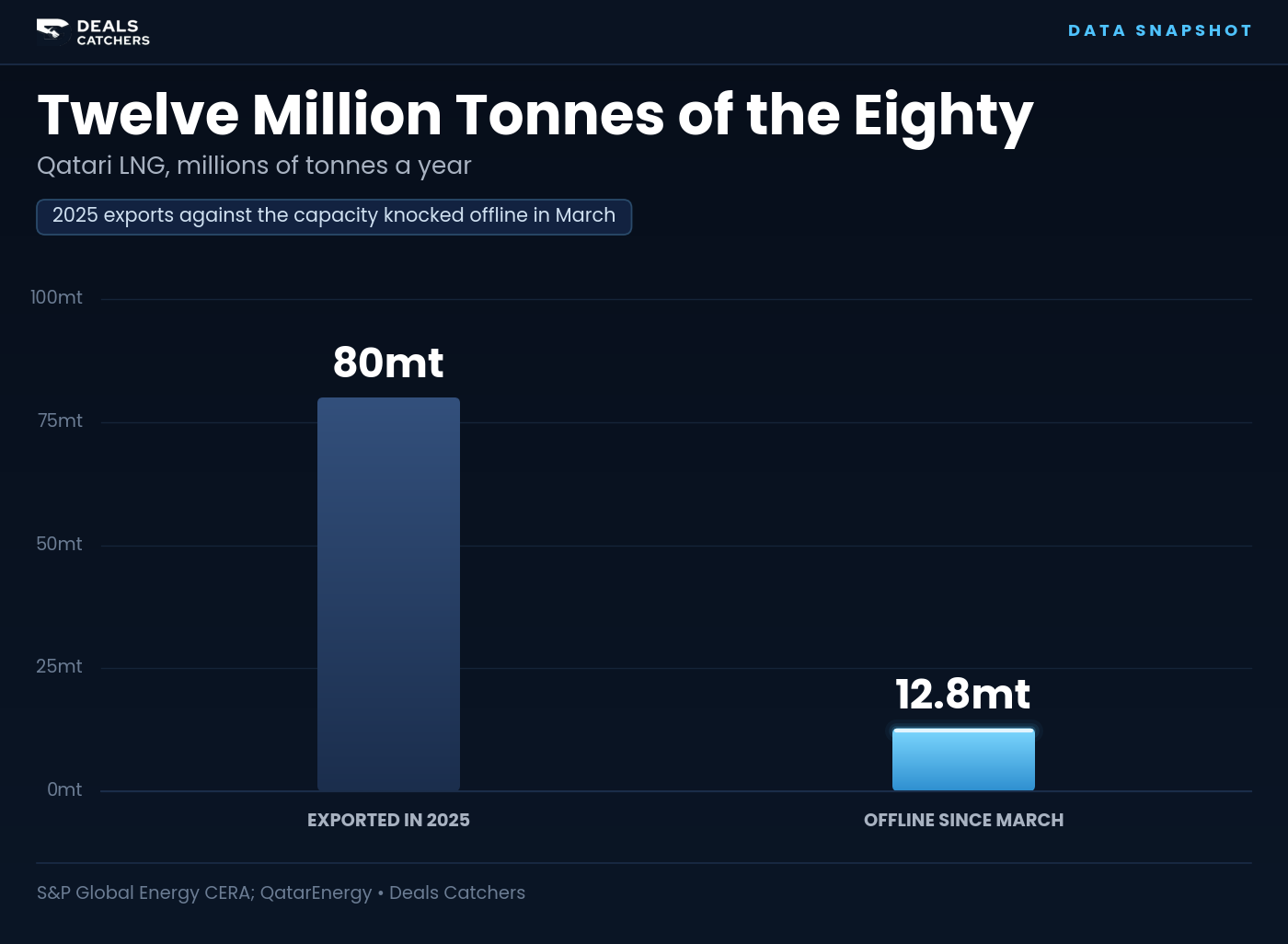
Scale is the point, not the excuse. Qatar delivered more than 80 million tonnes of LNG in 2025. The 12.8 million tonnes offline is $20 billion a year already taken out, and force majeure is already in the contracts. The other twelve trains do not rebuild the two that were hit. A handshake does not pour a new train.
The second clock is the Strait of Hormuz. The chief executive said last month that Qatar is currently producing very little LNG and could resume normal operations within weeks of the strait reopening. He also thanked neighbouring states for a pipeline route that would bypass it. That date belongs to a negotiation. It does not restart the damaged trains, and it does not deliver the turbines those trains are waiting on.
So there are two clocks, and neither one is a deal. The damaged trains come back in three years, if the equipment arrives. The rest of the plant comes back whenever ships can sail. A ceasefire can open the water. It cannot rebuild a liquefaction train that took years and tens of billions to put there.
sponsored The Damage Is Done |
The damage is done. I know that's not what you want to hear. You want to hear that the conflict in Iran is winding down but wanting the moon won’t bring it down to you. As I explain in this new documentary, the truth is this: even if the war ends today, the damage is done … the consequences for the markets will take years to resolve… and the shockwaves are about to unleash a new crisis here in America.  While politicians can shake hands and proclaim that the war is over, the reality is the decimation of the Persian Gulf’s energy infrastructure can’t be fixed with a “deal.” A peace treaty can’t rebuild a liquefied natural gas (“LNG”) facility that took 14 years and $50 billion to build… and all across the Middle East, energy infrastructure has been decimated. Qatar's Ras Laffan facility handled about 100 million tonnes of LNG per year, nearly a third of the entire global supply. It has been destroyed. The CEO of QatarEnergy, Saad al-Kaabi, said publicly that repairs will take "three to five years." Three to five years. That's not a political problem. That's an engineering problem. Saudi Aramco's Ras Tanura, the world's largest offshore oil loading terminal, was hit. Iran's own South Pars gas field, the largest natural gas field on the planet, has been struck. Oil infrastructure across the region that took decades and hundreds of billions of dollars to construct has been laid to waste. The International Energy Agency, the same body that has tracked every oil crisis since 1973, issued an alarming statement: "The war in the Middle East is creating the largest supply disruption in the history of the global oil market." That’s because this time it’s physical. Consider the embargo of 1973, that was political and could be reversed with a deal. Or the Iranian Revolution of 1979, which disrupted production but left infrastructure intact. This time, the infrastructure is rubble. And the devastation cannot be undone with a “deal.” Yet I fear that not enough people are pricing in what comes next. In my new video I lay out what the global oil shock means for America… and, most importantly, what you can do to get on the right side of the coming financial shock. Watch my video message now before it’s too late. Good investing, Porter Stansberry |
The Repairs Have Their Own Waiting List
A detail buried in the engineering coverage explains why a three-year estimate is not a negotiating position.
Restarting the damaged trains requires replacement gas turbines to drive the refrigeration compressors. Only three manufacturers in the world build the units required, and quoted delivery runs two to four years. The interesting name in that trade is not the plant on the coast. It is the company that builds the machine the plant cannot restart without.
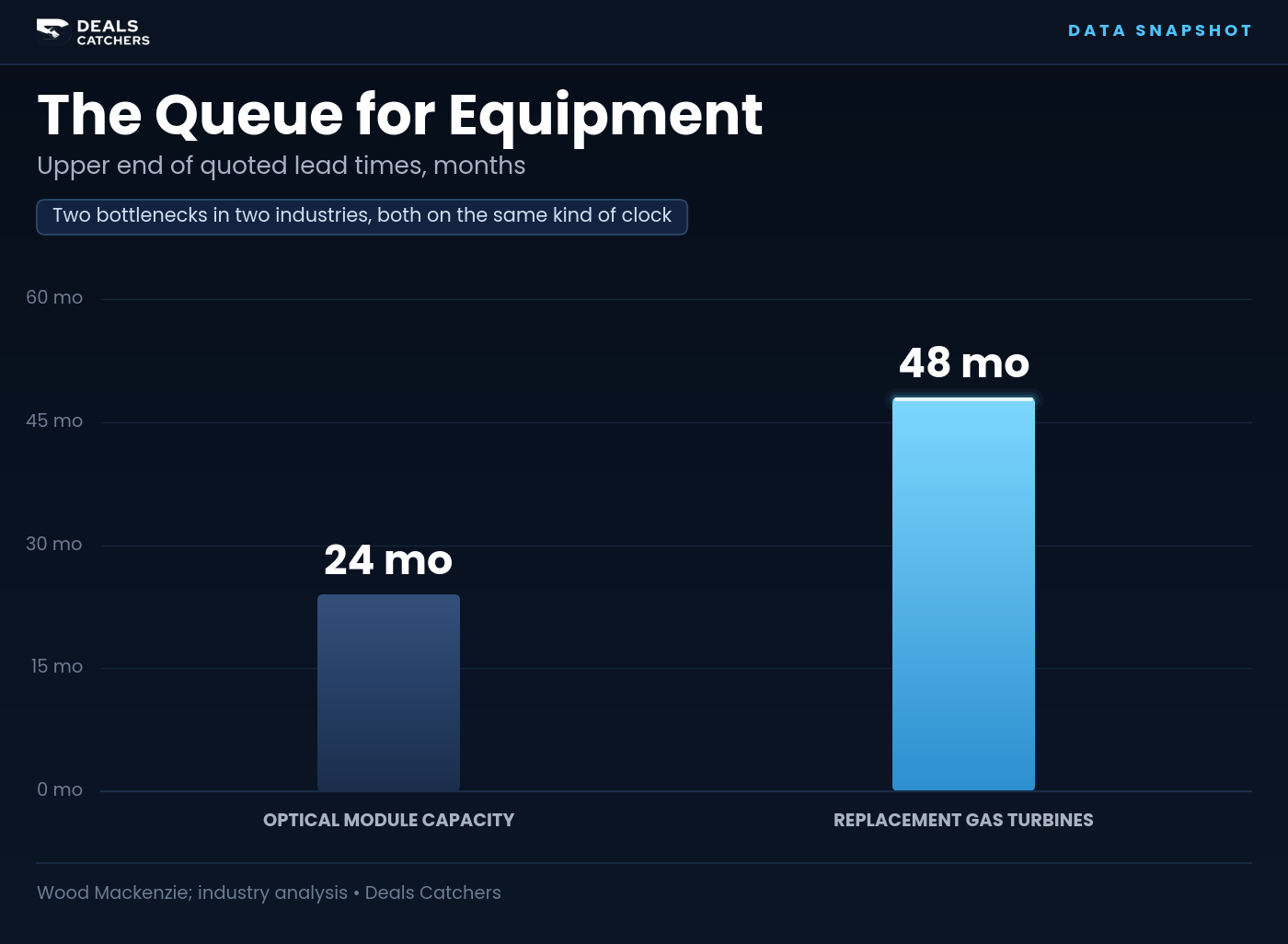
The same pattern shows up in a completely different industry this year. American regulators have been drafting a rule to bar new Chinese-made optical transceivers from data centres. Western suppliers would need twelve to twenty-four months to scale up replacement capacity, and the components they build depend on a material China placed under export permits in February 2025. The ban is not on the chip the Mag 7 gets the headline for. It is on the small part that moves data through the facility.
Two industries, two bottlenecks, and in both cases the constraint is a factory rather than a decision. A policy can be announced on a Tuesday. A turbine line or a photonics fab answers on its own schedule, and that schedule is measured in years. The announcement is the part everybody argues about. The component is the part that decides whether the facility runs.
Which is the part worth carrying into any supply-chain story. The announcement tells you what somebody intends. The lead time tells you when it can possibly happen, and the name that matters is rarely the one on the headline. It is the lesser-known supplier of the part every competing plant has to buy.
sponsored The Component Nobody Watches |
President Trump is going to war with China. Not a hot war with bombers, drones, and boots on the ground, but a new type of economic war that’s going to have massive consequences both here in the U.S. and abroad. His administration is drafting a ban on Chinese components inside American data centers. The ban isn’t on chips or software though – it’s targeting a tiny, unglamorous part almost nobody pays attention to. But it’s this component that moves data through every AI facility. Officials want the ban published this year because they know the AI war is a zero sum game and whoever is first to AGI (artificial general intelligence) will take all the spoils. This is just part of the story though. And it’s all downstream of a shocking new economic doctrine. A doctrine written by a highly controversial Silicon Valley CEO that has been adopted at the highest level of this government, and never once explained to the American public. It changes what a "safe" stock is. It changes which companies get protected and which get sacrificed. And it is already rewriting the rules of investing while most people argue about politics. In this new interview, legendary financial analysts Porter Stansberry and Luke Lango laid out the full story – including the money moves you need to make ahead of this radical economic shift. Don’t be left behind. Watch it now while you can. |
What is Scheduled
7 Oct | the minutes of the September Fed meeting, which raised rates for the first time since 2023. |
27–28 Oct | the next rate decision, six days before the midterm elections. |
Q1 2027 | when the damaged gas-to-liquids plant at Ras Laffan is expected back. The LNG trains are three years out. |
Energy prices run through the rate decision. A Gulf supply hole that a ceasefire does not fill feeds the inflation readings the committee pointed to in September, and the committee meets six days before a national vote. The vote does not shorten a turbine queue.
ad Instead move that money into smaller, lesser-known names that are showing real potential to dethrone the Mag 7. See the full strategy here |
Three Years and Four Years
3 years | to repair two LNG trains, and up to four years to take delivery of the turbines the repair needs. Both clocks started in March. Neither one responds to a ceasefire, a price move or an announcement. The plant that waits on them is a fifth of the world’s traded gas, and the name that gets paid is the one that builds the part. |
Forget the hot picks — protect what you’ve already built, and read the lead time next to the announcement. Because the best trade you’ll ever make is the loss you never took. Mike LeeDeals CatchersThanks for reading. Have a good weekend. |
Forwarded this? Get it every morning. |