🌎 The "Raft" Strategy: Why Smart Investors Are Stoping the "Hold Tight" Panic


In Partnership With

The "Raft" Strategy: Why Smart Investors Are Stoping the "Hold Tight" Panic
Hey everyone, quick question: Have you driven past your local bank branch lately?
If you have, you might have noticed something strange. A lot of them are dark. The lights are off. The ATM is boarded up. Maybe there’s a "For Lease" sign in the window where you used to deposit your checks.
It’s happening quietly, almost in the background of our daily lives. Banks are closing branches at the fastest rate we’ve seen in years. Major restaurant chains - staples of the American highway that have survived recessions before - are shuttering locations by the hundreds. The Treasury is signaling debt issues that make the 2008 numbers look like a rounding error.
Now, I’m not here to ruin your morning coffee with doom and gloom. That’s not what we do here at Deals Catchers. We aren't fear-mongers; we are pattern-matchers. We look for the setup.
When you see these signals - volatility rattling portfolios, institutions shrinking their physical footprint, the cost of living squeezing the consumer - you realize we are entering a period of choppy waters. It isn't necessarily a "crash" in the dramatic, Hollywood sense. It’s something potentially more dangerous: a slow, grinding erosion of stability.
The "Boiled Frog" Economy
You know the old fable. If you throw a frog in boiling water, it jumps out. But if you put it in tepid water and slowly turn up the heat, it sits there until it’s too late.
Right now, the American investor is sitting in warm water.
The stock market hits new highs, but your grocery bill is up 30%. The headlines say unemployment is low, but full-time jobs are being replaced by gig work. The banks say the system is sound, but they are quietly limiting cash withdrawals and closing physical access points.
This creates a cognitive dissonance. You feel like something is wrong, but your 401(k) statement says you’re doing okay. This is the danger zone. This is where complacency sets in.
The Two Types of Investors
In moments like this, the investing world splits into two distinct groups. It’s not about "Bulls" vs. "Bears" anymore. It’s about Passive vs. Active.
Group A is the "Hold Tight" crowd. These are the folks who see the storm coming and freeze. They grip the railing. They tell themselves, "It’ll come back. It always comes back." They rely on the strategy of "Hope."
- They rode the market down in 2000 during the Dot Com burst.
- They rode it down in 2008 when the housing market collapsed.
- They rode it down in 2020 during the pandemic panic.
They take the hit because they think they have no other choice. They have been trained by decades of financial media to "buy and hold," even when the fundamentals of the currency itself are changing. They are fully exposed to the system, with zero hedges and zero exits.
Group B is the "Grab the Raft" crowd. These are the investors we try to emulate. They don't panic. They don't sell everything and hide cash under the mattress (because inflation eats that, too). Instead, they look for the life raft.
They ask a different set of questions:
- "If the dollar loses value, what holds value?"
- "If the banks close, where is my wealth stored?"
- "If the stock market corrects, what asset is non-correlated?"
They look for the vehicle that is designed to float when everything else is sinking.
The Illusion of Diversification
The problem is, most people don't know the raft exists. They think they are "diversified" because they own an S&P 500 index fund and maybe a bond fund.
But let’s be honest: In 2024 and beyond, stocks and bonds often move together. When interest rates rise or the debt ceiling wobbles, both asset classes can take a hit simultaneously. That isn't diversification; that’s just two different seats on the same sinking ship.
True diversification requires owning something that sits outside the paper financial system. Something that doesn't rely on a CEO’s promise, a bank’s solvency, or a government’s printing press.
The Third Door
There is a third door. It’s not a loophole. It’s not some risky offshore scheme. It’s not buying cryptocurrency on a sketchy exchange.
It is a specific, boring, federally approved line of the U.S. tax code that the wealthy have been using for decades to weather these exact storms.
The reason you haven't heard of it is simple: Wall Street doesn't make money when you use it.
Your bank manager isn't going to tell you about it, because it involves moving funds out of their ledger. Your generic financial advisor probably won't bring it up, because they can't charge their annual 1% fee on it as easily.
But just because they aren't talking about it doesn't mean you can't use it. In fact, for anyone with a retirement account - a 401(k), IRA, TSP, or 403(b) - this might be the single most important "raft" you can grab before the water gets rough.
We aren't telling you to panic. We are telling you to prepare. The difference between "Holding Tight" and "Grabbing the Raft" is simply information. And in Part 2, we are going to break down exactly what that information is.
Sponsored Content
Wall Street Won’t Tell You This IRA Move Exists...
It's happening again - but this time, it's faster.
✅ Banks are quietly closing branches across the country.
✅ The Treasury is signaling deeper debt problems.
✅ Major restaurant chains are closing locations.
✅ Stock market volatility is rattling portfolios daily.
And through it all... your retirement stays fully exposed?
You have two options:
1. Hold tight and ride it down - like millions did in 2008 and 2020.
2. Or grab the raft that more informed investors are quietly using to stay afloat.
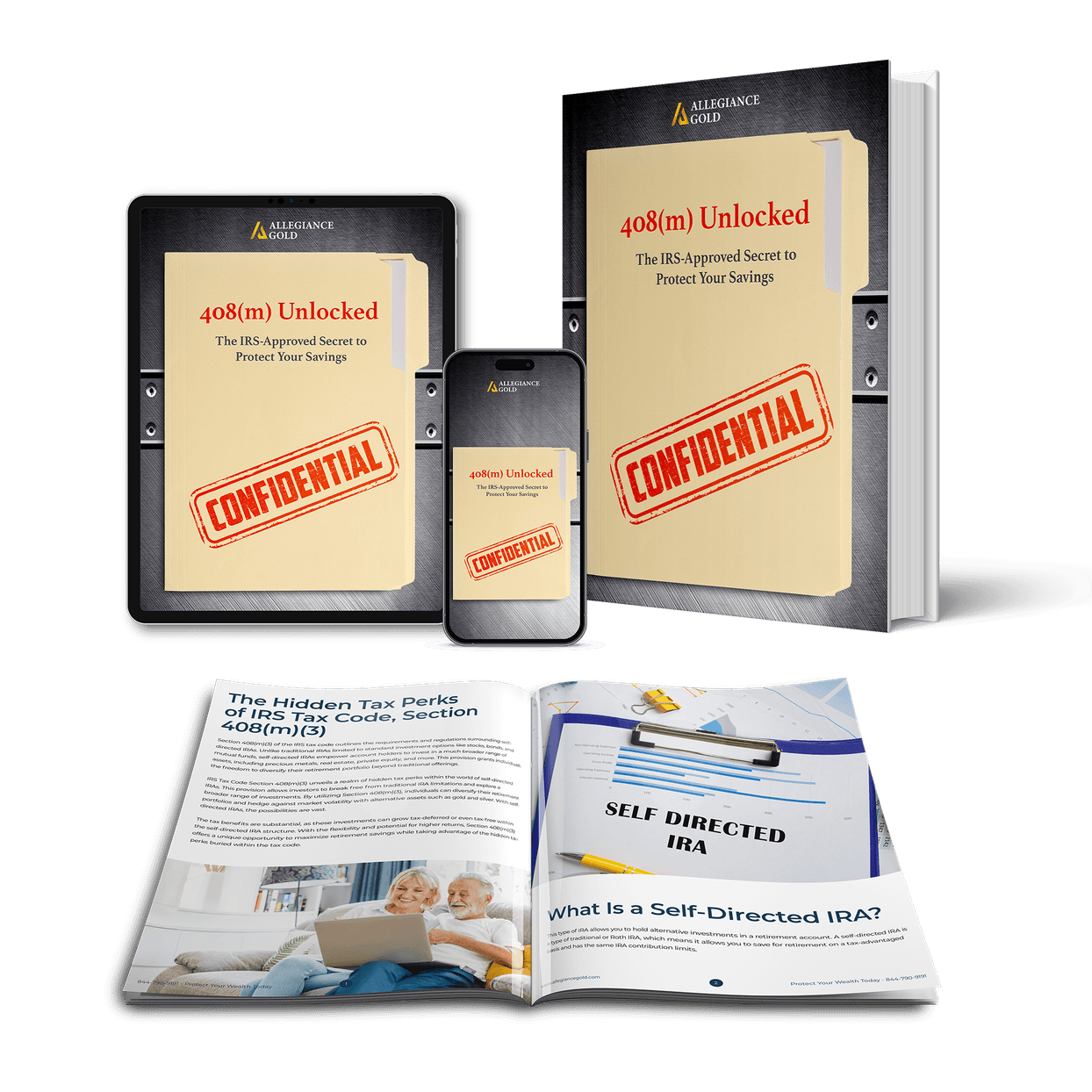
Here's what few are talking about - but the wealthy already know: U.S. Tax Code Section 408(m)
Never heard of it? That's the point.
This IRS-backed provision allows qualified Americans to reposition a portion of their 401(k), IRA, TSP, or 403(b) - without penalties, without moving to cash, and without staying fully exposed to a system that's clearly shaking.
No hype. Just protection, privacy, and a strategy Wall Street rarely mentions.
Allegiance Gold, LLC is not a broker-dealer and does not provide investment, tax, or legal advisory services. No statement in this communication should be construed as a recommendation to purchase or sell any security, or as investment, tax, or legal advice. Precious metals, like all investments, carry risk, are not suitable for all investors, and past performance does not guarantee future results. We do not guarantee any investment performance. Please consult your own investment, tax, or legal advisor prior to making any investment decision.
De-Mystifying Section 408(m): Your Legal Right to Opt Out of Volatility
Okay, let’s get into the mechanics. I promised you the "Raft," and here it is.
We are talking about U.S. Tax Code Section 408(m).
It sounds dry. It sounds bureaucratic. But this single paragraph in the IRS tax code is the key to unlocking true financial sovereignty for your retirement savings.
Most Americans operate under the assumption that an IRA (Individual Retirement Account) or a 401(k) must hold stocks, bonds, or mutual funds. We assume this because that’s what Fidelity, Vanguard, and Schwab offer us. They give us a menu of paper assets, and we pick from the list.
But Section 408(m) creates an exception.
It states that acquiring physical precious metals - specifically gold, silver, platinum, and palladium that meet certain purity standards - is NOT treated as a taxable distribution if handled correctly.
In plain English? The IRS allows you to hold real, physical gold bars and coins inside your retirement account, with all the same tax benefits you currently enjoy.
Why This is a Game-Changer
This changes the entire equation of retirement planning. Here is why savvy investors are moving billions into this strategy right now:
1. The "Repositioning" Power (No Tax Event) This is the biggest hurdle for most people. They think, "I'd love to own gold, but my money is locked in my 401(k). If I take it out to buy gold, I’ll get hit with a 10% penalty and a massive income tax bill." Section 408(m) solves this. You aren't "taking it out." You are performing a Rollover or a Transfer. You are moving capital from a paper asset (like a tech stock ETF) to a tangible asset (a gold bar), all within the protective shell of your qualified retirement account. The IRS never sees it as income. The tax man doesn't touch it. You keep the tax shelter; you just change the foundation of the house from straw to brick.
2. The "Counter-Cyclical" Defense Let’s go back to the signals we discussed in Part 1 - bank instability, rising national debt, and inflation. These are all symptoms of a weakening fiat currency. Historically, gold acts as the counter-weight to the dollar.
- When the dollar is strong and the economy is perfect, gold is boring.
- When the dollar wobbles, debt explodes, and uncertainty hits, gold wakes up. By using 408(m) to allocate, say, 10-20% of your portfolio to physical metals, you are building a shock absorber. When the paper market drops, the metals often hold steady or rise. It smooths out the ride. It prevents the catastrophic 40% losses that ruin retirements.
3. Removing Counterparty Risk This is the advanced concept that the wealthy understand deeply. When you own a stock, you have "counterparty risk." You are relying on the company to make a profit. You are relying on the exchange to stay open. You are relying on the brokerage to hold the shares. When you own physical gold, there is no counterparty. A gold bar doesn't need a CEO. It doesn't have an earnings report. It doesn't can't go bankrupt. It simply is. In a world where banks are closing branches and digital systems are vulnerable, holding an asset that exists in the physical world is the ultimate form of insurance.
4. The "Paper Gold" Trap vs. Real Gold Many people ask, "Can't I just buy a Gold ETF (like GLD) in my regular brokerage account?" You can, but that is not the same thing. An ETF is a paper claim on gold. It is a financial instrument. If the financial system freezes, your ETF freezes with it. Section 408(m) allows for Allocated Physical Storage. That means specific bars and coins are held in a secure depository (like the Delaware Depository) in your name. It is off the balance sheet of the bank. It is yours.
How to Execute the Strategy
This isn't something you can do on your standard banking app. You can't just log into a standard brokerage and click "Buy Gold Bar." They aren't set up for physical goods.
To utilize Section 408(m), you need a specific structure called a Self-Directed Gold IRA.
Here is the simplified process:
- Open: You open a Self-Directed IRA with a specialized custodian (this takes about 10 minutes).
- Fund: You transfer funds from your old 401(k), IRA, or TSP into the new account. This is a tax-free, bank-to-bank transfer.
- Select: You choose the IRS-approved metals (Gold American Eagles, Silver Buffalos, etc.).
- Secure: The metals are shipped to an insured, IRS-approved depository for safekeeping.
Why You Need a Guide
While the tax code allows this, the IRS has strict rules on purity standards and storage. You cannot bury the gold in your backyard (that counts as a distribution). You cannot buy collectible numismatics that don't meet the fineness requirements.
This is why we partnered with Allegiance Gold. They specialize in exactly this. They act as the navigator for the raft. They handle the paperwork, they ensure compliance with Section 408(m), and they facilitate the secure storage.
The Window of Opportunity
We aren't saying "sell everything and live in a bunker." We are advocating for balance.
If 100% of your net worth is tied to the performance of the US Dollar and the S&P 500, you are taking a massive gamble on the competence of politicians and central bankers.
If you have a portion of your wealth in physical assets, you have a raft.
The "Hold Tight" strategy worked in the past because the debt levels were manageable. Today, the math is different. The volatility is different.
Don't wait until the next major correction to wish you had a hedge. Grab the raft while the water is still relatively calm.
Sponsored Content
Something Interesting For You
Buy This Gold Stock Before the New Year |
Musk Just Leaked a Shocking Fed Transcript |
Trump’s Debt Bomb - Your IRS 408(m) Lifeline |
CLOSING THOUGHTS
- The Signal: Banks closing, debt spiraling, and businesses shrinking are flashing yellow lights.
- The Trap: Doing nothing ("Holding Tight") leaves you fully exposed to the drop.
- The Solution: Use Section 408(m) to reposition part of your savings into physical gold - tax-free and penalty-free.