The Next Rate Decision Lands Six Days Before the Midterms


 |
1 OCTOBER 2026
 By Mike Lee
sponsored Diversification Is for Dummies |
Most financial advisors love to tell you to diversify. They want you spread across 50 different stocks, hoping for the best.  According to Market Wizard Larry Benedict, "Diversification is for dummies." > When you're watching everything, you're watching nothing. Especially now, as President Trump triggers a historic regime change at the Federal Reserve. Trillions of dollars are about to shift. And instead of scrambling to guess which sectors will win, Larry focuses on just ONE specific ticker that sits directly at the heart of Fed policy. This exact ticker previously helped his readers capture massive double and triple-digit gains during market shocks. Today, he’s giving the name of this ticker away completely free. No guesswork. No complicated charts. Just one symbol you can trade right from your phone in under 60 seconds. |
Three Numbers to Start
8–4 | the April vote to hold rates, with four dissents. The committee had not produced that many since October 1992. |
54–45 | the Senate vote confirming a new Fed chair in May, the narrowest for the job in the modern era. |
28 Oct | the next rate decision, six days before the midterm elections. |
ad Especially now, as President Trump triggers a historic regime change at the Federal Reserve. Trillions of dollars are about to shift. Go here to get the ticker symbol |
The Committee That Set Rates in January Is Not the One That Meets This Month
Monetary policy gets discussed as though a single institution decides it. Twelve people vote, the names change, and this year almost every name changed at once.
The April meeting held rates at 3.50% to 3.75% on an 8–4 vote. Four dissents is the most the committee has produced since October 1992, and they split over the path ahead rather than the decision itself. It was also the outgoing chair’s last meeting in the role.
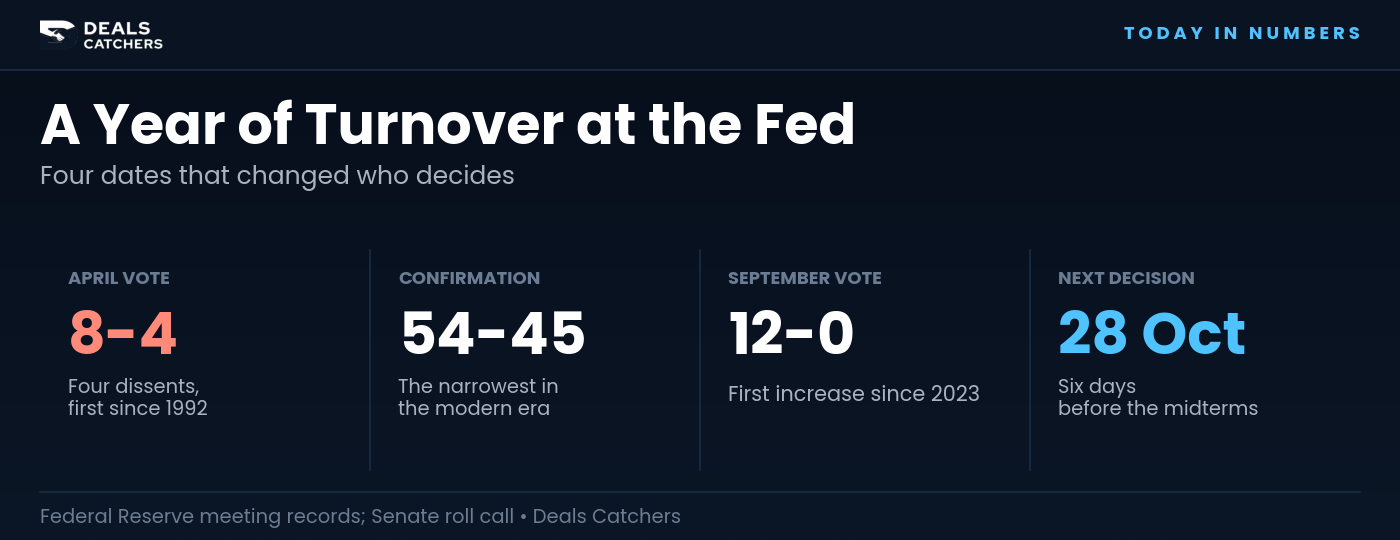
His term as chair ended on 15 May. The successor was confirmed 54–45, the narrowest Senate vote for the position in the modern era, and was sworn in on 22 May. The predecessor remains on the Board of Governors, which is unusual and means the committee still contains the person who ran it.
The committee itself has nineteen people in the room and twelve votes: seven governors, the New York president permanently, and four of the remaining eleven regional presidents on a yearly rotation. That rotation changes in January, which means the body voting on the December decision is not the one that will vote through most of next year.
At his confirmation hearing the new chair described himself as strictly independent and argued for a change in the policy framework itself rather than in the rate path. His first meeting in June produced a unanimous hold.
Then came September. The committee raised rates by a quarter point to 3.75% to 4.00%, the first increase since 2023, on a unanimous 12–0 vote. Sixteen of eighteen participants projected at least one more before December, and the chair declined to submit his own projection for the second consecutive quarter.
Which brings the calendar to the part that matters now. The next decision lands on 28 October, six days before the midterm elections. A new chair, a predecessor still at the table, and sixteen of eighteen participants already projecting another increase. The money that moves on that decision does not wait for a poll. It sits in the instrument tied to the rate itself.
Four dissents in April, unanimity in June, unanimity again in September, and a chair who keeps his own forecast out of the published record. The names changed. The path did not get clearer. Watching fifty sectors through that is how the shift gets missed. The decision lands on one rate, and the position that matters is the one that sits on that rate.
Ten Losses in a Row Costs 18% or 65%, and You Choose Which
A second kind of arithmetic decides more outcomes than any forecast, and it has nothing to do with being right.
Take a system that wins half its trades. Over two hundred trades, a run of ten consecutive losses turns up roughly one time in eleven. It is not a tail event. It is a Tuesday that arrives in a cluster.
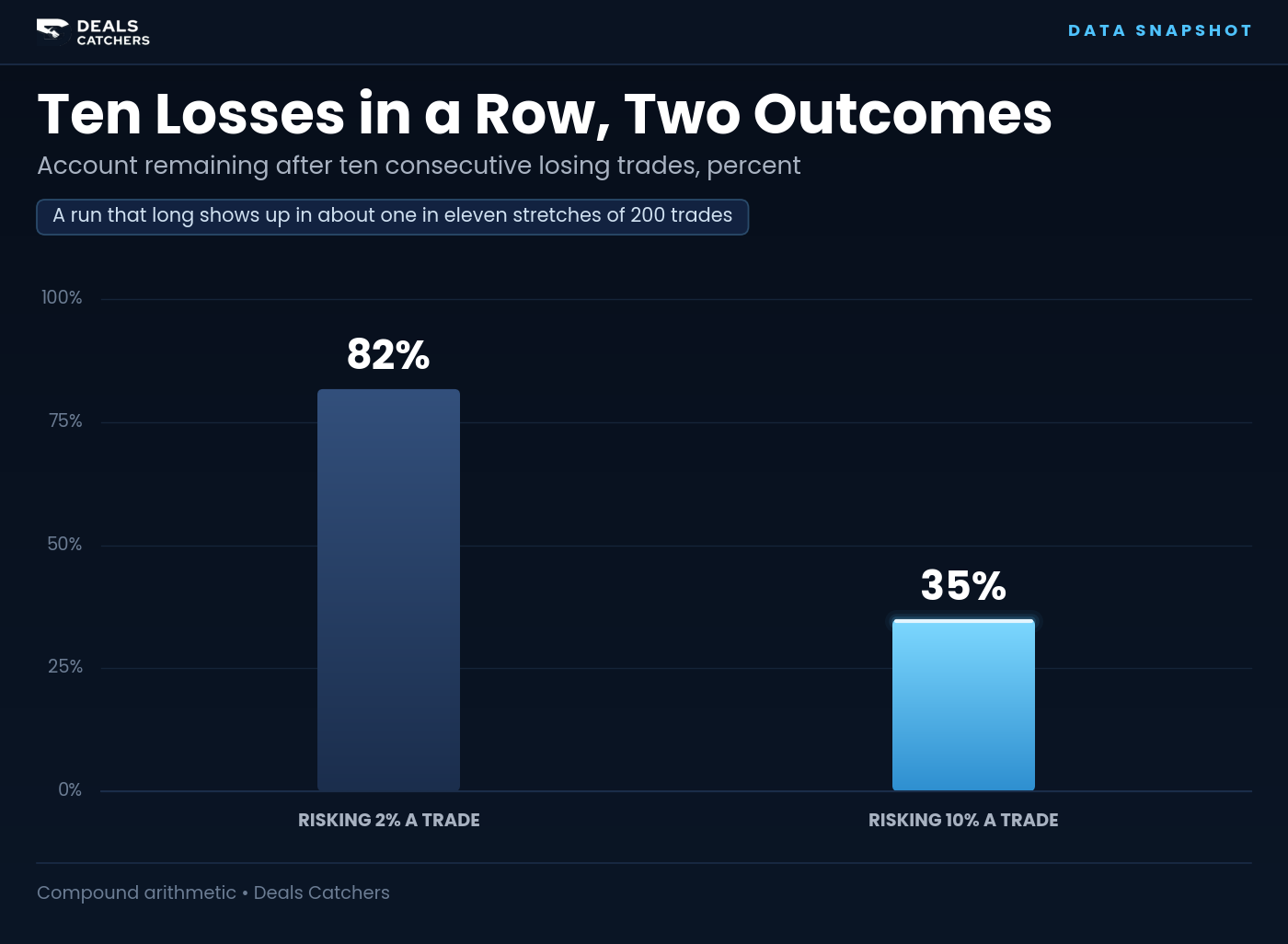
What that run costs depends entirely on one decision made before it starts. Risking 2% of the account per trade leaves 81.7% of it after ten straight losses. Risking 10% leaves 34.9%.
The run itself is not rare and not a sign of anything being broken. At a 50% win rate the chance of ten losses in any particular stretch of ten is one in 1,024, and across two hundred trades those stretches overlap enough to make the cluster ordinary rather than exceptional.
The first account needs a 22% gain to get back to even. The second needs 187%. Same system, same losing streak, same market, and the difference between a bad month and the end of the account is a number chosen in advance.
This is why the rule that matters is written before the trade, not after the streak. The entry decides whether a trade is right. The size decides whether being wrong matters. Two rules, applied before the first ticket, are the difference between an 18% dent and a 65% hole.
sponsored Two Simple Rules |
Two simple rules || Your first $1,000 “Market Wizard”: “Two simple rules I’ve learned in my decades on Wall Street could hand you your first $1,000 in a matter of days.”  |
The Same Profit, Taxed Two Different Ways
The third piece of arithmetic arrives in April, long after the trades are closed, and it depends on what was traded rather than on how well.
Options on individual stocks and on most exchange-traded funds are taxed the ordinary way. Hold one for under a year, which income strategies almost always do, and the gain is short-term and taxed at your full marginal rate.
Broad-based index options fall under section 1256 of the tax code and get a blended treatment: 60% of the gain is taxed as long-term and 40% as short-term, regardless of how long the position was held. A contract opened on Monday and closed on Friday still gets the 60/40 split.
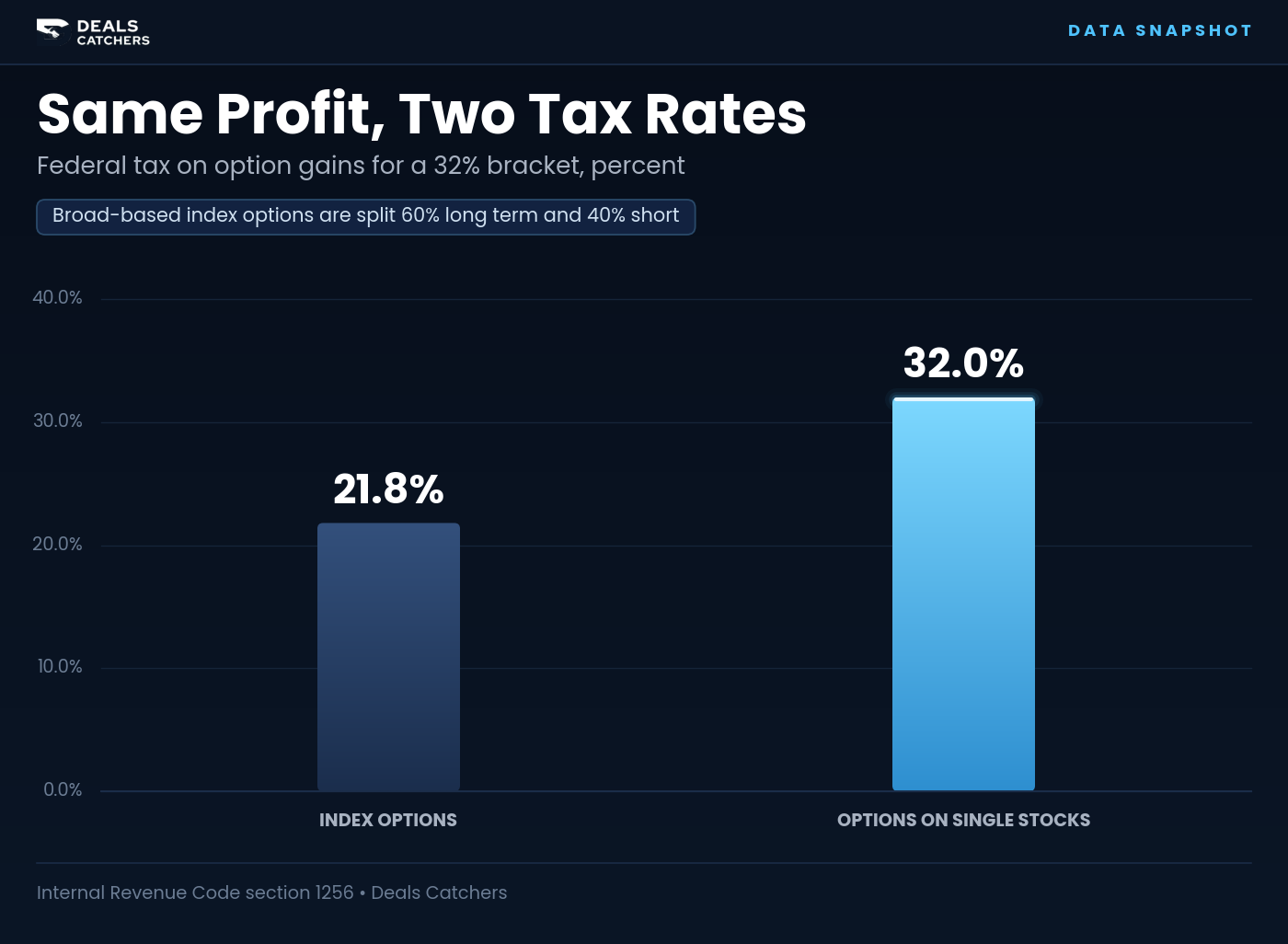
For somebody in the 32% bracket the difference is 21.8% against 32%. On $20,000 of annual option income that is about $2,040 a year, which is the kind of gap that quietly outweighs several percentage points of strategy performance.
The distinction runs on the instrument rather than the strategy. Options on the S&P 500 index qualify. Options on the exchange-traded fund that tracks the same index do not, because the fund is a security rather than a broad-based index. Two positions that move together all day are taxed under different sections of the code.
Section 1256 carries two other features worth knowing. Open positions are marked to market at year end and taxed as though closed, which pulls unrealised gains forward. And the wash sale rules do not apply to them, which makes loss harvesting simpler than it is with equity options.
The system is the same. The instrument is not. Two traders running the same income book keep different amounts of what it earns, and the gap is a section number, not a forecast. On $20,000 a year that section is worth about $2,040 before the next trade is placed.
sponsored Nine Hundred and Ten Winners |
Dave Aquino here. The markets have been anything but stable recently... and I think it’s safe to say the volatility is here to stay. But traders using my Ultimate Income Trading System would likely tell a different story... Because they’ve seen 971 trades to date... 910 winners... and a 93.7% win-rate in a market where conditions are against us... That’s what’s on the table today inside my Ultimate Income Trading System e-book (that you can get for FREE).  Starting on page 1 you’ll discover: What Separates Profitable Traders From The Losing 90% Why Trading Success Is So Hard To Find Why You Need A Rock-Solid Income Trading System The Full Details On How To Use My 11-Hour Options Strategy Download the Ultimate Income Trading System - NOW A simple trading system with 910 winners (and counting)... is at your fingertips for free. In a market where things are ALWAYS changing... finding any source of steady income seems less possible by the day... But not here. Download the Ultimate Income Trading System - FREE See what you’ve been missing out on in your free copy of the Ultimate Income Trading System. But I wouldn’t wait too long…my income trading system could pinpoint the next winner at any moment... with or without you. Want in before that happens? See how to get access to these trades inside your free guide: Download the Ultimate Income Trading System - NOW Dave Aquino |
What is Scheduled
7 Oct | the minutes of the September meeting, which will show how the unanimous vote was argued. |
27–28 Oct | the next FOMC meeting, with the decision at 2pm Eastern on the second day. |
3 Nov | the midterm elections, with all 435 House seats and 35 Senate seats contested. |
The order of those three dates is the story of the quarter. The minutes land first. The decision lands six days before the election. The committee that votes has already turned over once this year, and the rotation turns over again in January. Size the position before that week, not during it.
ad When you’re watching everything, you’re watching nothing. See the full details here |
Six Days
28 Oct | the next rate decision, six days before the midterms. The committee that makes it has a chair confirmed by two votes more than the minimum, a predecessor still sitting at the table, and sixteen of eighteen participants projecting at least one more increase this year. |
Forget the hot picks — protect what you’ve already built, and decide your size before you decide your entry. Because the best trade you’ll ever make is the loss you never took. Mike LeeDeals CatchersThanks for reading. See you tomorrow. |
Forwarded this? Get it every morning. |