
The Laptop Era Is Ending — Two Pre-IPO Companies Building What Comes Next

The $0.72 bet on the “Next Device After Smartphones”
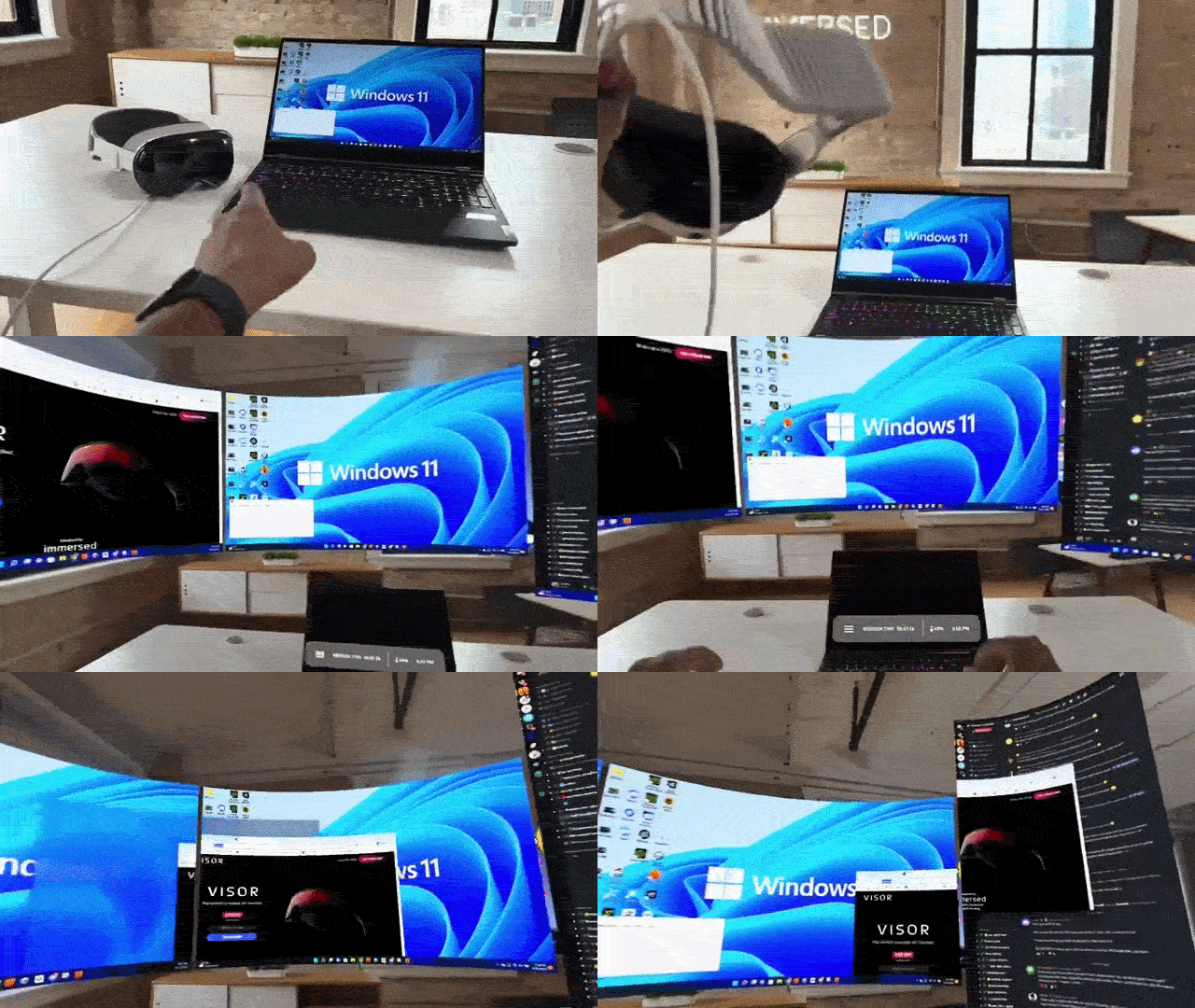
As AI computing demand surges by an estimated 10,000x, we are facing a hardware bottleneck. You cannot manage a 3D AI revolution through a flat, 15-inch laptop monitor or a tiny smartphone screen. The professional “athlete of the mind” requires a new interface, and the Immersed Visor is the disruption the market has been waiting for.
Unlike bulky consumer headsets, the Visor is 70% lighter than its nearest competitors and delivers higher 4K resolution per eye than the Apple Vision Pro. It is a portable workstation that fits in your pocket but replaces five physical monitors.
This isn’t just a gadget; it’s a fundamental shift in professional infrastructure. We have already seen 4,000% growth because we solved the “comfort” problem that Big Tech couldn’t.
With the NASDAQ ticker reserved and manufacturing scaling up, this is the final opportunity to secure Pre-IPO shares at the fixed price of $0.72. The era of the laptop is ending—it’s time to invest in what comes next.
| Claim Your Stake in the Visor Revolution Here → |
Immersed is offering securities through the use of an Offering Statement that has been qualified by the Securities and Exchange Commission under Tier II of Regulation A. The valuation is set by the Company and there is currently no public market for the Company’s Common Stock. Please read the offering circular and related risks at invest.immersed.com. Nasdaq ticker “IMRS” has been reserved by Immersed and any potential listing is subject to future regulatory approval and market conditions.

The AI revolution has a hardware problem that nobody is talking about. AI compute demand is surging by an estimated 10,000x — but the interface humans use to interact with AI output has barely changed in 40 years. We are still staring at flat, 15-inch laptop screens and 6-inch phone displays. The information density that modern AI generates cannot be consumed, managed, or acted upon through these constrained interfaces.
Every previous computing revolution was defined by a new interface: mainframes had terminals, PCs had monitors, smartphones had touchscreens. The AI revolution requires spatial computing — lightweight headsets that project unlimited virtual screens in physical space, giving the human brain the canvas it needs to keep up with AI output. The global spatial computing market is projected to grow from $222 billion in 2026 to over $1 trillion by 2034 — a 21.7% CAGR that rivals the early smartphone era.
But every headset on the market has the same problem: they are too heavy to wear for a full workday. Apple Vision Pro weighs over 600 grams. Meta Quest Pro is similar. No knowledge worker will strap a pound-and-a-half device to their face for 8 hours. The comfort problem is the bottleneck holding back the entire spatial computing market — and one company claims to have solved it.
The solution is not incremental improvement. It is a fundamental redesign of the device category.
As AI computing demand surges by an estimated 10,000x, we are facing a hardware bottleneck. You cannot manage a 3D AI revolution through a flat, 15-inch laptop monitor or a tiny smartphone screen. The professional “athlete of the mind” requires a new interface, and the Immersed Visor is the disruption the market has been waiting for. Unlike bulky consumer headsets, the Visor is 70% lighter than its nearest competitors and delivers higher 4K resolution per eye than the Apple Vision Pro. It is a portable workstation that fits in your pocket but replaces five physical monitors. We have already seen 4,000% growth because we solved the “comfort” problem that Big Tech couldn’t. Claim your stake in the Visor revolution here (AD).
The “Comfort Problem” Big Tech Couldn’t Solve
|
🚨 The Headset Weight Problem Apple Vision Pro: 600-650g — users report neck strain after 45 minutes. Meta Quest Pro: 722g — designed for 2-hour sessions, not full workdays. Samsung Galaxy XR: ~500g — lighter, but still too heavy for 8-hour use. Immersed Visor: 70% lighter than competitors — designed for 60-hour workweeks. 4K per eye. Fits in your pocket. |
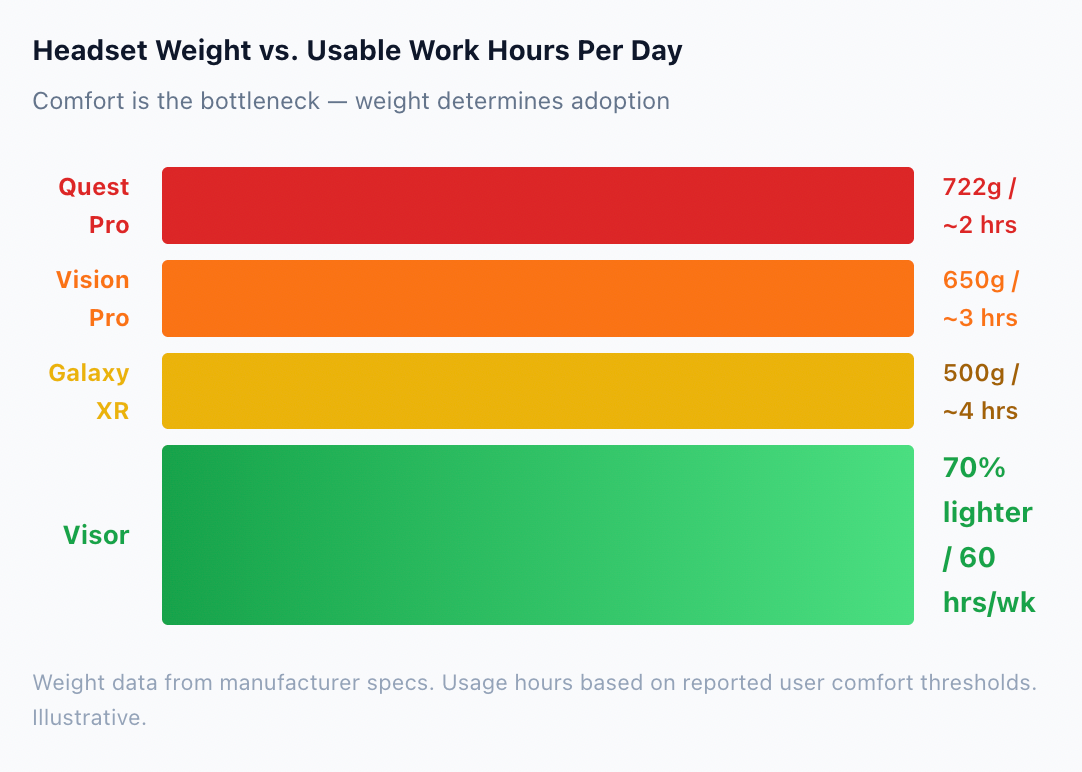
Industry analysts project that headsets need to reach below 300 grams with 6+ hour battery life to enable full-shift enterprise adoption — a threshold projected for commercial availability around 2027-2028 for most manufacturers. Immersed claims to have already crossed that threshold with the Visor. If true, it has a multi-year head start on every major competitor in the one metric that determines mass adoption: comfort.
Meanwhile, Your Smartphone Is Quietly Making Someone Else Rich
While the spatial computing revolution is about replacing the next professional interface, a parallel revolution is happening on the device you already own. Every time you scroll, watch a video, play a game, or open an app, you generate data and attention that is worth money. For years, that value went entirely to Big Tech — Apple, Google, Meta collected the revenue while you provided the engagement for free.
One company flipped that model. Instead of extracting value from phone users, it created technology that lets users earn from their everyday phone activity. The results speak for themselves: 50 million+ users, over $1 billion in earnings and savings generated for those users, and 32,481% revenue growth.

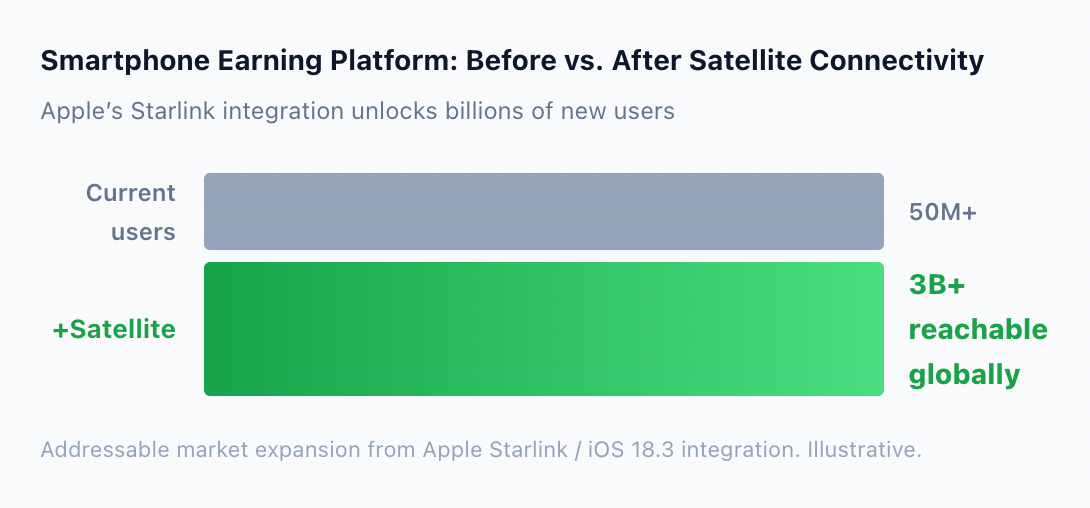
And now Apple just quietly released iOS 18.3, which added Starlink satellite connectivity to iPhones. This means smartphones can connect anywhere on Earth — no towers, no dead zones, no coverage gaps. For a company whose entire platform is built around smartphone users earning from everyday phone activity, the addressable market just expanded by billions of people overnight.
Apple Just Unlocked Billions of New Smartphone Users — And One Company Is Ready
With Starlink satellite connectivity now built into iPhones, the concept of a “dead zone” is disappearing. Smartphones can function anywhere — in rural Africa, remote Southeast Asia, the Pacific Islands. 3 billion unbanked people who were previously outside the smartphone economy are about to come online.
The company that built the earning technology already has the platform, the users, and the revenue model. It has secured the $MODE Nasdaq ticker as it prepares for a potential IPO. Over 59,000 investors have already participated in previous rounds. And right now, shares are still available at the pre-IPO price before the company potentially goes public.
Apple just unlocked a massive phone opportunity
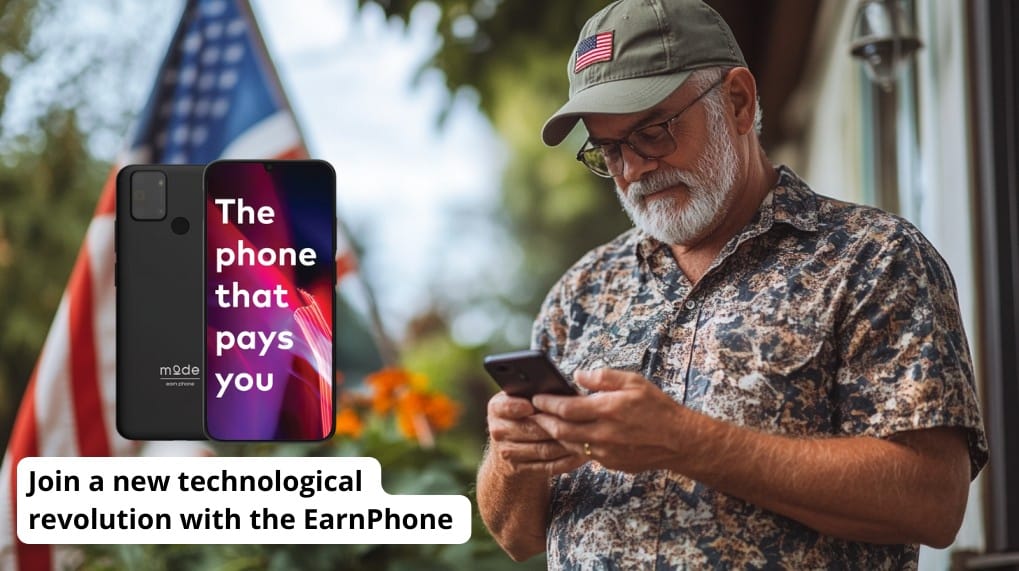
Your Phone Is Quietly Making Someone Else Rich In 2026!
Here’s something most people never realize… Every time you use your phone, whether scrolling, watching videos, playing games, Someone is making money from it. For years, that money went almost entirely to Big Tech. But something big just changed.
Apple quietly released iOS 18.3, which added Starlink satellite connectivity to iPhones. This means smartphones could soon connect anywhere on Earth. No towers. No dead zones. No coverage gaps. And that change could unlock billions of new smartphone users globally.
Now here’s where the financial opportunity comes in. A company called Mode Mobile already built technology that turns smartphones into earning devices. Their platform allows users to earn from everyday phone activity like:
• Playing games
• Using apps
• Listening to music
• Charging their phones
The results so far:
• 50M+ users
• $1B in Earnings and Savings
• 32,481% revenue growth
And with Apple expanding global smartphone connectivity… Mode’s platform could suddenly reach billions of additional users worldwide. That’s why investors are watching closely.
Mode has already secured the $MODE Nasdaq ticker as it prepares for a potential IPO. Right now, investors can still buy pre-IPO shares before the company potentially goes public. Over 59,000 investors have already participated in previous rounds.
| 👉 Click Here to See the Mode Mobile Pre-IPO Opportunity |
Please read the offering circular and related risks at invest.modemobile.com. This is a paid advertisement for Mode Mobile’s Regulation A+ Offering. Mode Mobile recently received their ticker reservation with Nasdaq ($MODE), indicating an intent to IPO in the next 24 months. An intent to IPO is no guarantee that an actual IPO will occur. The Deloitte rankings are based on submitted applications and public company database research, with winners selected based on their fiscal-year revenue growth percentage over a three-year period. Pro forma revenue and EBITDA, includes full year numbers of the businesses acquired throughout 2025.
Two Interface Revolutions, Two Pre-IPO Windows
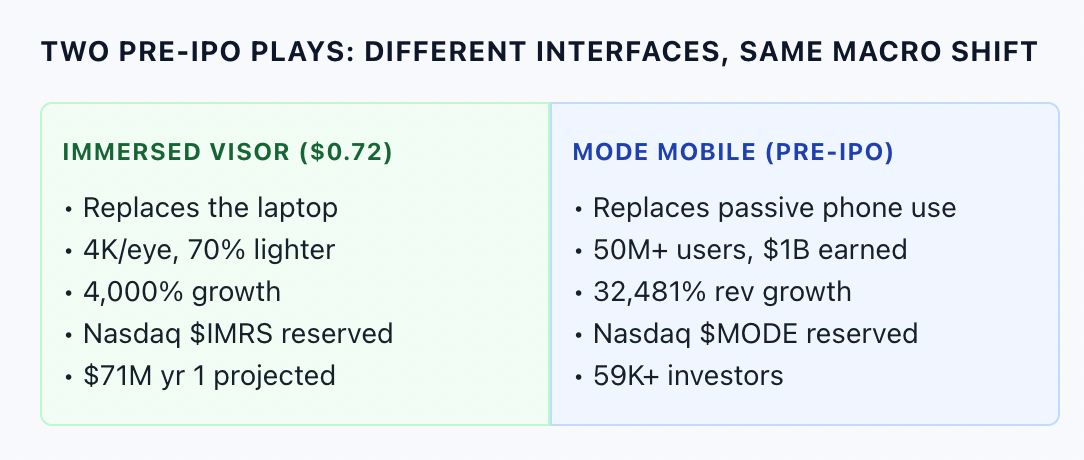
The Immersed Visor and Mode Mobile represent two sides of the same macro shift: the replacement of legacy computing interfaces with purpose-built platforms designed for the AI era. The Visor replaces the laptop for knowledge workers. Mode replaces passive phone usage with an earning platform for everyone. Both are pre-IPO. Both have reserved Nasdaq tickers. And both are at the stage where early positioning produces the largest returns.
Your Phone is Secretly Making Someone else Rich
Apple just added Starlink satellite connectivity to iPhones. Mode Mobile already has 50M+ users earning from everyday phone activity — $1B in total earnings and savings, 32,481% revenue growth. With satellite unlocking billions of new users globally, Mode’s addressable market just exploded.
Nasdaq ticker $MODE reserved. 59,000+ investors already in. Pre-IPO shares still available.
The Laptop Era Is Ending. The Passive Phone Era Is Ending. Position Accordingly.
Both of these companies are at the stage where 95% of value creation happens in private markets. Once the Nasdaq listings activate, the pre-IPO pricing disappears permanently. The Visor at $0.72 per share will not survive the listing. The Mode Mobile pre-IPO round will close once the IPO process begins.