The Equal-Weight S&P Fell 4.8% in a Month the Index Did Not


 |
6 OCTOBER 2026
 By Mike Lee
sponsored Sell This, Buy That |
I've just revealed a powerful investing strategy that boils down to " Sell This, Buy That." It's a way to rid yourself of overpriced AI stocks before the tech trade breaks down this summer... And instead move that money into smaller, lesser-known names that are showing real potential to dethrone the "Mag 7". I even give away a Hotlist and Hitlist of buy and sell ideas that you can act on right now. Like my recommendation I call "an upgrade to Tesla stock." It's a little-known company that just inked a groundbreaking partnership with the king of AI, Nvidia. This deal virtually hands this under-the-radar firm the keys to the self-driving industries' biggest customers, putting them miles ahead of Tesla in the autonomous vehicle race. That's why I want to put this stock on your radar before markets open. You can get the name and ticker symbol here. Sincerely, Marc Chaikin Founder, Chaikin Analytics |
Three Numbers to Start
-4.8% | the fall in the equal-weight S&P 500 during September, a month the headline index came through almost unchanged. |
52.59c | the premium per pound that Colombian coffee commanded over Brazilian naturals in June, a gap that widened 77% in a month. |
None | the number of major gold discoveries made anywhere in the world in 2023 or in 2024. |
ad A way to rid yourself of overpriced AI stocks before the tech trade breaks down. And instead move that money into smaller, lesser-known names. See the hotlist and hitlist |
September Was Not a Market. It Was a Sector.
The index finished the month in roughly the same place it started. Almost nothing inside it did.
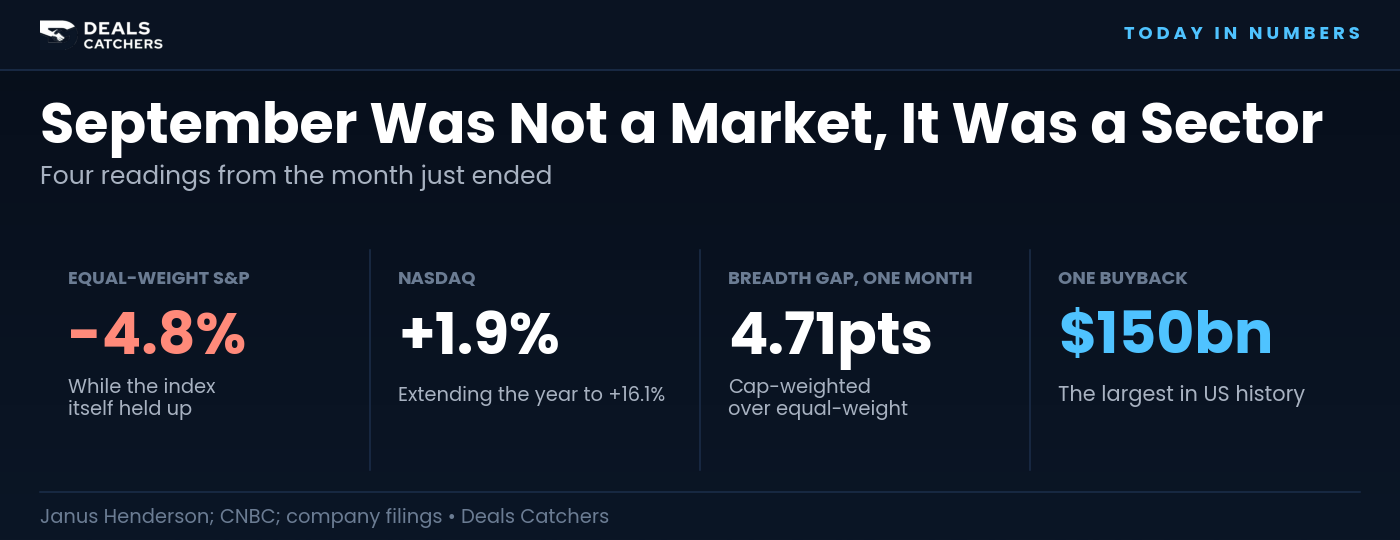
The equal-weight S&P 500 fell 4.8% in September, lagging its cap-weighted twin by about 4.5 percentage points. The Nasdaq rose 1.9% and extended its year to 16.1%. Semiconductors, hyperscalers and the optical networking names carried the month while everything else gave ground to higher yields and dearer oil.
The mechanism is not mysterious. Higher long-term yields hit the companies whose cash flows sit furthest out, and higher oil hits the ones that burn it, and both of those describe the broad middle of the index rather than the top of it. A mega-cap with net cash does not borrow at a spread over Treasuries. Most of the other 490 do.
The reversal is what makes it interesting. The equal-weight index had been beating the cap-weighted one for most of the first half, which is why the fund tracking it crossed $100 billion in assets this year after taking in $12 billion. That rotation stopped when the war pushed money back into the largest names.
Over the past month the gap between the cap-weighted index and the equal-weight version ran 4.71 percentage points. A spread that size resolves one of two ways: the laggards catch up, or the leaders come back to them.
The other number from the week belongs in the same conversation. Nvidia announced a $150 billion buyback, the largest in American corporate history. Read it plainly and it says the company with the most cash in the trade could not find a better use for it than buying its own shares.
Small caps did open October better, with the Russell 2000 outperforming on the first day of the quarter and sitting about 12% higher on the year, slightly ahead of the S&P. One session is not a rotation. It is the first thing anybody looking for one will point at.
Colombia Gets Paid Fifty-Two Cents More Than Brazil
A different market pays for quality in a way that is measurable to the cent, and it explains how a producing country earns more than the commodity price.
Coffee trades against a single benchmark, but no two origins sell at it. Buyers pay or deduct a differential against the exchange price depending on where the beans come from and how they were processed.
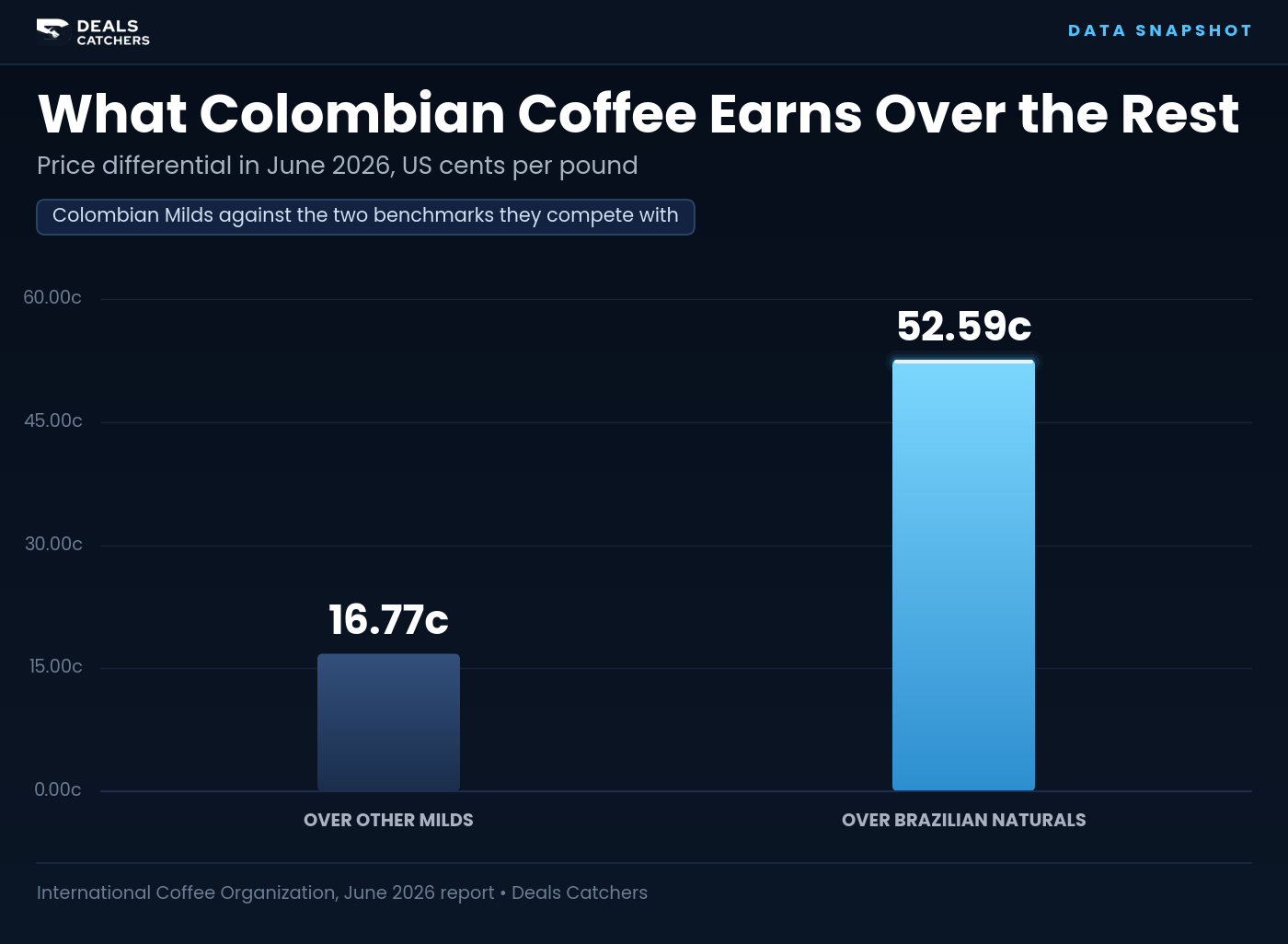
In June the Colombian Milds differential over other washed arabicas rose to 16.77 cents a pound, more than doubling from 8.03 cents the month before. Over Brazilian naturals the gap widened by 77% to 52.59 cents. Colombian export prices have averaged roughly 10% above other milds since the 1990s.
The volumes behind that premium are substantial. Colombia produced 14.9 million bags in the 2024/25 coffee year, its highest in more than three decades, and exported 13.3 million. The 2025 crop was worth a record 24.4 trillion pesos, up 52% on the year, and coffee alone accounts for about 1.5% of the country’s GDP.
The crop behind those figures is unusually concentrated in smallholders. Colombian coffee is grown on hundreds of thousands of family farms, and productivity now runs about 21 bags of green coffee per hectare after two decades of replanting with rust-resistant varieties. The institutional layer that funds that research is paid for by a levy on exports.
Roughly 40% of Colombian output qualifies for specialty premiums on top of the origin differential, and the country exports about 93% of what it grows. The domestic market is almost an afterthought in the economics.
Which is the structural point behind every integrated coffee business. The differential is earned at the farm and the mill, and it is collected by whoever owns both. A buyer who purchases green coffee pays the premium. A company that grows and processes its own captures it.
sponsored Colombia's #1 Coffee Producer, by the Numbers | ||||||||||||||||||||||||||||||||||||
|
Nobody Found a Major Gold Deposit in 2023 or 2024
The third market in this letter has the opposite problem from coffee. The margins are extraordinary and the inventory is running down.
Gold miners are earning more per ounce than at any point in the industry’s history. Newmont generated $7.3 billion of free cash flow in 2025 and finished the year holding more cash than debt. All-in sustaining costs sit near $1,621 an ounce against a gold price above $4,300.
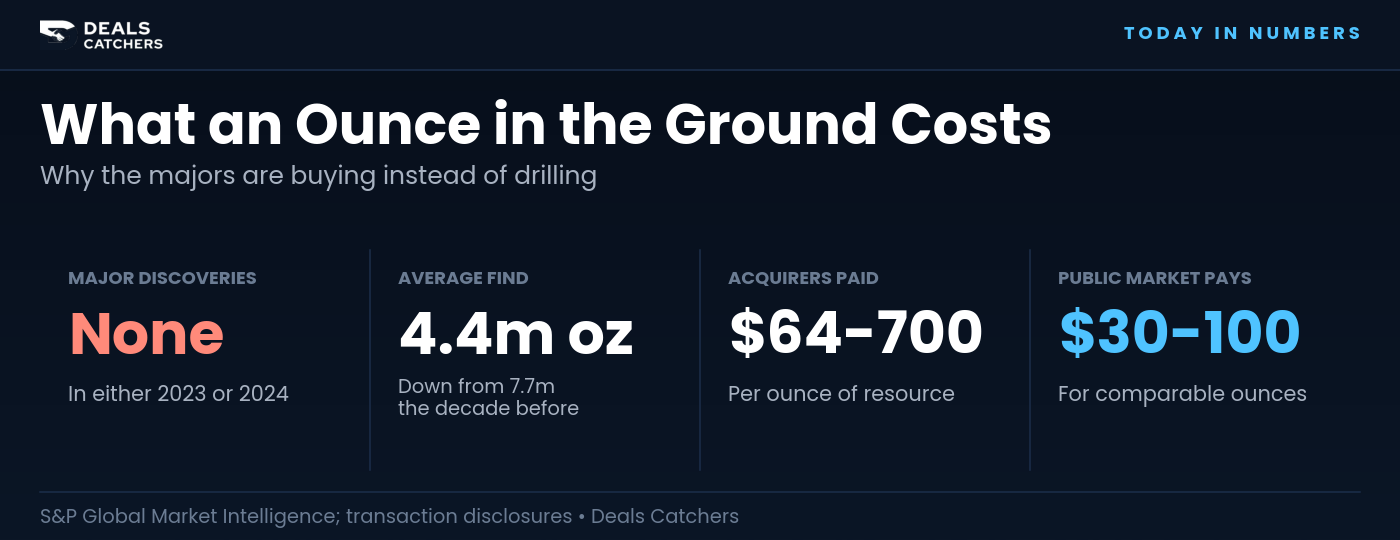
What that cash cannot buy is reserves. No gold deposit of two million ounces or more was discovered anywhere in the world in 2023 or 2024. The average discovery now runs 4.4 million ounces against 7.7 million in the previous decade, and roughly one find in ten contains enough metal to justify a mine.
So the industry buys what it cannot find. Recent acquisitions have valued ounces still in the ground at $64 to $700 each, while public markets price comparable junior assets at $30 to $100. That spread is the entire argument for owning the smaller companies, and it is also the reason the spread exists: an ounce in a resource statement needs permits, capital and a decade before it becomes an ounce in a vault.
There is a second reason the spread persists. A major with twenty mines can absorb one that disappoints; a company with a single asset cannot. The discount on a junior is partly a discount on concentration, and it narrows only when the asset is far enough along that the risk of it never being built has mostly gone.
Which makes the question for any gold equity narrower than the metal price. How many ounces does it have, what does it cost to get them out, and how many years of production are left before the answer stops mattering.
sponsored He Who Has the Gold Makes the Rules |
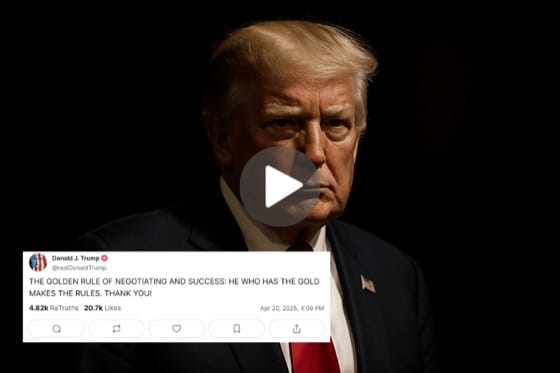 Trump dropped 9 words that sent shockwaves through the financial world: “He who has the gold makes the rules.” It wasn’t a rant. It was a warning. And insiders say it’s just the beginning. His economic inner circle is already building the foundation for a hard-asset reset — while the Fed keeps printing. This isn't a theory. It's already happening. Golden Portfolio IV (GPIV) reveals the short list of gold stocks positioned to surge as Trump’s vision becomes reality. Click HERE to get the list >>> |
What is Scheduled
7 Oct | the minutes of the September Fed meeting, which raised rates for the first time since 2023. |
27–28 Oct | the next rate decision, six days before the midterm elections. |
3 Nov | the midterm elections. |
Breadth and rates are the same story told twice. Higher yields punish the companies whose value sits furthest in the future and the smaller ones that borrow at a spread over Treasuries, which is most of what the equal-weight index contains.
ad Instead move that money into smaller, lesser-known names that are showing real potential to dethrone the Mag 7. See the full strategy here |
Minus Four Point Eight
-4.8% | the September fall in the equal-weight S&P 500, in a month the headline index barely moved and the Nasdaq rose. The average stock had a bad month inside an index that did not, which is the clearest picture available of what the market is currently paying for. |
Forget the hot picks — protect what you’ve already built, and check what the average holding did before you trust what the index did. Because the best trade you’ll ever make is the loss you never took. Mike LeeDeals CatchersThanks for reading. See you tomorrow. |
Forwarded this? Get it every morning. |