Half a Million Driverless Rides a Week


 |
28 SEPTEMBER 2026
 By Mike Lee
sponsored The Company Behind the Empty Seat |
 I just watched footage of a Tesla driving itself down a public highway. No one is at the wheel. Then I looked up the one company without which none of it works. Almost nobody knows it exists. Click here to see what I found → |
Three Numbers to Start
500,000 | paid driverless rides a week, run by a single operator across eleven American metro areas. |
$1.45tn | borrowed against shares in margin accounts as of August, after a record $1.53 trillion in June. |
59% | of all S&P 500 index option volume now expires the same day it is traded. |
ad I just watched footage of a Tesla driving itself down a public highway. No one is at the wheel. Then I looked up the one company without which none of it works. See what I found |
Half a Million Driverless Rides a Week, and Nobody Calls It News
The empty driver’s seat stopped being a demonstration eighteen months ago. The shift did not need a launch day. It needed a fleet that got paid.
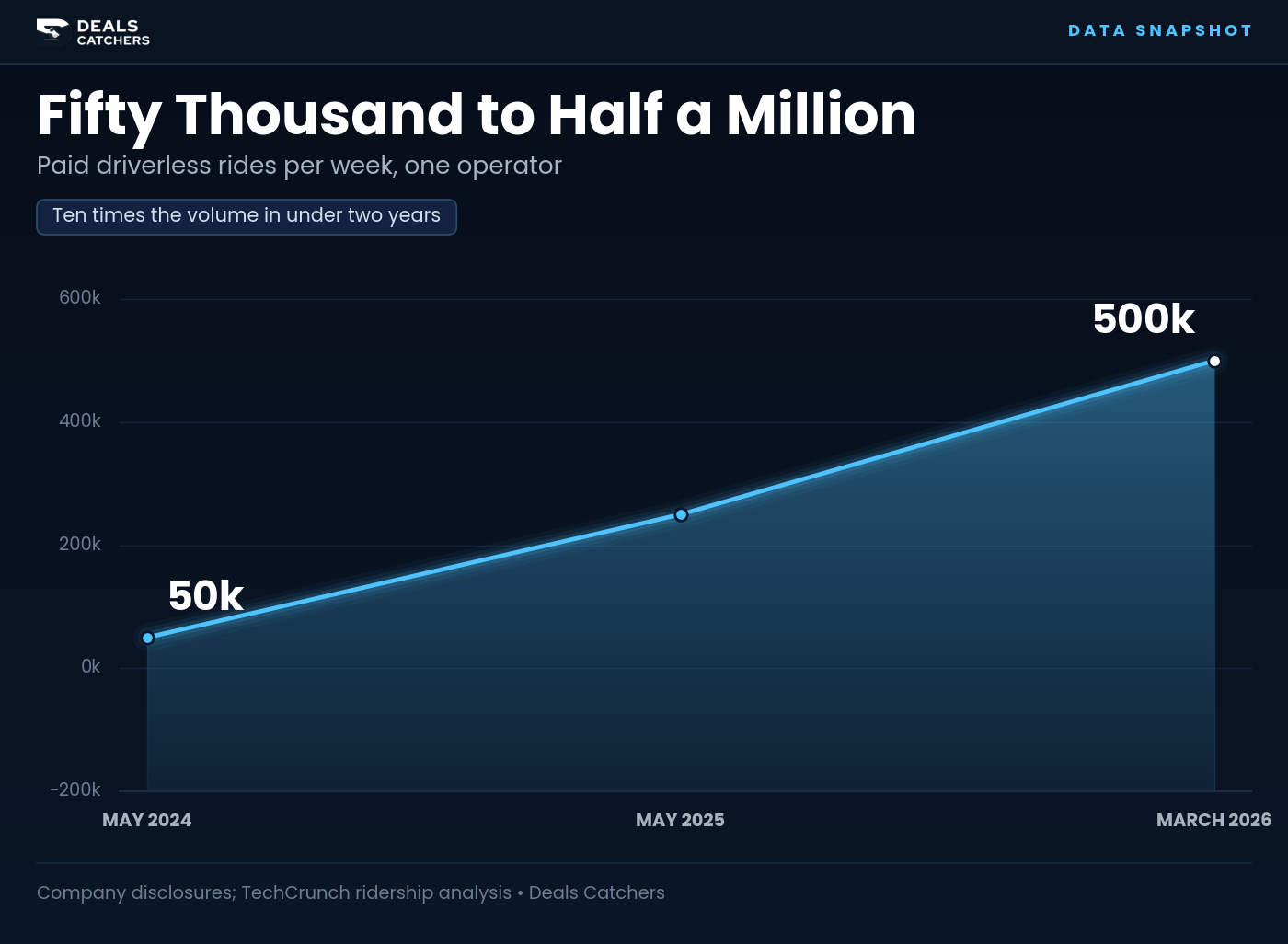
The market leader now runs about 500,000 paid rides every week across eleven metro areas with roughly 3,000 vehicles, logging close to four million autonomous miles in the same period. Last private valuation: $126 billion. The target it has given investors is a million rides a week by December.
Tesla took a different route and is adding cities faster than the coverage suggests. Paid service began in Austin in June 2025 with a safety monitor in the passenger seat. Dallas and Houston followed on 18 April. As of this month the cars run without an in-vehicle supervisor in three Texas cities and three Florida ones, and with a supervisor in the San Francisco Bay Area.
The purpose-built two-seater with no steering wheel entered paid service in Austin on 3 September. Texas records showed about 45 of them registered, inside a state fleet of roughly 420 cars. The same day, federal regulators opened an audit of the safety standards the company certified the vehicle against. The cars are still on the road. The audit does not change what every one of them has to buy.
One operator runs thousands of cars across eleven metros. The other runs hundreds across seven cities and has been pulling supervisors since April. Both are past the demonstration stage. Neither is at a million rides a week. Both still have to source the same four things.
Elsewhere the field has thinned. A purpose-built rival began charging on the Las Vegas Strip on 10 August. In China one operator reports 300,000 rides a week and has opened in Dubai. General Motors stopped funding its robotaxi arm in December 2024 and folded what remained into driver assistance.
What the survivors share is not a breakthrough in driving. It is a supply chain. Every one of these vehicles depends on the same short list: the sensors that build the picture, the compute that reads it, the mapping that tells it where the kerb is, and the remote desk that takes over when the car stops and will not move.
None of those parts is made by the company whose badge is on the bonnet. The fleet operators get the footage. The layer underneath gets the volume, whichever brand wins the week.
A Record $1.53 Trillion Borrowed Against Shares
The second number is the market, not the car.
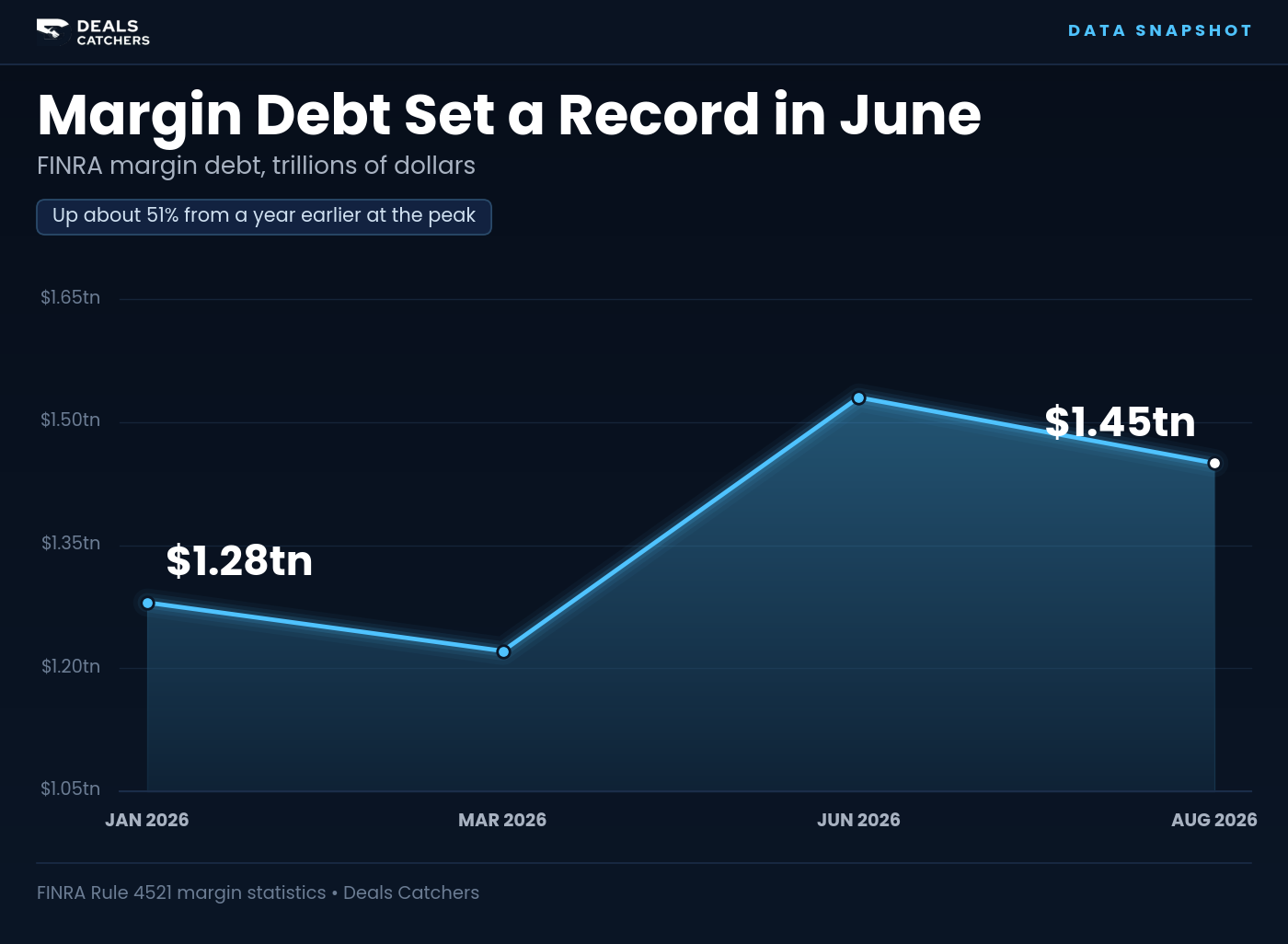
Margin debt is the total borrowed against the securities in brokerage accounts, reported monthly under FINRA Rule 4521. It reached $1.53 trillion in June, a record in a series that starts in 1997, after rising nearly 8% in that month alone. August printed $1.45 trillion.
The speed is the tell. The June figure was up about 51% from a year earlier. Against GDP the ratio sits near 4%, above the October 2021 reading.
Since 1997 that pace has shown up three other times: late 1999 into early 2000, the middle of 2007, and the spring of 2021. In each case the market was making new highs while the borrowing accelerated. In each case the twelve months that followed were the ones that emptied accounts.
The mechanism does not negotiate. A margin call does not ask whether you still like the position. When the collateral falls below the maintenance line, the broker sells. The selling hits a tape that is already falling for the same reason at every other desk.
August was 3.2% below the June record — the first two-month decline since winter. That is how these series turn: the peak prints first, the forced selling prints later. Popular names with a crowd behind them are the ones that travel farthest on the way down.
Leverage does not pick the reason for a drop. It sets the speed. The speed is what leaves a loss nobody chose to take.
sponsored Five Stocks to Avoid Right Now |
Sell Alert: 5 Stocks to Avoid Right Now  Let me ask you something… Do you own any stocks on this list? Because if you do… You may be exposed to the next market drop. Behind the scenes, the market is starting to shift. And according to new data, five popular stocks our data suggests are worth watching closely if volatility spikes. Millions of investors still hold them. But if selling pressure accelerates, these stocks could fall much faster than most people expect. That’s why a new report reveals: 5 stocks investors may want to sell now Why these companies could be at risk What smart investors are watching instead |
Fifty-Nine Percent of Index Options Now Expire the Same Day
The third change is in the options tape. It rewrote how a loss arrives.
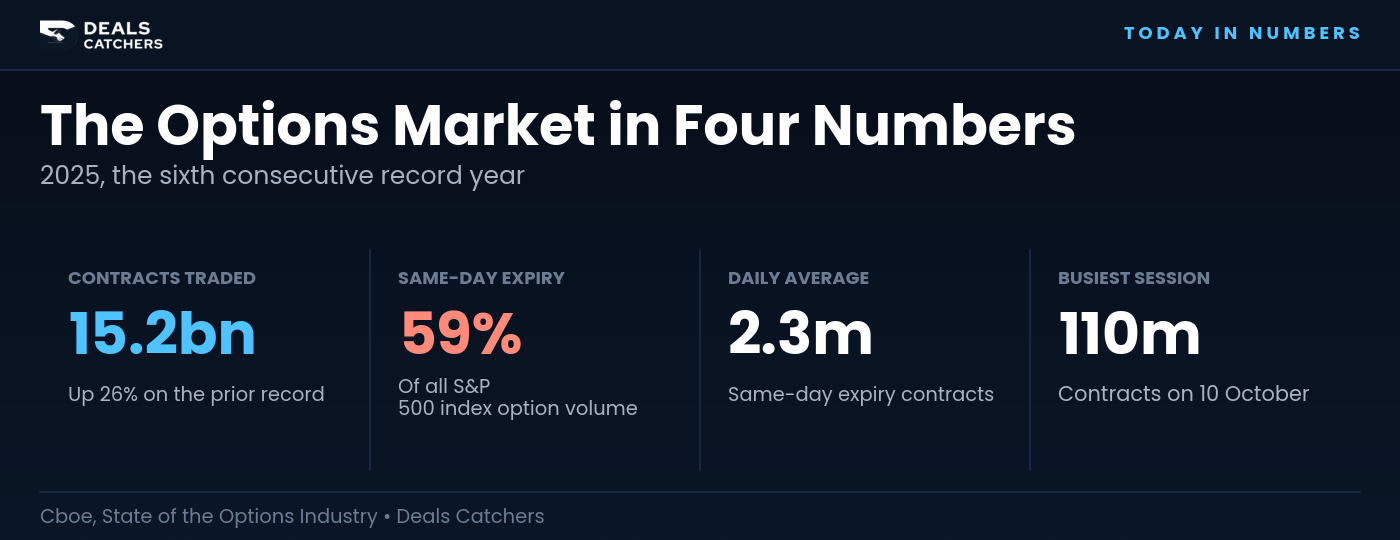
Total options volume reached 15.2 billion contracts in 2025, up 26% on the prior year and the sixth consecutive record. Single-day volume passed 70 million contracts on 21 separate days, and 110 million on 10 October.
The growth sits in one product. Same-day expiry contracts made up 59% of all S&P 500 index option volume, averaging 2.3 million contracts a day. A majority of index options now live and die inside a single session.
Selling an option is selling insurance. You collect a small, near-certain payment and accept a large, rare loss. That structure produces a high win rate by design. A book that prints 95% winners is doing what the product is built to do.
The arithmetic that keeps the book alive is the other number. At a 95% win rate the average loss has to stay under nineteen times the average win just to break even. One session that runs four or five times wider than the model assumed takes a year of premium with it.
Same-day expiry changed the shape of that worst case. A contract with weeks left gives a seller time to adjust, roll or close. A contract that expires in hours does not. The position finishes in the money or it does not, at a price set in the last minutes of the tape.
So the first question is not how often the trade wins. It is the size of the worst loss, and whether the setup you are running was built to survive it. The desks that have sold premium for decades already know which window they will not leave open.
sponsored Twenty-Eight Years of Selling Premium |
Twenty-eight years. That's how long Dave Aquino traded options professionally — a decade at Merrill Lynch, then managing more than $650 million in options income strategies for Vanguard's wealthiest clients. And the thing he kept coming back to, after all of it? One setup. One focused window. One "rinse and repeat" ticker. Not because options are simple. Because after 28 years, he knew exactly what to ignore. Nearly 900 trades. 95.3% success rate.  He wrote it all down in a guide you can read in an afternoon. The ticker is inside. It's free. Get the free guide To better trading, Dave Aquino, Base Camp Trading |
What is Scheduled
Oct | the next Fed meeting. Markets price roughly an even chance of another increase after the first rise since 2023. |
3 Nov | the midterm elections. |
31 Dec | the close of the tax year for gifts, Roth conversions and required withdrawals. |
Leverage and the policy rate work on each other. A higher funds rate raises the cost of carrying a margin balance. A record margin balance makes any decline faster. Both numbers move again in October.
ad Almost nobody knows it exists. See the company behind the empty seat |
The Number Under the Empty Seat
500,000 | paid rides a week with nobody at the wheel, one operator, eleven metros. The cars carry four badges. The parts list underneath is much shorter, and that list gets paid whichever operator scales. |
Forget the hot picks — protect what you’ve already built, and ask what the worst loss looks like before you ask how often it wins. Because the best trade you’ll ever make is the loss you never took. Mike LeeDeals CatchersThanks for reading. See you tomorrow. |
Forwarded this? Get it every morning. |