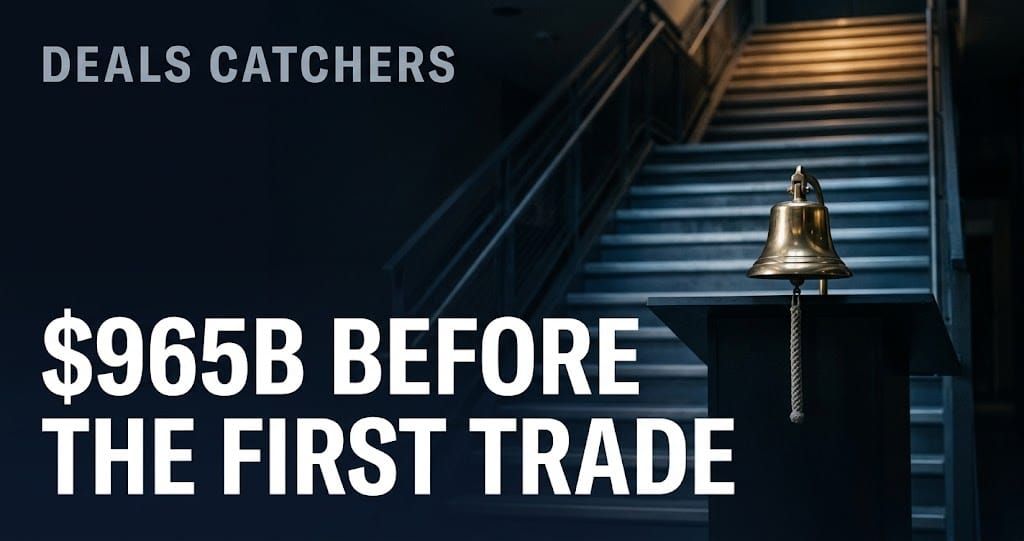
$965 Billion before the First Trade

 |
9 OCTOBER 2026
 By Mike Lee
sponsored A Stake Before the Listing |
Venture capitalists call a private company worth over $1 billion a unicorn. $10 billion and it’s a decacorn. $100 billion is a hectocorn. But what do you call a private company worth over a trillion dollars? Anthropic is there, right now. The first of its kind. It’s worth more than every American airline — combined. It’s even bigger than the U.S. defense budget … Anthropic’s annualized revenue grew by 80 times in the first quarter. They’ve already filed the paperwork for an IPO … Some estimates say they are going public as early as November. Now, here’s what’s really exciting. You can take a stake in this IPO … Right now. Today. Before it goes public. For a chance to see gains on day one. Click here to find out how. |
Three Numbers to Start
$965bn | Anthropic’s valuation in its May funding round, up from $61.5 billion in March 2025. |
14 days | the length of a lunar night, which anything on the Moon has to survive without sunlight. |
10 Jan | the new end date of the US-China truce that keeps China’s broadest rare-earth export rules suspended. |
ad But what do you call a private company worth over a trillion dollars? Find out how to take a stake before it goes public |
The Largest Listing on Record Starts Marketing Next Month
Anthropic, the company behind the Claude AI models, confidentially submitted a draft registration statement to the SEC on 1 June. Bloomberg reported on 1 October that it aims to list as soon as mid-November, with marketing that could start the week of 9 November and meetings with prospective investors from 14 October.
Investors are discussing a valuation of up to $2 trillion. SpaceX set the current record in June, when it listed at $1.77 trillion. Reuters, which obtained the prospectus at the end of September, reported that Anthropic’s revenue grew about twelvefold in 2025, to roughly $4.6 billion.
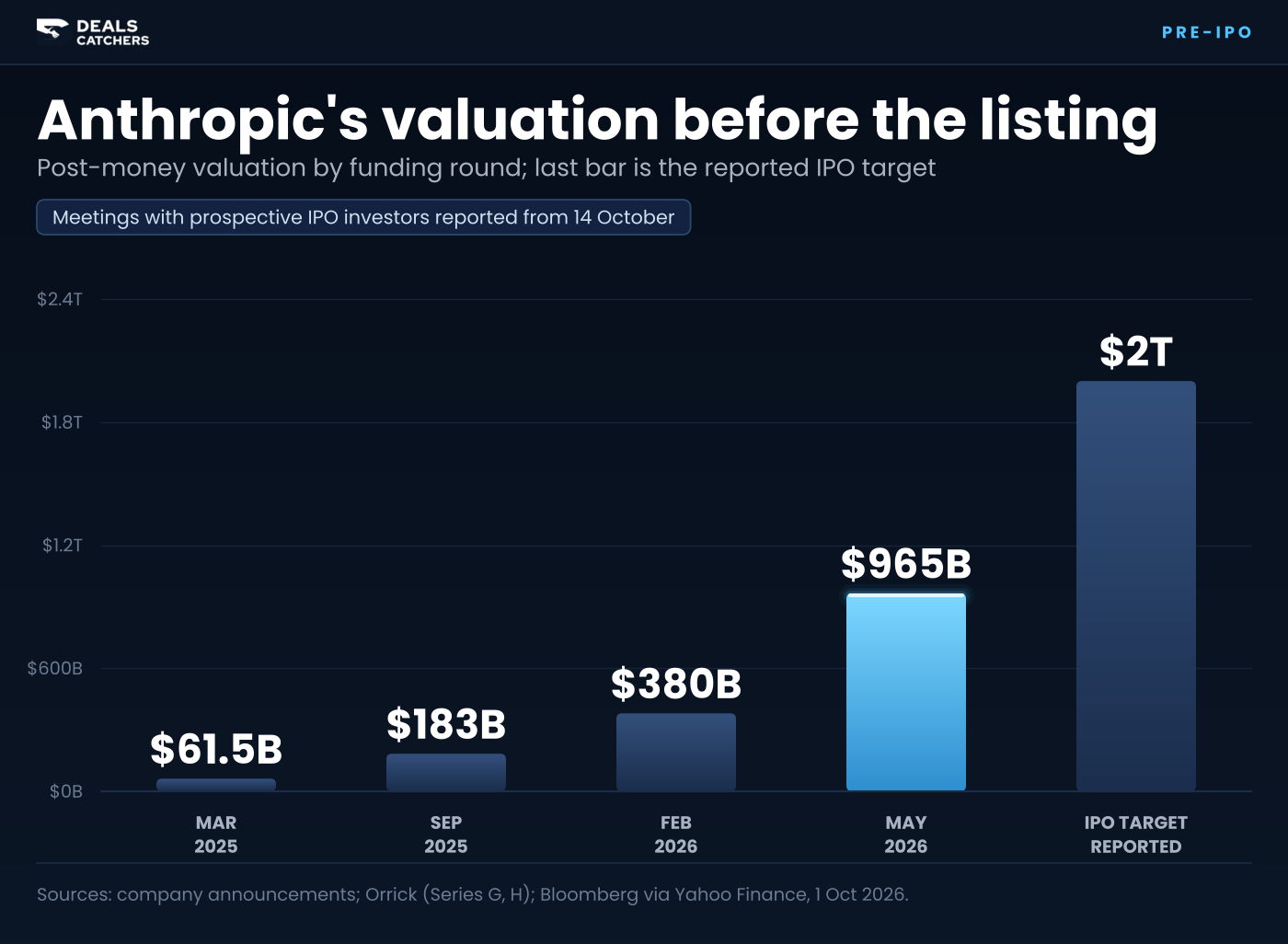
The private rounds carry most of the story. Anthropic was valued at $61.5 billion in March 2025, $183 billion that September, $380 billion in February and $965 billion in May. That is close to sixteen times in fourteen months, and every step of it happened before a public investor could buy a share.
A listing at $2 trillion would roughly double the May price. The first fifteen-fold went to the funds and employees who held stock in private. Access before the listing is the only way to own part of that curve, and the window for it closes when the shares start trading.
Fourteen Days Without Sunlight
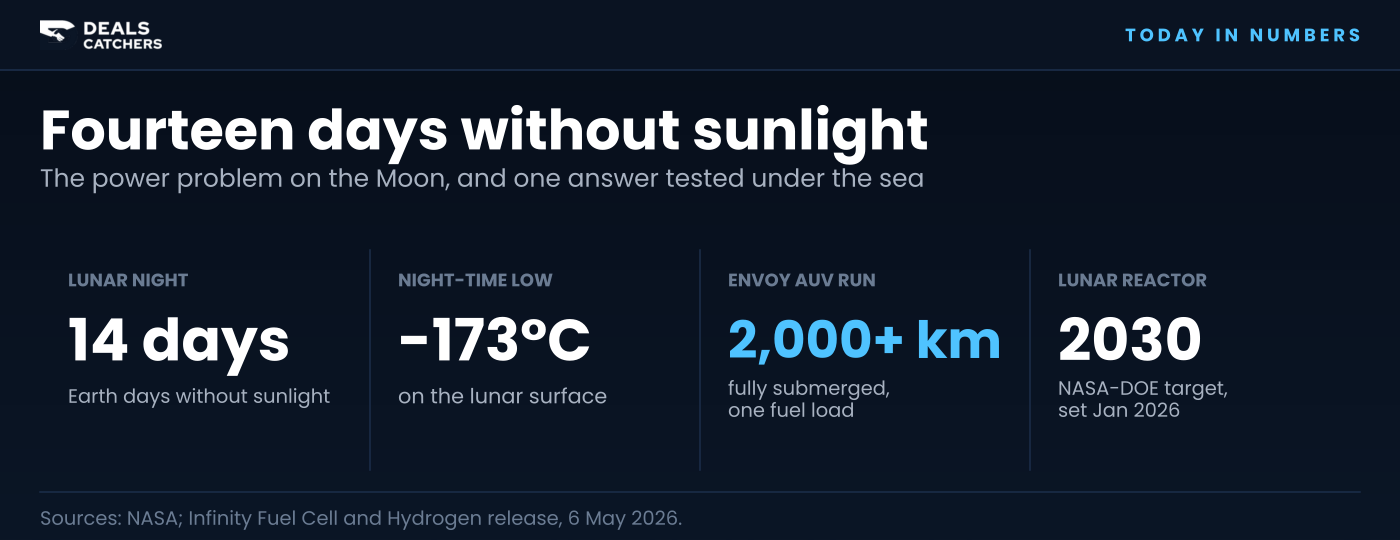
A night on the Moon lasts about fourteen Earth days, and the surface drops to around minus 173 degrees Celsius. Solar panels produce nothing for the whole stretch, so anything that has to keep working needs stored energy or its own source of power.
NASA and the Department of Energy agreed in January to put a reactor on the lunar surface by 2030. Until one arrives, landers, rovers and the first base equipment have to carry the night with them.
Batteries handle that badly. A battery keeps its energy inside the same cells that deliver it, so twice the endurance takes roughly twice the battery. A fuel cell separates the two: the stack makes the power and the tanks hold the energy, so longer missions need bigger tanks while the power plant stays the same size.
Infinity Fuel Cell and Hydrogen, a Connecticut company founded in 2002, built its air-independent fuel cells with NASA funding and later support from the Office of Naval Research, and flew them twice on Blue Origin’s New Shepard. In May it reported that a Cellula Robotics Envoy underwater vehicle ran more than 2,000 kilometres fully submerged on one fuel load with its Mystic 2000 power plant.
The ocean and the lunar night pose the same problem: no air, no sunlight, and a long way from a charger. Infinity is raising money from individual investors under Regulation Crowdfunding, and its offer adds 5% in bonus shares for anyone who commits before 15 October.
sponsored The Battery Trap |
 How NASA & the Navy Escaped “The Battery Trap” In physics, the “Battery Trap” is well known. To make one last twice as long, it must be twice as big. But Infinity Fuel broke free from that limitation, finally creating energy technology that doesn't trade size for performance. And the demand speaks for itself. 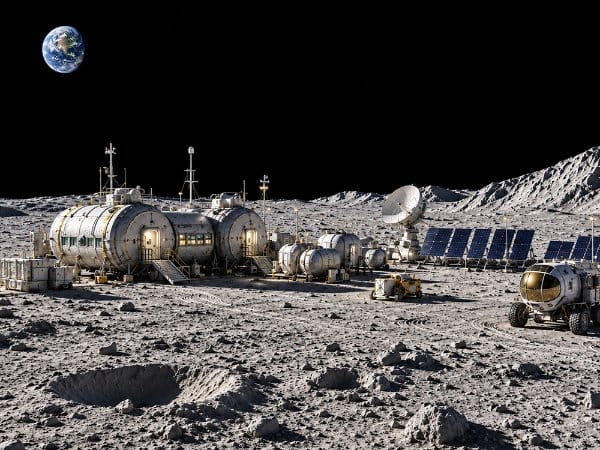 NASA signed a deal to help illuminate the Moon during 14-day lunar nights. The US Navy signed one to help power its underwater drones. Those aren’t the only reasons investors are paying attention to Infinity Fuel’s new early-stage opportunity, either:
Now is your chance to own a piece of this ceiling-shattering energy tech at the early stage. Not only that, if you invest before October 15, you’ll earn 5% in guaranteed bonus shares. Maximize your stake in Infinity Fuel before the deadline. |
The Rare-Earth Truce Now Runs to 10 January
During Xi Jinping’s state visit to Washington last month, Treasury Secretary Scott Bessent extended the trade truce agreed in Busan by two months, to 10 January 2027. The truce keeps China’s broadest rare-earth export rules, announced in October 2025, on hold. Many importers had hoped for a full year.
Some rules never paused. Since April 2025, exporters of seven medium and heavy rare earths, including dysprosium and terbium, have needed a Chinese licence. The White House fact sheet from the summit says shipments still have to return to appropriate levels.
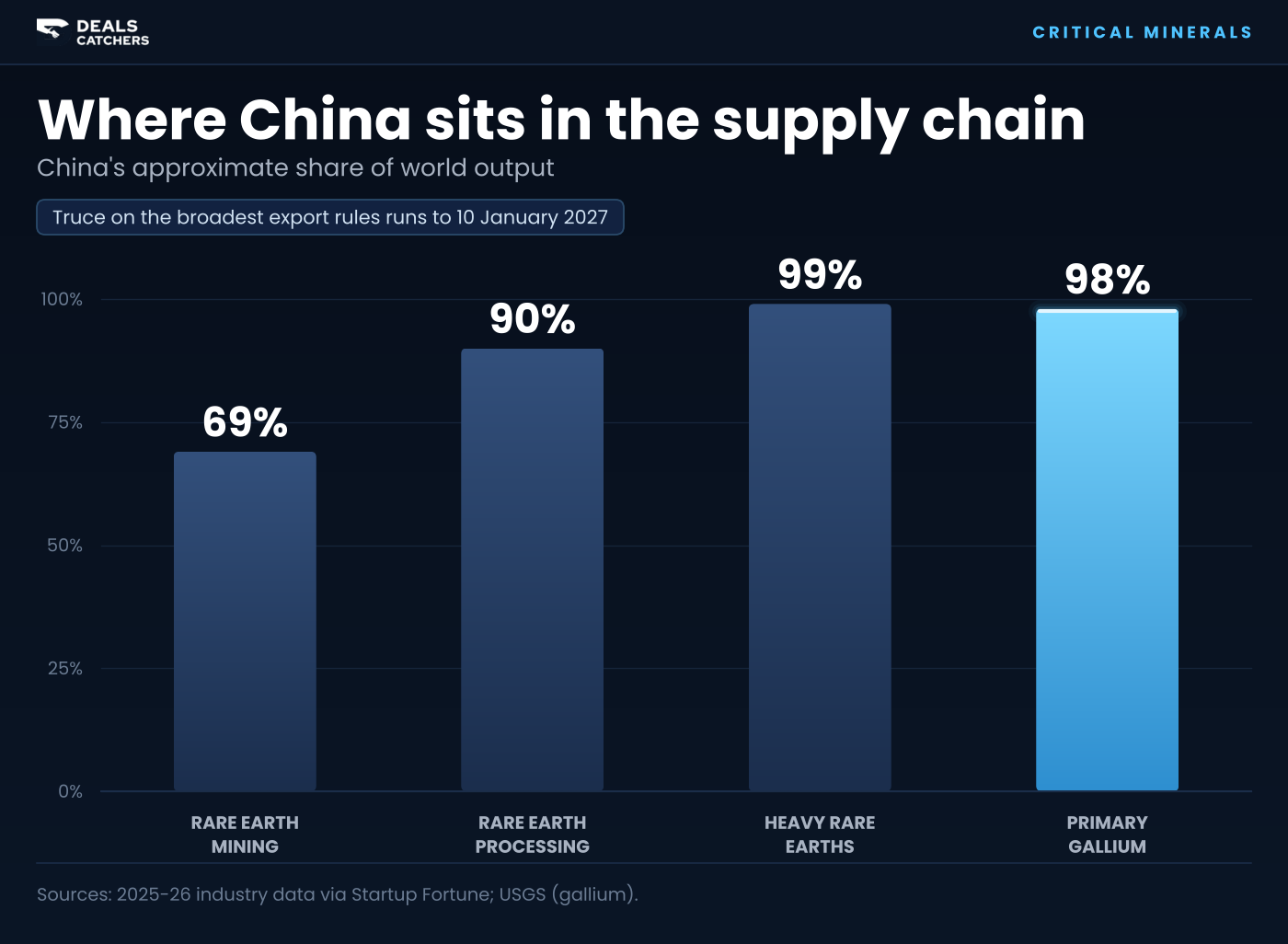
The leverage behind those licences is easy to measure. China mined about 69% of the world’s rare earths in 2025, processes up to 90% of them and close to 99% of the heaviest elements, and produces about 98% of the world’s primary gallium, a metal that goes into radar, LED and power chips.
Washington’s answer arrived in February. Project Vault is a $12 billion strategic stockpile of critical minerals, funded by a $10 billion Export-Import Bank loan and $1.67 billion of private capital. General Motors, Boeing, Google and more than a dozen other manufacturers commit in advance to buy materials at set prices, and three trading houses do the buying. The Pentagon already guarantees MP Materials $110 a kilogram for its rare-earth output.
The metals behind AI chips, defence electronics and electric motors now move on two-month truces and government price floors. Porter Stansberry argues the dollar itself is being rebuilt around those materials, and names five companies sitting at the chokepoints.
sponsored The Silicon Dollar |
On a hostile, sand-blasted planet at the edge of an imperial frontier, a harvester the size of a small town crawls across the desert floor. Beneath the orange sand, a vital substance is forming that the rest of the universe cannot live without. It powers the trading vessels of the Spacing Guild. It extends the lives of the great nobles. It sharpens the minds of the mystics who advise emperors. The planet is Arrakis. The substance is spice. And the entire architecture of an interstellar civilization rises and falls on its flow. This is the mesmerizing world Frank Herbert built in his 1965 novel, Dune. And at the centre of his universe sits a powerful refrain – a mantra: The spice must flow. That’s the cold, immovable law that governs every decision made by every faction in Herbert's universe. Houses might rise and fall, emperors might be murdered in their beds, whole planets might burn – but the spice, the lifeblood of civilization, had to keep flowing, or everything stopped. Every great empire in human history has been organized around a single irreplaceable substance, and the geographic chokepoint where that substance emerged. Egypt had grain from the floodplain of the Nile. Venice had spices from the Indies. Spain had silver from a mountain in the Andes. Britain had gold in vaults beneath London. And America had oil in the salt caverns of the Gulf Coast. Each critical substance defined an era. And each era ended when the substance was supplanted by another. In 2026, the substance around which world trade, politics and order is structured is being replaced again. The New Spice The lifeblood of the twenty-first-century empire is no longer petroleum. It is silicon, lithium, gallium, germanium, cobalt, and the 17 rare-earth metals without which not a single advanced semiconductor can be built. These are the AI-critical materials that power artificial intelligence, modern defence, electric mobility, communications, and the entirety of the post-industrial economy. Vladimir Putin understood the stakes years long before any American president. In 2017, addressing Russian schoolchildren on the subject of artificial intelligence, the Russian leader said "Whoever becomes the leader in this sphere will become the ruler of the world." It was a near-perfect echo of a line spoken sixty years earlier by a different Vladimir – Baron Vladimir Harkonnen, the cunning antagonist of Dune – who said, "He who controls the spice controls the universe." These materials – essential to the multi-trillion-dollar scaling of AI – are the new spice. And the world's two great superpowers are locked in battle to control them. China controls 98% of global gallium production, roughly 70% of the world's silver refining capacity, and the vast majority of refined rare earth output. The factories that extract, separate, and prepare the 17 metals on which every modern military and every modern AI system depends are owned, supervised, or subsidised by the Chinese Communist Party. The Politburo did not stumble into this position. It built it deliberately, patiently, over forty years, while America was wasting time and money fighting unwinnable wars. And over the past few years, China has begun restricting the flow. Beijing has imposed export controls on gallium and germanium, quietly throttled rare-earth shipments to Western buyers, and forced companies like Tesla to apply for licences just to keep production lines running. The message from Beijing is clear – whoever depends on the new spice will sit at China's mercy. Trump's Bid for Arrakis In Washington, the Trump administration has finally understood the existential threat of China’s control on the materials that power AI. And the radical measures being taken could have a huge impact on every aspect of your financial life. In February of this year President Trump signed an executive order authorizing a $12 billion strategic stockpile of critical minerals. The administration calls it Project Vault. Behind it sits a national reserve already exceeding$2 trillion in committed capital, a treaty signed by 13 foreign nations at the State Department… Bilateral deals with Saudi Arabia and the UAE worth more than a trillion dollars combined… Government equity stakes in MP Materials, Lithium Americas and Trilogy Metals, and $500 billion in Ukrainian mineral rights… The obsession with Greenland, the endless tariffs, the President’s close relationship with Musk, OpenAI and Palantir… It’s all connected to America's bid for control of the new spice. And Trump is going all in. Because securing the new spice is not the end of the story. It is part of something even larger – a complete overhaul of the U.S. dollar. For 50 years, our currency has been anchored to a single deal struck in the Saudi desert. In 1974, Henry Kissinger persuaded King Faisal to price every barrel of oil exported from Saudi Arabia in U.S. dollars. Within a year, every other OPEC nation followed. The dollar was now backed by something the modern world could not function without. They called it the petrodollar. That arrangement quietly expired in June of 2024 And what our research indicates is being assembled in its place could be the foundation of a new monetary order. One anchored not to Saudi oil, but to the new spice. To the materials and resources America needs to dominate AI. I call it the Silicon Dollar. And I believe it could trigger an historic repricing of goods and assets traded inside the U.S. – just as it did half a century ago. Over the decades that followed Kissinger’s deal in the desert, a great dividing line cleaved the nation in two. Almost 24 million new millionaires have been created by the petrodollar since the 1970s. Yet, at the same time, millions of others saw their financial lives slowly hollowed out. That same dividing line is being drawn once again. And I believe what you do with your money between now and December 2026 may very well decide which side you end up on. That’s why I’ve laid out the full story in my new documentary, which you can watch here for free. You’ll discover the full story behind Trump's audacious monetary reset – including the executive orders and historic treaties that set it in motion… And the five companies sitting at the chokepoints of America's new spice trade – including the name and ticker of one asset that could benefit as this story accelerates. Here’s everything you need to know.  Good investing Porter Stansberry |
What Is Scheduled
14 Oct | the September consumer price index, and Anthropic’s first reported meetings with prospective IPO investors. |
9 Nov | the week Anthropic could start marketing its listing. |
10 Jan | the end of the extended US-China truce on rare-earth export rules. |
ad Anthropic’s already filed the paperwork for an IPO… and you can take a stake right now, before it goes public. Click here to find out how |
Sixteen-Fold
15.7x | the rise in Anthropic’s private valuation between March 2025 and May 2026, from $61.5 billion to $965 billion. A listing at the reported target would double it again, and the investors who held stock before the bell have owned every step. |
Forget the hot picks — get in where the value is created, before the crowd pays the listing price. Because the best trade you’ll ever make is the loss you never took. Mike LeeDeals CatchersThanks for reading. Have a good weekend. |
Forwarded this? Get it every morning. |