9.8 Million Applications. Two in Ten Thousand Got Shares.

 |
4 OCTOBER 2026
 By Mike Lee
sponsored 8,000X Oversubscription Could Reset Robotics Stocks |
8,000X Oversubscription Could Reset Robotics Stocks 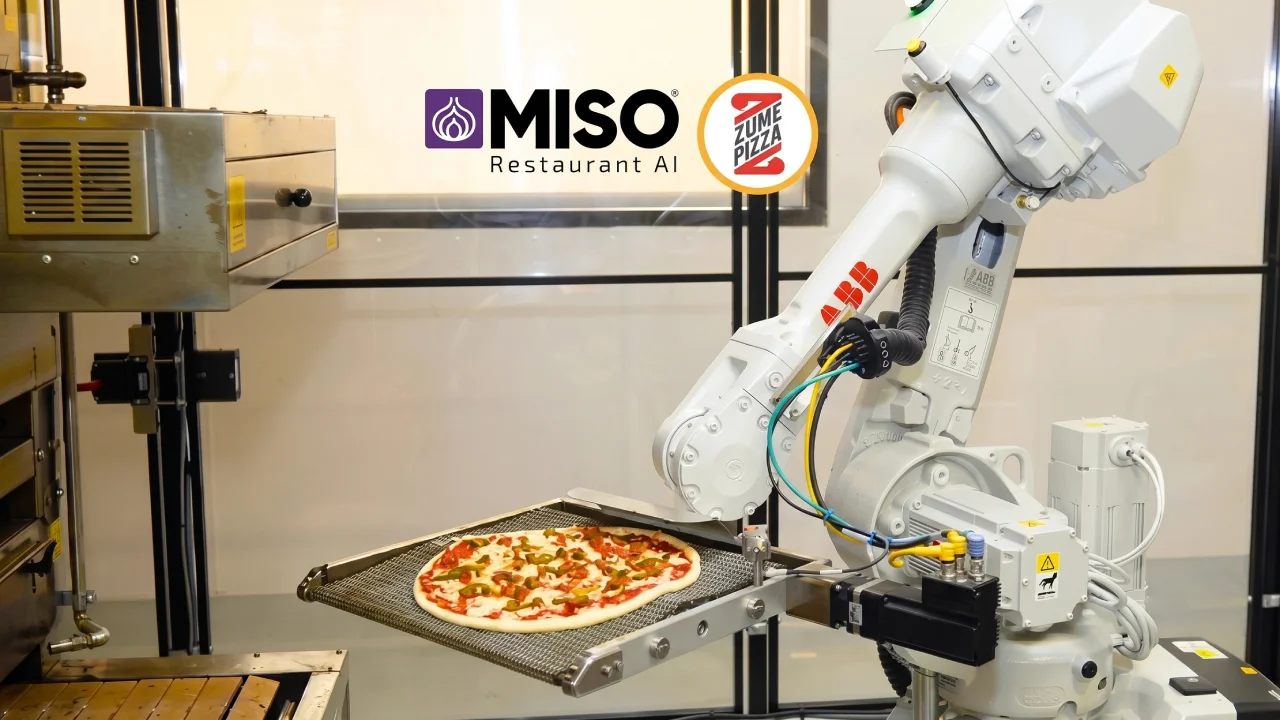 Robotics stocks are having a pivotal moment. And one of those stocks resets its price in days. A recent robotics IPO was oversubscribed 8,000X, and nuts and bolts flew in celebration. Experts say this frenzy is reshaping how investors view robotics stocks — including Miso. Everyday investors have been paying close attention to where this is heading. a private-stage company named Miso Robotics. Miso's Flippy robot works the fry station and was already boosting profits up to 4x for restaurant brands like White Castle. That led industry powerhouse Ecolab to invest in Miso’s growth and NVIDIA to collaborate. 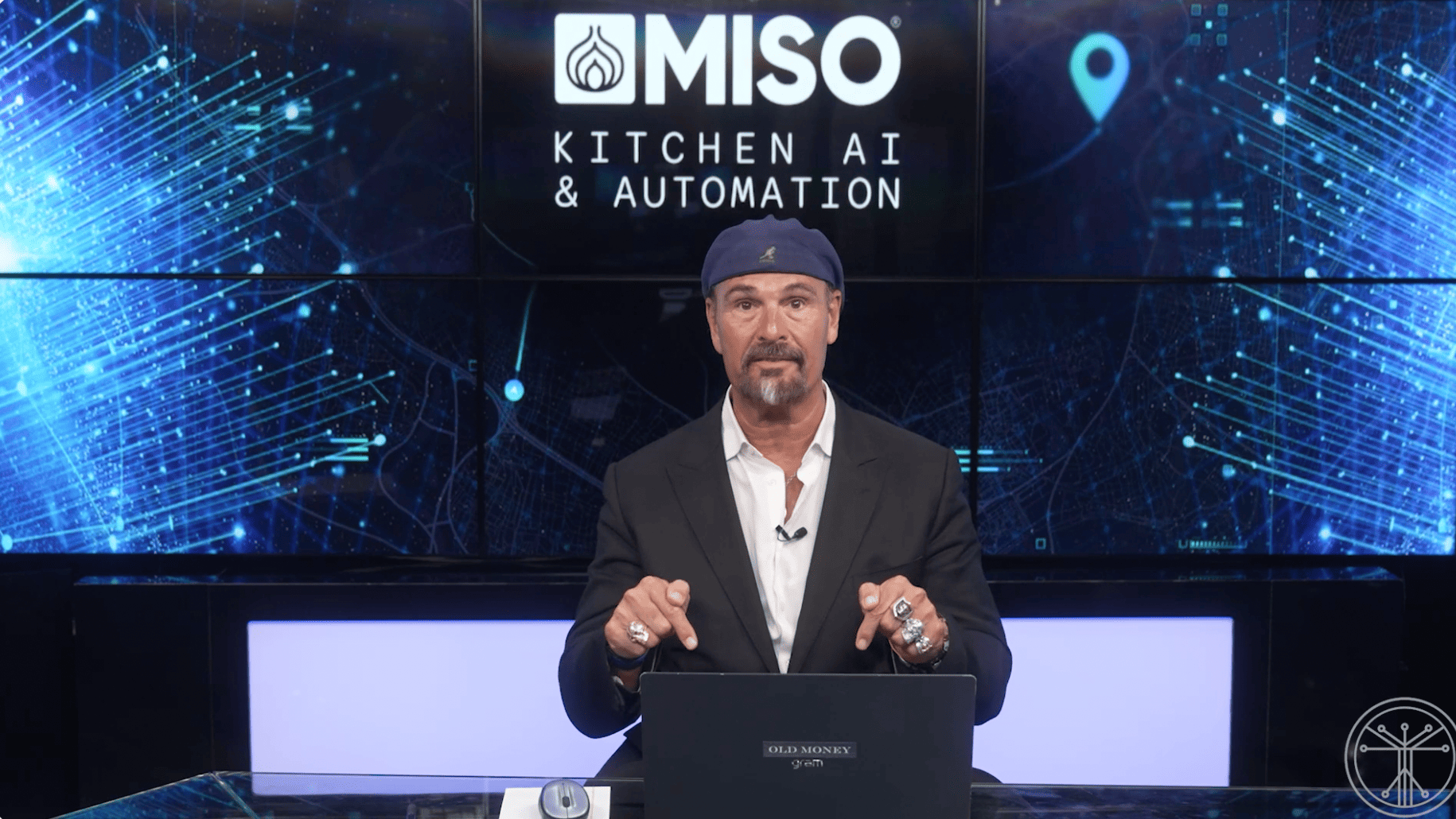 Now, after Miso made two major asset acquisitions in 2026, Flippy is the star of Miso’s expanding ecosystem. Customers think of it as the new operating system for modern restaurants. This year alone, Miso added big-name customers like Jersey Mike’s and Cinnabon, and grew their patent portfolio by ~10X to over 300. Their robots have even expanded beyond restaurants, entering college campuses and NBA arenas. 44,000+ people already claimed their stake — before an 8,000X-oversubscribed IPO put a spotlight on the whole sector. That spotlight is putting the whole sector in focus. See the current share price and decide for yourself. |
Three Numbers to Start
8,000x | the oversubscription on the retail portion of a $900 million robotics listing in Shanghai this August. |
0.018% | the chance any individual applicant had of being allocated shares. Most of the 9.8 million who applied received nothing. |
219x | the multiple of 2025 earnings at the offer price, before the stock closed its first day 460% higher. |
ad Robotics stocks are having a pivotal moment. And one of those stocks resets its price in days. See the current share price |
Nine Point Eight Million Applications for Nine Point Seven Million Shares
The clearest picture of what investors currently think about robotics came from an auction in Shanghai, and the number that matters is the queue.
A Hangzhou maker of humanoid robots listed on the STAR Market in August, raising about $900 million. The online retail tranche was oversubscribed more than 8,000 times. Roughly 9.8 million retail accounts competed for about 9.7 million shares, which produced a lot-winning rate of 0.018%.
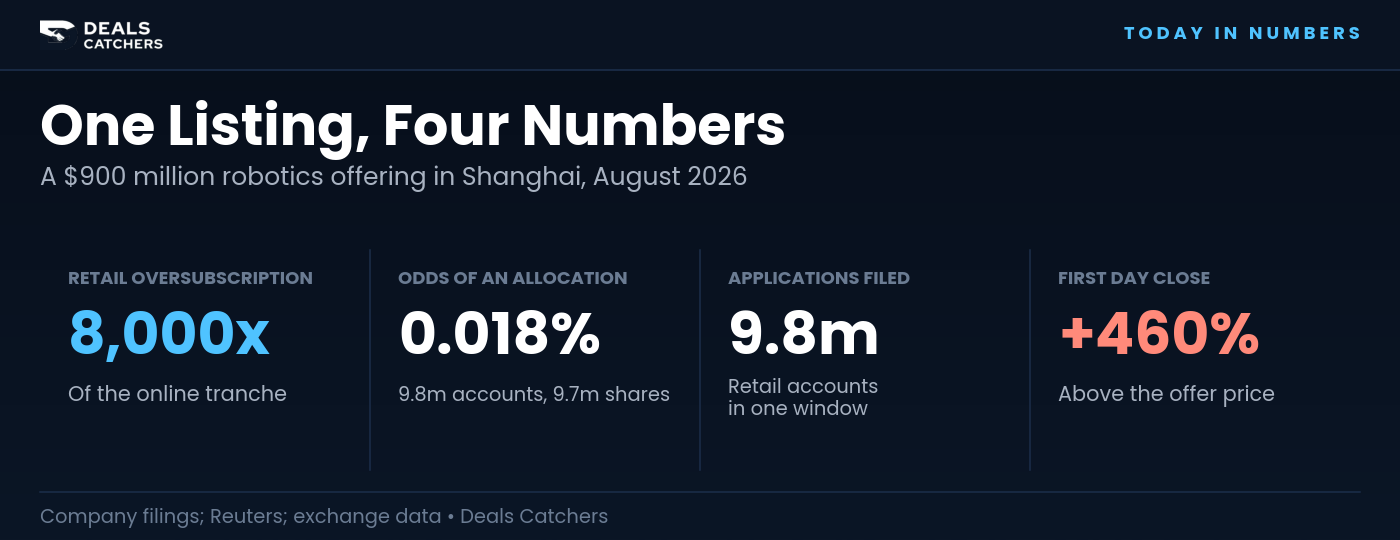
Put that in plain terms. Out of every ten thousand people who applied, fewer than two received anything at all. The institutional side was calmer and still extraordinary, with proposed subscriptions running more than 2,760 times the offline allocation. The public queue is closed. Almost nobody who wanted the allocation got it.
The structure of the sale explains part of the frenzy. Only a slice of the company was sold, the rest stayed locked up, and a state-backed listing on a market built for technology companies carries an implicit endorsement. Scarce supply plus official approval produces queues anywhere it is tried. That queue is now the price every adjacent robotics name gets measured against.
The company itself is real and small. It shipped more than 5,000 humanoid units in 2025. China accounts for roughly 85% of the global humanoid robot market, and Chinese investors have put more than $14.9 billion into the sector this year alone.
The sector around it is queuing up behind the same demand. A Hong Kong listing from the closest domestic rival began its process in July with three major banks as sponsors, and at least four other Chinese robotics firms have filed or signalled listings this year. Each one will now be priced against the August debut rather than against its own revenue. A private name in the same trade gets that spotlight before it has a ticker.
The approval moved at a pace that tells you how much the state wanted this listing. The application was accepted on 20 March and cleared the listing committee on 1 June, a span of 73 days that the company described as a record.
Two Hundred and Nineteen Times Earnings, Before the Open
Demand of that size is the reset. The terms of the deal show what the crowd was willing to pay to be in it.
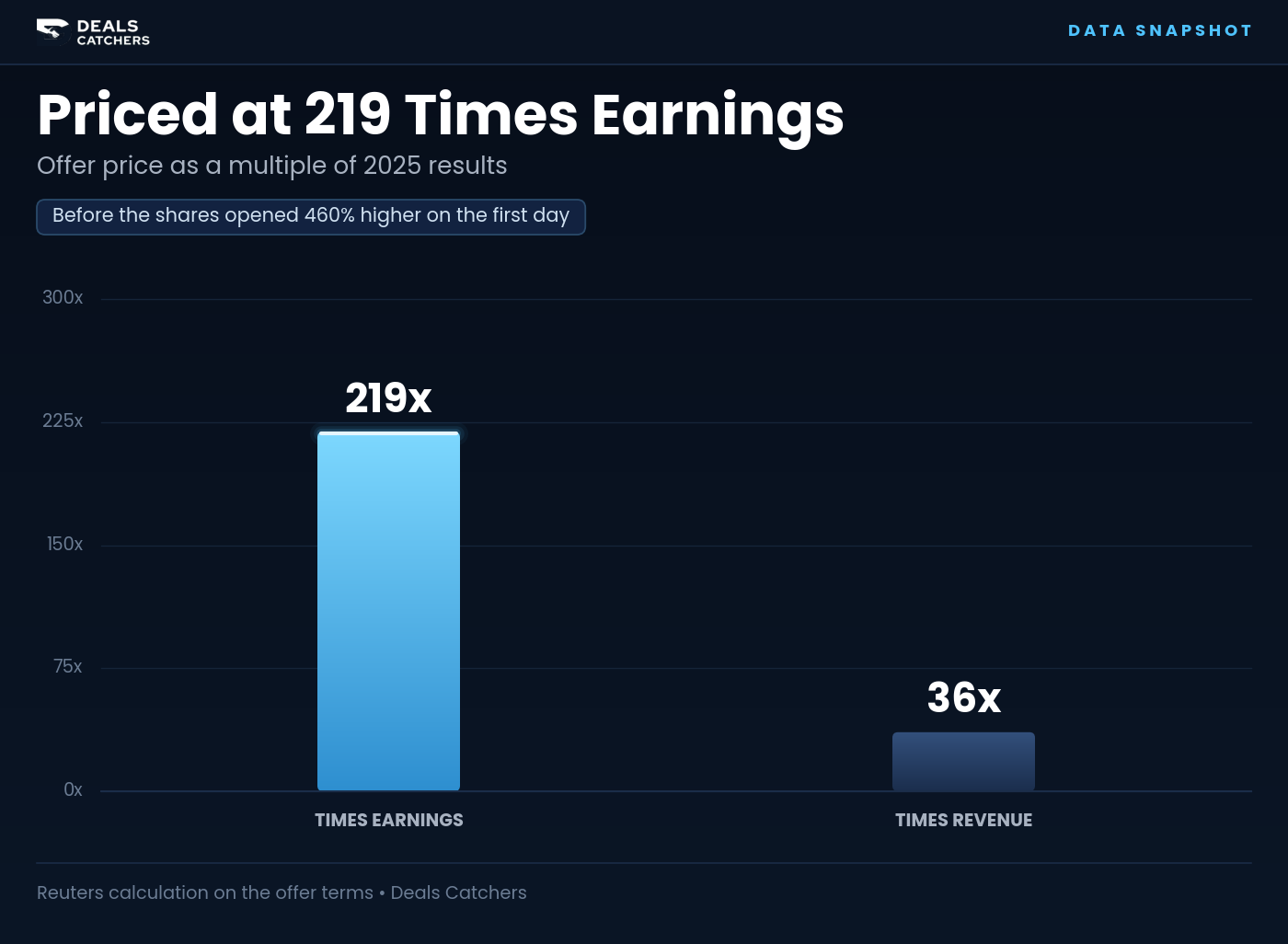
At the offer price the company was valued at about 219 times its 2025 earnings and 36 times its revenue. Those are the numbers investors were queuing for the right to pay. The stock then closed its first day roughly 460% above that price, which puts the company near $50 billion. The people who missed the allocation paid the second price. The people who had it did not.
So the prize was the allocation itself, which could be sold immediately into a market willing to pay five times more. That is why a hot listing gets oversubscribed by multiples that look absurd. The ticket is the asset. Once the listing has happened, the ticket is gone.
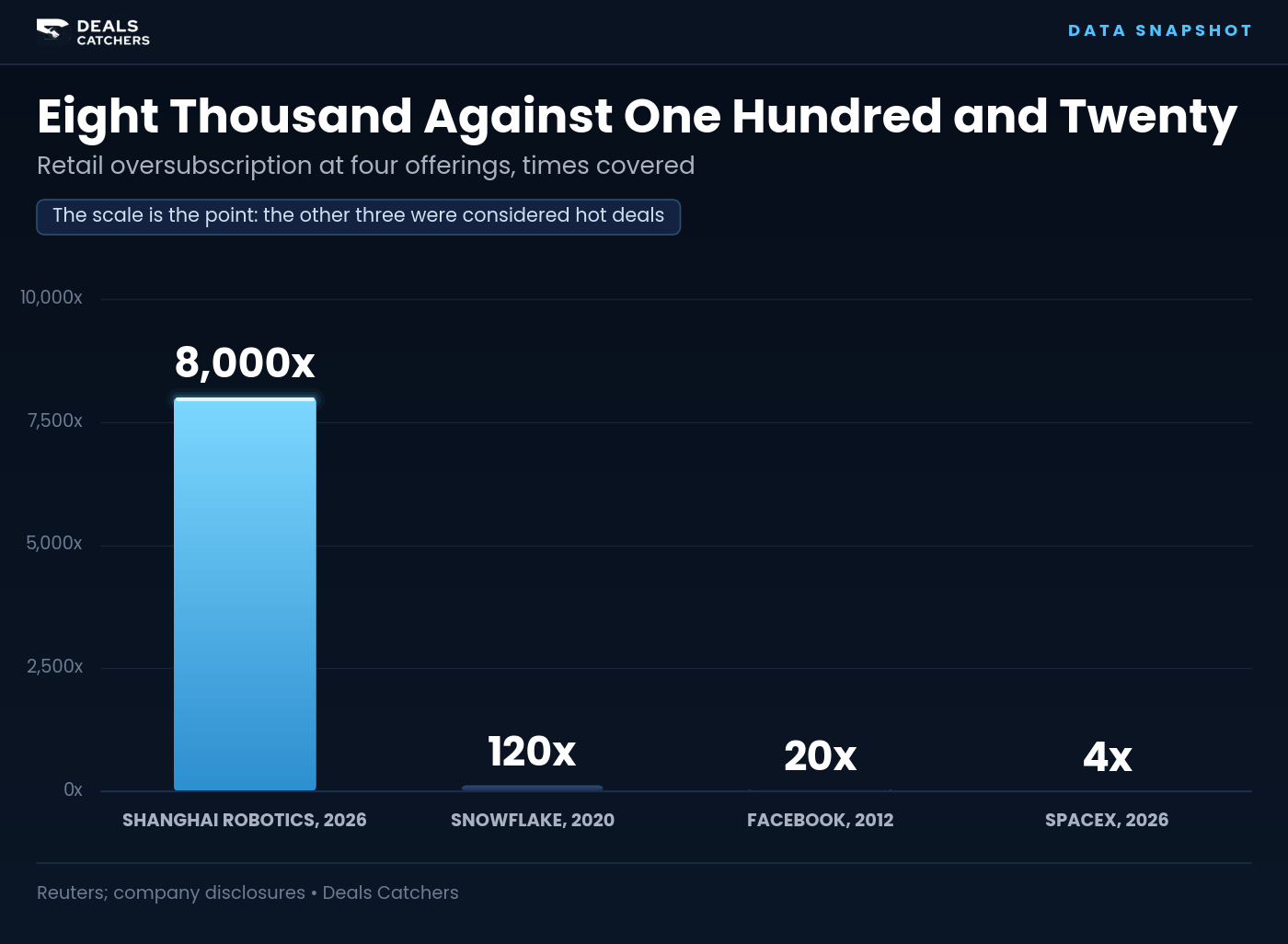
For comparison, a 2020 cloud listing that was described at the time as the hottest in years ran 120 times oversubscribed. A 2012 social media offering ran 20 times. A much larger space company this June ran about four times. The Shanghai deal was in a different category of demand entirely. That is the multiple the rest of the sector now gets priced against.
There is a structural reason the number reached four figures. The exchange allocates the retail tranche by lottery rather than pro rata, so an application costs almost nothing and the rational move is to apply. A lottery with a free ticket collects every ticket in the country, which is what 9.8 million applications describe. Two in ten thousand won. The other 9,998 are now looking at every robotics name that has not listed yet.
The comparisons tell you how many people wanted in at a fixed price. That queue is what resets the price of everything sitting next to the listing, including the companies that are still private.
What the Private Side of the Same Trade Looks Like
A listing like that pulls attention to every company doing something adjacent, including the ones that are not listed at all. That is the side of the trade the Shanghai queue could not get into.
Under Regulation A a private company can raise up to $75 million a year from the general public, with investors who are not accredited limited to 10% of the greater of their income or net worth. That is how a company still in private hands can take a cheque from somebody who would never qualify for a venture round, and who just watched 9.8 million people miss a public allocation.
The difference from Shanghai is the price. A Regulation A share is not listed anywhere by default, so it has not been reset by an 8,000-times queue. There is no closing print each evening. The price is the one the issuer is still offering. In the public lottery, two in ten thousand got a ticket they could sell the next morning at five times the offer. In the private round, the allocation is still there, at the price set before the spotlight.
Two rules set the floor under that. The issuer has to file annual and semi-annual reports with the regulator while the offering is live, so the numbers are on file. The exit is the event: an acquisition, a listing, or a buyback the issuer chooses to offer. That is the same clock the Shanghai buyers were paid to wait on. The difference is they had to win a lottery to start it.
Money goes in at a price the issuer sets, before the sector is repriced against a debut that closed 460% above its offer. It comes out when the listing or the deal arrives. The public queue is the one that already closed. The private price is the one that has not been reset yet.
The practical test is the one the Shanghai crowd answered with 9.8 million applications. Who gets the allocation before the open, and what did the people who missed it pay the next day. Those two numbers are the whole argument for looking at a robotics name that is still taking cheques.
In Shanghai, 9.8 million people competed for the right to own something they could sell the next morning, and almost all of them lost. In a private round, the shares are available before that auction. The queue was the asset. The allocation that is still open is the one the queue did not get.
What is Scheduled
7 Oct | the minutes of the September Fed meeting, which raised rates for the first time since 2023. |
27–28 Oct | the next rate decision, six days before the midterm elections. |
3 Nov | the midterm elections. |
One more date belongs on that list for anybody holding a private position. Regulation A issuers file an annual report on Form 1-K within 120 days of their fiscal year end, which for a December year end means the end of April. That filing is where the numbers behind the private price become public, before the next listing resets them again.
Rates matter to this story more than it first appears. A company valued on earnings a decade away is priced against what safe money earns while you wait, and that number moves again at the end of this month. The Shanghai crowd did not wait for it. They paid 219 times earnings for the right to be in the queue.
ad 44,000+ people already claimed their stake, before an 8,000X-oversubscribed IPO put a spotlight on the whole sector. See the offering and decide for yourself |
Two in Ten Thousand
0.018% | the chance of receiving any shares in the Shanghai robotics listing, after 9.8 million applications for 9.7 million shares. The offer valued the company at 219 times earnings, and the first day closed 460% above it. The queue was the asset. The allocation that is still open is the one the queue did not get. |
Forget the hot picks — protect what you’ve already built, and look at the allocation before the queue resets the price. Because the best trade you’ll ever make is the loss you never took. Mike LeeDeals CatchersThanks for reading. See you tomorrow. |
Forwarded this? Get it every morning. |