
$302.8 Billion of Digital Dollars Are Already Out


 |
29 SEPTEMBER 2026
 By Mike Lee
sponsored The Digital Dollar Guide |
U.S. GOVERNMENT DIGITAL DOLLAR PLAN  We have urgent news… The U.S. government is moving forward with the Central Bank Digital Currency (CBDC) — and this may be your final opportunity to protect your cash and privacy. Once this system is in place, the government will have full control over your money. They’ll decide what you can buy… how much you can spend… and they’ll be able to track every transaction you make. But here’s the good news — there’s still time to legally “opt out” before the Digital Dollar becomes mandatory. Everything you need to know is explained step-by-step in this new, confidential guide. Click here now to get your FREE copy before it’s taken down. This may be your only chance to learn how to protect your savings, your privacy, and your family’s financial freedom before the switch is flipped. Don’t wait — every day you delay gives the government more power over your money. CLICK HERE TO CLAIM YOUR GUIDE NOW |
Three Numbers to Start
$302.8bn | of dollar-pegged stablecoins in circulation this month, all of it issued by private companies rather than a central bank. |
93 days | the maximum maturity of the Treasury bills that qualify as backing for those tokens under federal law. |
0.25% | the rate that tax lien certificates clear at in the most competitive Florida counties, against a statutory maximum of 18%. |
ad There’s still time to legally opt out before the Digital Dollar becomes mandatory. Everything you need to know is explained step-by-step in this new, confidential guide. Get the free digital dollar guide |
The Dollar Already Went Digital, and a Private Company Issued It
While the argument about a future central-bank coin continues, a digital dollar is already at scale. It is issued by private companies, it moves on a public network, and it runs on a statute Congress wrote last year.
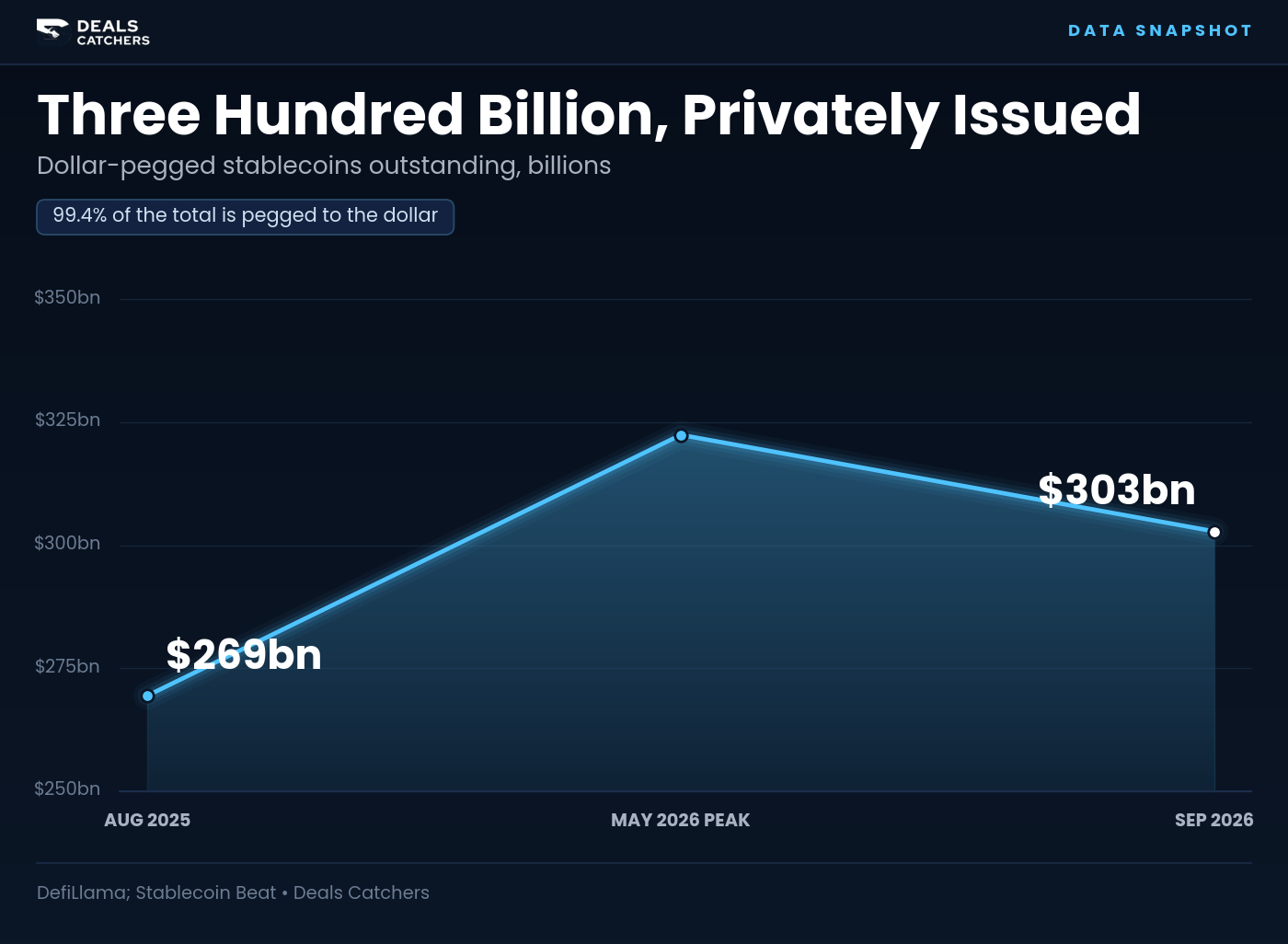
Dollar-pegged stablecoins outstanding stood at about $302.8 billion this month, after peaking at $322.4 billion in May. Roughly 99.4% of all stablecoin supply is pegged to the dollar, and two issuers account for the overwhelming majority of it.
These are tokens that promise to be worth exactly one dollar, redeemable on demand, and they move on public networks rather than through the banking system’s settlement rails. For cross-border payments they have become ordinary infrastructure rather than a crypto instrument.
The legal framework arrived on 18 July 2025, when the GENIUS Act became law. It requires an issuer to hold reserves equal to at least 100% of the tokens outstanding, in cash, insured deposits, Federal Reserve balances, Treasury bills maturing within 93 days, repurchase agreements against Treasuries, or government money market funds.
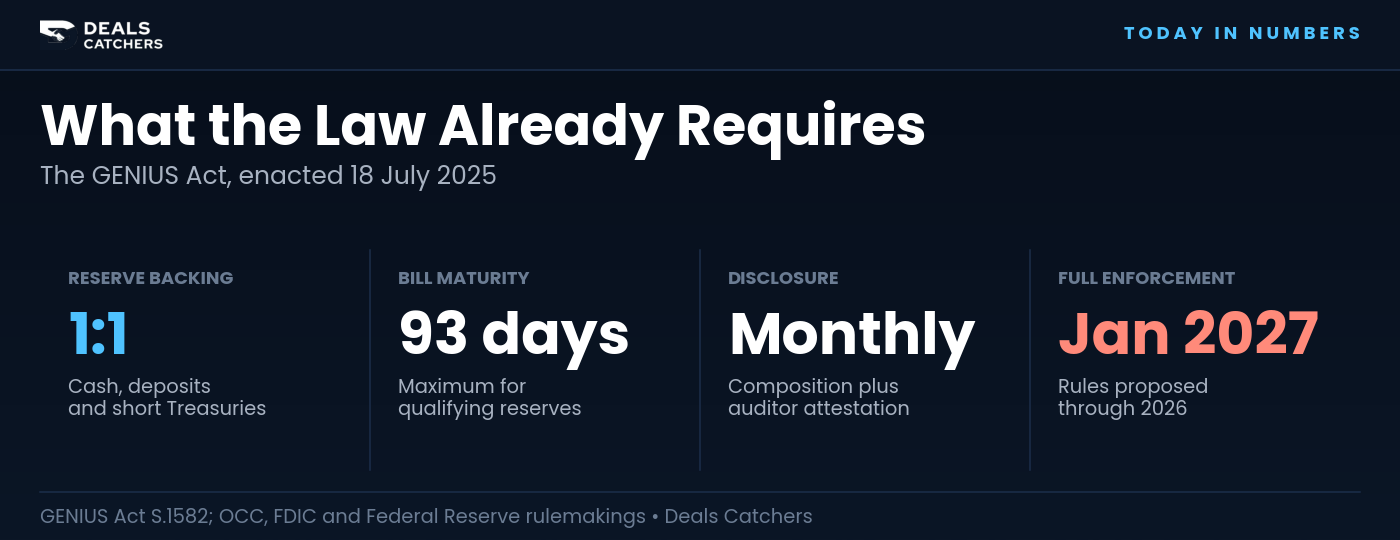
The law also bans issuers from paying interest to holders, requires monthly public disclosure of reserve composition with an auditor’s attestation, applies bank-grade anti-money-laundering obligations, and puts token holders ahead of general creditors if an issuer fails.
The rulemaking has run all year. The Comptroller of the Currency proposed its rules in February, the FDIC in April, and the Federal Reserve published two proposals on Thursday covering reserves, capital, custody and the application process for bank subsidiaries that want to issue. Full enforcement is scheduled for January 2027.
The ban on paying interest is doing more work than it looks. A regulated issuer earns the yield on its own reserves and keeps it, so a token holder gets a dollar that does not grow while the issuer collects on the bills behind it. At current bill yields, three hundred billion of reserves produce well over ten billion dollars a year, and none of it belongs to the people holding the tokens.
Sit with the fact. A digital dollar that is trackable, freezable at the issuer and governed by federal statute is already in circulation at three hundred billion. It did not wait for a central-bank brand. It arrived through private issuers and a bank regulator, with the same levers people said they were watching for: who can see the transfer, who can stop it, and which statute sits over the account. The Federal Reserve’s Thursday proposals are the next layer on a system that is already live.
Three Hundred Billion Dollars That Must Sit in Short Treasuries
The reserve rule has a second consequence that reaches well beyond anyone holding a token.
Every qualifying dollar of backing has to sit in cash or in government paper maturing inside 93 days. One large issuer reports 99.5% of its reserves in cash, short Treasury bills and overnight repurchase agreements, held through a registered government money market fund.
So the sector functions as a standing bid for the shortest end of the Treasury curve. The Bank for International Settlements has noted that stablecoin reserves already make up a meaningful share of demand for short-dated bills, and that flows into and out of the sector move their prices.
That creates a loop nobody designed. A token issued to move money on a public network is backed by the same bills that money market funds buy, which are priced off the policy rate the Fed sets. Growth in stablecoins pulls the short end lower; a contraction sells bills into the market.
The maturity limit matters as much as the size. Reserves cannot sit in ten-year paper, so none of this money funds long-term government borrowing. It concentrates in the part of the curve that reprices every few weeks, which is also the part the Fed moves directly when it changes the policy rate.
The Comptroller’s own rulemaking cited projections of a $500 billion sector this year and $2 trillion later this decade. If anything close to that arrives, the buyer of last resort for Treasury bills will be a payments product.
sponsored Midnight in America |
Have you seen this video yet?  If you haven't seen it yet, access our exclusive presentation - "Midnight in America" here. I've kept this presentation simple... So ANYONE could understand exactly what to do to take advantage of this major investment opportunity. Click here to watch our exclusive video here >>> "The Buck Stops Here," Dylan Jovine, CEO & Founder Behind the Markets |
Eighteen Percent on Paper, One Percent After the Auction
A different kind of government-backed yield has its own arithmetic. The statutory rate is real. Where you buy the certificate decides whether you keep it.
When a property owner stops paying local taxes, the county still needs the money. In roughly two dozen states the county sells a tax lien certificate: an investor pays the overdue tax, and the owner has to repay that amount plus statutory interest to clear the lien. The obligation is secured by the property itself.
The statutory rates look extraordinary. Illinois allows 18% per six-month period, which annualises to 36%. Florida sets a maximum of 18% and Arizona 16%. The interest is set by state law rather than by a market.
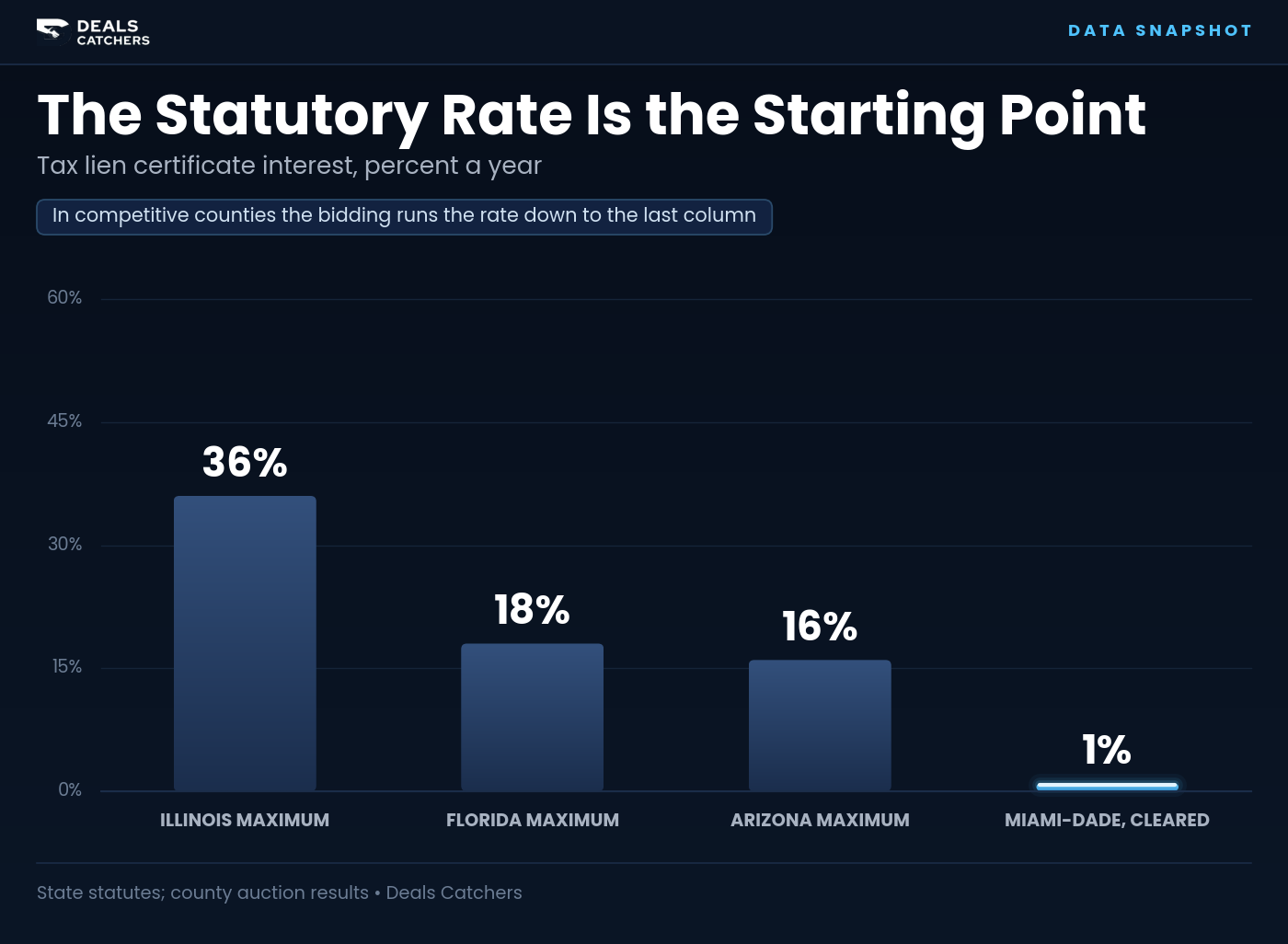
Then comes the auction. Most states run a bid-down format: the certificate goes to whoever accepts the lowest rate. In Miami-Dade and Broward, institutional funds routinely bid the rate down to between 0.25% and 1%. Those two counties are not the market. They are the counties with an online auction and a crowd.
Most liens are redeemed by the owner, usually within six to eighteen months, which is how the interest gets paid. The obligation is still secured by the property. The county still needed the tax. That is the government backing: the lien sits on the parcel until the owner or the process clears it.
Where the statutory rate survives is where the crowd does not. Certificates that go unsold at auction are available over the counter at the full statutory rate. Smaller counties with in-person auctions and no online bidding see far less institutional money. That is the list worth opening: not the Miami tape, the counties the funds do not sit in.
The arithmetic of a small certificate is worth seeing once. A $2,000 lien bought at an 8% bid and redeemed after eleven months returns about $147 of interest. The same certificate bought at 0.5% returns roughly nine dollars, on the same paperwork, the same county process and the same amount of capital tied up.
Subsequent years’ taxes usually have to be paid to keep priority. The parcel still has to be a parcel worth the paperwork. The work is knowing which county list you are reading before the auction, not after the bid-down has already taken the rate.
sponsored The Tax Lien List |
Tax Lien List Have you checked out the tax lien list from your state? There’s literally thousands of houses investors earn monthly income from... -- without dealing with rentals -- without costly marketing -- without cold-calling And get this... The returns are 100% backed by the government. No kidding. Can you imagine the government paying us for once? Rather than the other way around. Access the Tax Lien List Happy Investing, Jp Moses |
What is Scheduled
Oct | the next Fed meeting. Markets price roughly an even chance of another increase after the first rise since 2023. |
3 Nov | the midterm elections. |
Jan 2027 | full enforcement of the stablecoin rules now working through three federal agencies. |
The rate decision touches both stories in this letter. A higher policy rate raises what stablecoin reserves earn on their bills, and it raises what a county lien has to compete against before anyone bids the rate down.
ad Once this system is in place, they’ll decide what you can buy, how much you can spend, and they’ll be able to track every transaction you make. Claim your guide now |
The Number Nobody Was Watching
$302.8bn | of digital dollars already in circulation, issued by private companies, backed by Treasury bills maturing within 93 days and governed by a statute passed in July 2025. The Federal Reserve proposed its rules for them on Thursday, and enforcement begins in January 2027. |
Forget the hot picks — protect what you’ve already built, and treat a digital dollar that can already be frozen as the system that is running, not the one still being argued. Because the best trade you’ll ever make is the loss you never took. Mike LeeDeals CatchersThanks for reading. See you tomorrow. |
Forwarded this? Get it every morning. |