200+ Companies Are Preparing to IPO in 2026. The Ones Nobody Is Watching Are Historically Where the 1,000X Returns Come From.

The 1000x Stocks
“Be fearful when others are greedy and greedy when others are fearful.” — Warren Buffett
Every decade, a small group of companies emerges that goes on to reshape entire industries. At the start, they rarely look impressive. They’re unpopular. Small. Often dismissed.
Amazon was an online bookstore. Apple started in a garage. Airbnb rented out air mattresses.
Before they became household names, they were simply early-stage companies that were unpopular.
Today, thousands of unpopular companies are trying to become the next breakout success. ...Most will fail. But a handful will grow 100x… even 1000x.
Inside The 1000x Companies briefing, you’ll discover: Why the biggest winners almost always start out unpopular. The patterns shared by companies before they explode in growth.
Sign up for the Unpopular Stocks newsletter and get The 1000x Companies briefing instantly. Because once a company becomes popular, the opportunity is already gone.
| 👉 Subscribe to Download the Report |
By clicking the link above or any link in this email, you agree to receive market insights from Equiscreen, LLC, along with two complimentary bonus subscriptions. We respect your privacy — you can unsubscribe at any time. For more information, please review our privacy policy.

Between 200 and 230 companies are expected to IPO in 2026, raising between $40 and $60 billion according to DealRoom Research. The secondary market for private company shares — where early investors trade pre-IPO positions — reached $160 billion in 2024 and is projected to exceed $200 billion this year. SpaceX dominates the headlines, but it is one name in a pipeline that includes Databricks, Anthropic, Discord, Plaid, Klarna, Revolut, Figure AI, and dozens more across AI, fintech, defense tech, and spatial computing.
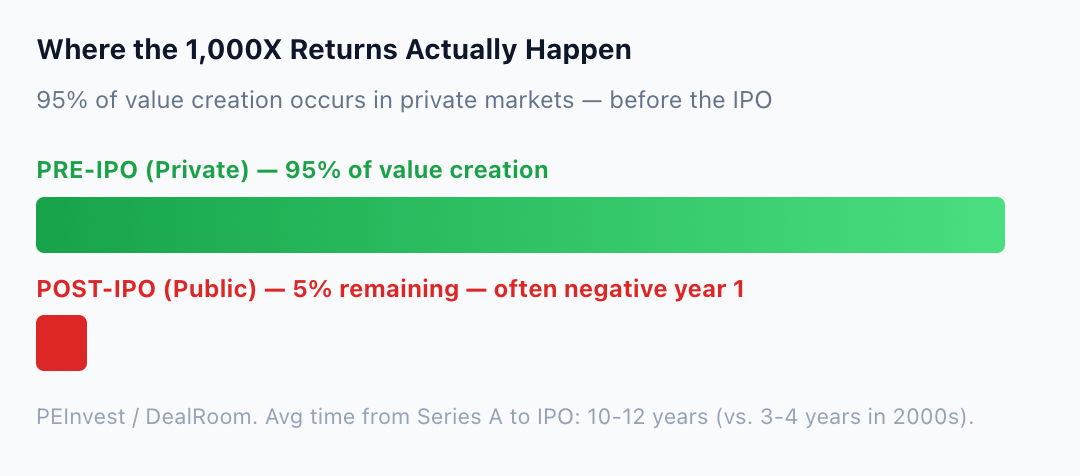
But here is the detail that matters most for investors: private companies are staying private longer than at any point in modern financial history. The average time from Series A to IPO has stretched from 3-4 years in the 2000s to 10-12 years today. That means the majority of value creation — 95% by some estimates — now happens during the private phase, before retail investors can access shares on public exchanges. By the time a company IPOs, the founders, VCs, and early employees have captured most of the upside. The retail investor who buys on IPO day is often providing exit liquidity, not capturing early-stage growth.
The pattern that separates the companies that produce 1,000x returns from the ones that fade into obscurity is remarkably consistent across decades. The future winners almost always look unpopular at the start. Amazon was an online bookstore that lost money for seven years. Apple was a garage project that nearly went bankrupt in 1997. Tesla was dismissed as a rich man’s toy that would never scale. The companies that reshaped industries were not popular investments at the beginning. They became popular after the returns had already been captured by the early investors who saw the pattern before it was obvious.
The 2026 IPO pipeline is the richest in years — and the unpopular names in it are where history says the biggest returns will come from.
Every decade, a small group of companies emerges that goes on to reshape entire industries. At the start, they rarely look impressive. They’re unpopular. Small. Often dismissed. Amazon was an online bookstore. Apple started in a garage. Airbnb rented out air mattresses. Before they became household names, they were simply early-stage companies that were unpopular. Today, thousands of unpopular companies are trying to become the next breakout success. ...Most will fail. But a handful will grow 100x… even 1000x. Because once a company becomes popular, the opportunity is already gone. Subscribe to Download the Report (AD).
The Pattern That Separates 1,000X Companies from the Ones That Disappear
Crunchbase’s predictive intelligence tools — which evaluate funding history, growth signals, investor mix, and market timing — identified 15 companies across AI, enterprise software, fintech, space, defense, healthcare, and consumer tech that could go public in 2026. DealRoom tracks over 70 companies in the active pipeline. The question is not whether some of these will produce 1,000x returns. History guarantees that a handful will. The question is which ones — and whether you can identify the patterns before the mainstream market does.
One Sector That Checks Every Box on the 1,000X Pattern List
Spatial computing — the market for AR, VR, and mixed reality devices and platforms — is currently in the exact phase where every previous 1,000x company lived before breaking out. The market is real ($250 billion+ and projected to exceed $1 trillion by 2034). The use case is validated (enterprise adoption crossed the “strategic infrastructure” threshold in 2026). The incumbents have validated the category but failed to dominate it (Apple Vision Pro shipped 390,000 units at $3,500; Meta Quest dominates gaming but not enterprise). And the companies filling the gap between what exists and what enterprises need are still in their pre-IPO phases.
The pattern is identical to what happened with smartphones in 2007, cloud computing in 2010, and AI in 2023. The incumbents validated the category. The mainstream dismissed it. And the companies that actually solved the adoption problem — the ones building devices lightweight enough for all-day use, affordable enough for mass deployment, and powerful enough to replace the existing workflow — captured the market from underneath the headlines.
4,000% Growth, 1.5 Million Users, and a Nasdaq Ticker Reserved — While Still Pre-IPO
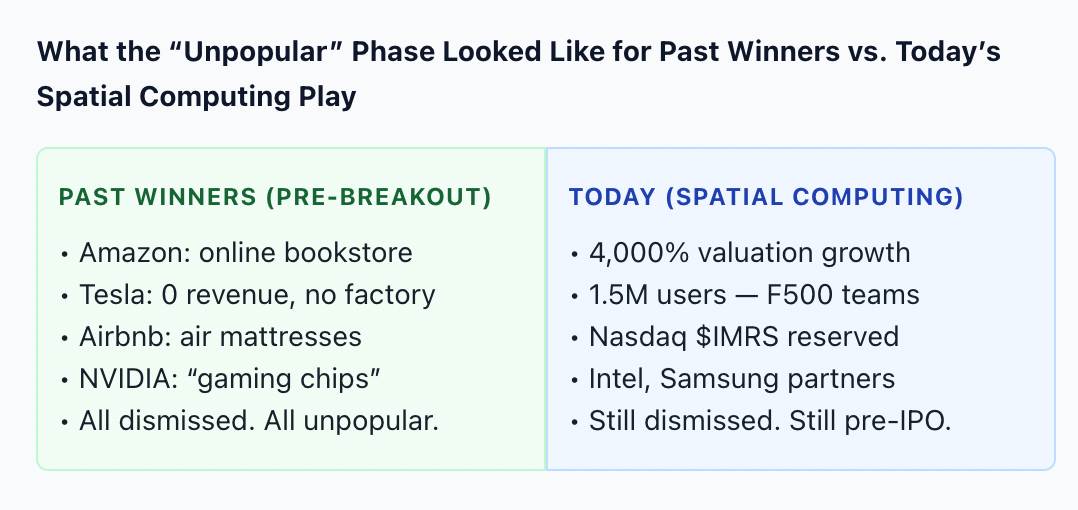
The spatial computing sector has a company that has grown its valuation by 4,000%, has 1.5 million users including Fortune 500 teams working up to 60 hours a week inside its platform, has reserved a Nasdaq ticker, and is backed by executives from Intel, Samsung, Facebook, Reddit, and Palantir. Its headset has 2 million more pixels than Apple Vision Pro at 70% less cost and 70% less weight. It is projecting $71 million in first-year hardware sales. And it is still in its pre-IPO phase at $0.72 per share. By every measure on the 1,000x pattern checklist — real problem, fast growth, dismissed by mainstream, revenue inflecting, insiders accumulating — it checks every box. The question is whether you see the pattern before it becomes obvious to everyone else.
This Pre-IPO Stock is Up 4,000% Already
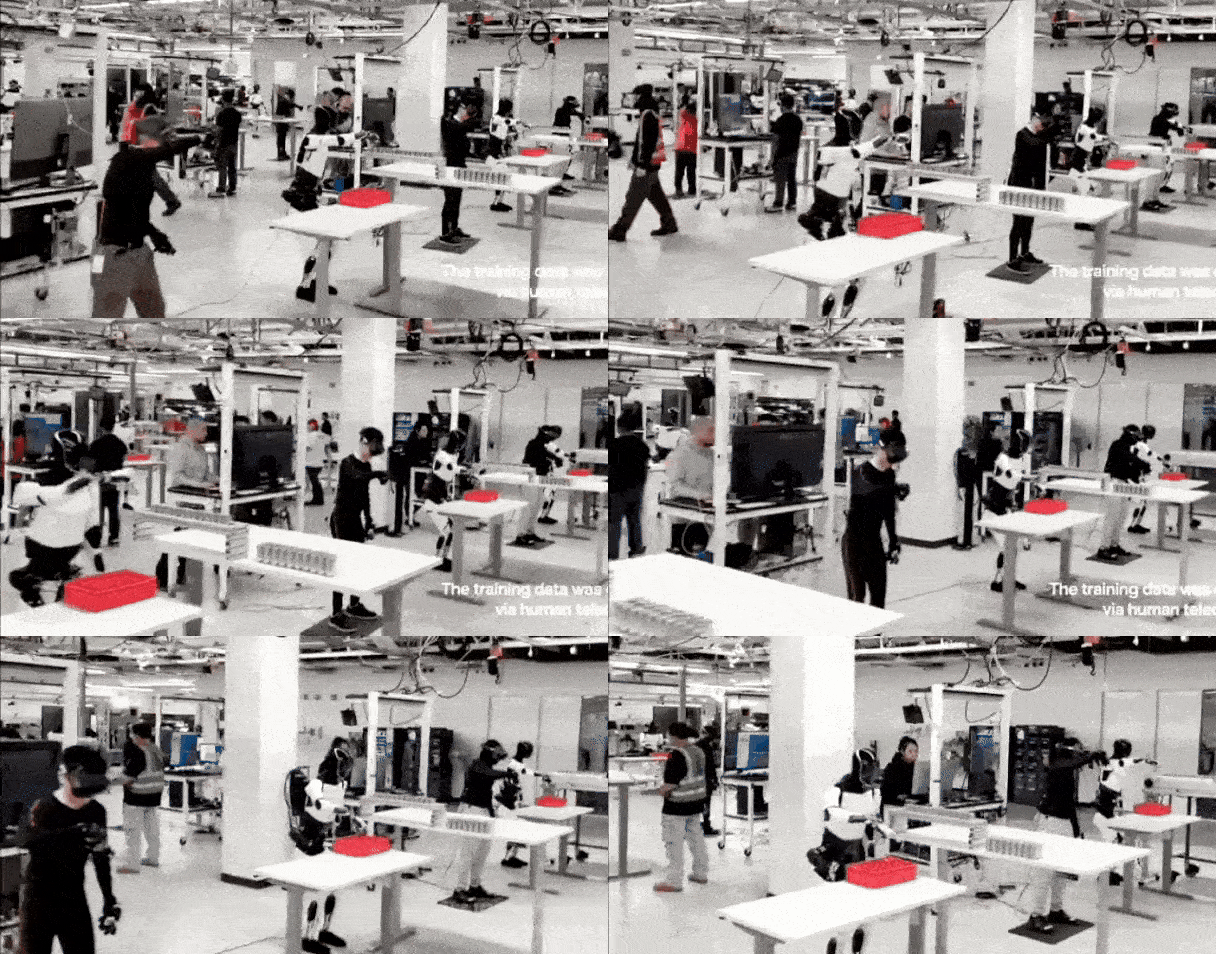
What do you do after 4,000% growth? If you’re Immersed, you build the future.
How do you follow 4,000% valuation growth? By preparing for what’s next. That’s what Immersed did, reserving the Nasdaq ticker $IMRS. But the real opportunity for investors is now, before public markets.
Why? Immersed changed the game in extended reality (XR), developing the Meta Quest store’s most popular productivity app. More than 1.5M people, including Fortune 500 teams, already use it up to 60 hours a week.
But that’s not all. Immersed’s soon-to-be-released XR headset has 2M more pixels than Apple’s Vision Pro for 70% less money. No wonder they’re projecting $71M in first-year sales.
Here’s how they’re redefining the $250B+ future of work:
Breakthrough Platform: Immersed built the first full-stack remote productivity system, combining immersive XR software, a distraction-free AI assistant, and its own lightweight Visor headset to replace the traditional desktop.
Massive Momentum: Immersed is preparing to ship Visor, its first productivity-focused headset, with 75,000+ already on the waitlist. Meanwhile, its AI assistant, Curator, is rolling out new features to deepen user engagement and adoption.
Opportunity: You can join 6,000+ investors who have already secured pre-IPO shares in Immersed’s growth.
They have partnerships in place with Intel and Samsung. Executives and founders from SendGrid, Facebook, Reddit, and Palantir invested. You can, too. But there’s no time to waste. Invest in Immersed before the opportunity closes.
| Invest Before the Pre-IPO Round Closes → |
Immersed is offering securities through the use of an Offering Statement that has been qualified by the Securities and Exchange Commission under Tier II of Regulation A. The valuation is set by the Company and there is currently no public market for the Company’s Common Stock. Please read the offering circular and related risks at invest.immersed.com. Nasdaq ticker “IMRS” has been reserved by Immersed and any potential listing is subject to future regulatory approval and market conditions. Investor references reflect factual individual or institutional participation and do not imply endorsement or sponsorship by the referenced companies.
The 2026 IPO Pipeline Will Separate the Positioned from the Late
The 200+ companies preparing to IPO this year represent the largest pipeline since 2021. SpaceX alone is targeting $75 billion. Databricks, Discord, Plaid, Klarna, and Revolut are all in various stages of preparation. The secondary market is processing $200 billion+ in pre-IPO transactions. And the average time from Series A to IPO has stretched to 10-12 years — meaning the companies IPOing in 2026 have been building value in private markets for over a decade. The retail investor who waits for IPO day is buying at the end of the value creation cycle, not the beginning.
The Motley Fool’s data shows 7 of 10 largest IPOs underperformed the S&P 500 from listing day. The pattern is consistent: the biggest returns are captured before the stock starts trading publicly. The companies still in their pre-IPO phases — the ones that are unpopular, dismissed, and available at early-stage pricing — are historically where 1,000x returns originate. The popular companies on IPO day are where exit liquidity is provided.
This Pre-IPO Stock is Up 4,000% Already
4,000% valuation growth. 1.5M users including Fortune 500 teams. 2M more pixels than Vision Pro at 70% less cost. 75,000+ on the Visor waitlist. Intel, Samsung, Palantir executives invested. Nasdaq $IMRS reserved. Pre-IPO at $0.72/share.
Bottom Line
The 2026 IPO pipeline is the largest since 2021, with 200-230 companies expected to go public and the secondary market for pre-IPO shares projected to exceed $200 billion. Private companies are staying private longer than at any point in modern financial history — the average time from Series A to IPO has stretched to 10-12 years, meaning 95% of value creation now happens before retail investors can access shares on public exchanges. The Motley Fool’s data confirms the pattern: 7 of 10 largest IPOs underperformed the S&P 500 from listing day, with a median first-year decline of 31%.
The companies that produced 1,000x returns — Amazon, Apple, Tesla, NVIDIA — all shared the same profile before they broke out: solving a real problem, growing fast, dismissed by the mainstream, revenue inflecting, and insiders accumulating. Every decade, a small group of companies emerges that goes on to reshape entire industries. At the start, they rarely look impressive. They’re unpopular. Small. Often dismissed. Before they became household names, they were simply early-stage companies that were unpopular. But a handful will grow 100x… even 1000x. Because once a company becomes popular, the opportunity is already gone.
Spatial computing is currently in that exact unpopular phase. The market is real ($250B+ and growing to $1T+ by 2034). The incumbents validated the category but failed to dominate it. And the company filling the gap has grown its valuation 4,000%, has more than 1.5M people using its platform up to 60 hours a week, built the first full-stack remote productivity system, and is preparing to ship its Visor headset with 75,000+ already on the waitlist. How do you follow 4,000% valuation growth? By preparing for what’s next. That’s what Immersed did, reserving the Nasdaq ticker $IMRS. But the real opportunity for investors is now, before public markets.
The 2026 IPO pipeline will separate the investors who positioned during the unpopular phase from the ones who waited until popularity made the opportunity obvious. The secondary market is processing $200 billion+ in transactions. The SpaceX S-1 drops in days. Dozens of companies across AI, fintech, defense, and spatial computing are preparing to list. The pre-IPO windows that close when these companies go public will not reopen. The pattern that identified every previous 1,000x winner is visible right now — in the companies that are unpopular, dismissed, and available at early-stage pricing. The investors who recognize it will capture the returns. The investors who wait will provide the exit liquidity.